
Case Report 
 Creative Commons, CC-BY
Case Report: Focus on Cleaning and Disinfection to Tackle Severe Post-Weaning Diarrhoea of Viral Aetiology
*Corresponding author: Frédéric Vangroenweghe, Elanco Animal Health Benelux, BU Swine & Ruminants, Elanco Animal Health, Belgium and Department of Internal Medicine -Reproduction - Population Medicine, Ghent University, Belgium.
Received: August 02, 2024; Published: August 06, 2024
DOI: 10.34297/AJBSR.2024.23.003096
Abstract
The present case report covers the overall approach of an acute clinical case of severe watery diarrhea in post-weaned piglets, vaccinated with a commercial E. coli F4 and F18 vaccine, in a previously stable clinical situation. Several consecutive steps are implemented to identify the specific cause of the clinical problem, including a vaccination audit, a broad diagnostic approach using 3rd generation sequencing and an evaluation of Cleaning and Disinfection (C&D) procedures through hygiene scores using Rodac plates. The vaccination audit did not reveal any abnormalities that could explain the clinical problem. The 3rd generation sequencing diagnostics revealed the presence of 19 different bacterial and viral pathogens, of which several viral pathogens could have an impact on intestinal integrity. Evaluation of C&D procedures revealed a major gap in the standard C&D procedure, resulting in potential increase in infectious pressure and potential survival of several intestinal pathogens, such as Rotavirus A-B-C-H. Therefore, an optimal C&D procedure was implemented in all post-weaning compartments, including a supplementary cleaning step with NaOH 2% followed by application of a glutaraldehyde disinfection. This resulted in optimized hygiene scores and a clear improvement of the clinical condition and performance of the post-weaned piglets. In conclusion, the occurrence of clinical episodes of PWD in a previously stable situation applying a commercial E. coli F4 and F18 vaccination should be examined more broadly to identify other potential interfering intestinal pathogens and impaired management measures that could have an impact on the overall infectious pressure in the environment of the post-weaned piglets.
Keywords: Post-weaning diarrhoea, Cleaning and disinfection, Piglets, Hygiene scores
Abbreviations: C&D: Cleaning and Disinfection; E. coli: Escherichia coli; ETEC: Enterotoxigenic E. coli ; GVP: Good Vaccination Practices; HS: Hygiene Score; NaOH: Sodium Hydroxide; PWD: Post-Weaning Diarrhea.
Introduction
Farm Profile
A 1000-sow farm operating in a standard 1-week batch management system, weaning piglets at 24 days of age, had a history of Post-Weaning Diarrhoea (PWD) due to F4-ETEC. The isolated F4- ETEC strain had a highly resistant antimicrobial profile, limiting the available options for antimicrobial therapy (Table 1).
Therefore, the piglets were orally vaccinated against PWD with a commercial E. coli vaccine (Coliprotec F4F18, Elanco Animal Health) at the age of at least 18 days. This vaccine protects the piglets against severe clinical diarrhea due to both F4- and F18-ETEC and reduces the excretion of pathogenic F4- and F18-ETEC bacteria. The vaccine should be administered at least 8 days prior to the manifestation of clinical signs of PWD, which occurred from 3-4 days post-weaning onwards on the present farm. Implementation of vaccination against PWD resulted in reduced mortality, improved Average Daily Weight Gain (ADWG) and reduced use of antimicrobials during the post-weaning period [2-4].
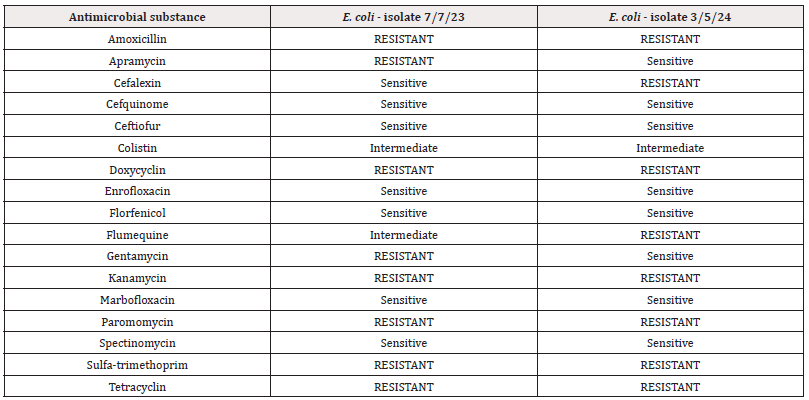
Table 1: Antimicrobial resistance profile of the isolated E. coli strains from piglets suffering from PWD.
Case Event
However, after 9 months of consistent piglet vaccination with the commercial E. coli vaccine, a new episode of severe watery diarrhoea occurred in the post-weaned piglets from 2 days post-weaning onwards. This resulted again in increased mortality, reduced performance, increased use of antimicrobials, and increased number of runt piglets throughout the post-weaning period.
Materials and Methods - Diagnostic Approach
Vaccination Audit
To assess Good Vaccination Practices (GVP), a vaccination audit was performed to go through all different critical steps of vaccination against PWD from vaccine preparation and distribution to vaccine uptake by the suckling piglets. The vaccination audit revealed no critical issues regarding vaccine preparation, administration and uptake by the suckling piglets. Therefore, it was concluded that other factors might be responsible for the clinical problems of watery diarrhoea during the early post-weaning phase.
Disease Identification
To identify the potential cause of severe watery PWD, 5 faecal samples of severely affected piglets were collected at day 2 post-weaning for diagnostic examination using 3rd generation sequencing (Oxford Nanopore Technology; Patho Sense, Merelbeke, Belgium). Analysis of the faecal samples revealed a total of 19 different bacterial and viral pathogens (Figure 1).
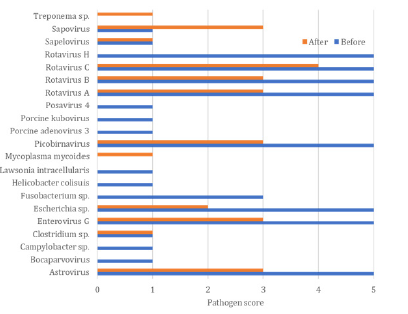
Figure 1: Oxford Nanopore Technology (PathoSense, Merelbeke, Belgium) pathogen identification report in fecal samples before (blue bars) and after (orange bars) implementation of optimized cleaning and disinfection procedure of the post-weaning facilities. Pathogen score from 0 (absence) to 5 (high prevalence).
The most prominent pathogens with an impact on the intestinal integrity were Enterovirus sp., Rotavirus A-B-C-H, Picobirnavirus and Astrovirus. Several of these pathogens are known to be quite resistant in the environment [1].
Evaluation of Cleaning and Disinfection Procedures
Therefore, Cleaning and Disinfection (C&D) procedures of the premises prior to the start of a new batch of post-weaned piglets were extensively checked. Hygiene Scores (HS) using Rodac plates were performed comparing different C&D scenario’s:
(I) a recently emptied compartment prior to cleaning (positive control), (II) normally cleaned compartment disinfected with standard product (peroxide), (III) optimally cleaned compartment disinfected with broad spectrum disinfectant (glutaraldehyde; Virocid; CD Lines, Ieper, Belgium), and (IV) optimally cleaned compartment using a supplementary 2% NaOH cleaning step combined with glutaraldehyde (Virocid) disinfection (NaOH + glutaraldehyde). The advised optimal cleaning and disinfection protocol is given in (Table 2).
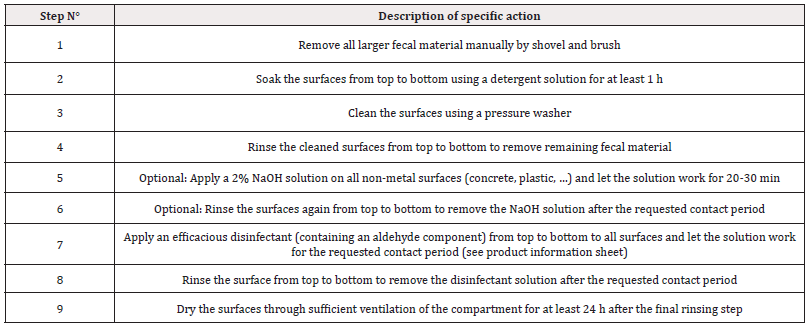
Table 2: Ideal cleaning and disinfection protocol as implemented on the farm in the C&D scenario III (glutaraldehyde) and IV (NaOH + glutaraldehyde).
Results and Discussion
Based on results of previous vaccination trials, we can conclude that active immunization of piglets against PWD caused by F4-ETEC or F18-ETEC results in significant better post-weaning piglet performances as compared to the piglets managed under the standard therapeutic approach. Several economically important performance parameters, such as FCR, mortality rate and treatment incidence were significantly improved in the vaccinated piglets [2-4]. In the current case, the vaccination during a 9-month period also resulted in a clear improvement of piglet performance and reduction of clinical manifestation of PWD due to F4-ETEC.
Therefore, the rather sudden deterioration of this stable clinical situation was unexpected. Since our experience learns that several issues can occur throughout the vaccination procedure, we initially performed a vaccination audit to ascertain that all aspects of GVP for the orally administered E. coli vaccine were fulfilled. No issues were detected that could explain the diagnosed clinical condition of PWD in the vaccinated piglets.
A next step in the case approach was focused on a broader diagnostic approach related to intestinal pathogens. Therefore, samples at the onset of watery clinical diarrhoea were collected and subsequently examined using 3rd generation sequencing. This diagnostic technique revealed a total of 19 different bacterial and viral pathogens, of which several could have a negative impact on the intestinal integrity. It has been demonstrated previously that rotaviruses are relatively resistant in the environment, resulting in an increased infectious pressure on the long-term [4].
Therefore, the C&D procedures were evaluated through Hygiene Scores (HS). To evaluate the best options for cleaning and disinfection, we compared an emptied, but uncleaned compartment (I) to a compartment that was cleaned according to the standard farm protocol and subsequently disinfected using a peroxide disinfectant (II), with two compartments cleaned and disinfected according to our optimal advised protocol (Table 2) without (III) or with the addition of a supplementary NaOH 2% cleaning step (IV) and combined with a glutaraldehyde disinfectant. The results of the HS are given in (Table 3). Only the glutaraldehyde disinfection (III; HS=3.00) and the extended NaOH cleaning combined with the glutaraldehyde disinfection (IV; HS=1.50) resulted in a significantly lower (P<0.05) HS as compared to the uncleaned positive control (I; HS=3.69) and the standard cleaning and disinfection with peroxide (II; HS=3.46). However, for a maximal result, the HS after C&D should be lower than 2.0. Therefore, only the extended C&D protocol, including supplementary NaOH cleaning and glutaraldehyde disinfection, was able to obtain the required result (HS =1.50).
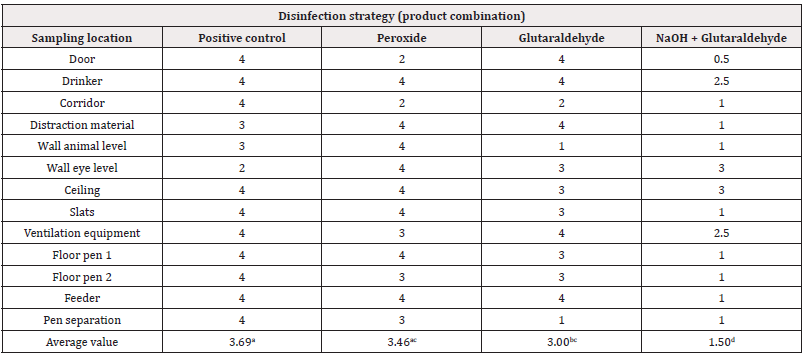
Table 3: Hygiene scores using Rodac plates. Minimal RESISTANT score 0 (no bacteria), maximal score 5 (uncountable). Average values are calculated on the 13 standard sampling locations determined in the hygiene score protocol. Average values with different superscript letters are significantly different (P<0.05).
Subsequently, all post-weaning compartments were subjected to this extended C&D protocol. This protocol was applied for the consecutive 8 weeks, which was the average turn-over of the post-weaning compartments on the farm.
To evaluate the clinical situation following this management intervention, a new fecal sampling was conducted on day 2 post-weaning. Analysis of these fecal samples revealed a total of 12 different bacterial and viral pathogens. When compared to the initial analysis, there was a clear decrease in Enterovirus sp., Rotavirus A-B-C-H, Picobirnavirus and Astrovirus (Figure 1). Other pathogens were no longer present or had markedly decreased in the clinical sample. Clinical evaluation of post-weaned piglets placed into the optimally cleaned and disinfected compartments revealed major improvement in their clinical condition, associated with return to previously observed levels of piglet performance (lower mortality, improved ADWG, lower use of antimicrobials, and decreased number of runt piglets).
Conclusion
In conclusion, the occurrence of clinical episodes of PWD in a previously stable clinical situation applying a commercial E. coli F4 and F18 vaccination should be examined more broadly to identify potential interfering intestinal pathogens and impaired management measures. Besides preventive therapeutic and immunological measures, basic management practices, including hygiene, should also be considered in the overall case approach towards resolution. Macroscopic evaluation of C&D practices does not always allow to identify potential gaps in the hygiene management. Therefore, more specific quantitative HS using Rodac plates could help to identify C&D issue and evaluate the impact of an optimized C&D protocol.
Acknowledgement
The authors greatly acknowledge the technical staff of the farm for their cooperation in applying the updated C&D procedures to evaluate the clinical effect of C&D on the piglet performance.
Conflict of Interests
No conflicts of interest to be reported.
References
- ORyan ML, Nataro JP, Cleary TG (2011) Microorganisms responsible for neonatal diarrhoea. In: Infectious Diseases of the Fetus and Newborn (7th Edition). Eds. Remington JS, Wilson CB, Maldonado YA, Klein JO, Nizet V Elsevier Inc: 359-418.
- Vangroenweghe F (2021) Improved piglet performance and reduced mortality and antimicrobial use following oral vaccination with a live non-pathogenic Escherichia coli F4/F18 vaccine against post-weaning diarrhoea. Aust J Infect Dis.
- Vangroenweghe F, Thas O (2020a) Improved piglet performance and reduced antibiotic use following oral vaccination with a live avirulent Escherichia coli F4 vaccine against post-weaning diarrhea. J Clin Res Med 3: 1-8.
- Vangroenweghe F, Thas O (2020b) Application of high energy and protein ciets in combination with a live avirulent Escherichia coli F4 vaccine against post-weaning diarrhea. Vacc Res 7: 1-9.




 We use cookies to ensure you get the best experience on our website.