
Research Article 
 Creative Commons, CC-BY
Epidemiological Profile of The Surgical Treatment Of Femur Fractures in A Tertiary Hospital of The Public Health System (SUS) in The Year 2021 - A Pandemic Year
*Corresponding author: Rian Souza Vieira, Orthopedist and Traumatologist, Specialist in Spine Surgery, Surgeon in chief at RSV Clínica Avenida Wladimir Meirelles Ferreira, 1660 - Edifício W. Offices - Salas 901/902 - Jardim Botânico - Ribeirão Preto, SP, Brazil, 14021584, rianvieira@hotmail. com, +55 (16) 98111-0612.
Received: August 16, 2024; Published: August 22, 2024
DOI: 10.34297/AJBSR.2024.23.003128
Abstract
Femur fractures are quite common in orthopedic practice and may involve the proximal and distal extremities and the diaphysis of the bone or even nonspecific regions. The incidence of fractures of the proximal femur varies considerably according to some factors such as age, existence of previous diseases, osteopenia, osteoporosis, sex, mechanism of trauma, force of trauma, in addition to also varying according to the geographical location of the study and factor’s regional locations. In view of the above, the importance and the need to carry out a retrospective epidemiological survey of fractures of the femur that occurred in the Orthopedics and Traumatology Service of the Hospital Beneficência Portuguesa de Ribeirão Preto - SP in the year 2021 is observed, guaranteeing the profile of the patient treated in the Sector. Knowledge of this profile may provide information that will be important in order to systematize care for this type of patient, perhaps facing the waiting time in pre-care and hospitalization optimization until the synthetic procedure is performed, the costs for the Service, thus providing better recovery for the affected patient.
Keywords: Femur fracture, Femur surgery, Femur
Introduction
Femur fractures are quite common in orthopedic practice and may involve the proximal or distal ends of the bone, its diaphysis, or even nonspecific regions. In Brazil, the variation in incidence between different cities studied can be justified by the large climatic variations, sun exposure, populations of different racial origins and distinct lifestyles, as well as variations in anthropometric characteristics - factors that directly influence the anatomy and personality of the fractures.
In a study involving 308 cases of femur fractures, an overall incidence rate of 37.5 per 100,000 person-years was observed, 56 were femoral neck, 199 were transtrochanteric, 23 were subtrochanteric, 22 were diaphyseal, 8 involved the distal femur, and 15 were located in nonspecific points of the bone. Approximately 35% of these fractures were caused by severe trauma, especially in young male patients, mainly diaphyseal fractures. One third of the fractures were associated with moderate trauma, which is responsible for the increasing incidence rates with age at all fracture sites, especially in women. Patients with fractures resulting from moderate trauma had previous evidence of generalized osteopenia, or even a condition susceptible to such [1].
Fractures of the femoral neck constitute 53% of all proximal fractures of this bone [2]. It is known that the risk of proximal femur fracture doubles after the age of 50, and that the occurrence is much higher in women than in men. By the age of 90, approximately 32% of women and 17% of men will have experienced fractures in the proximal region of the femur [3]. In a review of 103 cases of proximal femur fracture, 52 were male and 51 were female. Approximately 85% of the patients, aged 70 to 75 years, reported minor trauma as the precipitating cause of fracture. The incidence of the injury in men and women aged over 50 years was 71 and 100 per 100,000 person-years, respectively [4].
It can be seen, therefore, that the incidence of femur fractures varies considerably according to age, existence of previous diseases such as osteopenia and osteoporosis, gender, occurrence and forces of trauma, in addition to varying according to the geographic location of the study. Therefore, it is understood that it is necessary to conduct a retrospective epidemiological survey of proximal femur fractures that occurred in the Orthopedics and Traumatology Service of the Hospital Beneficência Portuguesa de Ribeirão Preto - SP in 2021, aiming to establish the profile of the patient affected by this type of injury.
Knowledge of this profile may provide information that will be important in order to systematize the care of patients with femur fractures, possibly reducing the waiting time for care and surgery, the costs for the Service, and enabling a better recovery for the affected patient. Early treatment of a fractured femur demonstrated by patients admitted to the hospital within 48 hours after the fracture is essential.
According to Guerra [5] studies, just like Rocha [6], most patients were found to be independent. After one year, 50% of patients were walking again with support after recovering from their injuries. Silva's [7] research shows a higher rate of surgical patients whose method of care conflicted with the study.
Recovering patients who experience complications after their procedures require long-term preventive treatment. Maintaining the long-term quality of life of these patients for years to come is promoted through ongoing treatment.
The articles of authors Guerra [8], Leme [9], Lehtonen [10] and Petros [11] confirmed that a person would need assistance to walk after recovering from the disease. They were also able to regain some ability to walk, although not full ability. Patients benefit from the help of their previous autonomy during the postoperative recovery period. This also helps to modify the results.
Materials and Methods
This is a retrospective epidemiological study, consisting of 308 femur fractures treated surgically at the Hospital Beneficência Portuguesa de Ribeirão Preto from January to December 2021. Pediatric patients are not included in this study.
Through a review of medical records, the following items were cataloged: age, sex, fracture diagnosis, affected side, length of hospital stay and date of surgery, use of anticoagulants, ambulation after surgery and access to physical therapy.
The groups that involved low energy (falls from standing height) were more common in elderly individuals and women, presenting less unstable fractures without associated trauma. The fractures were divided into femoral neck, transtrochanteric, subtrochanteric, femoral diaphyseal and distal femoral, classified radiologically according to the AO universal fracture classification.
Results and Discussion
The distribution of femoral fractures (neck, transtrochanteric, subtrochanteric, diaphyseal and distal femoral fractures) is shown in Figure 1. The main type of fracture was transtrochanteric (62.9%).
The mean age was 77 years (range 19 to 99 years) with a predominance in the seventh to ninth decade of life. These data confirm reports by the authors Rocha [12], Pinto [13], Rau, et al. [14], Koivisto, et al. [15].
The majority of patients were female (67.3%). In other studies, there was a clear female prevalence, ranging from 2 to 8:1 [16-20].
Systemic arterial hypertension (SAH) was described in 55.3% of cases and the presence of type 2 Diabetes Mellitus (DM2) in 24.4% of cases, with no differences between the distribution of these pathologies and sex.
Regarding the affected side, 158 (51%) patients suffered a fracture in the left proximal femur, 150 (49%).
The main type of fracture was AO 31A2, occurring in 26.7% of cases. The distribution according to the classification of fractures can be seen in the Table 1.
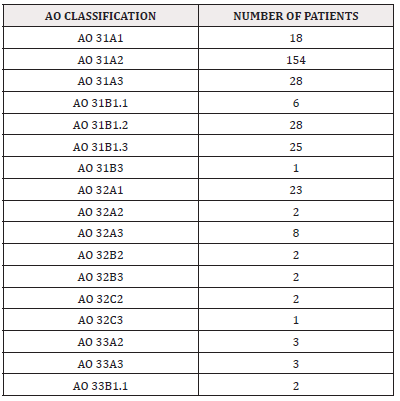
Table 1: Classification of fractures.
Source: Author´s data collection (2021).
Most fractures were corrected using a short intramedullary nail (50.9% of cases). The distribution according to the type of surgery can be seen in Table 2.
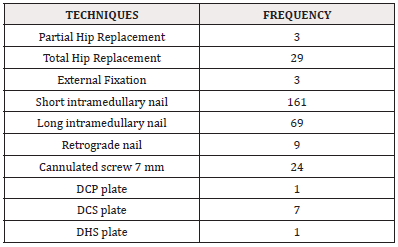
Table 2: Distribution according to type of surgery.
Source: Performed by the authors (2021).
The mean length of hospital stay until surgery was 2 days (range: 0-13) and the mean total hospital stay was 3 days (range: 0-22). Most patients (64%) did not require physical therapy and 28.5% of patients were walking without assistance at the last medical visit.
The mortality rate was 16.8% among female patients and 18.3% among male patients (p=0.87). The median age of those who died was 83 years (range: 54-99) compared with a median age of 75 years (range: 19-96) in those who did not die.
In this 1-year retrospective study, of the 308 (100%) patients for whom we obtained information, 58 (18.8%) died and 250 (81.3%) were alive.
A femur fracture, regardless of its anatomical location, is considered a serious and serious health problem. This is because this condition requires a long recovery time in most cases and complications and consequences develop in some cases [21].
In the age group and related diseases, the stay is longer, sometimes even in intensive care units due to complications and others. With the extension of the rehabilitation period, many do not regain independence in routine activities, which entails high financial and social costs. In addition to the proven high incidence and mortality, it is clear that the financial impact of treating fractures in this population on the public health system is enormous, with an average cost of almost 86 million reais per year [22].
The high cost of this type of fracture is observed in other countries, such as the United States, where there are studies that show that the cost of femur fracture in the elderly is US$ 26,000 [23]. Our study also found that most femur fractures occur in women, approximately 67.3%, and 33.7% in men. This information is consistent with other studies in Brazil and other countries that show a higher prevalence of this disease in elderly women.
Conclusions
It is concluded that transtrochanteric fractures of the femur are common in the daily life of an orthopedic surgeon. Mortality due to transtrochanteric fracture is due to respiratory difficulty in adults (thromboembolism, fat), in addition to bleeding, which occurred in 2% of cases and arterial damage, morbidity occurs as well as shortening, rotation and malintegration, infection, joint stiffness, delayed consolidation, pseudoarthrosis, neuropathy and heterotopic ossification.
Types of trauma mechanisms, high morbidity and mortality, high direct and indirect costs make these undermining public health problems. The study analyzed epidemiological characteristics and findings of these fractures with a well-established characteristic.
We observed a characteristic in our work in the bimodal presentation of femur fractures, similar to that described in the literature, where high-energy mechanisms such as traffic accidents, falls from height and injuries are more frequent. Among young adults and adults, peaks of 77 years, female gender, unstable personality of fractures, with more severe traumas.
Acknowledgement
Work carried out at the Orthopedics and Traumatology at the Imaculada Conceição Hospital Beneficência Portuguesa - Ribeirão Preto, SP.
Conflict of Interest
The authors declare that there was no conflict of interest in conducting this work.
References
- Arneson TJ, Melton 3rd LJ, Lewallen DG, O Fallon WM (1988) Epidemiology of diaphyseal and distal femoral fractures in Rochester, Minnesota, 1965-1984. Clin Orthop Relat Res 1988(234): 188-94.
- Thorngren KG, Hommel A, Norrman PO, Thorngren J, Wingstrand H (2022) Epidemiology of femoral neck fractures. Injury 2002(33): 1-7.
- Gallagher JC, Melton LJ, Riggs BL, Bergstrath E (1980) Epidemiology of fractures of the proximal femur in Rochester, Minnesota. Clin Orthop Relat Res 1980(150): 163-71.
- Farias FID, Terra NL, Guerra MTE (2017) Evaluation of the effectiveness of a care program for elderly patients with hip fractures: a network strategy. Rev bras geriatr gerontol 20(5): 702-711.
- Farooqi V, Maayken EL van den Berg, Ian D Cameron, Maria Crotty (2016) Anabolic steroids for rehabilitation after hip fracture in older people. São Paulo Medical Journal 134(5).
- Franco LG, Amanda Loffi Kindermann, Lucas Tramujas, Kelser de Souza Kock (2016) Factors associated with mortality among elderly people hospitalized due to femoral fractures. Rev bras Ortop 51(5): 509-514.
- Felicissimo P, Branco J (2017) Envelhecimento, metabolismo e nutrição no doente ortopé Rev Port Ortop Traum 25(3): 186-192.
- Guerra MTE, Roberto Deves Viana, Liégenes Feil, Eduardo Terra Feron, Jonathan Maboni, et al. (2017) One-year mortality of elderly patients with hip fracture surgically treated at a hospital in Southern Brazil. Rev bras ortop 52(1): 17-23.
- Leme LEG, Sitta MC, Toledo Manuella, Henriques Simone da Silva (2011) Cirurgia ortopédica em idosos: aspectos clí Rev Bras Ortop 46(3): 238-246.
- Lehtonen EJI, Robert Davis Stibolt, Walter Smith, Bradley Wills, Martim Correia Pinto, et al. (2018) Trends in surgical treatment of femoral neck fractures in the elderly. Einstein 16(3).
- Petros RSB, Ferreira PEV, Petros RSB (2017) Influence of proximal femur fractures in the autonomy and mortality of elderly patients submitted to osteosynthesis with cephalomedullary nail. Rev bras ortop 52(1): 57-62.
- Rocha SA, Avila MAGd, Bocchi SCM (2016) Influência do cuidador informal na reabilitação do idoso em pós-operatório de fratura de fêmur proximal. Rev Gaúcha Enferm 37(1).
- Pinto IP, Luis Felipe Brandt Ferres, Guilherme Boni, Guilherme Guadagnini Falótico, Maurício de Moraes (2019) Does early surgical fixation of proximal femoral fractures in elderly patients affect mortality rates? Rev bras ortop 54(4): 392-395.
- Rau Y, Jasper Amtsfeld, Nils Reimers, Ludwig Matrisch, Jasper Frese (2023) The development, incidence and treatment trends of trochanteric fractures in Germany: a cohort study. J Orthop Surg Res 18(1): 491.
- Koivisto, Topi Laaksonen, Ilkka Helenius, Henri Vasara, Antti Stenroos (2023) Epidemiology and risk factors for premature physeal closure in distal femur fractures. Acta Orthopaedica 94: 348-353.
- Lotzien, S, Darius Baron, Thomas Rosteius, Charlotte Cibura, Christopher Ull (2023) Medial augmentation plating of aseptic distal femoral nonunions. BMC Musculoskelet Disord 24(1): 554.
- Bayraktar MK, Tekin EA (2023) Headless cannulated screw and external fixator in the treatment of type C distal femur fractures: Effect of early mobilization on clinical outcomes. acta orthopaedica belgica 89(1): 122-127.
- Levaillant M, Louis Rony, Jean François Hamel Broza, Julien Soula, Benoît Vallet (2023) In France, distance from hospital and health care structure impact on outcome after arthroplasty of the hip for proximal fractures of the femur. J Orthop Surg Res 18(1): 418.
- Lodde MF, M J Raschke, J Stolberg Stolberg, J Everding, S Rosslenbroich (2022) Union rates and functional outcome of double plating of the femur: systematic review of the literature. Arch Orthop Trauma Surg 142(6): 1009-1030.
- Hong Yuan, Hailong Yu, Yunpeng Zhu, Liangbi Xiang, Hongwei Wang (2022) Effect of Age on the Patterns of Traumatic Femoral Fractures: Seven Years of Experience at a Regional Tertiary Hospital. Orthop Surg 14(9): 2132-2140.
- Weber B, Lackner I, Miclau T, Jonathan Stulz, Florian Gebhard (2021) Early myocardial damage (EMD) and valvular dysfunction after femur fracture in pigs. Sci Rep 11(1): 8503.
- Grønhaug KML, Dybvik E, Gjertsen JE, Samuelsson K, Östman B (2022) Subsequent ipsi- and contralateral femoral fractures after intramedullary nailing of a trochanteric or subtrochanteric fracture: a cohort study on 2012 patients. BMC Musculoskelet Disord 23(1): 399.
- Hedge G, Thaker S, Botchu R, Fawcett R, Gupta H (2021) Atraumatic fractures of the femur. Br J Radiol 94(1121): 20201457.




 We use cookies to ensure you get the best experience on our website.