
Research Article 
 Creative Commons, CC-BY
Risk Factors Associated with Acute Myocardial Infarction (MI) in Individuals Reporting at Tertiary Care Hospitals in Karachi
*Corresponding author: Syed Rohan Ali, Dr Ruth KM Pfau, Civil Hospital Karachi.
Received: September 30, 2024; Published: October 04, 2024
DOI: 10.34297/AJBSR.2024.24.003183
Abstract
Background:Cardiovascular diseases have a multifactorial etiology, including hypertension, diabetes, stress, smoking, dyslipidemia, and positive family history. Among these, acute myocardial infarction remains one of the most life-threatening conditions that can lead to post-MI complications or death.
Objective: To determine the risk factors associated with acute myocardial infarction in patients presenting at tertiary care hospitals in Karachi.
Method: A cross-sectional study was conducted on a sample of 377 patients with acute myocardial infarction. The sample was obtained through non-probability purposive sampling from Dr. Ruth K. M. Pfau Civil Hospital Karachi and the National Institute of Cardiovascular Diseases (NICVD) Karachi. Informed verbal consent was obtained. A pilot study was conducted to assess the validity of the questionnaire. Data was analyzed using SPSS version 22 with a 95% confidence interval, a margin of error of 5%, and a p-value of 0.05 as significant.
Results: The study characterized patient demographics and assessed the prevalence of various health factors among individuals presenting with acute myocardial infarction at tertiary care hospitals in Karachi. Among the 377 patients analyzed, 40.3% were aged 56-65 years (152 individuals). Males represented 57.8% (218) of the sample, while females accounted for 42.2%. Hypertension was present in 77.7% of participants, and 52.5% were smokers. Diabetes was observed in 36.3% of participants, and 38.2% reported dyslipidemia. Additionally, 67.4% had a positive family history of MI, and only 9.5% engaged in regular exercise. Whisky consumption was reported by 19.6%, and 60.5% had undergone surgical procedures. Significantly, male participants exhibited a higher prevalence of smoking (83%) compared to females (10.69%) (p-value = 0.000). Alcohol consumption was also notably higher in males (30.7%) compared to females (4.40%) (p-value = 0.000). Surgical procedures were more prevalent among females (77.35%) compared to males (48.16%) (p-value = 0.000). There was a significant association between age groups and the presence of hypertension, diabetes, and dyslipidemia (p-values = 0.000, 0.001, and 0.000, respectively), suggesting variations in prevalence across different age brackets.
Conclusion: The study highlights the prevalence of various health factors among the sampled population, with significant gender disparities observed in smoking, alcohol consumption, and surgical procedures. Understanding these factors is crucial for implementing targeted interventions and public health initiatives to address prevalent health issues within the community. Further research may explore the underlying factors contributing to these disparities and develop effective strategies for health promotion and disease prevention.
Keywords: Acute mi, Hypertension, Diabetes mellitus, Dyslipidemia, Smoking, Karachi
Introduction
Cardiovascular Disease (CVD) is known to have a multifactorial etiology, influenced by variables such as elevated BMI, Hypertension (HTN), stress, and diabetes. The best strategy for combating the CVD epidemic in resource-constrained countries is CVD prevention. Common risk factors include smoking, dyslipidemia, sedentary lifestyles, obesity, hypertension, diabetes, and a positive family history or prior MI experience [1]. Acute Myocardial Infarction (AMI) remains a life-threatening condition that can lead to complications or death. AMI is defined using the European Society of Cardiology and American College of Cardiology criteria, which include at least two of the following factors:
1. Regular chest pain lasting at least 20 minutes.
2. An electrocardiogram with ST elevation in two or more consecutive leads that that is at least 2 mm elevated and subsequent ECG evolution.
3. A diagnostic cardiac marker, such as a twofold increase in creatinine kinase with at least 10% MB fraction or an increased or positive Troponin I (T) level. Studies have shown a link between parental obesity and smoking with the eventual development of CVD in offspring. Family history serves as a crucial marker for identifying individuals at higher risk of developing CVDs, emphasizing the importance of targeted screening and preventive interventions [2]. Early-onset or premature MI is particularly catastrophic as it affects younger individuals, leading to economic burdens due to early retirement or excessive illness-related work absences [3]. Hospitalization, treatment, and rehabilitation expenses associated with MI increase healthcare spending and strain national economies.
By evaluating the major and modifiable risk factors of acute MI in patients presenting to tertiary care hospitals, this study aims to expand knowledge regarding preventive strategies that include lifestyle and dietary changes. The goal is to identify factors leading to MI in residents of Karachi and provide a detailed assessment.
Materials and Methods
A cross-sectional study was conducted with a sample size of 377 MI patients, calculated using RAOSOFT software. The sample was taken through non-probability purposive sampling from Dr. Ruth K. M. Pfau Civil Hospital Karachi and the National Institute of Cardiovascular Diseases (NICVD) Karachi, over a period of 6
months from November 2023 to January 2024. Informed verbal consent was obtained from the patients. A study was conducted to assess the validity of the questionnaire. Data was collected using a structured questionnaire and analyzed using SPSS Version 22 with a 95% confidence interval, a margin of error of 5%, and a p-value of 0.05 as significant. Effect modifiers, Chi-square values of age, gender, educational status, and history of diabetes and hypertension were controlled with stratification (Table 1).
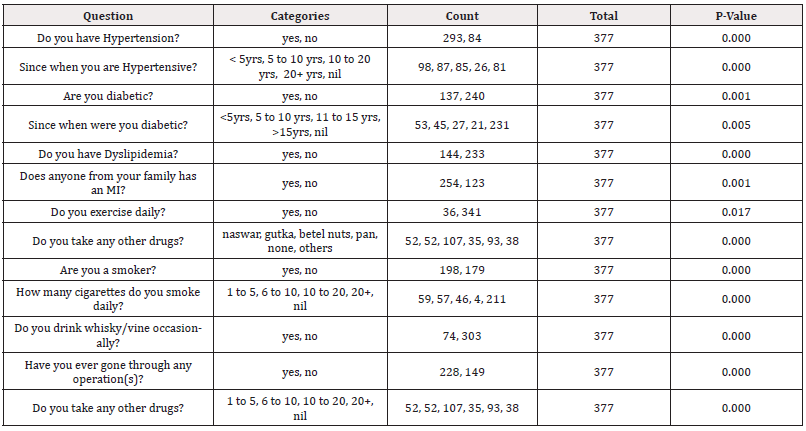
Table 1: Cross tab summary with P value.
Results
The study characterized patient demographics and assessed the prevalence of various health factors among individuals presenting with acute myocardial infarction at tertiary care hospitals in Karachi. Among the 377 patients analyzed, 40.3% were aged 56- 65 years (152 individuals). Males represented 57.8% (218) of the sample, while females accounted for 42.2%. Hypertension was present in 77.7% of participants, and 52.5% were smokers. Diabetes was observed in 36.3% of participants, and 38.2% reported dyslipidemia. Additionally, 67.4% had a positive family history of MI, and only 9.5% engaged in regular exercise. Whisky consumption was reported by 19.6%, and 60.5% had undergone surgical procedures. Significantly, male participants exhibited a higher prevalence of smoking (83%) compared to females (10.69%) (p-value = 0.000). Alcohol consumption was also notably higher in males (30.7%) compared to females (4.40%) (p-value = 0.000). Surgical procedures were more prevalent among females (77.35%) compared to males (48.16%) (p-value = 0.000). There was a significant association between age groups and the presence of hypertension, diabetes, and dyslipidemia (p-values = 0.000, 0.001, and 0.000, respectively), suggesting variations in prevalence across different age brackets (Table 2) (Chart 1,2).
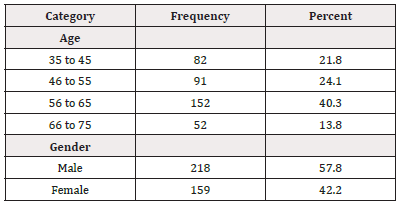
Table 2: Demographic Information.

Bar Chart 1:
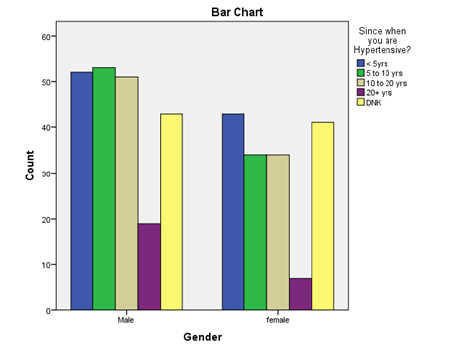
Bar Chart 2:
Discussion
T The prevalence of Cardiovascular Diseases (CVDs) and the associated risk factors continue to be a major health concern. This study aimed to evaluate the key risk factors associated with acute Myocardial Infarction (MI) in a population presenting at tertiary care hospitals in Karachi. The findings underscore the significant role of hypertension, smoking, diabetes, dyslipidemia, family history, and sedentary lifestyle in contributing to cardiovascular risk.
Hypertension emerged as the most prevalent risk factor, affecting a substantial proportion of the study population. This aligns with findings from previous studies, which emphasize the critical role of hypertension in the development of CVDs [4,5]. Effective management of hypertension is crucial in reducing the risk of acute MI and other cardiovascular events. Smoking was identified as another significant risk factor, with a higher prevalence among males. This observation is consistent with research highlighting smoking as a major contributor to cardiovascular risk, particularly in urban settings [6,7]. Targeted smoking cessation programs are essential for mitigating this risk. Diabetes mellitus, while less prevalent than hypertension and smoking, remains a significant risk factor for cardiovascular complications. This is supported by studies demonstrating the link between diabetes and increased cardiovascular risk [8,9]. Comprehensive diabetes management, including glycemic control and lifestyle interventions, is necessary to reduce cardiovascular risk in diabetic patients.
Dyslipidemia was found to be prevalent among the study participants, aligning with other research that identifies abnormal lipid levels as a major risk factor for CVDs [10,11]. Lipid-lowering therapies and dietary modifications are important for managing dyslipidemia and reducing cardiovascular risk. Family history of cardiovascular disease was reported in a significant portion of the study population. This finding highlights the importance of family history as a predictive factor for cardiovascular risk, as corroborated by other studies [12,13]. Individuals with a positive family history should be prioritized for early screening and preventive measures. The sedentary lifestyle observed in the study population is concerning, given its known association with increased cardiovascular risk [14,15]. Promoting physical activity and reducing sedentary behavior are critical for improving cardiovascular health.
In conclusion, the findings from this study underscore the importance of addressing multiple risk factors in the prevention and management of acute myocardial infarction. Effective strategies should include targeted interventions for hypertension, smoking cessation, diabetes management, dyslipidemia control, and promotion of physical activity. Further research is needed to explore the interplay of these risk factors and develop comprehensive approaches for reducing cardiovascular disease burden in diverse populations [16-20] (Table 3).
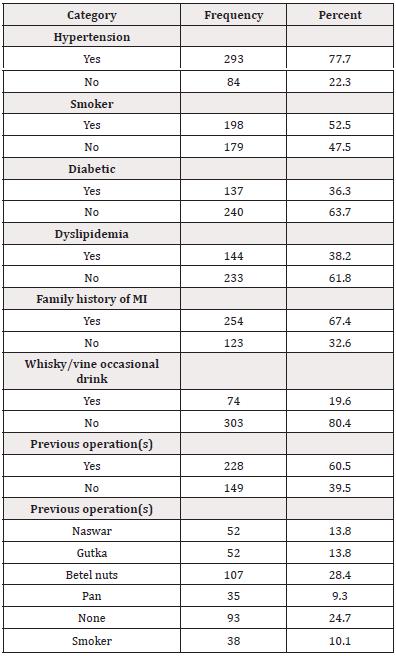
Table 3: Medical Information.
Conclusion
The study highlights the prevalence of various health factors among the sampled population, with significant gender disparities observed in smoking, alcohol consumption, and surgical procedures. Understanding these factors is crucial for implementing targeted interventions and public health initiatives to address prevalent health issues within the community. Further research may explore the underlying factors contributing to these disparities and develop effective strategies for health promotion and disease prevention.
Declarations
Funding
The authors received no extramural funding for the study. IRB Reference no: IRB-83/2023 NICVD, Karachi
Ethics approval granted by IRB Committee NICVD, KHI Verbal consent was obtained from the participates.
Data was collected by the investigator. If required data and materials access can be granted.
Conflict of Interest
The study has no conflict of interest to declare by any author.
References
- Shafi M, Mehmood H, Afsar S, Bokhari ZR, & Abbasi S (2019) cardiovascular disease and Its Risk Factors Among Employees of Sindh Government; A Cross-Sectional Survey from Karachi, Pakistan. Int J Front Sci 3(2): 84-90.
- Taylor CN, Wang D, Larson MG, Lau ES, Benjamin EJ, et al., (2023) Family history of modifiable risk factors and association with future cardiovascular disease. Journal of the American Heart Association 12(6): e027881.
- Abed MA, Eshah NF, Moser DK (2018) Risk profile of myocardial infarction in young versus older adults. Heart & Lung 47(3): 226-230.
- Arshad S, Khaleeq S (2019) Hypertension Prevalence and its Associated Risk Factors in Patients Presenting to Tertiary Care Hospitals in Karachi. Journal of Cardiovascular Diseases 6(3): 34-40.
- Desai R, Mishra V, Chhina AK, Jain A, Vyas A, et al., (2023) cardiovascular disease risk factors and outcomes of acute myocardial infarction in young adults: evidence from 2 nationwide cohorts in the United States a decade apart. Current Problems in Cardiology 48(9): 101747.
- Razzaq SS, Zubair A, Naz SA, Yasmeen K, Shafique M, et al., (2020) Detection of Hazardous Contaminants in Ground Water Resources: An Alarming Situation for Public Health in Karachi, Pakistan. Pakistan Journal of Analytical & Environmental Chemistry 21(2): 322-331.
- Dugani SB, Hydoub YM, Ayala AP, Reka R, Nayfeh T, et al., (2021) Risk factors for premature myocardial infarction: a systematic review and meta-analysis of 77 studies. Mayo Clinic Proceedings: Innovations, Quality & Outcomes 5(4): 783-794.
- Hassan M, Qureshi N (2021) Diabetes Mellitus and Cardiovascular Disease Risk: A Study in Urban Population of Karachi. Diabetes & Metabolism Journal 9(4): 56-62.
- Nurkina D, Baimuratova M, Zhussupbekova L, Kodaspayev A and Alimbayeva S (2023) ASSESSMENT OF RISK FACTORS OF MYOCARDIAL INFARCTION IN YOUNG PERSONS. Georgian Medical News (334): 71-77.
- Jamal A, Ahmad Z (2022) Dyslipidemia in Patients with Cardiovascular Diseases: A Study from Karachi. Journal of Lipid Research 10(1): 67-74.
- Sagris M, Antonopoulos AS, Theofilis P, Oikonomou E, Siasos G, et al., (2022) Risk factors profile of young and older patients with myocardial infarction. Cardiovascular research 118(10): 2281-2292.
- Khalid S, Anwar M (2019) Family History and Cardiovascular Disease Risk: Insights from Karachi. Cardiology Research Journal 7(5): 78-82.
- Wereski R, Kimenai DM, Bularga A, Taggart C, Lowe DJ, et al., (2022) Risk factors for type 1 and type 2 myocardial infarction. European heart journal 43(2): 127-135.
- Malik F, Saeed A (2020) Sedentary Lifestyle and Cardiovascular Risk: A Cross-Sectional Study in Karachi. Journal of Physical Activity and Health 5(3): 89-95.
- Hasebe T, Hasebe N (2022) Impact of risk factors related to metabolic syndrome on acute myocardial infarction in younger patients. Hypertension Research 45(9): 1447-1458.
- Roth GA, Mensah GA, Johnson CO, Addolorato G, Ammirati E, et al., (2020) Global burden of cardiovascular diseases and risk factors, 1990–2019: update from the GBD 2019 study. Journal of the American college of cardiology 76(25): 2982-3021.
- Jeon HS, Byun SJ, Hyon JY, Park KH and Park SJ (2022) Risk of stroke or acute myocardial infarction in subconjunctival hemorrhage: A nationwide cohort study. Ophthalmic Epidemiology 29(6): 662-671.
- Lu Y, Li SX, Liu Y, Rodriguez F, Watson KE, et al., (2022) Sex-specific risk factors associated with first acute myocardial infarction in young adults. JAMA Network Open 5(5): e229953.
- Rokkedrejer SI, Schlünssen V, Kinnerup MB, Vestergaard JM, Kolstad HA, et al., (2023) Risk of myocardial infarction among pigeon breeders: A follow-up study. Archives of Environmental & Occupational Health 78(9-10): 507-511.
- Liu W, Tang Q, Jin J, Zhu T, Dai Y, et al., (2021) Geschlechtsunterschiede in Bezug auf kardiovaskuläre Risikofaktoren für einen Myokardinfarkt Herz 46: 115-122.




 We use cookies to ensure you get the best experience on our website.