
Review Article 
 Creative Commons, CC-BY
The Multi-Criteria Historical Analysis of the Gradual Increase of Life Expectancy in the World
*Corresponding author: Efthymios Spyridon Georgiou, Company Efthymios Georgiou, Stathogianni 4, 11741, Athens, Greece.
Received: November 02, 2024; Published: November 08, 2024
DOI: 10.34297/AJBSR.2024.24.003233
Abstract
The modern world is changing. From 1900, changes in the health conditions in the cities, agricultural production, the quality of medicine, the accessibility of the citizens to health services, education, and living conditions (home, job).
Humanity passed a catastrophic Second World War and continuously developed law systems, politics, security, protection of the environment, conservation of traditional buildings, museums, and cultural heritage. The most countries have increased the indexes of sustainable development.
The current paper aims to examine life expectancy in people using maps, statistics, a theoretical approach, and solutions politics. The methodology has priorities and actions, including the official website https://ourworldindata.org/, the software QGIS, and significant articles such as Wilkinson, Richard G “Income distribution and life expectancy” and Oeppe J & Vaupel JW [1] “Broken limits to life expectancy”
Summarize the manuscript analysis, classified and hierarchy mathematics indexes, and statistics. Also, the design maps and spatial information about the allocation of the life expectancy in the world's countries. The results of the manuscript are the spatial solutions, the making of policies, the design of digital products, and the historical analysis of the changes in the value of life expectancy
Introduction
The current paper analyzes life expectancy in the world. The classification by the years shows the historical change and improvement of the duration of life. The reasons for this gradual increase are the natural environment, the quality and quantity of medicine services have improved. Also, innovation and technological change have led to the discovery of new and better medicine solutions. Many health needs are covered in the countries. The group of developed countries has improved rapidly, and the group with the lowest GDP has the slowest improvement. Finally, the end of the second war is due to increased happiness and life satisfaction. Access to education for more people, the production of agricultural products, the construction of houses, the political directions of freedom and security, and human rights are the main criteria that have significance in the better future of the world.
The central questions that it examines in the current work are the following:
a) Why do greener cities improve the duration of life expectancy?
b) What are the statistical changes in life expectancy in the countries from 1951 to 2021?
c) What are the political decisions, actions, and axes of the gradual increase in the duration of life?
The world changes, and it will change. Cities and countries need to become cells of democracy. Peace, life satisfaction, accessibility to medicine services, water, safe regions, homes, increased production and increased access to agricultural products, and learning and training technological solutions are some of the political directions. Sustainable development in the world is a direction that gives benefits. In developed countries, there are rapid changes. The inequalities between the countries need to decrease because all people have the human right to freedom, peace, employment, and security; democracy is for all, and democratic societies need to learn from the past. The planet's future is responsible for the level of citizens and governance. For instance, poverty in many people is a crucial factor for administration and efforts to help the citizens.
Sustainable Making Policies and Life Expectancy
This information can be used for actuarial purposes in planning and policy-making. It is also helpful in identifying high-risk populations for whom preventive health care and medical care can compress morbidity during the last years of life [2]. Educational level and life expectancy are clearly related. The social gradient in terms of health expectancy is even greater than that in terms of life expectancy [3].
Economic growth, population growth, and health expenditure can significantly and positively affect life expectancy, but CO2 emissions can significantly and negatively affect life expectancy. The significant findings reveal that CO2 emissions can explain life expectancy. It is essential to formulate policies on reducing CO2 emissions so that life expectancy will not be affected (Murphy U, 2021).
Green cities can be models in the process of achieving urban sustainable development. They can contribute by creating green spaces, implementing public lighting based on renewable energy, using urban transport fuel with lower greenhouse gas emissions, or improving the energy efficiency of buildings [4].
Healthy Standards and Life Expectancy
The use of health expectancies in social policy, particularly in highlighting health inequalities [5]. The debate about the performance of healthcare systems has evolved from defining indicators for management information for health authorities to attempts at measuring performance in a broader sense. The World Health Organization's World Health Report 2000 is an essential step in this [6]. Healthy life expectancy is a valuable index for the appreciation of changes in both the physical and mental health states of the general population, for allocating resources, and for measuring the success of political programs [7].
Greener Cities and Peaceful Policies
The environmental conditions affect life expectancy [8]. The transformation of the duration of life greatly enhanced the quantity and quality of people’s lives [1]. Some countries might be caught in a low life expectancy/low-environmental quality trap [8]. The quantity and particularly quality of urban green are positively associated with small-area. This concurs with growing evidence that urban green reduces stress, stimulates physical activity, improves the microclimate, and reduces ambient air pollution [9]. The studies show reduced cardiovascular disease (CVD) mortality risk in areas with higher residential greenness [10].
Mathematical Statistics and Indexes
Life expectancy is a significant index of sustainable development. The world has experienced catastrophes, wars, complex environmental phenomena, pandemics, urbanization, industrialization, innovation, and technological change. Humanity's resilience, the political and legal system, and the living standards of citizens have adapted to these changes. For instance, urbanization increases the level of stress in the citizens, the quick daily life, and the globalization of cities. Many people in these countries face complex difficulties in their daily lives, poverty, and health problems.
As a result, life expectancy is low. Tables 1 and 2 show the highest and lowest values in the world countries in 1951, 1981, and 2021. Monaco, 85.9 years old in 2021, has the highest life expectancy value, and Chad, 52.5 years old, has the lowest. From 1951 to 2021, the highest value increase was +13,4 years. In addition, the lowest value increase is +34,8 years. This means that people's lives have increased and improved (Table 1).
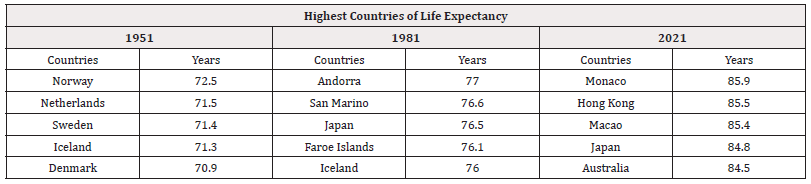
Table 1: Highest Values of the Countries.
Finally, the difference between the highest and lowest values is 54, 8 years in 1951, 48 years in 1981, and 33, 4 years in 2021. These stats show that inequality has improved in the last 70 years (Table 2).
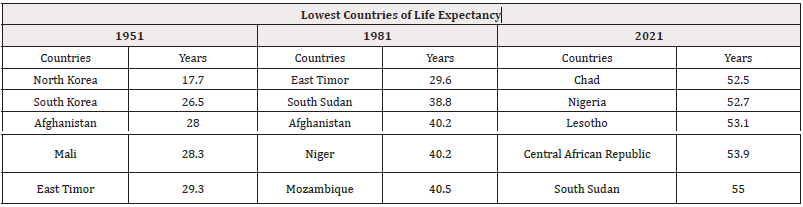
Table 2: Lowest Values of the Countries.
Design Maps in Geographic Information Systems
Geographic Information System Science manages, classifies, and analyses the hierarchies of spatial data. The QGIS offers solutions for the spatial and description information. Technological change and the progress of digital tools give solutions to information visualization. The biggest question is the measurement of spatial reality. Documenting and authenticating regional problems is an innovative action. The technology and the use of QGIS often analyze the phenomena on earth better than the human eyes. The QGIS offers solutions for earth observation with vector and raster datasets and satellite images, addressing statistical measurements and re-planning strategic goals. For instance, the measurement of the use of plastic on the planet is an environmental problem-the statistical measurement and spatial visualization of strategic planning for better sustainable development in the future.
Digital World Maps
Maps give us the reality that exceeds our reach, our vision, and the span of our days, a reality we achieve in no other way. We are always mapping the invisible or the unattainable or the erasable, the future or the past, whatever is – not-here present-to-our- senses-now and, through the gift of maps, transmuting it into everything it is not…. into the real, into the everyday [11]. The myth that the world is "well mapped" is perpetually rated in various subtle ways, from the road maps we use to the atlases we possess. Just because people can use road maps to guide them from one place to another does not mean. Those maps will accurately depict how many acres of agriculturally active land one will pass through [12].
A perspective suggests that maps are as much a reflection of the culture that produces them as they are representations of a section of the earth or activities upon it [13]. Cartographic philosophers should certainly remember him when they read that the map is a "socially constituted image or inherently political [14].
Maps of Life Expectancy
t would be interesting to use this approach to map small-area life expectancy losses elsewhere across more extensive and heterogeneous regions. In that case, one would likely find relationships between life expectancy losses and underlying socioeconomic, demographic, or environmental factors [15]. Life expectancy is an essential and representative parameter to indicate a region's public health status. Previous studies indicated that regional life expectancy can be influenced by factors such as economic status, environment, education, infant mortality rate, and even political conditions [16]. There are specific patterns of correlation between social and economic indicators at the district level and local life expectancy. It is well known that poor, disadvantaged, and less (formally) educated people have lower life expectancy than those with higher income, better economic prospects, or a university degree [17].
Life expectancy is the age at which a person in a cohort exposed from birth to death to the mortality rates observed at a given time is expected to live. Life expectancy can be estimated for a population as a whole or for subgroups of a population, such as persons of different sexes, different races, or different ages. Life expectancy is used in many areas, including pension planning, life insurance pricing, and health assessment [18] (Figure 1,2,3).

Figure 1: Life Expectancy in 1951.
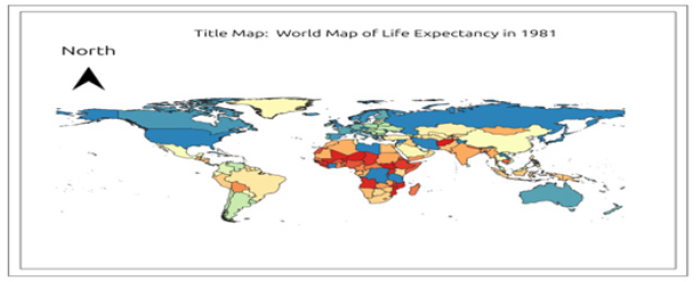
Figure 2: Life Expectancy in 1981.
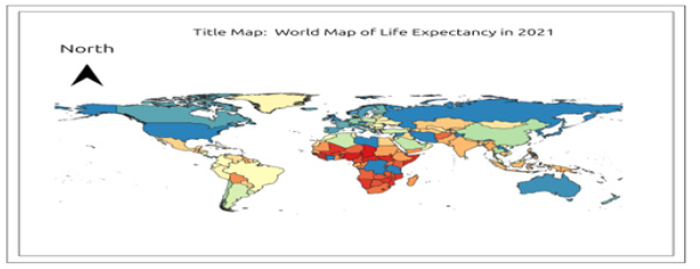
Figure 3: Life Expectancy in 2021.
Results
The value of eliminating a risk to life at a specific age is the expected present value of consumer surplus from that age forward [19]. Trajectories of mortality improvements over age and time describe changes in life expectancy and life span equality [20]. Survival and health should be distinguished [21]. In high-income countries, life expectancy at age 60 years has increased in recent decades. Falling tobacco use (for men only) and cardiovascular disease mortality (for both men and women) are the main factors contributing to this rise [22]. Making a difference to the health of populations, however small, is what most people in public health hope they are doing [23].
Discussion
The points of interest for the development dialogue are relative to the offer of political, environmental, cartography, and medical solutions and the direction of a more healthy and sustainable planet.
a) Geographic information system science is a technological tool that helps visualize information. Maps are digital products that help better understand regions. For instance, there are inequalities between the countries of Africa and Asia in terms of life expectancy.
b) The politics of sustainable development and the gain of peace in most regions of the world are political factors in increasing gradually life expectancy. Also, many countries in the world measure the level of happiness and satisfaction in people’s lives.
c) The environment, contact with nature, low–stress towns, and a balance between work hours and spare time are some of the criteria for improving longevity.
d) Finally, the decrease in smoking, cardiovascular disease mortality, CO2 emissions, improved mental and physical condition, and human organization stamina are some healthy criteria for a sustainable world.
The democratic societies need democratic political solutions. The world and humanity have passed many difficult times. Learning from the past leads to better management of the future. Democracy, there isn’t ever in the world-the previous generations making policies that advance the health of the planet and the people.
Acknowledgement
None.
Conflict of Interest
None.
References
- Oeppen J, Vaupel JW (2002) Broken limits to life expectancy. Science 296(5570): 1029-1031.
- Katz S, Branch LG, Branson MH, Papsidero JA, Beck JC, et al. (1983) Active life expectancy. N Engl J Med 309(20): 1218-1224.
- Brønnum Hansen H, Andersen O, Kjøller M, Rasmussen NK (2004) Social gradient in life expectancy and health expectancy in Denmark. Soz Praventivmed 49(1): 36-41.
- Angheluţă PS, Badea CG (2018) The Green Economy Influence on The Urban Sustainable Development. Economics, Management and Financial Markets 13(3): 315-326.
- Jagger C, Robine JM (2011) Healthy life expectancy. International handbook of adult mortality: 551-568.
- Groenewegen PP, Westert GP, Boshuizen HC (2003) Regional differences in healthy life expectancy in the Netherlands. Public Health 117(6): 424-429.
- Robine JM, Ritchie K (1991) Healthy life expectancy: evaluation of global indicator of change in population health. BMJ 302(6774): 457-460.
- Mariani F, Perez Barahona A, Raffin N (2010) Life expectancy and the environment. Journal of Economic Dynamics and Control 34(4): 798-815.
- Jonker MF, Van Lenthe FJ, Donkers B, Mackenbach JP, Burdorf A (2014) The effect of urban green on small-area (healthy) life expectancy. J Epidemiol Community Health 68(10): 999-1002.
- Gascon M, Triguero Mas M, Martínez D, Dadvand P, Rojas Rueda D, et al. (2016) Residential green spaces and mortality: a systematic review. Environ Int 86: 60-67.
- Wood D (2010) Rethinking the Power of Maps. The Guilford Press.
- Estes JE, Mooneyhan DW (1994) Of maps and myths. Photogrammetric engineering and remote sensing 60(5): 517-524.
- MacEachren AM (2004) How maps work: representation, visualization, and design. Guilford Press.
- Harley JB (2002) The new nature of maps: essays in the history of cartography (No. 2002). JHU Press.
- Puig X, Ginebra J (2023) Mapping Life Expectancy Loss in Barcelona in 2020. The American Statistician 77(4): 417-424.
- Wang L, Li Y, Li H, Zhang F, Rosenberg M, et al. (2014) A study of air pollutants influencing life expectancy and longevity from spatial perspective in China. Sci Total Environ 487: 57-64.
- Rau R, Schmertmann CP (2020) District-level life expectancy in Germany. Dtsch Arztebl Int 117(29-30): 493-499.
- Puig X, Ginebra J (2022) Bayesian Spatiotemporal Model for Life Expectancy Mapping; Changes in Barcelona From 2007 to 2018. Geographical Analysis 54(4): 839-859.
- Rosen S (1988) The value of changes in life expectancy. Journal of Risk and uncertainty 1(3): 285-304.
- Aburto JM, Villavicencio F, Basellini U, Kjærgaard S, Vaupel JW (2020) Dynamics of life expectancy and life span equality. Proc Natl Acad Sci U S A 117(10): 5250-5259.
- Riley JC (2001) Rising life expectancy: a global history. Cambridge University Press.
- Mathers CD, Stevens GA, Boerma T, White RA, Tobias MI (2015) Causes of international increases in older age life expectancy. Lancet 385(9967): 540-548.
- Leon DA (2011) Trends in European life expectancy: a salutary view. Int J Epidemiol 40(2): 271-277.




 We use cookies to ensure you get the best experience on our website.