
Review Article 
 Creative Commons, CC-BY
What governs the Brain? Is Neuroscience Immersive for Consciousness?
*Corresponding author: Ashok Kumar Mukhopadhyay, Ex-Professor & Head, Department of Laboratory Medicine, All India Institute of Medical Science, Delhi.
Received: December 06, 2024; Published: December 17, 2024
DOI: 10.34297/AJBSR.2024.25.003298
Abstract
The paper develops a new road map along the axiology of consciousness-cognition-behavior for investigating brain-consciousness relationship, where the brain operates as natural, formal, informational (codal), live, and conscious system to make the unknown imaginable, imagined intelligible, intelligible possible, possible verifiable, and verifiable verified. Consciousness, on the other hand, as a non-observable and influential, supports the brain’s reflex activities, upholds habituated acts, and participates in cognitive functions. Consciousness uses the brain to make its political statements by asserting its “will”/“won’t”, in developing multisystem concurrence, creativity, and exhibiting holonomic group behavior, and leadership.
Introduction
In the ongoing paradigm war for a science of consciousness when at least a dozen of theories are around for more than thirty forty years, when every theorist is stuck with his own, and none of them has time, or a ‘will’ to look into other’s viewpoint [1], science policy and the business of science promote only neuro-centric consciousness that suggests neurons or the organ brain are essential for conscious activities and are the source of consciousness, this article deals with a disruptive opinion reversing ontologically the prevalent view of neuro-centric consciousness and cognition into a consciousness-centric neuroscience. There is no credible evidence supporting the prevalent view. The participants on this view are losing bait [2] or, put to questions like whether they were running after an illusion so far [3]. The neuro-centric view has limited itself to network and communication, and never questioned why neurons amongst all cells are so special for consciousness? Also, there is no accepted defined version of what are verifiable conscious activities, and how much of the organ brain is essential to carry out such activities. Neuro-ontologically and neuro-phylogenetically the prevalent view of physical processes in the brain giving rise to subjective experience have at least four explanatory gaps namely, referral, unity, qualia and causation [4]. The gaps are unbridgeable by any known physical force, or energy, or in any abstract way of logic or mathematics. On the other hand, the proposed view that non-observable and contact-non addressable but ‘influential’ consciousness uses the brain for its manifestation, although missed the attention of Robert Kuhn’s seminal paper [5] on the landscape of consciousness research, has gained ground from sci-fi/imaginary to intelligible, possible and verifiable phase following accumulation of evidence in favor. Consciousness-centric science of the brain is heading for an immersive neuroscience where the nature of consciousness uses the nature of the brain to manifest behavior.
Defining Conscious Activities
The traditional stimulus-response paradigm covers only a limited part of conscious activities, habituated and perceptive behaviors. The testimonials for conscious activities, however, remain as the ability of (i) extracting information from a signal, (ii) self-nonself distinction and executing intention, (iii) doing uncertainty-certainty and asymmetry-symmetry homeostasis, and harness dark energy for body’s gene machinery and protein factory, (iv) learning and retaining what is learnt as memory, and finally (v) opting for a choice and making a decision, ‘will’/‘won’t’, in a simple or a complex situation often with creativity and lead. Conscious activities account for autonomous and holonomic behaviors of the system.
How much of the Brain can a person do Without?
The whole brain is not needed for conscious cognitive, creative and lead activities. For most of the conscious activities important are the rostral brainstem [6], the cerebral cortex, and the connections between the two in the form of reticular projections. The case published in Lancet [7] of a 44 year old white-collar civil servant who has lost more than 90% of his brain tissue due to hydrocephalus, lives almost a normal life with two children, having verbal IQ 84 and performance IQ 70, is not a ‘white crow’ evidence. A few more cases are available in the literature like Popular Mechanics (September19, 2014), describing a man of Louisiana missing all but the brainstem, a 42 year old Virginia Native missing half of the entire brain, a German girl missing half of the cerebral cortex, and a 24 year old Chinese lady with missing cerebellum. All of them have little compromised life. The incredible life of Carlos Rodrigues, the man who lost half of his brain in an accident has been published in Culture in 2021 [8]. An experimental study on hydrocephalic rats, “life without a brain” sings in a similar tune [9].
Conscious Activities in Absence of the Brain
Conscious activities are observed in brainless land animals like snails, and several sea animals such as jellyfish, corral, octopus, sea urchin etc. Very complex group behavior and even competitive leadership between different marine species having brain (e.g., fish) and without the brain (e.g., octopus) has been recently reported [10].
Traditional plant biologists think plants lack any anatomical structure remotely comparable to ganglion or brain and do not possess consciousness [11]. However, it has been found that the cells at the apex of the plant roots can make them exhibit a behavior similar to distinguishing self from non-self [12]. The fact that mind-controlling zombie fungi can hijack the host’s brain is opening a new landscape to understand host-parasite relationships [13].
A single unicellular life-form, Physarum polycephalum [14], Stentor coeruleus [15], Stentor roeseli [16], all evolutionarily backward from neuron or brain, shows conscious activities. An unicellular slime mold has been reported to lace the inter-galaxy patterns in its slime [17]. In human beings, cells exhibit intention-based extracellular vesicle transport [18], and telomere-transfer activities between immune cells [19].
Flaws in the Assumption of Brain as the Source of Consciousness
If my assumptions are incorrect, I will be doing wrong science! Neural correlates [20,21] or correspondence of conscious experience are the finest scientific documents for incremental growth of neuroscience, for understanding which all lobes of the brain, or which all connectomes are involved in conscious experiencing, leadership, creativity or sex! However, none of such data is supportive of the view that the brain is the source of consciousness! The idea of neuro-centric consciousness with which we have so much cognitive-biological fixation [22] is based on flawed assumptions.
1. Artificial neural network (ANN) was inspired from brain operations. Now, ANN and computational neuroscience are considered experimental tools to investigate consciousness as an Objective Reality, missing the fact that the system brain in addition to 100 billion live neurons has 2-10 times more glial cells. We are nowhere near Drosophila’s consciousness after identification of every FlyWire connectome [23]. ANN technology now powers generative AI, a non-living and not-conscious device.
2. Complexity of the brain is not a material but multilayered biological complexity. In the human cerebral cortex, one neuron connects with 5000-10000 others to produce 500-1000 trillion synapses. The cortical and cerebellar synapses are tripartite with astrocytes. One astrocyte is reported to modulate approximately two million synapses. The inter-neuronal connections are biological, electromagnetic, and even wireless [24], and ephatic [25] too.
3. The brain itself has automated its reflex and habituated functions. The autonomous cognitive behaviors and the holonomic group, lead, and creative behaviors are beyond the bounds of machine-mindset, and have been missed out.
4. The brain has been assumed to be informationally closed at the cerebral cortex, by which the transmissive functions of the brain have been totally ignored. It is the brain which makes the unknown imaginable, imagined intelligible, intelligible possible, possible verifiable, and verifiable verified.
5. The brain has been assumed merely as a natural or formal system. The brain is a codal (informational), live and conscious organ as well.
Author’s Stand on Consciousness-Brain Relationship
Since 1985 [26-31] till today I operate with the idea that the brain is not the source of consciousness. Nor can it use consciousness. It is consciousness which governs the brain for its manifestations. In the context of the brain, consciousness could be brainbound, and contextually supracortical in certain situations. In a larger context, consciousness is the medium of the universe, or even of the system multiverse, having no medium behind! The fabric of reality our senses detect is all on the foreground of this consciousness.
Powerful Ideas in Favor
There are Transmissive Theory of brain functions by William James, Radio Reception Theory of brain by Henry Bergson, and the brain operating as a Biological Reducing Valve by Aldous Huxley, Television analogy for the brain functions by George Wald, and John C. Eccles’ World III. According to Eccles and Popper, “the brain is owned by the self rather than the other way round” [32]. Sperry noted in the “consciousness revolution” [33], a shift from behaviorism to mentalism.
Evidence in Favor
During a paradigm war, no evidence is insignificant, or a fringe phenomenon.
That without using any technology the members of indigenous tribes communicate with each other regularly over long distances is known to social science. We gather soft cultural evidence watching the revered Pope keep his blessing hands on the head of Stephen Hawking, where religion meets science. Long distant healing by means of prayer is another evidence communication of ‘will’ and wishes from well-wishers to patients without any technological help.
The evidence that consciousness can move out-and-in of the brain comes from uncommon neurophenomenology such as autoscopy, out-of-body experience, near-death experience, and the phenomenon of flying-in-dream.
Jan Pilotti [34] argues that consciousness is beyond the brain in Space-Time! The brain-states are considered as wave-like motifs [35]. Stochastic neurodynamic is both spatial and temporal, consisting of both equilibrium and dissipative structures. In describing temporal neurodynamic of conscious experience of olfaction, Morsella and Bargh [36] reports happenstance of supracortical location of consciousness, which might be interpreted as functional inversion, or virtual inside-out phenomenon of the brain. Richard Funk argues for a portal or a “membrane” between the cerebral and extracerebral space time domain [37].
Psycho-neuro-phenomenological evidence of surgery under hypnosis replacing general anesthesia [38-40], and PET scan evidence [41] on psychotherapy of compulsive obsessive disorder patients leading to similar result in the head of the caudate nucleus as of medication therapy strongly suggest primacy of cognitive faculty over the brain.
The evidence of interbrain transfer of thoughts happening between the brains within Faraday’s cage points out deeper than electromagnetic connections [42]. Ellingsen, et al. document PET scan evidence of behavioral mirroring in patient-clinician interaction [43,44].
Inter-netting of brains takes another step when event-related EEG correlations between spatially related subjects is demonstrated [45], and Robert Martone’s evidence [46] are taken into account.
Consciousness-Cognition-Brain Axis
The brain’s nature appears to be immersed in circum-cerebral nature, in which consciousness is a stake-holder in both the spheres! The brain operates on the axis of Consciousness-Cognition- Behavior [47].
A. Consciousness operates from the top, may be in a brainbound state on the neural and glial network, or occupying individualized supracortical position, or as a brain-independent ground with no background.
Consciousness’s presence in a brain-bound state is recognized bottom-up when (i) a signal leads to sensation, (ii) sensation to perception, (iii) perception to concept formation and (iv) having an experience, unconscious or conscious. Top down, consciousness’s presence is recognized by having ability to (i) make a “will”/“won’t”, (ii) develop a multisystem (read brains) concurrence of experience, (iii) exhibit holonomic group behavior without crossing each other’s autonomy accounting for ethics and aesthetics, and (iv) make political statements by creativity, and leadership. The last one is a testimonial for the existence of a brain-independent consciousness asserting on brain-bound consciousness. Multisystem concurrence and holonomic behavior cannot be explained by quantum entanglement since the systems are live systems. Information entanglement might be a testable mechanism in this context where consciousness is individualized as CEO, or the ‘self’ of the system. Information holographically entangles ‘self’s of several systems.
B. Cognition is a function of the cognitive faculty operating within the brain. Non-observable but influential cognitive faculty are five in number namely, (i) operative consciousness as a ‘will-making’ entity, (ii) a sentient entity as ‘self” that brings the sense of ‘i’, ‘me’, and ‘mine’, (iii) the homeostatic entity as the subtle parts of ‘life’, performing uncertainty-certainty homeostasis, asymmetry-symmetry homeostasis, and intangible (dark) and tangible energy homeostasis within the system, (iv) the event-making entity as mind that makes intangible tangible, non-observable observed, and (v) information, which connects the cognitive and material worlds by converting itself into a signal through mind. None of the five members is localizable in space or time, therefore nonlocal in nature, and together constitute the system psyche [48], the cognitive orchestra [49]. If not by nomenclature, the members could be identified by their described specific operation. Why and how the members of the cognitive orchestra find the brain-substratum as their favored ‘home’ merit investigations, so also three more complex cognitive functions namely, (i) thought formation and processing, (ii) intelligence creation, and (iii) feeling development.
The substratum for cognitive expressions could be a brain, or any other living system without a brain, or even a single cell.
C. Behavior is of three types; automated reflex and habituated behaviors executed through the neural (and glial) network, autonomous behaviors executed on the initiative of cognitive orchestra, and holonomic behavior with other systems and the environment itself, executed by extracerebral consciousness. Besides, there are political statements of consciousness through the brain.
A Model for Consciousness-Brain Coupling
Consciousness and the brain are categorically two different substances. Their coupling is facilitated by the hierarchical ladder of the members of the cognitive family with the geometry and symmetry of different information states.
The sensation is within cells, neurons. Perception is in ‘mind’. Conceptualization is within ‘self’. The experiencer is ‘self’. Experience generation requires subtle parts of ‘life’, and its fabric for storage. Wisdom is in consciousness. The members of the cognitive orchestra, therefore, offer a ladder for the operations on neurons to ascend sensation to consciousness, on the throne.
Mind operation (operation I) converts a signal into a piece of information. Operation of self (operation II) transforms information into a concept/knowledge. The experience is built up by means of symmetry-breaking and symmetry-making process, an operation (operation III) executed by subtle parts of life. From the experience, emerges an individualized theory. Intervention by consciousness (operation IV) transforms system-bound theory into a worldview by means of multisystem concurrence and concurrence with the environmental whole.
The nervous system recognizes energy of the natural world as noise, signal as sensation, information as perception, non-factorizable ensemble of information as a concept, information manifold as experience, and crystallized information as wisdom!
Therefore, the natural, formal, informational and live world of the nervous system couples with consciousness along the ladder of cognition (Figure 1).
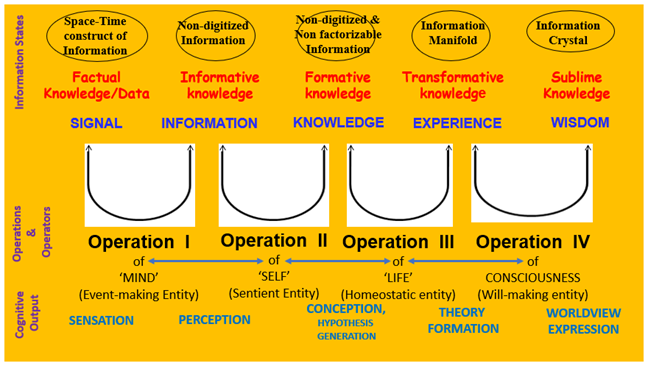
Figure 1: Begin your observation with the central horizontal axis of the figure, with the words in blue. On the left side, it begins with the signal, followed by Information, Knowledge, Experience, and at the extreme right side ends with Wisdom. In terms of knowledge, these milestones have been represented by data/factual knowledge, informative knowledge, formative knowledge, transformative knowledge, and sublime knowledge. On the topmost line, the figure describes the same milestones in the language of information-science, starting with space-time construct of information, followed by non-digitized information, non-factorizable information (where three folia of information, namely content, intent and the ability to reduce uncertainty, could not be separately identified, and several related information are in a combinatorial symmetry), information manifold, and information crystal. In the perspective of Informatics-Neuroscience, signals lead to sensation, information to perception, knowledge to concept formation and hypothesis generation, and experience to theory, and wisdom to Worldview formation. Stretched over the five landmarks/milestones, there are four operations expressed numerically from the left to right, as Operations I, II, III, and IV conducted by the non-observable but influential operators. In popular language of the formative world, Operator I of the natural world is known as ‘Mind’, Operator II of the natural world has been mystically labelled as ‘Self’ in the formal world, Operator III of the natural world in the language of science of the formative world is called ‘Life’ in the formal world, and the Operator IV in both scientific and spiritual terms of natural and formal worlds are labelled as Consciousness.
It has been reported [50] that at least 25% of unconscious patients who are unresponsive in the existing conventional stimuli-response paradigm, are found to be responsive to verbal instructions as per the records in their fMRI and EEG. Although the brain can couple with consciousness, the execution deficit is due to brain injury.
How does Consciousness Couple with the Brain?
Consciousness couples with the brain to make its ‘will’ a neural signal by climbing down the cognitive hierarchical system intertwined with hierarchically organized information states. The model of organogram [51] of consciousness to space time and energy, and from the ‘will’ to an event is described in Figure 2. Its caption explains the steps.
Investigation of Akinetic Mutism where the patient is conscious but not asserting his ‘will’ might bring further clarity of the model above.
The two models, combined, explain how through the brain the eyes or ears, skin or the tongue or the nose, are connected to hands and legs, ingestion and excretion, speech or mating!
Why is the Brain so Important?
The brain is the most important organ for several reasons. It is informationally ‘open’, acts as a ‘sensor’ for different environmental information states. The evidence has been emerging [52] favoring this view, and is strengthened by an observation [53] in clinical set up that the brain-neurons can detect patterns without conscious thought.
The brain has perfected to express automated, autonomous and holonomic behaviors of the individual. Automated multitasking is made possible in robotics. Habituated multitasking and creative multitasking, e.g., giving dictation to four persons to write letter on four different subjects is natural for a developed brain. Conscious activities appear in tandem. Clustered automatic, autonomous and holonomic behavior is possible by the brain.
Sensation becomes perception, perception turns into conception, and conception matures to experience and experience transforms into wisdom inside the brain (Figure 1). This is how the factual data is gradually elevated to the highest level of perfection by error-correction inside the brain. This error correcting function may be limited in some brains, and may fail in others letting the individual stuck at a specific level. The Top-down model shows how cognitive ‘will’ through the brain, turns into intent, intent translated into informative instructions, and information delivering a new event (Figure 2). The translation failure on some occasions gets the individual stuck at his level.
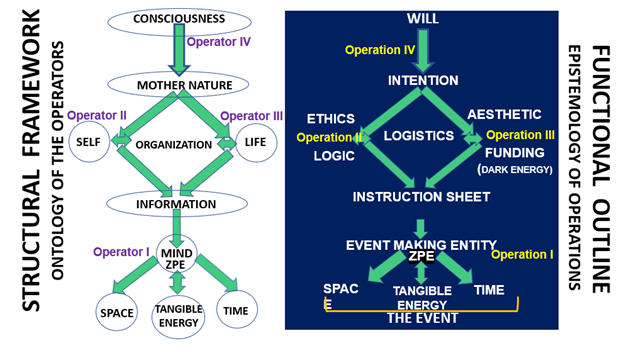
Figure 2: The left side of the figure describes the structural framework of the ontological operators with their phase position. The right side shows the functional outline of the operations from the ‘will’ to the event. In absence of any known force, field or visible energy consciousness operates with only ‘will’ that is converted into intention by the nascent nature (labelled as Mother Nature). Self’s operation examines the logic and ethical part of intention while the ‘life’-operation takes care of the aesthetic part of its execution along with the energy-homeostasis. Instruction sheet, thus formed, is handed over to the event-making entity, the ‘mind’ for occurrence of events in the 4-D world. The result is creation of new space, new time, and new tangible energy within the neural substrate of cognition. This last operation happens across ZPE in the natural world, and through network operative in the ZPE state of the brain.
Cognitive family members ontologically do not emerge from neural activities. They make the brain their favored ‘home’. They use the brain for their housekeeping, and other precious tasks. Their epistemic functions might be related to space time resonance of neuronal assembly.
Human brain’s uniqueness shines when it makes the unknown imaginable, imagined intelligible, intelligible possible, possible verifiable, and verifiable verified. The activities are testimonials of brain-independent consciousness operating through the brainbound consciousness. Such insights are supported by evidence of the brain’s functions like Intuition, Illumination and Revelation! The functions suggest that the brain is not merely a monodic (either formal or natural), a dyadic (both natural and formal), or a triadic (natural, formal and codal), or a tetradic (natural, formal, codal/informational, and ‘live’) system. The brain is a pentadic (simultaneously a natural, formal, informational, ‘live’, and conscious) system!
The Role of Consciousness in the brain- Activities: The Spider and Caterpillar Models of Consciousness
Like a spider, consciousness weaves the net but itself is outside the snare of the net (Spider model). Consciousness like a caterpillar advances its activities through the formidable trio of Mind-Self-Life (Caterpillar Model). Consciousness supports reflexes, upholds habituated responses, participates in cognitive activities, and intervenes when required. It also helps the brain to create. Consciousness, as the ground, makes its “will”/“won’t” to change the intention of the system (Figure 3).
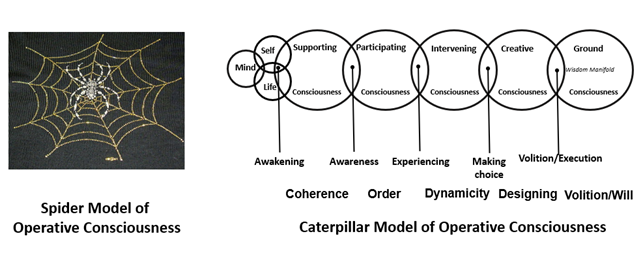
Figure 3: Spider and Caterpillar Models of Consciousness
Robot and Generative AI are Unconscious Systems
What is automation in a mechanical system is biologized as reflex activities in the living system. Systematization in a mechanical device having ANN, is habituation in the nervous system by the live neural network. Machines can be trained while a biological system actively learns since it can create memory in true sense while ANN cannot! AI consumes an exorbitant amount of energy with huge contribution to environmental pollution [54,55] while the formidable genome factory and outstanding proteome machinery of neurons are run by intangible energy with nil environmental pollution.
Mechanical system deals with quantity, or quantized quality, not quality itself, and therefore its achievements end there. Fractal algebra or sacred geometry cannot replace beauty, or a perfume. Algebraic signals cannot create a feeling, or simply a sensation in a machine, but do it in neurons. AI, although run by a language, cannot think or create thought! “Language is primarily a tool for communication rather than thought” [56]. Information geometry can create perception in the nervous system but cannot do so in a robot. Symmetrical ensembles of information can create a concept out of percepts in the nervous system, but is impossible in a mechanical device! Information manifolds are stored in a live system, which is unthinkable in a machine. The creativity by a machine is combinatorial, algorithmic, and statistically quantizable, mostly repetitive! In live-situation every creation is qualitatively unique. Habituated and creative multitasking are possible by a brain, not by a robot. Though autophagy is ubiquitous in a living cell, AI Models collapse when trained on recursively generated data [57]. The model gets ‘MAD’ (Model Autophagy Disorder) [58]. AI has no “will”/“won’t”, the ability which even a single biological cell possesses! However, a programmed machine commits little error. Life keeps on improving pattern/data/signal to the level of wisdom by error correction and value-addition.
Political Statements by Consciousness on the Brain
To bring a new dynamism, consciousness actively intervenes on the brain activities. Extracerebral consciousness contextually becoming supracortical to make a big political statement. When the nature of disembodied extracerebral consciousness interacts with the nature of individualized embodied consciousness within the brain, or activities happen in the reverse, supracortical consciousness gets sandwiched in between. This embodying consciousness makes disembodied embodied, pushing the apparent envelope of the brain system. Supracortical consciousness also lets individualized embodied consciousness out to disembodied extracerebral consciousness.
When is such an intervention called into play? There are three occasions all of which are individualistic by nature.
1. During conscious experience, especially when it is phenomenal in nature; not during dealing with surface phenomena, which are mostly of material world, but during experience of interplay of elementary phenomena like sex, love, ego, life, and near-death experiences. Further deep, during depth phenomenology of faith, devotion and love (altruistic).
2. At the time of creativity, when the brain makes the Unknown imaginable, Imagined intelligible, and Intelligible possible. Intuition, Illumination, and revelation are also evidence of consciousness using the brain for its manifestation.
3. While transforming experience into wisdom by developing multisystem concurrence, during holonomic group and social behavior, and emergence of leadership.
Immersive Neuroscience
In this new perspective, neuroscience appears immersive for consciousness irrespective of a) the contents of the brain-bound consciousness (sensory, perceptual, conceptual and experiential memory, imagery, emotional, and motor contents like autosuggestions and self-talk), b) the states of consciousness (wakefulness, sleep, dreamless sleep, altered, higher spiritual, and disease states), c) the levels of being-consciousness (brainstem being, limbic being, cortical being or supracortical being), d) the developmental lines (cognitive, psychomotor and affective) of consciousness, and e) the planes of consciousness (unconscious, subconscious, conscious and super-consciousness) [59], regardless of the age, gender, race, religion, and the social caste of the being. However, for perfection, the brain requires multilevel integrity; classical, quantum, phenomenological, and readiness to remain transmissive. To receive Grace, the brain is to be in the State of Grace!
Three Fundamental Questions
Prasna, and Brihadaranyaka Upanishads raise three fundamental questions: What is God? What is this universe? Who am I? In neuroscience the questions could be reformulated as, what is consciousness? What is the brain world? What creates the sense of ‘I’, Me, and Mine? These fundamental questions arising from the depth of our mind are supposed to operate across zero-point energy (ZPE) state/fluctuations. The legendary first step for moving into the world posterior to ZPE is to investigate how a signal becomes a piece of information, or vice versa.
A New Perspective and the Road Map
If consciousness is an ‘unknown’ entity to conventional science we require the help of our brain which makes the unknown imagined. Einstein’s advice to school children to read fairy tales and more fairy tales to become another Einstein, or greater than Einstein emphasizes the imaginative power of the brain. When Leon Cooper says that imagination can take us there where logic or experience cannot, we are emboldened to make a science for/of this hitherto unknown consciousness which requires both a theoretical conceptual framework, and experimental verification. We have begun with a new research question. What governs the brain? Certainly not a ghost, which consciousness isn’t! Having philosophy as ‘love for wisdom’, science is how consciousness politicizes wisdom into a tangible mass-signal, and vice versa. Multiversal consciousness, where multiple universe(s) cohabitate, restrains politics from getting ‘dirty’ to anyone anytime at any location. In this process of sciencing, what is essential is the multilevel integrity of the brain, as mentioned earlier.
Brain-consciousness or consciousness-brain coupling is not as simple as how sperm hooks an ovum where both are biological entities [60]. Here, one is tangible, the other intangible. To verify the proposed models the neuroscience needs to concentrate on close watching in ICU of the patients on the border of ‘life’ and ‘death’, unconscious and conscious states, Akinetic Mutism, patients in ‘Locked-in’ and vegetative states. Dementia patients would be the best cases to study the proverbial first step in how a signal is converted into information.
We remain satisfied with the advancement of neural science in communication and networking. We never ask the question why neurons are so special? Three areas of the brain primarily involved in awareness and conscious actions are cerebral cortex, rostral brain stem, and reticular system. (i) They are like a forest of neurons where most of the neurons (trees) individually have no specified function but collectively they protect the environment. (ii) Neurons in general, and such neurons in particular exhibit ‘polarity’ of their membrane that determines consciousness-philia of neurons because of the specialty of different ion channels. Tripartite synapse with astrocytes makes neurons a hub for both digitized and non-digitized information. (iii) The neuron-philia of consciousness has evolved because of the ‘serenity’ of neuron’s genes due to down regulations of mitosis and therefore dissolution of microtubular structure, and a huge potential because of vulnerability to mutation of an unusually lengthy non-coding DNA sequences in subtlety of informational environment [61]. Such properties of neurons are most visible in the cerebral cortex, where apical dendrite terminals, non-synaptic dendritic spines, and the dendritic mat might act as “antennae” for space-time patterns, and/or information states!
Consciousness, on the other hand, could be approached from almost all apex disciplines of science, humanities, and spirit. However, consciousness has its own science, called the science of consciousness. Accepting consciousness as an inviolable constant, and other statistical constants used in science as flux in nature, the standing science might be respectfully complemented with consciousness’s operational presence accounting for many ‘explanatory gaps’, ‘puzzles’, with prediction of new events. The second approach makes science for consciousness, that opens multiple new doors for science.
Hold consciousness as an inviolable constant, there is ontological reversal. Quality does not originate from quantity. ‘Life’ cannot be sourced from only matter. Most of the organic matter like proteins, carbohydrates, fat, vitamins are products of ‘life form’. Majority of inorganic matters have their organic precursors. The gaps merit investigation.
Immersive neuroscience is at the intersection of science, spirit and humanity, and requires the brain itself to be at the zero-point energy state so that the engaged brain can investigate pre-quantum nature, the nature posterior to ZPE, and quantum void. From the classical Relativistic point of view ZPE is cosmological constant, and stops in dark energy. From the perspective of quantum physics, ZPE represents non-zero fluctuating states of energy quanta. From the scalar fields point of view, it is the door to infinite energy which is subtle being informational.
The nearest approximation of ZPE state/fluctuation of the brain is (i) the brain of a newborn, (ii) brain in the state of dreamless deep sleep when the mind is at complete rest, and (iii) in an exceptional state when the observer is habituated to remain awake in the deep sleep state, or (iv) an adult who has learnt to remain in newly born state, (v) the brain of a person who survived the NDE experience. The ZPE states of the brain and Default Mode Network (DMN, or M-FPN, medial frontoparietal network) are very close to each other, but with a difference. In addition to passive tasks in the internal forum of the brain in default mode, there is a passive focused external attention too in the ZPE state of the brain. DMN has been reported to have a causal relationship with critical thinking [62].
To pursue immersive neuroscience from the ZPE state of the brain, we leave aside vitalism but encounter two ‘World-knot’— ’Weltknoten’. First, how cognitive faculty make the brain their ‘home’? Or, how different information states handle those operations by name-sakes? Second, how extracerebral consciousness makes its political system through cognitive App?
Bottom-up, we are aware of firing of neural assembly. We have spoken about neural Wi-Fi, and mentioned ephatic coupling where neurons of the mouse cerebral cortex couple without synaptic activities (Shivacharan, et al.). Electrogenic neurons produce electromagnetic fields that spread through grey matter 5000 times faster than neuronal firing when information density staggers up 125 billion times more than what happens in synaptic firing [63].
Top-down, we require disruptive technology in five frontier terrains namely, vertically propagating scalar waves, information-carrying energy-particles (photon, phonon, conformon and neutrino) [64], subquantum physics, the matter correlates of consciousness [65] (the medium of exotic matter states), and how a biological cell harnesses dark energy to run its huge gene machinery and protein factory without polluting the environment.
Stretching the imagination further, it is possible to connect five frontiers with five ZPE states of the brain; newborn brain with scalar waves, deep sleep with information-carrying energy, subquantum physics with awakened in deep sleep state, adult brain in newborn state with matter correlates of consciousness, and the brain which survived NDE with harnessing intangible dark energy. This makes the road-map more intelligible, realistic and verifiable.
All, however, is not good in the roadmap of supracortical consciousness for an unprepared brain. In absence of multilevel (classical, quantum, phenomenal, and transmissive) integrity of the brain, extracerebral supracortical consciousness could be the reason for one neurological disease, epilepsy. The psychological state of synaesthesia, and psychological disease like hysteria, psychiatric syndromes of hallucination and delusion, Cotrad syndrome [66] with nihilistic delusion and severe depression with physical extension, are under suspicion to have supracortical origin.
References
- Lenharo M (2024) The Consciousness wars: can scientists ever agree on how the mind works? Nature 625: 438-440.
- Lenharo M (2023) Decades-long bet on consciousness ends — and it’s philosopher 1, neuroscientist 0. Nature 619: 14-15.
- https://www.youtube.com/watch?v=SzFqc7Cmq44&ab_channel=CloserToTruth
- Feinberg TE, Mallatt J (2016) The nature of primary consciousness: a new synthesis. Conscious. Cogn 43:113-127.
- Kuhn RL (2024) A landscape of consciousness: Toward a taxonomy of explanations and implications. Progress in Biophysics and Molecular Biology 190: 28-169.
- Devor M, Koukoui M, Baron M (2022) Searching in the wrong place: Might consciousness reside in the brainstem? Behavioral and Brain Sciences 45: e46.
- Feuillet L, Dufour H, Pelletier J (2007) Brain of a white-collar worker. Lancet 370(9583): 262.
- https://www.scoopwhoop.com/culture/true-story-of-carlos-rodrigues-man-with-half-a-brain/
- Ferris CF, Cai X, Qiao J, B Switzer, J Baun, et al (2019) Life without a brain: Neuroradiological and behavioral evidence of neuroplasticity necessary to sustain brain function in the face of severe hydrocephalus Sci Rep 9(1): 16479.
- Sampaio E, Sridhar VH, Francisco FA, Máté Nagy, Ada Sacchi, et al. (2024) Multidimensional social influence drives leadership and composition-dependent success in octopus-fish hunting groups. Nat Ecol Evol 8(11): 2072-2084.
- Taiz L, Alcon D, Draguhn A, Angus Murphy, Michael Blatt, et al. (2019) Plants Neither Possess nor Require Consciousness. Trends in Plant Sci 24(8): 677-687.
- Meredith L Biedrzycki, Harsh P Bais (2010) Kin recognition in plants: a mysterious behaviour unsolved. Journal of Experimental Botany 61(15): 4123-4128.
- https://www.the-scientist.com/zombie-fungi-hijack-hosts-brains-72271
- Beekman M, Latty T (2015) Brainless but multiheaded: decision making by the acellular slime mould Physarum polycephalum. J Mol Biol 427: 3734-3743.
- Tang SKY, Marshall WF (2018) Cell learning. Curr Biol 28: R1180-R1184.
- Dexter JP, Prabakaran S, Gunawardena J (2019) Complex Hierarchy of Avoidance Behaviors in a Single-Cell Eukaryote, A Complex Hierarchy of Avoidance Behaviors in a Single-Cell Eukaryote. Curr Biol 29: 4323-4329.
- Schenz D, Nishigami Y, Sato K, Nakagaki T (2019) Uni-cellular integration of complex spatial information in slime moulds and ciliates. Curr Opin Genet Dev 57: 78-83.
- Oh C, Koh D, Jeon HB, Kim KM (2022) The Role of Extracellular Vesicles in Senescence. Mol Cells 45(9): 603-609.
- Lanna A, Vaz B, D’Ambra C, Valvo S, Vuotto C, et al. (2022) An intercellular transfer of telomeres rescues T cells from senescence and promotes long-term immunological memory. Nature Cell Biol 24(10): 1461-1474.
- Crick F, Koch C (1990) Towards a neurobiological theory of consciousness. Sem Neurosci 2: 263-275.
- Crick F, Koch C (2003) A framework for consciousness. Nat Neurosci 6(2): 119-126.
- Dielenberg RA (2024) The biological foundations of fixation: a general theory. Academia Biology.
- Dorkenwald S, Matsliah A, Sterling AR, Philipp Schlegel, Szi-Chieh Yu, et al. (2024) Neuronal wiring diagram of an adult brain. Nature 634(8032): 124-138.
- Neural WiFi (2019) A new form of communication in the brain by electric fields. Physiology News Magazine 116: (whole issue).
- Shivacharan RS, Chiang CC, Durand DM (2019) Ephatic Coupling, a mechanism for spontaneous neural propagation in the brain. Brain Stimulation 12(2): e38.
- Mukhopadhyay AK (1985) States of Consciousness - A Holistic Hypothesis. Supracortical Consciousness - An Existing Reality. In, Frontiers of Research for Human Biologist for Next Hundred Years. New Delhi, Conscious Publications pp. 1-7.
- Mukhopadhyay AK (1987) The Dynamic web of Supracortical Consciousness. New Delhi, Conscious Publications.
- Mukhopadhyay AK (1989) Consciousness - from Behavioral Neurologists’ Horizon. Journal of Indian Council of Philosophical Research VI (3): 49-55.
- Mukhopadhyay AK (1995) Conquering the Brain. Towards the Essence of the Multiversity and the Akhanda Paradigm. New Delhi, Conscious Publications.
- Mukhopadhyay AK (2000) The Millennium Bridge. Towards the Mechanics of Consciousness and the Akhanda Paradigm. New Delhi, Conscious Publications.
- Mukhopadhyay AK, Supracortical Consciousness (2006) An Opening to Multiple new Doors of Science. In, The Enworlded Subjectivity. Its Three Worlds and Beyond. Project History of Indian Science, Philosophy and Culture (PHISPC) XI (4), Ed. R. Balasubramanian. New Delhi, Pub, Center for Studies in Civilization pp. 380-446.
- Popper KR, Eccles JC (1977) The self and its brain. Berlin, Heidelberg, London, New York. Springer-Verlag.
- Sperry RW (1987) Structure and Significance of Consciousness Revolution. The journal of Mind and Behavior 8(1): 37-66.
- Pilotti J (2011) Consciousness and Physics: Towards a scientific proof that consciousness is in Space-Time beyond the brain. Journal of Transpersonal Research 3(2): 123-134.
- Foster M, Scheinost D (2024) Brain states as wave-like motifs. Trends Cogn Sci 28(6): 492-503.
- Morsella E, Bargh JA (2007) Supracortical consciousness: Insights from temporal dynamics, processing-content, and olfaction. Behav Brain Sci 30(1): 100.
- Funk RHW (2024) Reflections about a “Membrane” between Mind and Brain. Arch Anat Physiol 9(1): 007-020.
- Laureys S (2019) Conversation with Anouk Bercht. The Science of Consciousness. Scientific American pp. 227.
- https://www.sciencephoto.com/media/654661/view/surgery-under-hypnosis
- https://www.awcof.com/news-worlds-first-deep-brain-surgery-using-hypnosis.html
- Kandel ER (2000) In, Principles of Neural Sciences. 4th Edition. Eds. ER Kandel, JH Schwartz, TM Jessell, SA Siegelbaum, AJ Hudspeth. New York: Mc Graw Gill pp. 1224.
- Grinberg Zylberbaum J, Delaflor M, Attie L, Goswami A (1994) The EinsteinPodolsky-Rosen paradox in the brain: The transferred potential. Phys Essays 7: 422-428.
- Ellingsen DM, Isenburg K, Jung C, Lee J, Gerber J, et al. (2020) Dynamic brain-to-brain concordance and behavioral mirroring as a mechanism of the patient-clinician interaction. Sci Adv 6(43): eabc1304.
- Yuting Liu, Yu Liu, Mingming Zhang, Pei Wang (2024) Preserving Trust in the Doctor-Patient Interaction: Unveiling the Interactive Positive Evolutionary Process of Doctor-Patient Trust through fNIRS Evidence. Research Square.
- Wackermann J, Seiter C, Keibel H, Walach H (2003) Correlations between brain electrical activities of two spatially separated human subjects. Neurosci Lett 336(1): 60-64.
- Robert Martone (2019) Scientists Demonstrate Direct Brain-to-Brain Communication in Humans Work on an “Internet of brains” takes another step. Scientific American.
- Mukhopadhyay AK (2020) Consciousness Cognition and Behavior. J Neurosurg Imaging Techniques 5(2): 278-299.
- Mukhopadhyay AK (2016) Systems Psyche: Its Structure, Operation and Possible Molecular Links. Psychol Behav Sci Int J 1(3): 555565.
- Mukhopadhyay AK (2021) Axiology of Nature Consciousness Reality: Relevance in Consciousness Study, Psychology and Psychiatry. World J Psychiatry Ment Health Res 5(1): 1028.
- Bodien YG, Allanson J, Cardone P, Bonhomme A, Carmona J, et al. (2024) Cognitive Motor Dissociation in Disorders of N Engl J Med 391(7): 598-608.
- Mukhopadhyay AK (2022) Einstein’s Abandoned Otherworld: How Conscious “Will” Manifests in a 4-D World?. EC Psychology and Psychiatry 11(5): 01-08.
- Kulacz L, Kliks A (2021) Brain-Inspired Data Transmission in Dense Wireless Network. Sensors 21(2): 576.
- Tacikowski P, Kalender G, Ciliberti D, Itzhak Fried (2024) Human hippocampal and entorhinal neurons encode the temporal structure of experience. Nature 635(8037): 160-167.
- Bourzac K (2024) Fixing AI’s energy crisis.
- Iqbal SS (2024) Generative AI is Poised with to Worsen the E-Waste Crisis. Scientific American.
- Fedorenko E, Piantadosi ST, Gibson EAF (2024) Language is primarily a tool for communication rather than thought. Nature 630: 575-586.
- Shumailov I, Shumaylov Z, Zhao Y, Nicolas Papernot, Ross Anderson, et al (2024) AI models collapse when trained on recursively generated data. Nature 631(8022): 755-759.
- Alemohammad S, Casco Rodriguez J, Lorenzo Luzi L, Humayun AI, Babaei H, et al. (2023) Self-Consuming Generative Models Go MAD.
- Mukhopadhyay AK (2016) Consciousness: Contents, States, Levels, regarding; Synthesis from Neurscience and Vedanta.
- Deneke, Andreas Blaha, Yonggang Lu, Johannes P Suwita, Jonne M Draper, et al (2024) A conserved fertilization complex bridges sperm and egg in vertebrates. Cell 187(25): 7066-7078.e22.
- Gariaev PP, Frriedman MJ, Leonova-Gariaeva, EA (2011) Principles of Linguistic-Wave Genetics. DNA Decipher Journal 1(1): 011-024.
- Eleonora B, Ethan D, Huy Q Dang, Rikki Rabinovich, R, Raissa K Mathura, et al. (2024) Default mode network electrophysiological dynamics and causal role in creative thinking. Brain: 147(10): 3409-3425.
- Hunt T (2024) Consciousness Might Hide in our Brain’s Electrical Fields. Scientific Americans.
- Mukhopadhyay AK (2012) Information Holograph The Structure, the Source and its Operation. International Journal of BioEngineering, NeuroSciences and Technology 2(2): 12-32.
- Mukhopadhyay AK (2020) Life-form a matters-syncytium: DeepScience for matter correlates of conscious states. EC Psychol Psychiatry SI.02: 01-16.
- Ruminjo A, Mekinulov B (2008) A Case Report of Cotard’s Syndrome. Psychiatry (Edgmont) 5(6): 28-29.




 We use cookies to ensure you get the best experience on our website.