
Mini Review 
 Creative Commons, CC-BY
A Multifaceted Exploration: From the “Strong” in Nature to the Dynamics of Knowledge and Technology
*Corresponding author:Liu Zhaoyang, Yang Yang International Plaza, Block A, ShaanXi province, Xi’an city, China.
Received:June 12, 2025; Published:June 16, 2025
DOI: 10.34297/AJBSR.2025.27.003559
Abstract
This article explores the four foundational elements of the strong, knowledge, and technology.
a) “Science is everything, and knowledge is space” a conceptual framework highlighting the centrality of knowledge in shaping
human understanding.
b) The evolution of technology is driven by four key elements: iteration, expansion, ecology, and collaboration.
c) To illustrate technological principles, animals are used as metaphorical models, offering insights into the patterns of biological
evolution.
Keywords:The Strong, Knowledge, Technology
The “Strong”: Rethinking Power in Nature
Disease as the Body’s “Strong”
Metaphorical Meaning: Disease can indeed “defeat” a healthy body, but this victory often stems from systemic imbalance rather than true “strength.” At its essence, disease represents a disruption of equilibrium rather than the fulfillment of biological purpose.
Philosophical Extension: This parallels cosmic phenomena: black holes and dark matter may represent localized gravitational “strength” without embodying the universe’s fundamental nature. Explaining cosmic origins through such localized forces is as incomplete as attributing human anatomy solely to a common cold both mistake symptoms for causes.
The Big Bang as the Universe’s “Strong”
Scientific Perspective: The Big Bang theory elucidates the universe’s early expansion but remains silent on its ultimate origin. It describes how expansion commenced without addressing why existence emerged or what preceded it the unresolved “first cause” problem.
Conceptual Limitation: To call the Big Bang the universe’s “strong” conflates a dominant process with a fundamental cause, much like claiming “flame is the strong of fire.” Flame, while visible, is merely combustion’s outward expression, not its chemical essence.
Implications for Origin Questions: Scale Disparity:
a) Disease reveals physiological mechanisms but not life’s genesis.
b) The Big Bang models spacetime dynamics but not existential
causality.
Causal Limitations:
a) “Strong” phenomena operate within existing systems; origins require transcending current frameworks (e.g., quantum gravity, multiverse theories).
Philosophical Reflections:
a) Science and metaphysics serve complementary but distinct
roles.
b) The “strong” metaphor risks teleology, while modern science
favors emergent, purposeless processes.
Knowledge: Redefining Power and Space
“Knowledge is Power”: A Qualified Truth
Core Proposition: Francis Bacon’s dictum holds, but its validity is context-dependent:
Application-Specificity: Knowledge transforms into power only when effectively deployed. Isolated theory remains inert.
Cognitive Relativity:
a) For the uninformed, basic insights yield exponential gains.
b) For experts, the same knowledge may represent foundational
common sense.
“Knowledge is Space”: A Multidimensional Metaphor
i. Cognitive Framework: Constructs our mental map of reality.
ii. Exploration Frontier: Infinite expansion akin to cosmic discovery.
iii. Mental Dwelling: Shapes values and worldview (e.g., scientific
vs. religious paradigms).
iv. Connective Tissue: Bridges individuals and civilizations across
time (e.g., shared mathematical truths).
Unified Insight:
Knowledge’s duality dynamic power and expansive space demands:
a) Critical evaluation of its contextual utility.
b) Celebration of its cumulative, boundary-transcending nature.
Technology: Iteration, Expansion, Ecosystem, and Synergy
Systematic Framework
(Table 1)
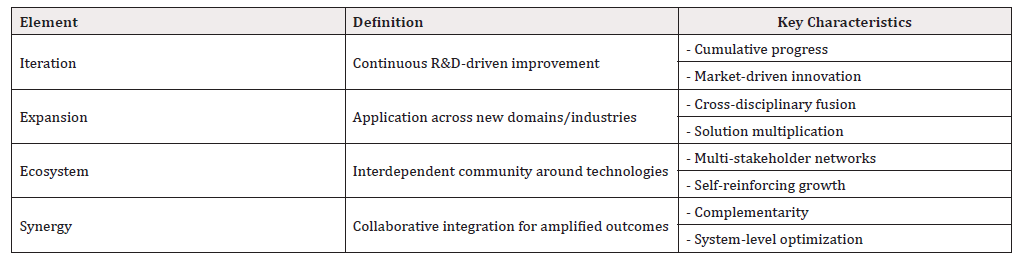
Table 1:
Dynamic Interplay
i. Iteration enables expansion by enhancing technological maturity.
ii. Expansion necessitates ecosystem development to support
scalability.
iii. Ecosystems foster synergy through diverse participant interactions.
iv. Synergy accelerates iteration via shared insights and resources.
lStrategic Imperatives:
a) Maintain iterative momentum to stay competitive.
b) Proactively explore adjacencies for growth.
c) Cultivate inclusive ecosystems to harness collective intelligence.
d) Coordinate across domains to solve complex challenges.
Synthesis: Bridging Paradigms
The examined concepts reveal a unifying truth: progress emerges
from interconnected dynamics. Whether analyzing:
i. Natural phenomena (disease, cosmic expansion)
ii. Epistemic constructs (knowledge as power/space)
iii. Technological systems (iterative ecosystems)
we find that meaningful advancement arises not from isolated
forces but from:
i. Contextual awareness (relativity of strength/power),
ii. Temporal humility (limits of causal explanations), and
iii. Systems thinking (recognizing interdependencies).
As Einstein wisely noted, “The important thing is not to stop questioning.” This philosophy shapes our approach to knowledge and innovation where each answer gives rise to new inquiries, and genuine progress emerges through clarity in navigating complexity [1,2].
War represents the most destructive ecological system imaginable. True science should aspire to cultivate planets lush with life worlds where flowers bloom and dew glimmers beneath humanity’s footsteps. It must never descend into the senseless chaos of Star Wars or aimless cosmic wandering that leaves only desolation in its wake.
Conflicting Interests
None.
Acknowledgments
None.
References
- Liu Zhao Yang (2020) Life Legend. Novel Research in Science 3(3): 1-2.
- Liu Zhao Yang (2022) Super Plant. Novel Research in Science 12(1): 1-2.




 We use cookies to ensure you get the best experience on our website.