
Case Study 
 Creative Commons, CC-BY
Case Study: Sleep Quality Disturbed by Infection
*Corresponding author:Kathy Sexton-Radek, Elmhurst University, Box 122, 190 Prospect Avenue, Elmhurst, Illinois, USA, 60126, United States.
Received:July 07, 2025; Published:July 15, 2025
DOI: 10.34297/AJBSR.2025.27.003605
Abstract
Keywords:Sleep, Sleep Quality, Young Adults, Infection
Case Background
24-year-old white male presented to the Insomnia clinic with a one-month onset of severe restless sleep with sweating and feeling warm, constant fatigue and moderate sleep onset Insomnia. The patient works a s computer analyst with traditional work hours, has a short commute to work and is generally advancing in the company based on good performance until recently where errors in computer programming he created occurred that were brought to his attention. He reports good health and no medical condition/ surgeries. The patient stated that he has “good” relationships with his parents that live forty-five minutes away. The patient lives alone in a rental community of mainly young adults in the small town of the State University where he graduated from. The patient related that he is very social with evenings out at bars/dance clubs nightly and social events sponsored by a singles group he is a member on the weekends. He related that has frequent sexual encounters and multiple partners, and at times, engages in sexual relations without protection. The patient related that he tried a relaxation app he read about online but did not think it worked. He also tried taking melatonin tablets and reducing his caffeine intake from five to two or three caffeinated beverages a day-all before 6pm. Following the intake interview and completion of self-report measures, the patient was provided with a treatment plan with two main foci: first, a referral to his Primary Care Physician for routine sexually transmitted disease screening and second, referral to the Sleep Psychologist for Brief Behavior Therapy for Insomnia.
Related Research Context
Young adult sleep patterns are commonly varied [6,10] with bedtimes ranging from 11pm to 4am for example and if working or school, a regular wake up time. This schedule places the young adult in a constant sleep debt with night after night of inadequate sleep. The accrued sleep deprivation, while leading to accommodation means often (e.g., abbreviated tasks, haphazard approaches to tasks, abstain or withdraw from tasks) due to the resultant excessive daytime sleepiness of sleep deprivation [3,4,10]. Additionally, cognitive and emotional consequences emerge with mounting sleep deprivation such as inadequate/incomplete work or study performance and irritability [7,11]. The young adult, ages 18-30 years, needs seven hours of sleep usually [8,10]. Basic research findings in sleep medicine have identified clear consequences of sleep deprivations. Rechtschaffen, et al. (1989) [9] reported on sleep deprivation experimentation findings in terms of pathophysiological outcomes the breakdown of host defenses that allows pathogens to infect the body, skin dermatoses normocytic anemia, hypoalbuminemia, increases in body temperature (0.4 to 0.5 Celsius), autonomic system dysregulation. In effect, sleep deprivation is an expensive high energy situation [3,5]. The laboratory animals effects were considered to resemble the hypercatabolic of a cancer patient, malnutrition symptoms of hyperalbumin [9]. Further, in follow up studies irregularities in slow wave sleep were identified. In a typical night of sleep, the slow wave sleep pattern characterizes stage 3/4 sleep and occurs in the sequence in the first half of the night of sleep and follows stage 2 sleep. However, with increases in sleep deprivation and resultant increases in core body temperature, decreases in SWS were found as well as misaligned sequences of SWS. The experience of excessive daytime sleepiness, fatigue and perturbances to executive functioning correlate with slow wave sleep amounts, timing and general sequence in the sleep cycle [4,10].
Reports of the 2017 Youth Risk Behavior Survey listed 39.5% of high school students having sexual intercourse with 9.7% with multiple partners and 53.8% using condoms [1,2]. Rates of chlamydia, gonorrhea and primary and secondary syphilis have been measured to be increasing with higher rates of increase amongst males. Sexually transmitted diseases caused by bacteria, viruses, protozoa, and parasites are a common concern of healthcare/public health agencies. Particular to chlamydia infections, inflammation is caused but may go undetected. The onset of slow wave sleep occurs following a peak in cytokines (i.e., natural killer cells, Interleukin-1) that are reduced during slow wave sleep [12,13]. IL-1 and IL-2 activity co-occurs with core temperature rise in infectious conditions.
The Brief Behavior Therapy for Insomnia (BBTi) intervention focuses on identifying a sleep pattern, adjusting the sleep pattern and implementing a stimulus control strategy. BBTi is effective in addressing the conditioned arousal of sleep onset Insomnia and fragmented sleep intervals [11]. The patient was responsive to the sessions that focused on providing information about sleep health, assigning an optimal sleep schedule and providing instruction and support for the patient’s use of stimulus control for the wake ups during the night [11]. Figure 1 depicts the patient’s sleep efficiency scores based on his sleep logging from the initial contact, when medical treatment began for an identify chlamydia infection and time that followed. The testing and immediate treatment for the patient’s sexually transmitted disease along with the education and increased awareness of the importance of his health and sleep health, collectively, lead to a positive impact for this patient. It is advised that in addition to the individual approach illustrated by this case study, a focus at the group and organization level with education about sleep health the effects of STI on sleep would be worthwhile.
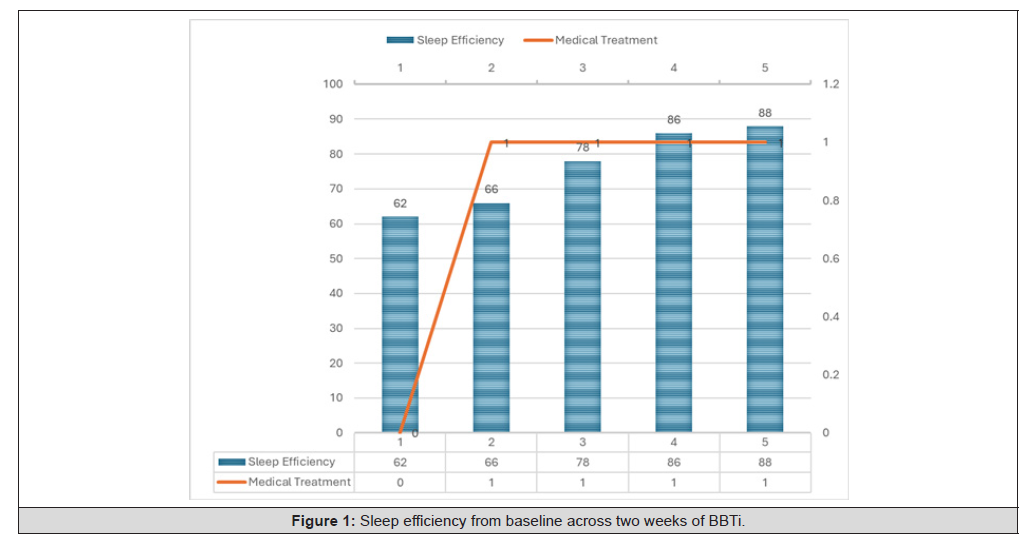
Figure 1:Sleep efficiency from baseline across two weeks of BBTi.
References
- Agwu L (2020) Sexuality, Sexual Health, and Sexually Transmitted Infections in Adolescents and Young Adults. Sexuality and Adolescents 28(2): 459-462.
- Cannovo N, Bianchini E, Gironacci L, Garbati E, DiPropero F, et al. (2024) Sexually transmitted Infections in Adolescents and Young Adults: A Cross Section of Public Health. Int J Environ Res Public Health 21(4): 501.
- Kalmbach DA, Anderson JR, Drake CL (2018) The impact of stress on sleep. Pathonomic sleep reactivity as a vulnerability to insomnia and circadian disorders. Journal of Sleep Research 27(6).
- Kuula L, Pesonen H, Heinonen K, Kajantie E, Anderson S, et al. (2018) Naturally occurring circadian rhythm and sleep duration are related to executive functions in early adulthood. J Sleep Res 27(1): 113-119.
- Moldofsky H, Lue F, Eisen J, Keystone E, Gorczynski R, (1986) The relationship of interleukin-1 and immune functions to sleep in humans. Psychosom Med 48(5):309-318.
- Ohayon MM (2005) Prevalence and correlations of nonrestorative sleep complaints. Arch Intern Med 165(1): 35-41.
- Plukaard S, Huiringa M, Krabbendam L, Jolles J (2014) Cognitive Flexibility in Healthy Students is affected by fatigue: An experimental study. Learning and Individual Differnces 38: 18-25.
- Ramar K, Mahotra RK, Carden KA, Martin JL, Abbasi Feinberg F, et al. (2021) Sleep is essential to health: An American Academy of Sleep Medicine position statement. J Clin Sleep Med 17(10): 2115-2119.
- Rechtschaffen A, Berman BM, Everson CA, Kushida CA, Gilliland MA (1989) Sleep deprivation in the rat: X. Integration and discussion of findings. Sleep 12(1): 68-87.
- Sexton Radek K (2008) Sleep Quality in Young Adults. New York: Mellon Press.
- Sexton Radek K, Graci G (2023) Sleep Disorders: Elements, History, Treatment and Research. New York: Praeger Press.
- Sexton Radek K (2014) Insomnia Affected by Infection: A Case Study. Journal of Infectious Diseases, ID: 11077702.
- Zentella A, Manogue K, Cerami A (1991) The role of cathelin/TNF and other cytokines in sepsis. In A. Sturk, S.J. vanDeventer, J. tencate, Hr.Buller, L.G., Thijs & J. Levin (Eds). Bacterial endotoxins: Cytokine mediators and new therapies for sepsis, 9-24. New York: Wiley-Liss.




 We use cookies to ensure you get the best experience on our website.