
Review Article 
 Creative Commons, CC-BY
Escaping the Threat of a Once-in-a-Millennium Tsunami or Flood
*Corresponding author: Shixiong CAO, School of Economics, Minzu University of China, No. 27 Zhongguancun South Street, Haidian District, Beijing 100081, P.R. China.
Received: May 12, 2025; Published: May 20, 2025
DOI: 10.34297/AJBSR.2025.27.003521
Abstract
Natural hazards threaten human survival and economic development. With climate change increasing the risk of extreme weather, the frequency and destructiveness of natural hazards are increasing, highlighting the need to prevent or mitigate these disasters. However, even countries that are frequently affected by natural hazards have not planned their response to large disasters, particularly for once-in-a-century or once-in-a-millennium disasters. To cope with the threat of such disasters, it’s urgently necessary to relocate the people who are at risk to safer lands and to plan responses to the worst disasters. Unfortunately, many of the populations at risk live in areas with rich agricultural land and easy access to river and maritime transportation; thus, they feel no incentive to leave. One possibility is to move farmers and those who benefit from, but don’t require, maritime transportation to safer areas, but much of the arable land that is not already cultivated is too dry and relocating established industries will be expensive. To solve these problems, governments must pay attention to the hazards these populations are exposed to by proactively moving people to safer areas and by developing plans that could reduce the harm caused by future disasters.
Keywords: Natural hazards, Coastal areas, Food shortage, Arable land, Water diversion
Introduction
Since humans evolved, we have continually experienced natural hazards such as earthquakes, hurricanes, floods, and tsunamis, all of which have drastically affected societies. For example, the COVID-19 pandemic that emerged in late 2019 has severely impacted global political and economic systems [1], and this is only a oncein- a-century scale of disaster. It is difficult for us to comprehend the destructive power of a once-in-a-millennium natural hazard and we tend to ignore such risks because individuals rarely live beyond 100 years, and natural hazards of this magnitude tend to occur at most once in a human lifetime. Thus, most of us can only read about such disasters in historical documents and archaeological journals.
The destructive power of natural hazards increases exponentially with increasing disaster frequency, and today, a once-in-a-millennium natural hazard could cause hundreds of millions of injuries and deaths worldwide [2]. Tsunamis result from oceanic earthquakes that cause seabed ruptures and rock slides that displace large volumes of seawater. Because the water fans out over large areas, the impact of the waves can be remarkably destructive [3]. Archaeological results have revealed that the ancient city of Liangzhu [4] Figure 1, which was founded in 3300 BC, was suddenly inundated by a huge tsunami around 2000 BC [5]. This tsunami not only extinguished the Liangzhu culture but also the Longshan culture (located in the lower reaches of the Yellow River), which was more than 1000 km away [2].
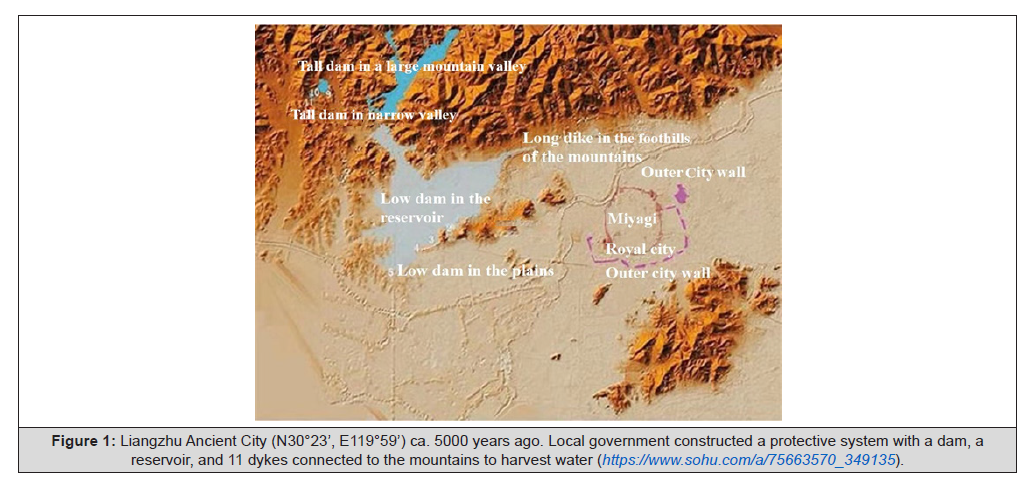
Figure 1: Liangzhu Ancient City (N30°23’, E119°59’) ca. 5000 years ago. Local government constructed a protective system with a dam, a reservoir, and 11 dykes connected to the mountains to harvest water (https://www.sohu.com/a/75663570_349135).
It’s hard to imagine how destructive the tsunami was. Yet only 2000 years later, the disaster occurred again. Two huge tsunamis, in 2 AD and 465 AD, inundated eastern China’s ocean coast, leaving little evidence of human activity in the areas below 4 m above sea level between 2 AD and 600 AD [6]. Large tsunamis can leave arable land in low-elevation areas along the ocean soaked with seawater for decades or longer, rendering it uncultivable [14]. As well, severe tsunamis may be accompanied by large volcanic eruptions, with huge amounts of volcanic dust filling the air and blocking sunlight [7]. After the eruption of Mount Vesuvius in 79 CE, the Roman cities of Pompei and Herculaneum were buried in ash. Together, these factors may reduce food production, causing famine that further threatens the survival and development of human societies that survived the disaster [8]. Compared to wars, natural hazards are an even greater challenge because they cannot be prevented by diplomacy.
In the modern era, booming industrialization has produced a global economy with widespread prosperity. This, in turn, has led to concentration of populations in or near large areas of arable land, many of which occur in rich river plains and coastal areas. In addition, under profit-oriented market mechanisms, populations increase near bodies of water to take advantage of convenient, lowcost marine transportation [9]. Because governments are more concerned with short-term economic gains than civilization’s longterm viability, they often overlook the costs of natural hazards that affect these areas [10]. Today, images of the world at night show dense concentrations of light in the world’s low-lying areas [11], and the light demonstrates both the concentration of economic development and its vulnerability [12].
Global climate change is increasing the frequency and destructive effects of weather-related natural hazards, but no governments seem to realize the seriousness of the problem [12], and politicians are so keen on economic competition and the arms race that they turn a blind eye to both frequent natural hazards such as hurricanes (typhoons) and more series once-in-a-millennium natural hazards. Because disasters such as tsunamis, earthquakes, and floods are interconnected, this can create damaging synergies through mutual reinforcement. Moreover, large-scale natural hazards are often followed by secondary hazards such as epidemics and famines, and social conflicts triggered by famines and other consequences exacerbate the problem [13]. An unusually severe disaster would exacerbate the risk of social collapse in the affected area and possibly even the elimination of a nation that isn’t sufficiently resilient to withstand the disruption and destruction [14]. Today, 1500 years have passed since the last thousand-year tsunami, and a natural hazard of this magnitude could happen again at any time. We understand this, but are unprepared to respond.
The world’s coastal areas often lie in volcanic and seismic zones where different tectonic plates are breaking or colliding. Unfortunately, more than two-thirds of the world’s population and industry are located in danger zone where frequent earthquakes, tsunamis, and floods occur [15,9]. No country could cope with a natural hazard of the once-in-1000-years magnitude. If such a tsunami arrives, many island nations will be destroyed and larger countries with a long, low-lying coast will be devastated. Moreover, in a context of diminishing global food security, the famines that follow such disasters will subject the affected countries to severe consequences; without help from other nations, it will be difficult for the affected societies to recover [16]. If enough ocean-going ships are destroyed or severely damaged by a tsunami, global logistics chains will collapse, making it difficult or impossible to transport required materials (such as food) to the affected countries. We saw this happen in the Suez Canal in 2021, when a single cargo ship cut off all marine traffic through the canal for almost 1 week (https://en.wikipedia. org/wiki/2021_Suez_Canal_obstruction). Have we learned from this crisis?.
If a giant tsunami occurs, survivors will be forced to move inland, away from coasts, until flood waters recede. Subsequent food shortages caused by soil salinization would threaten human survival. Populations that migrate inland will have difficulty finding sufficient arable land to feed themselves, and relocating these people to safe zones will require the largest Noah’s ark in human history. For example, it seems unlikely China will be able to feed itself if 25% of its most productive agricultural areas become unavailable for agriculture with a 4-m rise in sea level. Traditionally, the world’s governments have responded to disasters after the fact, but the larger the disaster, the less effective such reactive solutions become. Instead, governments should respond proactively by taking measures such as protecting areas of arable land farther from flood-prone regions so this land can be rapidly brought under cultivation when disaster strikes.
Perspective
Archaeological findings and historical records show that once-in-a-millennium natural hazards can destroy a society. Although modern governments have considerable experience dealing with annual-scale and possibly even century-scale disasters, they could not cope with larger disasters without much more advance planning [2]. Disasters are sudden, and are difficult or impossible to predict. Given the large populations that are affected, it’s impossible to give enough advance warning for those who will be affected to flee a tsunami or other serious flooding [17]. Moreover, some disasters leave nowhere safe for victims to go; for example, flooding in river basins often results from heavy rains that destabilize slopes above the floodwater that are the only place where local people can flee. Slower disasters, such as the rise in sea levels that is occurring under climate change, provide ample warning [18,19], but governments are reluctant to act.
Figure 2 shows the area of land that would be inundated by a sea level rise from 0 m to 60 m. Megacities such as Shanghai, Tokyo, and New York may be submerged when sea levels rise by as little as a few meters. Tsunamis and floods exacerbate this risk, and will reach farther inland. This is not idle speculation; China has experienced three such disasters in the past 4000 years. However, governments don’t seem concerned, even though our children and grandchildren will live with the consequences of our inaction. If we care about their fate, we can’t continue to turn a blind eye to the risks caused by these disasters.
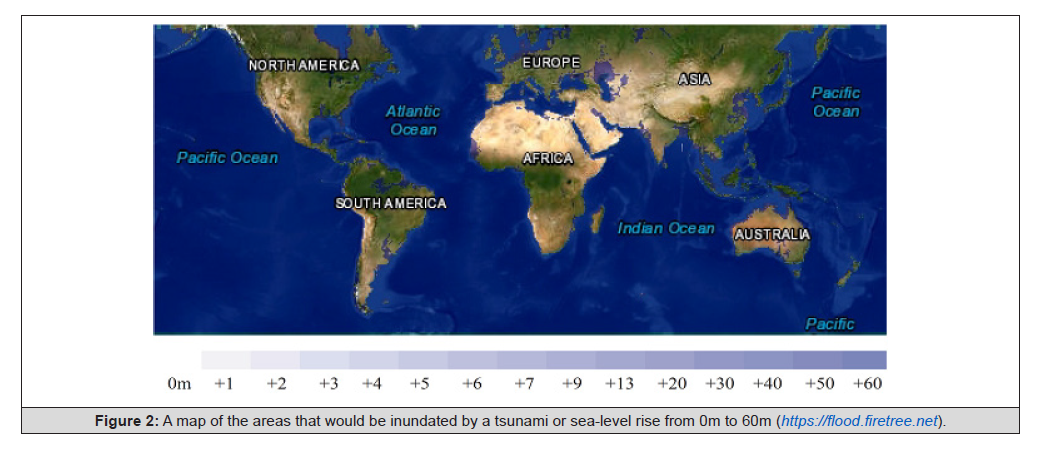
Figure 2: A map of the areas that would be inundated by a tsunami or sea-level rise from 0m to 60m (https://flood.firetree.net).
For nations and possibly even civilization to survive a once-in-a-millennium natural hazard [20], we must unite both nationally and globally to reallocate some of the funds spent on preparing for war and study better ways to deal with natural hazards and develop the institutional capacity to implement those solutions. These solutions may be technological, to create more robust and efficient equipment that can withstand and mitigate natural hazards or protect human lives, or social, such as relocation of populations to areas where they will be safe from the disasters that are most likely to strike their current homes. The Covid-19 pandemic taught us that it will also be necessary to set aside resources before a disaster so that the resources (equipment, supplies, food) will be rapidly available.
A once-in-a-millennium catastrophe, such as an earthquake, major volcanic eruption, tsunami, severe drought, or global climate change, would cause unprecedented levels of injury and death, possibly exacerbated by famine. Unfortunately, the many people who have never experienced a disaster don’t believe such a disaster can happen to them or disbelieve that natural hazards of this magnitude can occur at all [21]. Most seriously, this blindness affects governments, who may not have realized the seriousness of the problem, or who recognize its seriousness but choose to focus on more immediate concerns.
To mitigate and improve the response to severe disasters, governments should look for ways to gradually shift their nation’s key industries to safer areas and to disperse key economic sectors so that if one enterprise is struck by a natural hazard, the other enterprises continue to function. For example, high-tech industries that don’t require marine transport could be relocated inland to safer areas. This would be easiest and most feasible for industries whose products are sufficiently small, valuable, or time-sensitive that they can be transported by air or rail, but this relocation has also been accomplished for heavy industries, as in the case of Beijing’s relocation of traditional industries such as steel production to different regions [22]. This strategy would be particularly effective for industries relocated to underdeveloped regions, such as western China, and if the industries can be moved to locations near a major railway hub, such as the hubs of China Railway Express that transport exported goods and materials overland to Europe.
Countries and regions with geologically stable land and that lie outside flood-prone regions could provide safe havens for citizens of small island nations such as Tuvalu and the Solomon islands that are threatened by sea level rise, which also increases their vulnerability to tsunamis and typhoon flooding. In addition to the humanitarian benefits, such measures will protect humanity’s cultural diversity. These measures will also create concentrations of knowledge, science, technology, and industry that will help humanity recover from future disasters. Climate change and natural hazards are not just environmental and economic issues; they are political issues. The essence of political issues is that governments can choose between life and death, not only between more and less economic development. The slow-moving crisis of climate change and the unpredictable crises caused by natural hazards will challenge our ability to learn from the experience and wisdom that have let humans survive for more than 300,000 years.
Natural hazards so powerful that we feel powerless. This feeling can prevent us from acting. Yet we know that once-in-a-millennium disasters have recurred throughout Earth’s history, and they will inevitably recur at some point in the future. Such crises will not be purely environmental disasters; they will cause unprecedented social and political challenges. If we continue to follow the zero-sum game promoted by modern capitalism and nationalism, tensions between peoples and nations will grow, and this will compromise our ability to work together in a disaster. Instead, we must seek ways to unite to build a global capacity to respond more rapidly and effectively than is currently possible when a disaster strikes. Researchers and governments must act quickly and together to improve methods of predicting disasters so that appropriate responses can be designed and given adequate funding. Only through this approach can we hope to survive the disasters that await us (Figure 1,2).
Additional Informationt
The authors declare no competing financial interests.
Author contribution statement: S. Cao designed the research; X. Suo drew the pictures; and J. Guo and S. Cao analyzed the data and wrote the manuscript. All authors have reviewed the manuscript and approved it for submission.
Acknowledgments
We thank Geoffrey Hart of Kingston, Canada, for his help in writing this paper. We are also grateful for the comments and criticisms of an early version of this manuscript by our colleagues and the journal’s reviewers.
Disclosure Statement
The authors declare no conflict of interest. The opinions expressed here are those of the authors and do not necessarily reflect the position of the Government of China or of any other organization. We consent to publish this article in your journal and to transfer its copyright to the publisher once the manuscript has been accepted.
Ethical Statements
All procedures performed in this study were in accordance with the ethical standards of the university. Ethical clearance and approval were granted according to the Declaration of Helsinki and the UNESCO Universal Declaration on Bioethics and Human Rights.
Availability of Data and Materialst
The data used in our analysis was obtained solely from the literature, but the authors will be happy to provide a copy to other researchers on reasonable request.
Funding
There was no project-specific funding for this study; it was based on the authors’ research interests.
References
- Abramson DB (2019) Ancient and current resilience in the Chengdu Plain: agropolitan development re-“revisited.” Urban Studies 57(7).
- Al Omari AA, Shatnawi NN, Shbeeb NI, Istrati D, Lagaros ND, et al. (2024) Utilizing Remote Sensing and GIS Techniques for Flood Hazard Mapping and Risk Assessment. Civil Engineering Journal 10: 1423.
- Azzam R, Kong M (2021) Correlation of environmental parameters and the water saturation induced deterioration of earthen archaeological sites: the case of World Heritage Liangzhu City, China. Heritage 4: 387-400.
- Bagheri A, Greenhalgh S, Khojasteh A, Rahimian M, Attarnejad R (2016) Tsunami generation and associated waves in the water column and seabed due to an asymmetric earthquake motion within an anisotropic substratum. Journal of Geophysical Research: Oceans 121(10): 7701-7715.
- Blazhenkova NM, Tsarenko IV (2020) Social mechanism of sustainable development of the economy of the region in the market environment. Bulletin of the USPTU Science Education Economy Series 4: 45-51.
- Chen SJ (2023) Volcanic eruptions and their impacts in the past 13,000 years. Highlights in Science, Engineering and Technology 50: 233-240.
- Gustafson J, Speer J (2022) Environmental crises at the end of Safavid history: the collapse of Iran's early modern imperial ecology, 1666–1722. International Journal of Middle East Studies 54: 1-23.
- Imamura F, Boret S, Suppasri A, Muhari A (2019) Recent occurrences of serious tsunami damage and the future challenges of tsunami disaster risk reduction. Progress in Disaster Science 1: 100009.
- Keon D, Pancake C, Yeh H (2015) Protecting Our Shorelines: Modeling the Effects of Tsunamis and Storm Waves. Computer 48: 23-32.
- Li M, He B, Guo R, Li Y, Chen Y, et al. (2018) Study on population distribution pattern at the county level of China. Sustainability 10(10): 3598.
- Omira R, Ramalho RS, Kim J, González P, Kadr U, et al. (2022) Global Tonga tsunami explained by a fast-moving atmospheric source. Nature 609: 734–740.
- Rentschler J, Avner P, Marconcini M, Su R, Strano E, et al. (2023) Global evidence of rapid urban growth in flood zones since 1985. Nature 622: 87-92.
- Sarolkar P (2022) Disasters and Hazards: risk reduction, mitigation and management. Journal of Geosciences Research 7(2).
- Shi K, Yu B, Huang Y, Hu Y, Yin B, et al. (2014) Evaluating the Ability of NPP-VIIRS nighttime light data to estimate the gross domestic product and the electric power consumption of China at multiple scales: a comparison with DMSP-OLS data. Remote Sensing 6(2): 1705-1724.
- Soebroto AA, Limantara LM, Suhartanto E, Sholichin M (2024) Modelling of Flood Hazard Early Warning Group Decision Support System. Civil Engineering Journal 10: 614.
- Suo X, Yu Z, Cao S (2023) Utilizing water resources from the Tibetan Plateau: benefits, risks, and future research requirements. Catena 230: 107256.
- Walika M, Moitinho de Almeida M, Castro Delgado R, Arcos González P (2023) Outbreaks following natural hazards: a review of the literature. Disaster Medicine and Public Health Preparedness 17: e444.
- Wang X, Wang Y, Xu C, Chen L, Guo S (2016) Convergence of human populations in China: impact on sustainable development. Environmental Engineering and Management Journal 15: 2375-2382.
- Yu X (1995) Result of geo-environment variance in China in 4000 years. China History and Geography Review 2: 45-62.
- Yu X (1997) Variance of China geo-environment in 4000 years. Yunnan Social Science 4: 79-84.
- Zhan S, Yang YY, Fu C (2020) Public’s early response to the novel coronavirus–infected pneumonia. Emerging Microbes & Infections 9(1): 534-534.
- Zhang L, Meng Q, Sun Z, Sun Y (2017) Spatial and Temporal Analysis of the Mitigating Effects of Industrial Relocation on the Surface Urban Heat Island over China. ISPRS International Journal of Geo-Information 6(4): 121.




 We use cookies to ensure you get the best experience on our website.