
Research Article 
 Creative Commons, CC-BY
Five New Species of the Genus Atherigona (Acritochaeta) (Diptera, Muscidae) from China
*Corresponding author: Lianmeng Wei, Centre for Disease Prevention and Control of Anshun City, Anshun Guizhou, 561000 China.
Received:May 21, 2025; Published:June 02, 2025
DOI: 10.34297/AJBSR.2025.27.003542
Abstract
This paper is part of ongoing studies on Atherigona (Acritochaeta) from Guizhou and Sichuan, Southwestern China, which reports five new species: Atherigona (Ac.) chongqingensis sp. nov., Atherigona (Ac.) delongensis sp. nov., Atherigona (Ac.) kuankuoshuiensis sp. nov., Atherigona (Ac.) sichuana sp. nov. and Atherigona (Ac.) suiyangensis sp. nov. The type specimens of the new species are housed in the Wei Lianmeng Model Worker Innovation Studio, Anshun, Guizhou, China (WLMWISAGC).
Keywords:Taxonomy, Flies, Southwestern China, Identification key
Introduction
The muscid shoot fly Atherigona Rondani with over 230 species, most of which are found in tropical and subtropical regions (Pont and Magpayo 1995) [15], is an economic pest. The larvae are phytophagous and feed on a variety of wild and cultivated grasses (Poaceae) (Atherigona (At.)) or mostly saprophagous (Acritochaeta (Ac.)) (Pont and Magpayo 1995; Savage 2016) [17]. Atherigona (At.) are phytophagous, but Atherigona (Ac.) reveal a wide range of feeding strategies as larvae. Atherigona (Ac.) culicivora Kovac, Pont & Deeming, 2023 which was described from Thailand is a facultative predator of culicid larvae (Kovac et al. 2003) [8] (https://lkcnhm. nus.edu.sg/wp-content/uploads/sites/10/2023/10/RBZ-2023-0044. pdf), and Atherigona (Ac.) orientalis may be a carrion-feeding forensic indicator (Grzywacz and Pape 2014) [5] https://linkinghub. elsevier.com/retrieve/pii/S0001706X14001934).
Quantum Entanglement: [1] is a phenomenon in which a group of (quantum) particles is generated, interacts, and is located in space in such a way that the quantum state of each particle in the group cannot be described independently of the state of other particles, including when the particles are at a great distance from each other. The topic of quantum entanglement underlies the difference between classical and quantum physics: entanglement is a basic characteristic of quantum mechanics that is not found in classical mechanics.
The Term Quantum Entanglement: has long had a conventional meaning. Scientifically based terminology in these areas is characterized by the concepts of correlation or coherence of properties [3]. Terminology in controversial scientific issues has always had an important epistemological significance. For example, the term “quantum biology” is “difficult” to enter scientific usage, otherwise known as quantum physics and chemistry [4]. And “quantum genetics” is perceived by some scientists as pseudoscience [5]. Such problematic nature and “caution” are explained by an obvious circumstance-the direct connection of biology with living matter, with life.
An Analysis of the Literature Collection on Researchgate: [6] has shown that since 2000, approximately 350 publications have been submitted (for comparison, more than a thousand on nanotechnology issues annually), one way or another related to the problems of quantum biology. The authors are only 20 people, mostly from universities in Europe, the USA, China, India, Japan, and Turkey. Scientific activity has grown significantly over the past three years, accounting for 70% of the total number of publications. A recent review notes that quantum biology is an innovative field that combines quantum mechanics and biology to study how quantum phenomena affect biological processes [7]. The review examines the fundamental principles of quantum biology, its potential applications in medicine, materials science, and energy production, as well as the ethical implications of its progress. By understanding the quantum intricacies of life, we can gain insight into the mechanisms of disease development and develop innovative materials. The hotly debated question of whether quantum mechanics plays a non-trivial role in biology remains relevant to the field. The growing fields of nanotechnology, biotechnology, quantum technology, and quantum information processing are currently converging closely” [8].
From the literature analysis, it can be concluded that quantum biological research is still mainly cognitive in nature, and the field of quantum biology itself is at the very beginning of its development. The literature reviews are based on biophysical modeling of processes and conditions of individual organs (brain [9], heart [10]), systems (consciousness [11], oncology [12]), and even such fundamental issues as the origin of life [8,13]. Let’s call this traditional modeling, from which our version will differ.
Model Representations and Assumptions
The application of quantum mechanics to related fields of science is to build or select a model and describe it with a specific mathematical formalism. Quantum biology, having created a large number of theoretical studies, has not yet found its final solution, which can be judged because the search is actively continuing and there is no practical use. In our opinion, this is due to the fact that fundamental adequate model solutions have not been found. The search for such solutions is ongoing. In one of the first fundamental theoretical studies, a model of biological coupled channels was developed, similar to the hybrid quantum classical Markov model and the Kimura model, suitable for studying the transmission of quantum information from DNA to proteins [14]. Its key difference from the known models is the assumption that the DNA encoder is prone to information storage errors, while the RNA decoder is prone to translation errors. Errors are considered as genetic noise, which can be described quantum mechanically and solve problems to reduce them in various specific cases, for example, oncological processes.
In recent years, a series of papers have appeared on the research of a fundamental quantum phenomenon-quantum entanglement: quantum visualization of biological organisms using spatial and polarizing entanglement [15]; quantum biology and the potential role of entanglement and tunneling under inappropriate exposure to ionizing radiation: a review and a proposed model [16]; quantum effects in the brain: a review [17]. There are works on the study of quantum transport. Quantum transfer processes in biological systems have revealed an amazing phenomenon-quantum transfer, in which environmental noise does not reduce productivity, but increases the efficiency of bioenergy transfer. This discovery challenges the traditional notion that quantum coherence should always be maximized, and shows that a balance between coherence and decoherence can optimize (physical) transportation, as in natural systems [18].
“Chinese scientists from Shanghai and Sichuan Universities have put forward a theory according to which nerve fibers in the brain can create pairs of particles connected by quantum entanglement. To test the hypothesis, the scientists studied the interaction of the myelin sheaths that protect nerve fibers and photons in the brain. The study showed that infrared photons, interacting with the myelin sheaths, can transfer additional energy to the chemical bonds of the shell. These bonds generate some of the energy in the form of pairs of photons, many of which can be quantum entangled. However, this is only a theory at the moment, as it is difficult to find direct evidence of entangled photons in the brain and their role in synchronizing neurons” [19]. There is a common drawback in all the above works-biophysical models are defined in a general, not specific way. In [17], an attempt was made to present a model of a neuron in the form of a microtubule, and the brain itself in the form of a tangled network of neuronal connections. Figure 1 shows a comparison of schematic images of the brain and the topology of the microcircuit. It is clear that the picture of the brain is created in the likeness of the work of the microcircuit. In a microcircuit, series–parallel connections of active elements are well represented. This is not the case in the brain, and from this point of view it is not clear how the neurons are connected. Our assumptions on the biophysical model are as follows.
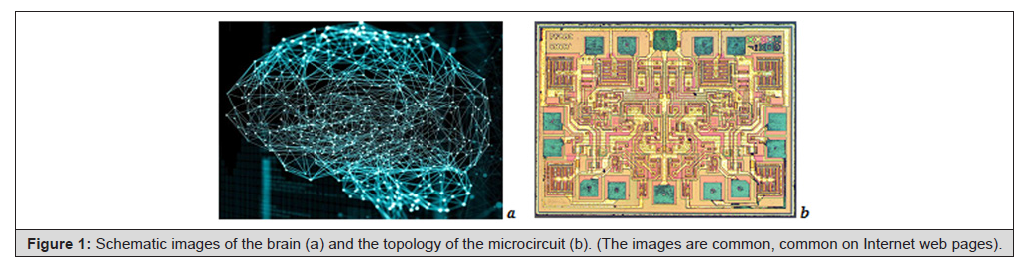
Figure 1:Schematic images of the brain (a) and the topology of the microcircuit (b). (The images are common, common on Internet web pages).
We proceed from the fact that the fields of natural sciencephysics, chemistry and biology-are sciences conditioned by the natural principle of unity and based on electronic processes. It is the behavior of an electron and its properties that determine all bio-physico-chemical processes in material elements. The quantum properties considered here are manifested in quantumdimensional elements, that is, those whose dimensions are less than the de Broglie wavelength for an electron. We call such an element a quantum-dimensional particle, QP. In such an element, there can be only one quasi-free electron (conduction), otherwise the Coulomb interaction (blockade) occurs due to the fact that the wave functions of the electrons overlap (Figure 1). The electron in QP is constantly moving in space–time and exhibits the properties of dualism-waves and particles. Due to the wave process, electrons have quantum properties and, consequently, coherent states. As a particle, an electron exhibits classical properties, causing decoherence and, consequently, the possibility of influencing the quantum properties of an electron and reading information using classical methods. The coherence and decoherence of electron states are constant processes. During decoherence, an electron emits photons due to space-time transitions, which under certain conditions can have the properties of quantum entanglement and carry information about entangled electronic states. That is, the interaction of biophysical elements (quantum particles) occurs due to the emission and absorption of entangled photons. The proposed model will be discussed in more detail in the discussion section. The elements of the proposed model have been considered in one form or another in the literature cited above. Our differences and clarifications relate to the ideas of a quantum-dimensional element, the action of a single electron in it, the emission of an entangled photon during decoherence of electronic states, and the interaction of elements due to the emission and absorption of entangled photons.
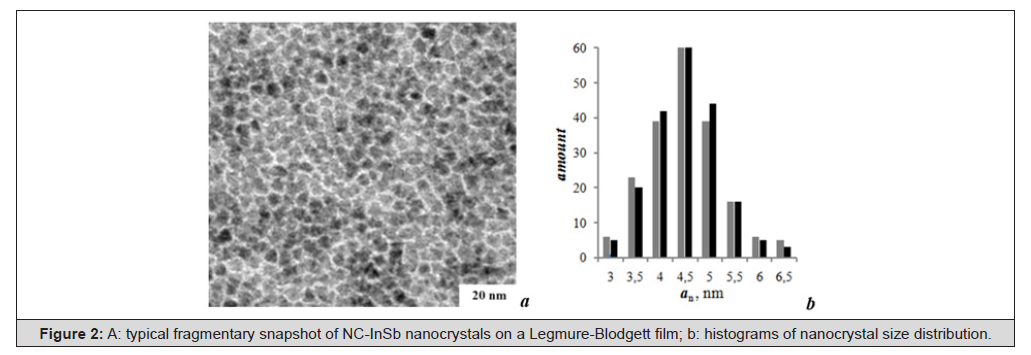
Figure 2:A: typical fragmentary snapshot of NC-InSb nanocrystals on a Legmure-Blodgett film; b: histograms of nanocrystal size distribution.
In the experiments of researchers with entangled photons ([21]), two streams of zero-total-spin photons emitted from the source were directed at Nicolas prisms, in which, due to double refraction, the polarizations of each photon were divided into elementary ones, after which the beams were sent to the detectors by two streams spaced over a considerable distance. The signals from the detectors were sent via photomultipliers to a recording device, where the Bell inequality was calculated by counting the numbers of polarized photons. In these experiments, entangled photons are actually created from ordinary (non-entangled) photons, and the phenomenon of entanglement itself is being tested as information teleportation. In our work, we believe that a nanocrystal can be a source of entangled photons under certain conditions. Then the experiment can be simpler.
We conducted such an experiment on two identical probe scanning microscopes, electrically and spatially unrelated and located at a distance of about one meter. First, the VAC of each sample was measured separately, and then simultaneously. On each of the samples, 25-30 points (nanocrystals) in the same zone were selected, the VAC was measured and their statistical processing was carried out. Figure 3 shows the averaged VAC of NC-InSb samples without interaction (cr.1 and 2) and with their interaction by the assumed entangled radiation (cr.1* and 2*). The frequency bands with resonance (characteristic resonance peaks) are significantly shifted relatively (Figure 3a). The VAC without them has not changed qualitatively (Figure 3b) (Figure 3) (Table 1).
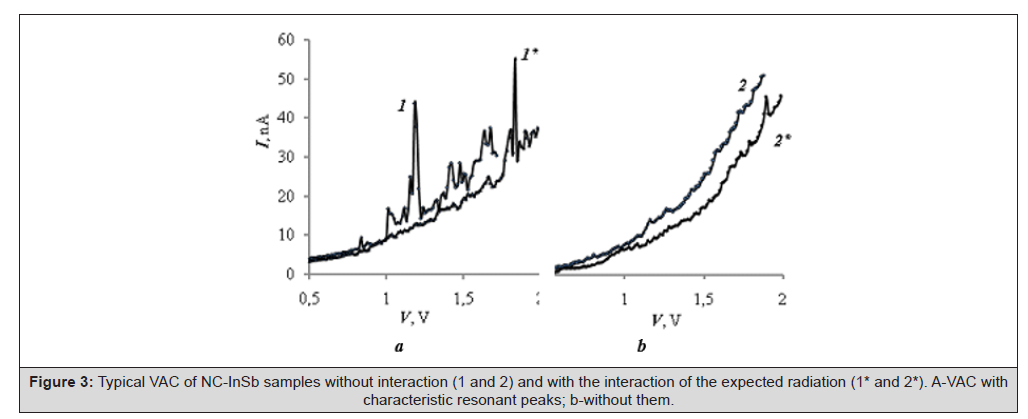
Figure 3:Typical VAC of NC-InSb samples without interaction (1 and 2) and with the interaction of the expected radiation (1* and 2*). A-VAC with characteristic resonant peaks; b-without them.

Table 1:Data on the VAC of remotely interacting NC-InSb.
Discussion
An electron in its quantum states has two fundamental properties, depending on how it moves (in the particle model)- orbital motion and the vector of its own magnetic field, diffusiondrift motion and the vector of its velocity. The quantum nature of the electron motion in these two cases is reflected by the spin and wave vector parameters. However, not all quantum states of an electron can be subject to entanglement. The quantum dimension of an element (nanocrystal) is due to the fact that all its dimensions are less than the de Broglie wavelength for an electron. This, in turn, means that the probability of finding a quasi-free electron (conduction) at any point in the nanocrystal is approximately the same and close to unity. In this case, it is obvious that there can only be one such electron in a nanocrystal, otherwise the wave functions of neighboring electrons would overlap, and Coulomb interaction and mutual blockade would occur. The transport process is thus single-electron with manifestations of quantum conduction and oscillations, while electron–photon interaction and generation are single-photon. In this case, the “path” of an electron’s motion, as a quantum particle, consists of successive one–dimensional linear distances-the lengths of resonators formed by parallel crystallographic planes. In electron transport, the dualism of its properties is manifested-a quantum wave process with the selection of quantum states by interference of plane Debreg waves and the movement of an electron as a quantum particle with mass and momentum.
An electron, in the particle model, moves between the boundaries of a nanocrystal along atomic orbitals. In these orbitals, it is quasi-free and can have a spin. In certain areas of this motion, the electron experiences deceleration (interaction with the lattice atom), emitting a photon with certain specific properties of an electromagnetic wave. In our opinion, the physical essence of the phenomenon in this case is that an electron in a nanocrystal, oscillating resonantly in time and space, creates single-photon (more precisely, poly-photon) radiation with rigidly fixed parameters (frequency, polarization, coherence, phase relations, spin, etc.). The time interval of radiation (the time size of a photon) is extremely small. Let’s call this radiation, conventionally, an entangled photon. Such radiation most likely interacts only with an electron in the same state as the one that emitted it, that is, with exactly the same nanocrystal. In this case, the state of uncertainty will be expressed in the statistical difference between the technologically specified properties of the nanocrystal and the quantum mechanical uncertainty of the electron states in it. If it is possible to find two absolutely identical nanocrystals, then only statistically on a large number of nanocrystals from a random sample. In this case, the interaction of two identical samples located at some distance from each other and devoid of any influence of an obvious nature-electric and electromagnetic-wave-should manifest itself. Due to the rigidly parameterized single-photon radiation interacting only with the “native” environment, its manifestation is possible, similar to quantum entanglement.
A fundamentally important parameter of a photon is its time interval tQ. In the models of quantum computer science (and entanglement), it plays the role of decoherence time [3]. Obtaining super-short radiation durations is a fundamental problem, including for quantum biology [22,23]. We assume that in our case, the entangled photons generated by a quantum-sized nanocrystal have at least femtosecond time intervals. We make this assumption based on the fact that the entangled photons emitted in our case should have time intervals one to two orders of magnitude shorter than the period of the main electromagnetic wave caused by the action of a quantum oscillator generating in the terahertz frequency range [24]. The physical meaning of an entangled photon, in our opinion, lies in the fact that its time interval is less than the time of the oscillation period of the electromagnetic wave TQ–tQ<TQ. In our opinion, when researchers artificially try to obtain entangled photons from "ordinary" ones, the first thing they do is receive single–photon radiation with the shortest possible tQ and the largest possible TQ (such photons could be called fractional). But there are very few such photons in their methods, which is why they have and count individual (entangled) photons as small probabilistic quantities out of a huge number of initial (laser) photons. Due to its super-short emission time, the photon does not interact with any ordinary medium because it "does not have time" to react to it. Thus, based on statistical measurements of the characteristics of electronic conductivity, it is assumed that nanocrystals of narrow-band semiconductors can be sources and recorders of entangled photons, and the entangled photons themselves have the properties of selective interaction, thereby providing information-teleportation manifestation.
Conclusion
Quantum resonances and oscillations are observed in the properties of electronic quantum transport in quantum-sized nanocrystals due to the quantum uncertainty of electronic states and, consequently, the space-time instability of charge. A manifestation of the dualism of the electron’s properties is expressed in the fact that a wave process of quantum-dimensional selection occurs, and the electron, as a quantum particle, interacts with the atom so that at each bifurcation of its states, a photon with specific properties and a super-short time interval is emitted. An experiment on two identical samples of nanocrystals has shown that when they interact remotely, resonant states are destroyed, which can be considered as a manifestation of quantum entanglement. In this case, the nanocrystal can be a source and recorder of entangled photons. It is assumed that the physical model of an entangled photon can be determined by the fact that its time interval is much shorter than the oscillation period of the electromagnet. Due to the natural unity of the directions of natural science, expressed by the properties of quantum-dimensional nanoelectronics, it can be assumed that organic quantum-dimensional elements have the same quantum properties and phenomena as inorganic ones. This makes it possible to transfer the results obtained on nanocrystals to biological quantum-dimensional formations, for example, to the DNA molecule, which is a long-twisted chain of nanometer-sized elements. In these elements, an electron performs a spatiotemporal motion similar to that in a nanocrystal, with the possible difference that spin processes may play a more significant role. In such a model, the elements interact due to the phenomena of quantum entanglement of electronic states with the generation and registration of entangled photons. It is clear that the continuation of the conducted research on “living” objects using in-vivo and invitro methods is required. This work, in addition to direct results on information management of the properties of living organisms, will allow us to obtain new fundamentally important knowledge not only about their nature, but also, to some extent, about the nature of the universe. Judging by the literature, for example, [19,24,25], researchers of quantum phenomena see real opportunities to gain new knowledge about matter, the origin of life, and the materialization of religious concepts and ideas [26].
Data Access Statement
Data confirming the conclusions of this study can be obtained from the author upon reasonable request.
Financing
This article was prepared on my own initiative.
Acknowledgements
The author is grateful to graduate student M. Gavrikov for measuring VAC.
Conflicts of Interest
The author has no conflicts of interest to disclose.
References
- (2025) Quantum entanglement.
- Daniel M Greenberger, Michael A Horne, Anton Zeilinger (2007) Going Beyond Bell's Theorem.
- Michael A Nielsen, I Chang Chang (2006) Quantum computing and quantum information. 824 p.
- (2025) Quantum Biology.
- (2024) The terrible secrets of Gariaev's wave genetics The Anatomy of delusion.
- Quantum Biology is a scientific topic.
- Eissa M (2024) Quantum Biology from Theory to the Future of Medicine and Pharmacy: A Reviev on a Revolutionary Change in our Perception of Life. Universal Journal of Pharmaceutical Research 9(5): 82-90.
- D Abbott, K Poll, P Davies, A Pati (2008) Quantum Aspects of Life. Litbit 468 p.
- B Adams, F Petruccione (2020) Quantum effects in the brain: A review. J AVS Quantum Science 2(2).
- Domuschiev I (2024) The link of Heart Rate Variability (HRV) with Time and Space from a quantum perspective.
- Dennis K (2010) Quantum Consciousness: Reconciling Science and Spirituality Toward Our Evolutionary Future(s). World Futures 66(7): 511-524.
- Muralidhar KR, P Srinvias, K Raghavendra (2023) The Next Generation Cancer Treatments-The role of Quantum Biology, Genomics and Artificial Intelligence. Medical Physics International Jornal 11(2).
- Youvan D (2024) AI, Directed Panspermia, and the Genetic Code: Speculations on an Intelligent Origin of Life. Researchgate.
- Djordjevic IB (2015) Quantum Biological Information Theory.
- Zhang Y, Zh He, X Tong, DC Garret (2024) Quantum imaging of biological organisms through spatial and polarization entanglement. 10(1495).
- Matarèse BFE, A Rusin, C Seymour, C Mothersill (2023) Quantum Biology and the Potential Role of Entanglement and Tunneling in Non-Targeted Effects of Ionizing Radiation: A Review and Proposed Model. Int J Mol Sci 24(22).
- Adams B, F Petruccione (2020) Quantum effects in the brain: A review. AVS Quantum Sci 2(2).
- Darren Orf (2024) Quantum Entanglement in Your Brain Is What Generates Consciousness, Radical Study Suggests. Consciousness.
- Youvans D (2024) Noise-Assisted Quantum Transport: Balancing Coherence and Decoherence in Biological and Artificial Systems.
- Zhukov ND, MV Gavrikov, SN Shtykov (2022) Dimensional Modeling of the Synthesis and Conductivity of Colloidal Quantum Dots Semiconductors. 56(4): 269-274.
- (2025) The Nobel Prize in Physics 2022.
- (2023) The Nobel Prize in Physics 2023.
- Morgan S (2017) Ultrafast Quantum Effects and Vibrational Dynamics in Organic and Biological Systems.
- Zhukov ND, SA Sergeev, AA Khazanov, IT Yagudin (2022) Features of the radiative properties of quantum-dimensional particles of narrow-band semiconductors. Letters to the Journal of Technical Physics 48(14): 70-73.
- Zhukov ND (2021) Quantum-dimensional matter. International Scientific Research Journal 10(112): 96-103.
- Zhukov ND (2022) A model-terminological and materialistic study of the categories of God and Soul based on the use of the physical properties of quantum-dimensional matter. International Scientific Research Journal 8(122): 1-6.




 We use cookies to ensure you get the best experience on our website.