
Opinion 
 Creative Commons, CC-BY
Discovery of Hyaluronic Acid in the Heart as a Lubricating Mechanism
*Corresponding author:José de la Fuente, SaBio, Instituto de Investigación en Recursos Cinegéticos (IREC), Ronda de Toledo 12, 13005 Ciudad Real, Spain.
Received:July 30, 2025; Published:August 05, 2025
DOI: 10.34297/AJBSR.2025.27.003629
Abstract
Keywords:Amber, Culture, Fossil, Medicine, Paleoproteomics
Amber in Cultural Representations
Amber has been used in multiple cultural representations. For example, in Chinese cultural representations, fossil amber is the symbol of the sun with protection against bad spirits and courage, strength, and resilience mediated by the tiger soul. Amber is also associated with Chinese Buddhism prey and meditation (Fig. 1A). The golden colour of amber is also a symbol of prosperity and wealth represented in decorations and jewelry (Figures 1B-1E). As described in the history of snuff bottles [7], although smoking tobacco was illegal during the Qing dynasty, the use of snuff with amber bottles (Figure 1C) was allowed because it was considered a remedy for common illnesses such as colds, headaches and stomach disorders. Additionally, amber has been involved in cultural communications such as between China and other regions by movement of raw Burmite materials of amber artifacts from Burma to the Central China through Yunnan in the Silk Road by free circulation during Han Dynasty [8].
Amber Fossil Inclusions
Amber fossil inclusions and syninclusions are composed of multiple organisms, including ants (Figure 1B) [9-12] and other arthropods such as ticks [5]. The study of these fossil inclusions provides information on the evolution of the interactions between different organisms (Figure 1E) [13-15] together with functional and ecological habits [9, 10]. The paleoproteomics applied to amber fossil arthropod inclusions are under development [16] and may provide insights into multiple areas including compounds associated with fossil extract preparations in traditional medicine [17].
Amber in Medical Interventions
The multiple cultural representations with amber inspired medical interventions. Accordingly, amber is used in traditional Chinese medicine and Feng Shui for its role in harmonizing individuals with environmental factors and healing properties [2]. Since ca. fifth century AD, amber has been used for medical interventions as a diuretic, to enhance mental stability, stop bleeding, aid in wound healing, to prevent and reduce allergic, neurotoxic and inflammatory effects, and to suppress melanin production, promote collagen production, reduce fat accumulation, and in folk medicine [3, 18-23]. As described by Luo, et al. [23], amber extracts are prepared for medical interventions by crushing, powdering, and extracting in 50% ethanol at 40 °C for 1 h under stirring, and then filtered extracted solution is depressurized and freeze-dried to form an extract powder which is dissolved in dimethyl sulfoxide. Amber inclusions may also contribute to compounds (e.g., derived from fossil arthropods) with potential pharmaceutical function [3, 16], thus leading to developing paleopharmaceuticals for medical interventions [24].
Conclusions and Future Directions
The study of fossil amber in different cultures and science provides information to advance in multiple areas of social interest. Amber is not only associated with cultural representations but also with medical interventions. For example, ants are not only of scientific interest in amber fossil inclusions but also as described here, a paradigm for cultural representations and a potential source for medical interventions. Future studies should continue to focus on fossil amber compounds and inclusions with innovative approaches and technologies such as paleoproteomics (Figure 1).
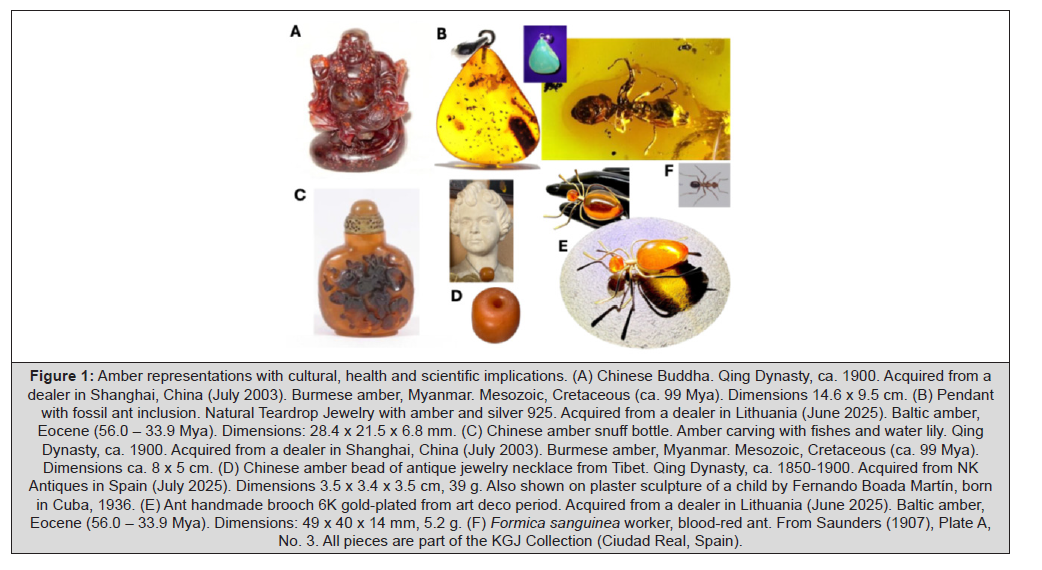
Figure 1:Amber representations with cultural, health and scientific implications. (A) Chinese Buddha. Qing Dynasty, ca. 1900. Acquired from a dealer in Shanghai, China (July 2003). Burmese amber, Myanmar. Mesozoic, Cretaceous (ca. 99 Mya). Dimensions 14.6 x 9.5 cm. (B) Pendant with fossil ant inclusion. Natural Teardrop Jewelry with amber and silver 925. Acquired from a dealer in Lithuania (June 2025). Baltic amber, Eocene (56.0 – 33.9 Mya). Dimensions: 28.4 x 21.5 x 6.8 mm. (C) Chinese amber snuff bottle. Amber carving with fishes and water lily. Qing Dynasty, ca. 1900. Acquired from a dealer in Shanghai, China (July 2003). Burmese amber, Myanmar. Mesozoic, Cretaceous (ca. 99 Mya). Dimensions ca. 8 x 5 cm. (D) Chinese amber bead of antique jewelry necklace from Tibet. Qing Dynasty, ca. 1850-1900. Acquired from NK Antiques in Spain (July 2025). Dimensions 3.5 x 3.4 x 3.5 cm, 39 g. Also shown on plaster sculpture of a child by Fernando Boada Martín, born in Cuba, 1936. (E) Ant handmade brooch 6K gold-plated from art deco period. Acquired from a dealer in Lithuania (June 2025). Baltic amber, Eocene (56.0 – 33.9 Mya). Dimensions: 49 x 40 x 14 mm, 5.2 g. (F) Formica sanguinea worker, blood-red ant. From Saunders (1907), Plate A, No. 3. All pieces are part of the KGJ Collection (Ciudad Real, Spain).
Acknowledgments
Amber and art pieces belong to the KGJ Collection (Ciudad Real, Spain).
Declaration of Conflicting Interest
The author(s) declare no known competing financial interests or personal relationships that could have appeared to influence the work reported in this paper.
Funding
The author(s) received no financial support for the research, authorship, and/or publication of this article.
Ethical Approval and Informed Consent Statements
Not applicable.
References
- Minakata K (1985) Chinese Theories of the Origin of Amber. Nature 51: 294.
- Kong F, Liu Y, Li J, Feng Y (2023) Culture of Amber Heritage and Related Archaeological Findings. Journal of Gems & Gemmology 25(4): 169-177.
- de la Fuente J (2025) Paleopharmaceuticals from fossil amber. Hektoen International a Journal of Medical Humanities.
- Mills JS, White R, Gough LJ (1984) The chemical composition of Baltic amber. Chemical Geology 47(1-2): 15-39.
- de la Fuente J (2003) The fossil record and the origin of ticks (Acari: Parasitiformes: Ixodida). Exp Appl Acarol 29(3-4): 331-344.
- de la Fuente J (2025) Fossil amber in artistic and cultural representations. International Journal of Humanities. Social Sciences and Education (IJHSSE) 12(3): 38-45.
- (2025) ICSBS, International Chinese Snuff Bottle Society, The history of snuff bottles and snuff.
- Chen D, Zeng Q, Yuan Y, Cui B, Luo W (2019) Baltic amber or Burmese amber: FTIR studies on amber artifacts of Eastern Han Dynasty unearthed from Nanyang. Spectrochim Acta A Mol Biomol Spectrosc 222: 117270.
- Perrichot V, Wang B, Engel MS (2016) Extreme Morphogenesis and Ecological Specialization among Cretaceous Basal Ants. Current biology 26(11): 1468-1472.
- 10. Zhuang Y, Xu W, Zhang G, Mai H, Li X, et al. (2022) Unparalleled details of soft tissues in a Cretaceous ant. BMC Ecol Evol 22(1): 146.
- Chen XH, Yin ZW (2023) New material of Euroleptochromus tuberculatus Yin & Cai (Coleoptera: Staphylinidae: Scydmaeninae) in Eocene Baltic amber. Zootaxa 5396(1): 131-134.
- Wu Q, Radchenko AG, Engel MS, Li XQ, Yang HR, et al. (2024) Cretaceous crown male ant reveals the rise of modern lineages. Zool Res 45(5): 983-989.
- Saunders E (1907) Wild Bees, Wasps, and Ants, and other Stinging Insects. With numerous illustrations in the text, and four coloured plates by Constance A. Saunders. London, Georges Routledge Ltd. New York, E. P. Dutton & Co.
- Zhou YL, Ślipiński A, Ren D, Parker J (2019) A Mesozoic clown beetle myrmecophile (Coleoptera: Histeridae) eLife 8: e44985.
- Zhuang Y, Luo C, Tang D, Araújo JPM, Yu H et al. (2025). Cretaceous entomopathogenic fungi illuminate the early evolution of insect-fungal associations. Proc R Soc B. Biol Sci 292(2048): 20250407.
- Villar M, Estrada Peña A, Tormo L, Paradela C, González García A, et al. (2025) Paleoproteomics characterization of proteins in fossil arthropod parasitiformes amber inclusions. Preprint Research Square.
- Zhao Y, Wang X, Kawai M, Liu J, Liu M, et al. (1995) Antioxidant activity of Chinese ant extract preparations. Acta Med Okayama 49(6): 275-279.
- Maruyama M, Kobayashi M, Uchida T, Shimizu E, Higashio H, et al. (2018) Anti-allergy activities of Kuji amber extract and kujigamberol. Fitoterapia 127: 263-270.
- Suzuki S, Abe J, Kudo Y, Shirai M, Kimura KI, et al. (2020) Inhibition of melanin production and promotion of collagen production by the extract of Kuji amber. Biosci Biotechnol Biochem 84(3): 518-525.
- Sogo E, Zhou S, Haeiwa H, Takeda R, Okazaki K, et al. (2021) Amber extract reduces lipid content in mature 3t3-l1 adipocytes by activating the lipolysis pathway. Molecules 26(15): 4630.
- Tian Y, Zhou S, Takeda R, Okazaki K, Sekita M, et al. (2021) Anti-inflammatory activities of amber extract in lipopolysaccharide-induced RAW 264.7 macrophages. Biomed Pharmacother 141: 111854.
- Luo Y, Zhou S, Haeiwa H, Takeda R, Okazaki K, et al. (2021) Role of amber extract in protecting SHSY5Y cells against amyloid β1-42-induced neurotoxicity. Biomed Pharmacother 141: 111804.
- Luo Y, Zhou S, Takeda R, Okazaki K, Sekita M, et al. (2022) Protective effect of amber extract on human dopaminergic cells against 6-hydroxydopamine-induced neurotoxicity. Molecules 27(6): 1817.
- (2025) GEN. Baltic amber gives rise to paleopharmaceuticals. Geneetic Engineering and Biotechnology News accessed on 20.




 We use cookies to ensure you get the best experience on our website.