
Mini Review 
 Creative Commons, CC-BY
Gut Brain Axis: Microbiota-Mediated Modulation of Neurological Function
*Corresponding author:Sarmin Ummey Habiba, Department of Anatomy, College of Medicine, Dongguk University, Gyeongju 38066, Republic of Korea.
Received:May 19, 2025; Published:June 11, 2025
DOI: 10.34297/AJBSR.2025.27.003553
Abstract
The Gut Brain Axis (GBA) represents a bidirectional communication system between the gastrointestinal tract and the Central Nervous System (CNS), mediated by neural, immune, endocrine, and metabolic pathways. Recent advances in neurobiology and microbiome science suggest that gut microbiota play a significant role in modulating brain function, behaviour, and neurodevelopment. Dysbiosis or microbial imbalance has been associated with several neuropsychiatric and neurodegenerative disorders, including anxiety, depression, Autism Spectrum Disorder (ASD), Alzheimer’s Disease (AD), and Parkinson’s Disease (PD). This mini-review explores the key mechanisms underlying gut brain communication, highlights current findings linking dysbiosis to neurological conditions, and discusses emerging therapeutic strategies targeting the microbiome.
Keywords:Gut brain axis, Microbiota, Neuroinflammation, Psychobiotics, Neurodegeneration, Probiotics
Introduction
The human gastrointestinal tract is inhabited by trillions of microorganisms, collectively known as the gut microbiota, which play a pivotal role in maintaining host health. In recent years, mounting evidence has established a complex bidirectional communication system between the gut and the Central Nervous System (CNS), commonly referred to as the gut brain axis. This connection is mediated through neural, endocrine, metabolic, and immune pathways and is integral to various aspects of brain function and behaviour. Disruptions in gut microbiota composition, also known as dysbiosis, have been implicated in a wide range of neurological and psychiatric disorders, including anxiety, depression, Alzheimer’s disease, autism spectrum disorders, and Parkinson’s disease. The precise mechanisms through which gut microbes influence neurological outcomes are still being elucidated, but emerging data suggest critical roles for microbial metabolites (e.g., short-chain fatty acids), neuroactive compounds, and modulation of the immune system. This mini-review aims to explore recent findings on the in fluence of gut microbiota on neurological function, focusing on both mechanistic insights and therapeutic implications. Understanding these pathways may open new avenues for treating neurological disorders via microbiota-targeted interventions, such as probiotics, dietary modifications, and microbiome engineering.
Mechanistic Pathways of the Gut Brain Axis
The Gut Brain Axis (GBA) represents a dynamic, bidirectional communication network linking the gastrointestinal tract and the Central Nervous System (CNS). This complex system integrates neural, immunological, endocrine, and metabolic signals, with the gut microbiota functioning as a central regulator. Disruption of this homeostatic communication has been implicated in the pathophysiology of various neuropsychiatric and neurodegenerative disorders. This section delineates the primary mechanisms through which the gut microbiota influences neurological function.
Neural Pathways and the Vagus Nerve
One of the most direct communication routes between the gut and the brain is through the vagus nerve, which innervates the gastrointestinal tract and transmits afferent sensory signals to the brainstem. The Enteric Nervous System (ENS), often referred to as the “second brain,” contains approximately 100 million neurons and operates semi-autonomously while remaining in constant communication with the CNS via the vagal and spinal pathways. Microbial- derived neuroactive compounds, including Gamma-Aminobutyric Acid (GABA), serotonin, and acetylcholine, modulate vagal tone and neuronal excitability. Experimental studies demonstrate that administration of Lactobacillus rhamnoses in rodents modulates GABA receptor expression in specific brain regions, a process that is abolished following vagotomy [1]. This evidence underscores the essential role of the vagus nerve in mediating microbial effects on the brain.
Immune System Regulation and Neuroinflammation
The gut microbiota significantly influences the host immune system, particularly through the modulation of intestinal epithelial cells and mucosal immune responses. Dysbiosis is often associated with systemic low-grade inflammation and disruption of the Blood Brain Barrier (BBB), enabling peripheral immune mediators to access the CNS and contribute to neuroinflammation.
Microglial activation, a hallmark of neuroinflammatory processes, is sensitive to changes in gut microbiota composition. Peripheral cytokines such as interleukin-6 (IL-6) and Tumor Necrosis Factor-Alpha (TNF-α) can infiltrate the brain and activate glial cells, thereby contributing to neurodegeneration and behavioral changes. O’Riordan, et al., (2025) [2] demonstrated that restoration of gut microbial balance attenuated inflammatory responses in murine models of anxiety-like behaviour, highlighting the immunomodulatory role of gut bacteria in CNS function.
Metabolic Signaling Via Microbial Metabolites
Gut microbiota produces a wide array of bioactive metabolites that influence neurophysiology. Among the most studied are Short-Chain Fatty Acids (SCFAs), such as acetate, propionate, and butyrate. These molecules are produced through the fermentation of dietary fibers and can cross the BBB to exert direct effects on microglial maturation, neuroinflammation, and the expression of neurotrophic factors, such as Brain-Derived Neurotrophic Factor (BDNF). In addition to SCFAs, certain microbial strains synthesize neurotransmitter analogs e.g., serotonin and dopamine precursors which modulate mood and cognition. Dinan and Cryan, et al., (2017) [3] highlighted how SCFA administration leads to enhanced hippocampal plasticity and anxiolytic behaviours in preclinical models, underscoring the therapeutic potential of targeting microbial metabolic pathways.
Neuroendocrine Modulation and HPA Axis Interactions
The Hypothalamic Pituitary Adrenal (HPA) axis is central to the body’s stress response. Gut microbiota influences the development and regulation of this axis, particularly during early life. Germ-free animal studies have shown exaggerated HPA axis responses to stress, which can be normalized through colonization with specific microbial strains. Microbial regulation of the HPA axis involves both direct signalling through microbial metabolites and indirect modulation via the immune system. Increased cortisol levels associated with dysbiosis have been linked to heightened anxiety and cognitive dysfunction, indicating that microbiota play a significant role in stress-related neurobiology.
Gut Microbiota and Neurological Disorders
The integrity of the gut microbiota is critical for maintaining neurophysiological balance. Alterations in microbial composition whether due to antibiotics, diet, infections, or genetics have been linked to a variety of neurological and neuropsychiatric disorders. These include mood disorders, neurodegenerative diseases, and neurodevelopmental conditions. In this section, we summarize emerging evidence connecting gut microbial dysbiosis to specific neurological pathologies.
Anxiety and Depression
An accumulating body of clinical and preclinical research has associated altered gut microbial diversity with the pathogenesis of mood disorders. Patients with Major Depressive Disorder (MDD) frequently exhibit reductions in beneficial bacterial genera such as Bifidobacterium and Lactobacillus, coupled with an increase in pro-inflammatory taxa. These microbial shifts may promote systemic inflammation, compromise Blood Brain Barrier (BBB) integrity, and lead to dysregulated neurotransmission. Ferrari, et al., (2024) [4] conducted a systematic review examining the efficacy of probiotic supplementation in anxiety and depression. They reported significant reductions in depressive symptoms among participants receiving multi-strain probiotic formulations, indicating a potential therapeutic avenue via microbial modulation.
Alzheimer’s Disease and Cognitive Decline
The microbiota gut brain axis is increasingly implicated in the etiology of Alzheimer’s Disease (AD), primarily through its role in neuroinflammation and metabolic regulation. Dysbiosis-induced inflammation has been shown to impair Amyloid-Beta (Aβ) clearance, disrupt mitochondrial function, and compromise synaptic integrity. Furthermore, gut microbiota influences the production of amyloidogenic peptides and modulate levels of acetylcholine and other cognition-related neurotransmitters. Forlenza, et al., (2018) [5] provided evidence that Fecal Microbiota Transplantation (FMT) from young to aged mice improved cognitive performance, potentially via modulation of microglial activation and reduction of neurotoxic metabolites.
Autism Spectrum Disorder (ASD)
Autism Spectrum Disorder (ASD) is characterized by impaired social communication and repetitive behaviours. Children with ASD frequently present with gastrointestinal symptoms and altered gut microbiota profiles, including decreased Bacteroides and increased Clostridia species. These alterations correlate with elevated levels of propionic acid and p-cresol microbial metabolites known to affect brain function. A review by Naufel, et al., (2023) [6] highlighted how early-life disruptions in microbial colonization may impair neuronal development and synaptic signalling, providing a microbial hypothesis for the neurodevelopmental anomalies observed in ASD.
Parkinson’s Disease
Gastrointestinal symptoms often precede the motor manifestations of Parkinson’s Disease (PD), suggesting a potential peripheral origin. Alpha-synuclein, a key pathological hallmark of PD, has been found in enteric neurons before its appearance in the brain. Gut microbiota may exacerbate PD pathology by modulating intestinal permeability and promoting the translocation of pro-inflammatory molecules. A 2021 study by Bhuiyan, et al., [7] proposed a mechanistic model wherein dysbiosis-induced inflammation triggers alpha-synuclein aggregation in the gut, which subsequently propagates to the brain via the vagus nerve (Table 1).
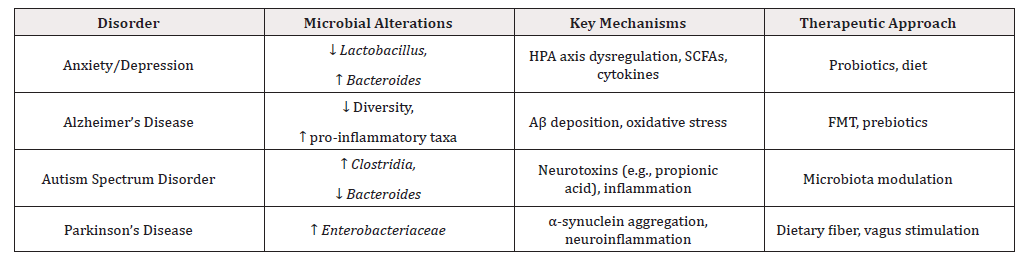
Table 1:Summarizes key neurological conditions linked to microbial dysbiosis and highlights relevant pathways and interventions.
Conclusion
The dynamics of individual EEG alpha rhythm frequency were expressed differently in groups with various stress-response profiles during a single session of the “VIRA-RALLY” game-based biofeedback, which initiates the development of emotional stress. Modeling a virtual environment with a stress-inducing scenario allowed for a more detailed assessment of the neurophysiological mechanisms regulating autonomic stress indicators using a simple yet sufficiently informative EEG monitoring method during testing. The results obtained in this study can contribute to a more comprehensive understanding of the neurophysiological mechanisms underlying stress response development. Involving a larger number of participants in the research will help develop personalized biofeedback protocols for the prevention and correction of stress-induced conditions, taking into account individual EEG frequency patterns.
Therapeutic Implications of Gut Microbiota Modulation in Neurology
The understanding that gut microbiota profoundly influence brain function has spurred the development of microbiota-targeted therapeutic interventions for neurological disorders. Strategies include the administration of probiotics, prebiotics, psychobiotics, dietary modulation, and more recently, synthetic biology and Fecal Microbiota Transplantation (FMT). These approaches aim to restore microbial homeostasis, reduce neuroinflammation, and enhance neurochemical balance.
Probiotics and Psychobiotics
Probiotics live microorganisms that confer health benefits when administered in adequate amounts are increasingly recognized for their ability to influence mental and cognitive states. Specific strains, known as psychobiotics, exhibit neuroactive properties through their capacity to modulate neurotransmitter levels, reduce systemic inflammation, and improve barrier functions. A systematic review by Ana Maria and Vodnar, et al., (2024) [8] emphasized that psychobiotic strains such as Lactobacillus rhamnosus and Bifidobacterium longum demonstrated anxiolytic and antidepressant effects in both preclinical and clinical trials. These effects were attributed to increased GABA receptor expression and reduced HPA axis hyperactivity.
Dietary Interventions
Diet plays a critical role in shaping the gut microbiota, influencing both microbial diversity and metabolite production. Prebiotic fibers such as inulin, Galacto-Oligosaccharides (GOS), and resistant starches stimulate the growth of beneficial bacteria that produce Short-Chain Fatty Acids (SCFAs) key modulators of neuroinflammation and blood brain barrier integrity.
Savardashtaki, et al., (2024) [9] reported that phytochemicals, particularly polyphenols from fruits, vegetables, and herbs, interact with gut bacteria to enhance the synthesis of anti-inflammatory metabolites. Diets rich in polyphenols have been associated with reduced cognitive decline in aging populations and improved mood regulation in clinical cohorts.
Synthetic Biology and Engineered Probiotics
Recent advances in synthetic biology have led to the engineering of probiotics that can sense environmental cues in the gut and release therapeutic molecules in response. These “smart probiotics” offer promise in neurology by delivering neurotrophic factors, anti-inflammatory agents, or neurotransmitter precursors with precision. Cesaro, et al., (2025) [10] explored engineered E. coli strains that modulate behavior in murine models by producing GABA analogs or BDNF mimetics, suggesting a potential role for programmable microbes in the treatment of anxiety and neurodegeneration.
Fecal Microbiota Transplantation (FMT)
FMT involves the transfer of fecal material from a healthy donor to a recipient to restore microbial balance. Though traditionally used for treating Clostridioides difficile infection, recent applications in neurology show promising results. Preclinical studies demonstrate improved cognitive function, reduced neuroinflammation, and reversal of age-related decline following FMT. Bruce- Keller, et al., (2018) [11] reported that microbiota transfer from young to aged mice enhanced synaptic plasticity and reduced oxidative stress, highlighting the rejuvenating potential of FMT in neurodegenerative models.
Future Innovations
The emergence of microbiome-based biomarkers, microbial gene editing, and personalized nutrition algorithms opens new frontiers in the prevention and management of neurological diseases. Integration of microbiome profiling into clinical practice could enable individualized interventions tailored to a patient’s unique microbial signature. Additionally, the development of organ-onchip models mimicking the gut brain axis provides a scalable platform to test microbial therapies and explore mechanistic pathways under controlled conditions.
Conclusion
The gut brain axis is a critical interface through which the gut microbiota influences the brain and behaviour. Disruptions in microbial communities are increasingly recognized as contributing factors in a wide range of neurological and psychiatric disorders. Therapies aimed at restoring microbial balance, whether through probiotics, diet, or engineered interventions, hold considerable promise. Continued investigation is necessary to translate these findings into clinically applicable tools and interventions.
Acknowledgement
None.
Conflict of interest
None.
References
- Morais LH, Schreiber IV HL, Mazmanian SK (2021) The gut microbiota–brain axis in behaviour and brain disorders. Nat Rev Microbiol 19(4): 241-255.
- O Riordan KJ, Moloney GM, Keane L, Clarke G (2025) The gut microbiota–immune–brain axis: Therapeutic implications. Cell Rep Med 6(2):100149.
- Dinan TG, Cryan JF (2017) The microbiome–gut–brain axis in health and disease. Gastroenterol Clin North Am 46(1): 77-89.
- Ferrari S, Mulè S, Parini F, Galla R, Ruga S, et al. (2024) The influence of the gut-brain axis on anxiety and depression: A review of the literature on the use of probiotics. J Tradit Complement Med 14(3): 237-255.
- Forlenza OV, De Paula VJ, Forlenza AS (2018) Relevance of gut microbiota in cognition, behaviour and Alzheimer’s disease. Pharmacol Res 129: 496-505.
- Naufel MF, Truzzi GDM, Frizzo ACF, Fernando Morgadinho SC (2023) The brain–gut–microbiota axis in the treatment of neurologic and psychiatric disorders. Arq Neuropsiquiatr 81(7): 670-684.
- Bhuiyan P, Chen Y, Karim M, Dong H, Qian Y (2021) Bidirectional communication between mast cells and the gut-brain axis in neurodegenerative diseases: Avenues for therapeutic intervention. Brain Res Bull 174: 95-107.
- AnaMaria C, Vodnar DC (2024) Exploring the gut-brain axis: Potential therapeutic impact of psychobiotics on mental health. Prog Neuropsychopharmacol Biol Psychiatry 134:111073.
- Savardashtaki A, Jaberi KR, Alamdari Palangi V, Pooya Vatankhah, Tannaz Jamialahmadi, et al. (2024) Modulatory effects of phytochemicals on gut–brain axis: Therapeutic implication. Curr Dev Nutr 8(6): 103785.
- Cesaro A, Broset E, Salimando GJ, Öztekin S (2025) Using synthetic biology to understand the gut-brain axis. Cell Rep Phys Sci 6(1): 100093.
- Bruce Keller AJ, Salbaum JM, Berthoud HR (2018) Harnessing gut microbes for mental health: Getting from here to there. Biol Psychiatry 83(3): 214-223.




 We use cookies to ensure you get the best experience on our website.