
Review Article 
 Creative Commons, CC-BY
Influences of Dynamic Viscosity Variations of Sound Living Thin Layer Bio-Fluids Flows on the Human Lifespan
*Corresponding author:Prof. DSc. Ph.D. M.Sc. Krzysztof Wierzcholski, University of (WSG) 85229 Bydgoszcz, Garbary street 2, Poland, ORCID: 0000-0002-9074-4200.
Received:May 27, 2025; Published:June 03, 2025
DOI: 10.34297/AJBSR.2025.27.003543
Abstract
Purpose: The aim of the presented paper discovers how much the kind and feature of normal bio living solid tissue influences on
dynamic viscosity of sound living thin layers flows, which are inflowing or lubricating the surface. And the research topic concerns
the influence of dynamic viscosity variations of living thin layer bio-fluid flow on the human metabolic age and lifespan.
Materials and Devices: To the living solid bodies used in presented research belong following postoperative samples: human
bones, human muscle, human skin, cartilage in human joints, thin phospholipid surface bilayer, thin solid inorganic tightly fitting
sport clothing surfaces coating the living bodies. To the living fluids belong: synovial liquid in human joint gaps, human sweat, human
blood in veins, urea water solutions, saliva, chyme in bowels, gastric juices. Moreover, are used following measurement devices:
segmental body composition analyzer Tanita MC 780MA, AFM, pedometer Garmin ltd.2015.
Methods: The presented methods are realized in the form of mutually performed lubrication measurements of synovial fluid dynamic
viscosity in human hip joint and the human sweat dynamic viscosity in the thin layer flow between clothing and skin. Moreover,
are performed analytical and numerical calculations using Mathcad professional program 15 by virtue of some solutions of
hydrodynamic lubrication equations and matter conversion and metabolism equations.
Results & Conclusions: The main direct influences on the human aging and rejuvenation during the squeezing and rotation stationary
or unsteady activities of normal bio-friction nods, are connected with the lubricant dynamic viscosity changes. The value variation
of the material (sound skin, clothing, sound cartilage) elasticity modulus, has indirect influence on the dynamic viscosity value
of the bio-fluid lubricant laminar or turbulent flow during the mentioned materials lubrication. Hence follows, that it is possibility
to control the human health, lifespan and MA by the adapt the proper value of elasticity modulus of clothing material depended of
the proper material kind.
Keywords:Joint cartilage, Skin, Clothing, Sweat, Synovial fluid, Lubrication, Control, Metabolic Age (MA)
Introduction to the Selected Kinds of Thin Living Fluid Layer Flows on the Bio-Surfaces
Bio-fluid dynamic viscosity during the various bio-lubrication activities depends on the contact conditions and synergistic counteractions forces between solid living bodies and liquid living materials creating overall effects more significant, than the same individual effects of any of them [1-6]. To explain this fact, we show some selected kinds of living thin fluid layer flows executed the lubrication of the solid living bio-surfaces. Various human activities are provoked the various thin living layer fluid flows.
i. During the bio-surface lubrication, especially near to cartilage covered by the phospholipid bilayer PL, we can find and we can observe following kinds of hydrodynamic bio-flows at namely: Lamellar and Laminar or Stationary, non-Stationary, (always unsteady Turbulent). Laminar and lamellar lubrications using thin layer steady flows are mutually not excluded (see Figure 1). The motion of fluid particles in lamellar flows can be provoked by the Brownian motion. Lamellar flow lubrication (word lamella in Latin denotes blade) occurs in the region (layer) between blades of five, six nanometer length, which are restricted gap about of 1.5 to 3 nm height. Sometimes the thickness of lamellar lubrication layer is less and attain about 1 nm height. In lamellar liquid flow the flow layers glide over one another. Laminar lubrication (word lamina in Latin denotes the scale, plank) occurs in the gap between two bio- surfaces of some milimiter- length restricted gap about 10 to 30 μm height. Over and over again enlargement of laminar particles fluid flow is similar to the sliding of the flax-seeds in the channel [2-3] (Figure 1).
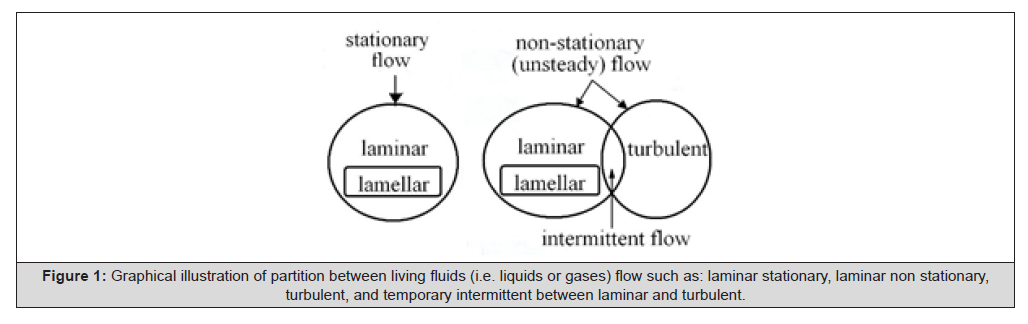
Figure 1:Graphical illustration of partition between living fluids (i.e. liquids or gases) flow such as: laminar stationary, laminar non stationary, turbulent, and temporary intermittent between laminar and turbulent.
ii. For rotation activities the living synovial fluid SF in Figure 2a or sweat in Figure 2b, creates the mobile convergent-lubricating film (thin layer) and moves with velocity V on the movable articular cartilage surface or on the movable human skin or movable tightly fitting clothing material. Friction force FR has reciprocal direction. The load L is situated in perpendicular direction to the contact surface between thin layer film and cartilage presented in Figure 2a and for clothing or skin in Figure 2b. Load carrying capacity C is situated in reciprocal direction to the L.
iii. For squeezing activities, the living synovial bio-liquid SF in Figure 3a or sweat in Figure 3b creates the mobile not convergent- lubricating film (thin layer). Thin layer moves parallel with velocity V in two contrary directions to the not movable (motionless) articular cartilage in Figure 3a or not movable human skin or clothing surface in Figure 3b. The load L is situated in perpendicular direction to the thin layer bio-liquid motion presented in Figure 3ab. In human joints the amount (number) of squeezing bio-lubrication flows dominates over the other bio-flows (for example in comparison with the translation/ rotation lubrication flows) [2,3] (Figures 2&3).
From the literature analysis, it can be concluded that quantum biological research is still mainly cognitive in nature, and the field of quantum biology itself is at the very beginning of its development. The literature reviews are based on biophysical modeling of processes and conditions of individual organs (brain [9], heart [10]), systems (consciousness [11], oncology [12]), and even such fundamental issues as the origin of life [8,13]. Let’s call this traditional modeling, from which our version will differ.
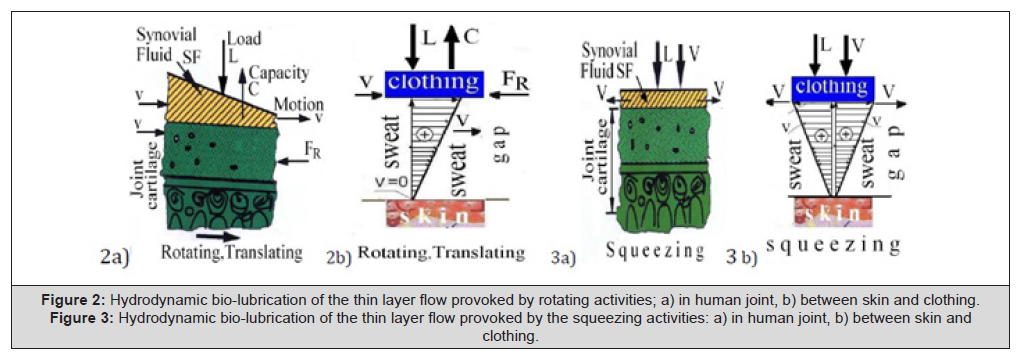
Figure 2:Hydrodynamic bio-lubrication of the thin layer flow provoked by rotating activities; a) in human joint, b) between skin and clothing.
Figure 3:Hydrodynamic bio-lubrication of the thin layer flow provoked by the squeezing activities: a) in human joint, b) between skin and clothing.
iv. For boosted squeezing activities the living synovial bio-liquid in Figure 4a or sweat in Figure 4b creates the mobile not convergent- lubricating film (thin layer). Movable articular cartilage surface or human skin or clothing moves with velocity V with two parallel contrary sense direction to the lubricated surface and moreover in the perpendicular direction to the lubricated surface accordance with the enlarged load L sense direction. The load L is situated (parallel) i.e. in the same direction to the bio-fluid motion presented in Figure 4 [1-3]. In human joints the amount (number) of boosted squeezing lubrication flows not dominates over the (in comparison with the) translation/ rotation lubrication flows. Such lubrication flow occurs in the case, when for example the human limbs with joints are going into the large sport effort [1-3].
v. For draining jumps activities (weeping lubrication), the living synovial bio-liquid in Figure 5a or sweat in Figure 5b creates the mobile not convergent-lubricating film (thin layer). Articular cartilage or human skin or tightly fitting clothing surface moves with the velocity V in the perpendicular direction to the lubricated surface and in contrary sense to the load L direction. The load is situated parallel in the same direction to the bio-fluid motion presented in Figure 5. In this case we have weeping lubrication of the cartilage, human skin or clothing material.
In human joints the amount (number) of weeping lubrication flows has almost the place after boosted squeezing lubrication bioflows. Such lubrication flow occurs in the case, when the human limbs with joints attain during the stress relieving effect i.e. after the large effort (Figures 4&5).
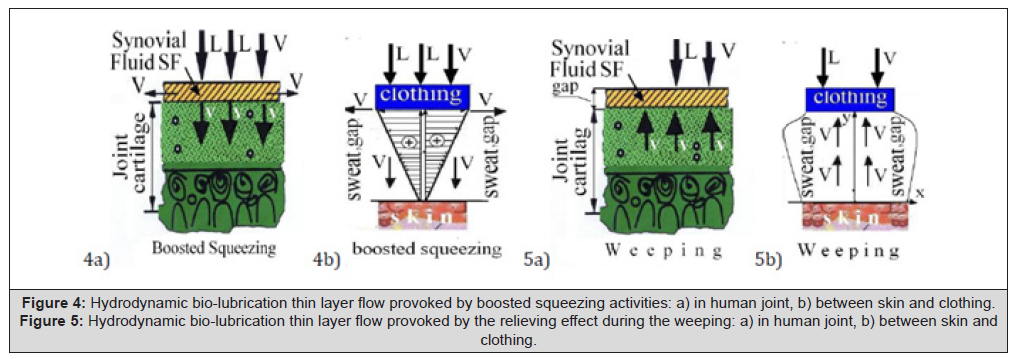
Figure 4:Hydrodynamic bio-lubrication thin layer flow provoked by boosted squeezing activities: a) in human joint, b) between skin and clothing.
Figure 5:Hydrodynamic bio-lubrication thin layer flow provoked by the relieving effect during the weeping: a) in human joint, b) between skin and clothing.
Realization Methods and Used Materials
The research methods presented in this paper are realized by the following kinds of thin layer living fluid flows: rotating, translating, squeezing, boosted squeezing and weeping lubrication with stationary, unsteady, lamellar, laminar, intermittent, turbulent flow. And the performed methods are exhibited using features of superficial thin fluid layer resting on the lubricated tissues and their surfaces of living bodies. Moreover, for living bodies are considered following features: elasticity or hypo-elasticity modulus, wear-ability connected with resistance properties and wettability depended of hydrophilic or hydrophobic materials.
Hitherto obtained not sufficient analytical results [7-8] referring aim of this paper, are in now presented research compared with the contemporary numerical achievements. Analytical and experimental forms of presented research are now performed using non-linear elasticity and hyper-elasticity basic equations for non-homogeneous non isothermal solid biomaterials and connected with the non-Newtonian bio-fluid mechanics equations of motion for sweat and synovial fluid. Such system of equations had been additionally implemented with the matter conversion and metabolic relations [9-10].
The some practical results attained in previously paper [11], are now in the next intersection extended. The considered data results of analytical computer calculations were additionally implemented with segmental body composition analyzer and AFM measurements for the following contact spaces: (joint-cartilage-synovial fluid) & (skin-sweat), &-(clothing-sweat) and for lamellar & laminar steady flow. In this paper are not verified unsteady turbulent flows.
The Connection Results Between the Living Fluid Dynamic Viscosity Variations and the Properties of Lubricated Tissues
Results presented in this section show and discover how much the dynamic viscosity variation of the kinds of sound, living thin lubricating layers flows depends on the properties of normal bio living solid tissues or surfaces.
The sweat dynamic viscosity SWV[Pas] variations (from 1- to 6 mPas) versus proper changes of elasticity surface modulus E[Pa]=Eskin of skin (from 0.01to 0.05GPa) and E[Pa]=Ed for clothing material (from 0.20 to 2.00 GPa), are presented in (Figure 6a, b) for stationary flow. And (Figure 6c) illustrates the synovial fluid dynamic viscosity SFV[Pas] distribution (from 50-to 300mPas) versus elasticity surface modulus E of the sound cartilage (from 0.02 to 0.20GPa). Mentioned figures Figure 6abc illustrate sweat and synovial fluid viscosity distribution for stationary flow, versus wettability We variations from 70o (hydrophobic) to 50o (hydrophilic), and versus wear-ability Wa in interval from 30 to 100, for skin, clothing and cartilage material.
During abovementioned dynamic viscosity variations for sweat and synovial fluid, the squeezing and rotation steady lubrication are respected. After achievements obtained in above environmental contact spaces: (cartilage-synovial fluid) & (skin-sweat) & (clothing-sweat) follows, that the decrements of elasticity modulus E[Pa] (from hydrophobic to hydrophilic of cartilage, skin and clothing material) during the rotating lubrication, imply the increments of lubricant fluid dynamic viscosity values [11-12]. And the analogously decrements of E[Pa] from hydrophobic to hydrophilic material during the squeezing lubrication lead to the decrements of fluid dynamic viscosity values in [Pas] see Figure 6abc (compare [13-15]). The changes from hydrophilic to hydrophobic material properties, are connected with the proper elasticity values E[Pa] of considered material variations. After initial up today not finished experimental results (described in Discussion section) follows, that for above considered environmental contact spaces, the dynamic viscosity distribution of the synovial fluid and sweat, versus elasticity modulus E, after boosted squeezing and weeping stationary or unsteady, turbulent lubrication activities not coincides with corresponding dynamic viscosity distribution for presented rotating and squeezing activities (see Figure 6abc) (Figure 6).
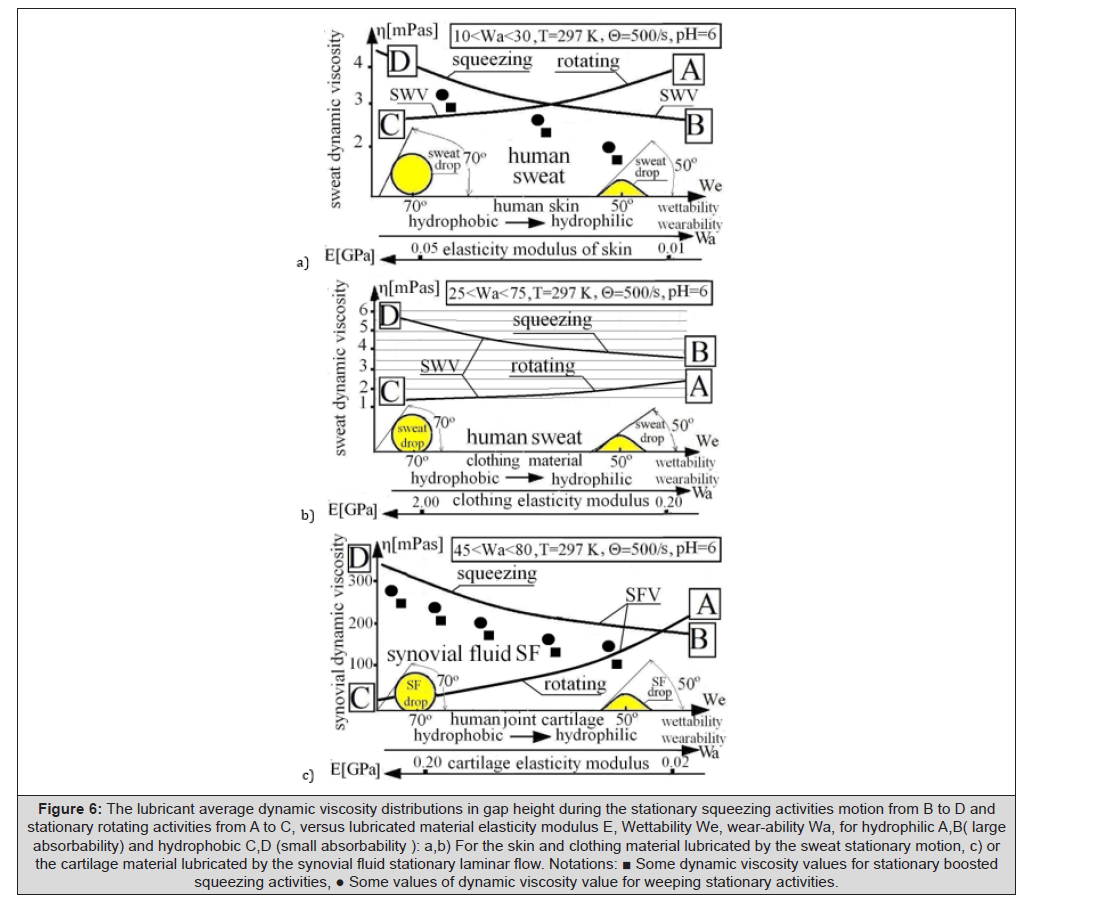
Figure 6:The lubricant average dynamic viscosity distributions in gap height during the stationary squeezing activities motion from B to D and stationary rotating activities from A to C, versus lubricated material elasticity modulus E, Wettability We, wear-ability Wa, for hydrophilic A,B( large absorbability) and hydrophobic C,D (small absorbability ): a,b) For the skin and clothing material lubricated by the sweat stationary motion, c) or the cartilage material lubricated by the synovial fluid stationary laminar flow. Notations: ■ Some dynamic viscosity values for stationary boosted squeezing activities, ● Some values of dynamic viscosity value for weeping stationary activities.
For hydrophilic skin lubricated by sweat and the cartilage material lubricated by the synovial fluid, the dynamic viscosity values obtained for rotating lubrication are larger than the dynamic viscosity values for squeezing lubrication (A>B) see Figure 6a, c. Such phenomenon not valid for clothing materials lubricated by the sweat (see Figure 6b). For hydrophobic skin, clothing lubricated by sweat and the cartilage material lubricated by the synovial fluid, the dynamic viscosity values obtained for rotating lubrication are always smaller than the dynamic viscosity values for squeezing lubrication (C<D) (see Figure 6abc).
The wear-ability of lubricated material (from 10 to 100) versus wettability from 70o to 47o and versus elasticity modulus of skin (0.05-0.05GPa), clothing (2.00-0.20GPa) and cartilage (0.20-0.02GPa) is presented on the Figure 7abc. It is visible that Wear-ability Wa increases if elasticity modulus of skin, clothing and cartilage decreases and wettability increases. The calculations and measurements are performed for nylon clothing material. It is visible that the largest wear-ability increments are affected for joint cartilage material see Figure 7c and smallest for the human skin see Figure 7a. The wear-ability values depended on the elasticity modulus of clothing and cartilage are larger for rotating than for squeezing stationary activities see Figure 7bc.
Presented viscosity and wear-ability distributions in Figure 6abc and 7abc are obtained for following constant values: temperature T=297K, shear rate of proper bio-fluid lubricant flow Θ =500/s, power hydrogen ion concentration pH=6, urea water solution U=1.10 kg/m3, hydrodynamic pressure p=0.0015 MPa dimensionless flow index for non-Newtonian bio-fluid properties n = 0.95 for proper considered synovial fluid and sweat (bio-lubricant) laminar stationary flow. Presented results are not valid for not laminar, unsteady turbulent flows [13-14] (Figure 7).
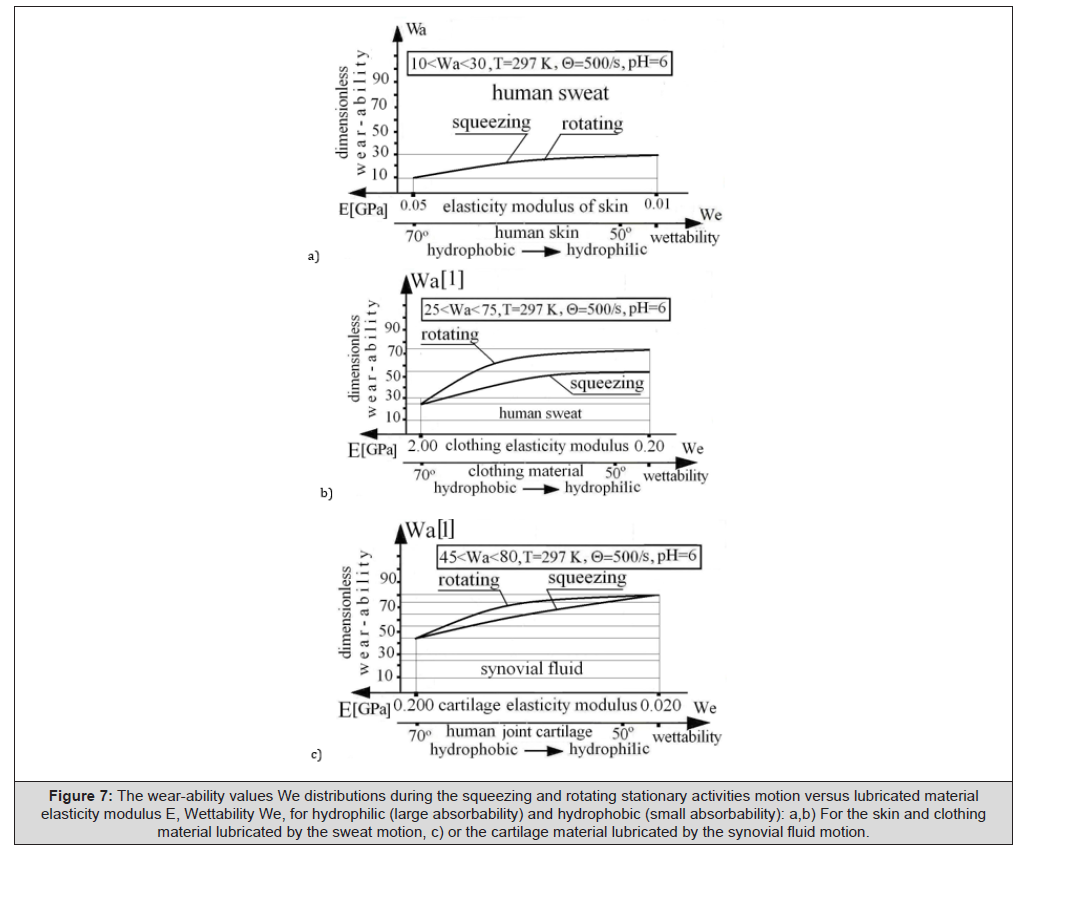
Figure 7:The wear-ability values We distributions during the squeezing and rotating stationary activities motion versus lubricated material elasticity modulus E, Wettability We, for hydrophilic (large absorbability) and hydrophobic (small absorbability): a,b) For the skin and clothing material lubricated by the sweat motion, c) or the cartilage material lubricated by the synovial fluid motion.
- Wear-ability (Wa) unit scale was applied, with the scoring range 1≤Wa≤100 and describes during the lubrication, the effect of the loss of materials such as cartilage body, human skin, clothing underwear [15]. One unit denotes the wear presented the 1mg loss of material during the time cooperation 1000 000s i.e. 10-6mg/s<Wa<10-4mg/s. Because the time of a one day includes 8640s and the year has 3 153 600 s, then during the one day the loss of material weight varies from 0.0086 mg to 0.8600 mg, and in one year, the loss of biomaterial weight changes in interval 3.153mg ≤Wa≤3153 g. After duration time t=10 years: for Wa=100 the maximum loss value of biomaterial (cartilage) attains value 3.153g, and for Wa=50, the loss of cartilage weight has value 1.576g.
Control Results of Metabolic Age for the Fluid Viscosity Variations
Using the material, devices and methods descried in foregoing intersections, the identified selected relation results are now presented for a rotational, squeezing, boosted squeezing, weeping, non- isothermal, incompressible, viscoelastic synovial fluid and sweat laminar, stationary flow lubrication, inside the thin gap height restricted by clothing or the living body, phospholipid surfaces PL on the steady time t=O(30-60s) see Figure 8abc (Figure 8).
Using the matter conversion [14] and elasto-hydrodynamic equations, we obtain in numerical way the BMR, MA values depended on the elasticity modulus ESM[Pa] of superficial layer material, power hydrogen ion concentration values 2<pH<10, wettability 300<We<750, wear-ability 10-6mg/s<Wa<10-4mg/s of the joint cartilage in joints and the clothing or skin. Mentioned connections for synovial fluid SF, human sweat SW, with the proper dynamic viscosity SWV[Pas] or SFV[Pas], are influenced direct and indirect on the human BMR [Kcal/day] and MA [years] [15]. Additionally, the temperature T[K], velocity flow v[m/s] of synovial fluid or sweat, kinds of motion in the form of rotation, squeezing, boosted squeezing, weeping is taken into account in Figure 8a. The influences of boosted squeezing and weeping influences on the MA, BMR are omitted in Figure 8bc.
The dynamic viscosity function η[mPas] for synovial SF, or sweat SW, indicated in Figure 8 has the form of the following function [16]:

Figure 8:The common mutually relations influences between two arbitrary points 1 &2 placed on the two arbitrary solid living bio-surface: a) The human BMR,MA (Metabolic Age) versus sweat and synovial-fluid dynamic viscosity η depended on ESM-elasticity modulus, We-wettability, Wa- wear-ability of the solid material (cartilage, skin, clothing), pH-power hydrogen ion concentration of the bio-fluid (synovial fluid, sweat), p-hydrodynamic pressure, U-the urea water solution component in considered bio-fluid, T- temperature, v- the considered average velocity of the synovial fluid or sweat, b) inequalities presented for laminar , stationary squeezing lubrication, c) inequalities for laminar stationary rotating lubrication.
ηT =ηT n pH p k v ε We Wa, ESM,T,t,U) , (1)
whereas: hydrodynamic pressure p=O(0.15Pa), temperature T [K]=(300K),bio-liquid or fluid velocity components v=O(1.5m/s) and the joint gap height or the distance between skin and underwear ε=O(10µm), Boltzmann constant k = 1.38054∙10–23[J/K], urea water solution for the sweat in interval 1.05 kg/m3 <U<1.15 kg/m3 dimensionless flow index n whereas (0.8<n<1.2). For n = 1, we have Newtonian liquid [17].
Additionally, it may be noticed that for squeezing (rotating) activities Figure 8b (Figure 8c), right hand side point 2 is situated for smallest elasticity modulus, smallest (largest) dynamic viscosity and simultaneously the same point 2 in both squeezing and rotating activities is laying in largest wear-ability and wettability
It is easy to seeing that for rotating activities the rejuvenation effect i.e. smallest quantity of MA can be attained in selected point 2 if and only if in this point: BMR, Wa, We, fluid lubricant dynamic viscosity is larger than in point 1, and simultaneously elasticity modulus of lubricated material is smaller than in point 1. Additionally, it is easy to seeing that for squeezing activities the rejuvenation effect i.e. smallest quantity of MA can be attained in selected point 1 if and only if in this point: Wa, We is smaller than in point 2, and simultaneously elasticity modulus of lubricated material, dynamic viscosity of the lubricant and BMR is larger than in point 2.
Aging and Rejuvenation After Selected Numerical Results
The numerical values are obtained on the ground of some solutions of hydrodynamic lubrication equations and matter conversion and metabolism equations [18-21].
In Appendix Table 1,2&3 are presented numerical calculation values implemented with measurements after about 30 experiments realized in sound bio-nods lubrication effects for students in chronological age interval 18-26 years, and between outset and end experiment time (1-2 years). Such values are localized in point 1, point 2 on the left- and right-hand side in horizontal axes of Figure 8bc during the rotating and squeezing activities for lubrication of normal bio-nods. Numerical results are referring to the relation values of skin and sweat in Table 1, clothing and sweat in Table 2, cartilage materials and synovial fluid in Table 3. In Tables are illustrated numerical values of the following parameters: elasticity modulus of skin, cartilage, clothing material in GPa, fluid dynamic viscosity of sweat, synovial fluid in mPas, dimensionless wear-ability, wettability in grad. Abovementioned parameter values, are mutually connected and implied the real dimensionless, relative value changes ΔBMR[Kcal] and ΔMA[years] of BMR &MA indicating rejuvenation or aging effects in considered points 1 and 2, during the rotating or squeezing activities [18].The ratio of the relative negative (positive) values i.e. decrements (increments) of Metabolic Age, to the total Metabolic Age values including human chronological age, denote decreases( increases) of Metabolic Age and is defined in the fraction form presenting Rejuvenation Percent RP= –ΔMA/MA( Aging Percent AP= +ΔMA/MA).
The main selected results are presented below:
1. The increases of normal skin elasticity modulus from 0.010 (in point 2) to 0.050 GPa (in point 1), implies following results (see Table 1):
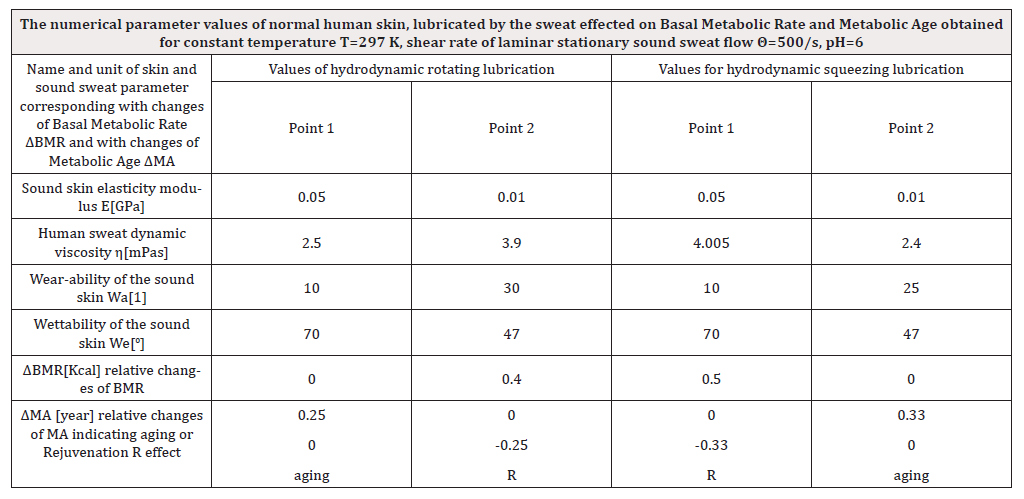
Table 1:Human normal skin and sweat parameter values corresponding with BMR and MA changes.
a) sound sweat dynamic viscosity decreases from 3.90 to 2.5
mPas for rotating lubrication,
b) sound sweat dynamic viscosity increases from 2.4 to 4.0 mPas
for squeezing lubrication,
c) BMR decreases at 0.40Kcal for rotating lubrication,
d) BMR increases at 0.50Kcal for squeezing lubrication,
e) MA increases at 0.25 year (3 month) for rotating lubrication
(i.e. aging AP=+1.5%),
f) MA decreases at 0.33 year (4 month) for squeezing lubrication
(rejuvenation RP= –2.0%).
2. The increases of clothing elasticity modulus from 0.20(in p.2) to 2.00 GPa (in p.1), implies following data (see Table 2):
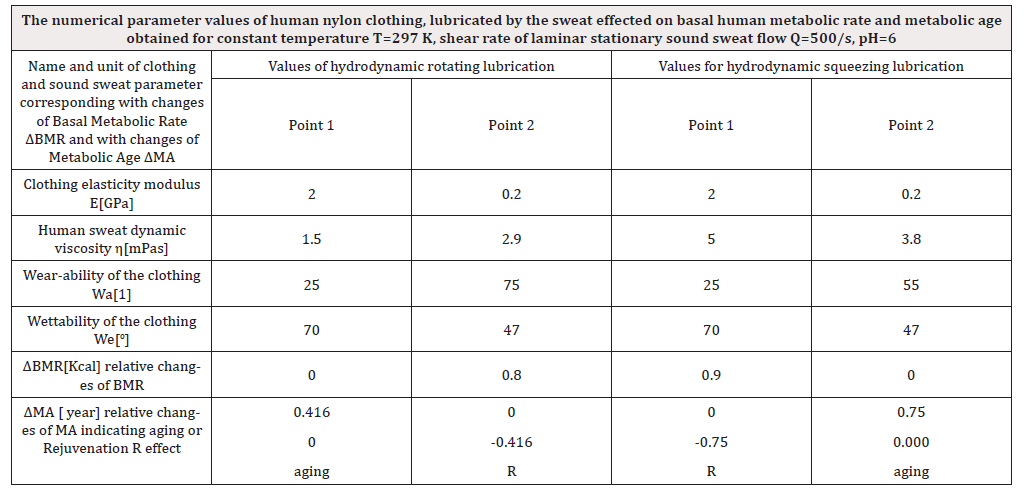
Table 2:Human clothing and sound sweat parameter values corresponding with BMR and MA changes.
a) sound sweat dynamic viscosity decreases from 2,90 to 1.5
mPas for rotating lubrication,
b) sound sweat dynamic viscosity increases from 3.8 to 5.0 mPas
for squeezing lubrication,
c) BMR decreases at 0.80Kcal for rotating lubrication,
d) BMR increases at 0.90Kcal for squeezing lubrication,
e) MA increases at 0.416 year (5 month) for rotating lubrication
(i.e. aging AP=+2.5%),
f) MA decreases at 0.750 year (9 month) for squeezing lubrication
(rejuvenation RP= –4.2%).
3. The increases of normal cartilage elasticity modulus from 0.02GPa (in p.2) to 0.20 GPa (in p.1), implies following results (see Table 3):
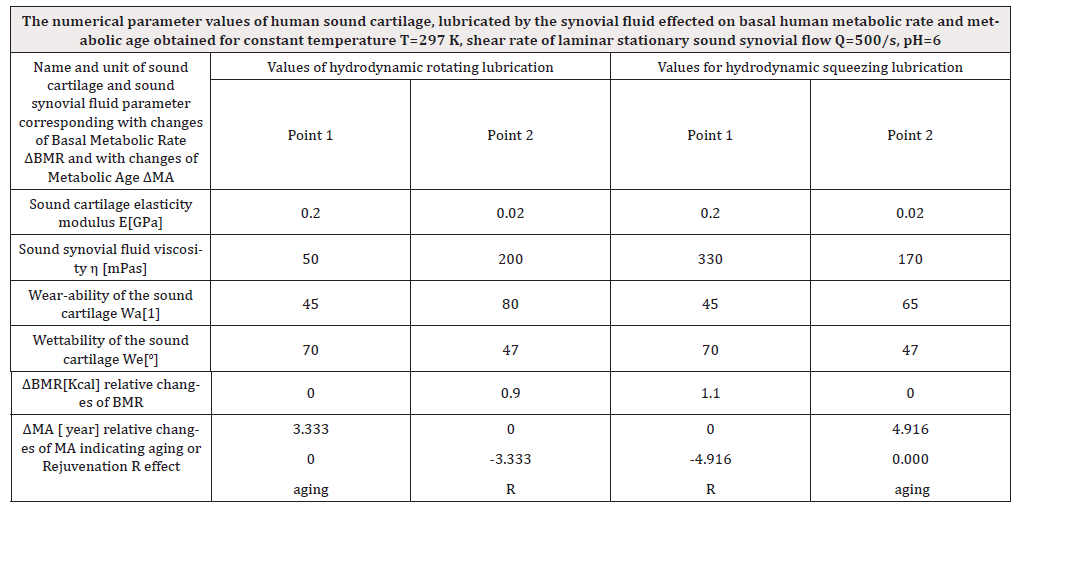
Table 3:Human hip joint sound cartilage and sound synovial fluid parameter values corresponding with BMR and MA changes.
a) sound synovial fluid viscosity decreases from 200 to 50 mPas
for rotating lubrication,
b) sound synovial fluid viscosity increases from 170 to 320 mPas
for squeezing lubrication,
c) BMR decreases at 0.90 Kcal for rotating lubrication,
d) BMR increases at 1.10 Kcal for squeezing lubrication,
e) MA increases at 3.333 years (40 month) for rotating lubrication
(i.e. aging AP=18.5%),
f) MA decreases at 4.916 years (59 month) for squeezing lubrication
(rejuvenation RP from 27% to –19%).
Final Highlight Conclusions
1) The variations of physical resistance properties of sound solid, living tissue, material surface, are depended on the kind of superficial, living liquid lubricant thin layer laminar or turbulent flow swimming round tissue, and are provoked by the training stationary or non-stationary activities. Moreover specific boundary conditions for pressure, temperature, velocity, on the superficial layer between solid living body and liquid, have been implied variations of the living thin layer liquid dynamic viscosity, and osmotic, isotonic properties. And next in consequence had been proved the influence from living thin layer bio-fluid features and solid living bio-surfaces properties onto human Metabolic Age (MA), Basal Metabolic Rate (BMR), human health and lifespan.
2) Planning the human lifespan (MA decreases), requires proper activities (rotating or squeezing effects) using simultaneously suitable clothing material with proper elasticity modulus.
3) For sound students in chronological age interval 18-26 years, and between outset and end experiment duration time (1-2 years), had been obtained the following research results:
i. The effect of the MA increases (aging) or MA decreases (rejuvenation), during the sound human rotational activities is provoked in 83.3 % by the sound joint cartilage lubricated with synovial fluid, and in 10.4% by the clothing lubricated with sweat, and in 6.25 % by the skin lubrication using sound sweat.
ii. The effect of the MA decreases (rejuvenation) or MA increases (aging), during the sound human squeezing activities is provoked in 81.4% by the sound joint cartilage hydrodynamic sound synovial fluid lubrication, and in 12.5% by the clothing lubricated with sweat, and in 5.65 % by the human sound skin lubrication using the sound sweat.
iii. The effect of the BMR decreases and increases, during the sound joint human rotational activities is provoked in 42.85% by the sound cartilage hydrodynamic synovial fluid lubrication, and in 38.09% by the clothing lubricated by the sweat, and in 19.04% by the human sound skin hydrodynamic lubrication using the sound sweat.
iv. The effect of the BMR increases and decreases, during the sound human squeezing activities is provoked in 44% by the sound cartilage hydrodynamic synovial fluid lubrication, and in 36% by the clothing, and in 20 % by the human sound skin hydrodynamic lubrication using sound sweat.
Discussion
It is important to explain or to consider the comparison of the dynamic viscosity distribution of sweat SWV, synovial fluid dynamic viscosity SFV versus elasticity modulus E of skin, clothing, cartilage inside interval from small (0.01;0.20;0.02) GPa to the large E values (0.05;2.00;0.20) GPa, during the squeezing, boosted squeezing, weeping activities presented in Figure 6abc.
The enlarged load 2L in boosted squeezing (see Figure 4) in comparison with load L in squeezing (se Figure 3), implies that the gap height between two cooperating surfaces in boosted squeezing is smaller than the gap height in squeezing. Moreover, always the gap height for small elasticity modulus E (0.01;0.20;0.02) GPa is smaller than the gap height for larger elasticity modulus values E (0.05;2.00;0.20) GPa [19,20] for skin, clothing, cartilage, respectively.
Hence by virtue of non-Newtonian sweat, synovial fluid properties follows that the velocity v, shear rate Θ of sweat, synovial fluid low in boosted squeezing increase and dynamic viscosity (SWF, SVF) decreases in small elasticity values E and in comparison, with the mentioned values in large elasticity values E for skin, clothing, cartilage, respectively.
The additionally velocity value v occurring in boosted squeezing (see Figure 4) in comparison with velocity value v in squeezing action (see Figure 3), enlarges the previous dynamic viscosity decreases caused by the load L. Thus, finally the dynamic viscosity in boosted squeezing actions attains significantly larger decreases for small elasticity values E in comparison with dynamic viscosity decrements for large values E, and in comparison, with dynamic viscosity values for squeezing activities for skin, clothing and cartilage.
The additionally velocity value v occurring in weeping actions (see Figure 5) in comparison with velocity value v in squeezing action (see Figure 3), are produced after weeping some decrements of previously obtained dynamic viscosity values during the squeezing and not larger than for boosted squeezing [3] as well for small E as for large E.
Appendix
(Tables 1,2,3)
Acknowledgements
Acknowledge the WSG Bydgoszcz University Street Garbary 2, Bydgoszcz, Mechanics and Computer Science and Prof. Ryszard Maciołek from WSG University Bydgoszcz in Poland, that technically supported this work. The Authors would like to thank all the persons involved in the discussions at the study preparation stage.
Conflict of Interest
The Author has declared that no competing interests exist.
Nomenclature
AFM-Atomic Force Microscope,
AP-Aging Percent +ΔMA/MA,
BMI- Body Mass Index, kg/m2,
BMR-Basal Metabolic Rate, Kcal/day,
ESM- Elasticity Surface Modulus, Pa, GPa,
Eskin –elasticity modulus of human skin, Pa
Ed –elasticity modulus of clothing underwear material, Pa, GPa
MA-Metabolic Age, year
PL-Phospholipid,
RP- Rejuvenation Percent= – ΔMA/MA,
SF-Synovial Fluid,
SFV –synovial fluid dynamic viscosity, Pa
SWV-sweat dynamic viscosity, Pas
SW-sweat,
T-Temperature, K,
U-urea water solution, kg/m3
Wa-wear ability of the material, mg/s
We-Wettability, grad,
ΔMA-Metabolic Age changes: +increases, – decreases,
k-Boltzmann constant, J/K,
n-dimensionless flow index,
p-pressure, Pa
PH –dimensionless power hydrogen ion concentration,
t-disease or experiment duration time,
v-bio-fluid velocity, m/s,
η-dynamic viscosity, mPas
Θ shear rate,1/s.
References
- ARAUJO J, CAI J, STEVENS J (2018) Prevalence of Optimal Metabolic Health in American Adults: Health and Nutrition Examination survey 2009-2016. Metab Syndr Relat Disord 17(1): 46-52.
- BRIAN D`SOUZA, ASHISH K KASAR, JAYCOB JONES, et. al. (2022) A Brief Review on Fraction Affecting the Tribology Interaction between Human Skin and Different Textile Materials. Special Issue Tribology: Friction and Wear of Engineering Materials. Materials (Basel) 15(6): 2184.
- BHUSHAN B (2007) Nano-tribology and nano-mechanics of MEMS/NEMS and BioMEMS/NEMS materials and devices. Microelectronic Engineering 84: 387-412
- EBERHARD O VOIGT (2020) The best models of metabolism. Advances Rev 9(16).
- Felix Morales Palomo, Miguel Ramirez Jimenez, Juan Fernando Ortega, Ricardo Mora Rodriguez (2019) Effectives of Aerobic Exercise Programs for Health Promotion Metabolic Syndrome. Med Sci Sports Exerc 51(9):1876-1883.
- LONGO VALTER (2016) La dieta della longevita. Antonio Vallardi Editore Surl, Milan (polish edition and translation published by Publishing House Bukowy Las, ISBN 978-83-8074-105-8.
- MUHAMMAD NIAZ KHAN, TINGWEI HUO, QIAN ZHANG, Zhuoyang Hu, Jiahui Zhao, et al. (2022) Synergetic adhesion in highly adaptable bio-inspired adhesive. Colloids Surf B Biointerfaces 212: 112335.
- MTKD-CT-2004-517226(2007) Transfer of Knowledge grant, Bio-and Slide Bearing: their Lubrication by non-Newtonian Fluids, Copyright Krzysztof Wierzcholski, Gdańsk University of Technology.
- OLANDER D (2007) Thermodynamics, chapter Bio-thermodynamics, CRC Press 2007, eBook 97 80429128516.
- RUBENSTEIB D (2021) Biofluid Mechanics. NY Elsevier Sc. Publishing, ISBN 9780128180341.
- SKROBACKI A (1967) Sweat components and its variations. Laboratory Diagnosis. Medical Academy Warsaw III (1).
- TROUPE RA, ASPY WL, SCHRODT PR (2022) Viscosity and Density of Aqueous Lactic Acid Solutions. Industrial & Engineering Chemistry 43(5): 1143.
- SAULI HALONEN, TEIJA KANGAS, MAURI HAATAJA, ULLA LASSI (2017) Urea-Water-Solution Properties: Density, Viscosity, and Surface Tension in an Under-Saturated Solution. Emission Control Science and Technology 3: 161-170.
- WEILANDT D R, MASID M, HATZIMANIKATIS V (2021) Metabolic Engineering. Concepts and Applications. Chapter 7: Thermodynamic of Metabolic Pathways. Wiley online Library, ed. By Jens Nielsen, Gregory Stephanopoulos, Sang Yup Lee.
- WIERZCHOLSKI K (2024) The Phenomenon of Impact on a Healthy Humans Lifespan, Clinical Research Notes 7(5)-149 ISSN 2690-8816.
- WIERZCHOLSKI K, MISZCZAK A, CWANEK J (2002) Relations Between Viscosity of Synovial Fluid, Gap Height and Angular Velocity, Young Modulus of Cartilage. Mechanics in Medicine 6, Proceedings of Scientific Seminar, Rzeszów, pp.201-207.
- WIERZCHOLSKI K, GOSPODARCZYK J (2022) The Metabolic Process After Lubrication of Human Joint and Skin Surfaces, Clinical Research Notes, Auctores Publishing LLC 3(3): 058.
- WIERZCHOLSKI K (2023) The Tribology of Human Metabolism Based on the Skin Lubrication. Tribologia 4/2023: 91-102.
- WIERZCHOLSKI K, GOSPODARCZYK J (2022) On Important Meaning of Bio-Fluid Dynamic Viscosity Variations in the Lubrication Flows, Tribologia 1/2022: 23-35.
- WIERZCHOLSKI K, SÓJKA M (2016) Influence of load and joint cartilage elasticity modulus on synovial fluid viscosity, Tribologia 2(265): 259-265.
- YOSHIYUKI MATSUYAMA, at al. (2020) New material property conversion equations for bone strength measurement for CT-based finite element modeling. Chiba Medical J 96E (2): 41-46.




 We use cookies to ensure you get the best experience on our website.