
Research Article 
 Creative Commons, CC-BY
The Relationship between Individual Alpha Peak Frequency and the Effectiveness of Coping with Stress Load
*Corresponding author:Olga Jafarova, Biofeedback Computer Systems Laboratory, Institute of Molecular Biology and Biophysics, Federal Research Center of Fundamental and Translational Medicine, Novosibirsk, Russia.
Received:June 02, 2025; Published:June 09, 2025
DOI: 10.34297/AJBSR.2025.27.003549
Abstract
This article examines the dynamics of the individual alpha peak frequency of the electroencephalogram as a potential neurophysiological marker of stress-induced states. The study results showed that the dynamics of the individual alpha peak frequency varied among groups with different stress-response profiles during a single session of the heart rate biofeedback game “VIRA-RALLY.” The findings indicate a connection between individual alpha band frequency characteristics and the effectiveness of coping with stress loads. The study demonstrates the need to consider baseline EEG frequency patterns when developing personalized neurofeedback protocols. Future research prospects involve optimizing biofeedback algorithms, which could improve the accuracy of stress state diagnostics and the effectiveness of self-regulation training. This work contributes to understanding the neurodynamic foundations of stress response and opens possibilities for creating technologies aimed at correcting psychoemotional states based on objective neurophysiological parameters.
Keywords:Electroencephalogram, Electromyogram, Individual alpha peak frequency, Heart rate biofeedback, Stress reactivity
Abbreviations:EEG: Electroencephalogram, EMG: Electromyogram, IEMG: Integrated Electromyogram, IAPF: Individual Alpha Peak Frequency, HR: Heart Rate, HRV: Heart Rate Variability, RT: Reaction Time.
Introduction
Stress has become an integral component of modern society, affecting many aspects of human life. Therefore, a comprehensive understanding of the mechanisms underlying stress-related states is a critical issue for neuroscience and medicine. Studying the neurophysiological mechanisms of autonomic stress indicators may be potentially linked to changes in individual alpha wave frequencies. The dominant rhythm in the brain of a healthy adult is formed by alpha oscillations with a typical power peak, most commonly observed in the 8-12 Hz range [1]. On one hand, the individual Alpha Peak Frequency (IAPF) is a highly heritable and stable neurophysiological marker reflecting the functional properties of the brain and general cognitive abilities. On the other hand, literature well documents that resting IAPF can vary significantly among individuals [1]. However, data on the relationship between IAPF and autonomic nervous system activity are fragmented and contradictory. For example, slow voluntary abdominal breathing is associated with an increase in individual alpha frequency and a reduction in situational anxiety [2,3]. Conversely, during relaxation-such as in Qigong practice [4] or prolonged meditation [5]-a significant decrease in IAPF occurs. A decrease in the dominant alpha peak frequency is observed in chronic neurogenic pain [6], while a high alpha frequency is associated with subjective pain perception [7]. Additionally, IAPF decreases during the mental reproduction of sadness and fear, whereas emotions like joy and anger shift IAPF in the opposite direction [8]. Frequency reduction may also result from stress or high workload in burnout syndrome [9].
The Biofeedback Computer Systems Laboratory has conducted studies on the effects of alpha power enhancement training on Heart Rate Variability (HRV), which resulted in increased HRV [10]. The current study aimed to investigate changes in IAPF as a potential neurophysiological correlate of autonomic stress indicators.
Materials and Methods
Study Participants
38 male participants, graduate and post-graduate students from the Moscow Institute of Physics and Technology and Novosibirsk State University (mean age 26.05 ± 5.93). All participants were informed about the experimental procedure in advance and provided voluntary consent.
Research Protocol
To describe the neurophysiological mechanisms of autonomic stress indicator regulation, EEG recordings were taken to determine IAPF before and after a single session of the biofeedback game “VIRA-RALLY,” with intermediate EEG recordings after “VIRA” under EMG control. EEG and EMG were recorded at three time points: before “VIRA-RALLY”, after the “VIRA” game, and after completing “VIRA-RALLY.” EEG and EMG recordings were performed using the “BOSLAB” hardware-software complex (COMSIB Ltd., Novosibirsk, Russia) with eyes closed (1 minute) and eyes open (30 seconds). EEG was recorded via a monopolar Pz site at a sampling rate of 720 Hz and impedance <10 kΩ. EMG was recorded using two bipolar electrodes placed on the frontal muscles. IAPF was determined in the individually established alpha band by comparing EEG spectra recorded with eyes closed (30 seconds) and eyes open (10 seconds) [11]. Integrated EMG (IEMG) was averaged over the recording interval as an indicator of psychoemotional tension [12].
The biofeedback games “VIRA” and “RALLY” are designed to be controlled by the player’s heart rate (HR) through the use of the BOSPulse device, developed by COMSIB Ltd. This device employs a photoplethysmography sensor, which is attached to the finger to monitor pulse signals. Biofeedback session consisted of 5 trials of the “VIRA” and 5 trials of the “RALLY” game. [13]. “VIRA” simulates underwater diving, where the player manages the speed of one of the divers. The objective is to overtake a competitor whose speed is based on the player’s average speed from the previous game trial. To win a trial, the player must develop the ability to regulate their heart rhythm. A slower pulse translates to a faster diver, meaning success depends on mastering emotional and physiological control during the stressful dynamics of gameplay. The competitor’s speed is determined by averaging the player’s HR from the prior trial. “RALLY” emulates a car racing scenario where the player navigates one of two cars. The car’s speed is inversely related to the player’s pulse, monitored via a pulse detector. Additionally, obstacles such as rocks appear unexpectedly along the track. To avoid these, the player must press the spacebar before hitting them. This game is designed to measure Reaction Time (RT) and track shifts in focus and attention during training sessions. From a psychophysiological perspective, players need to effectively lower their heart rate without significantly increasing their reaction time in order to perform well [13].
Results and Discussion
IAPF significantly decreased from 10.22 0.84 Hz to 9.93 ± 0.85 Hz (p < 0.001) after the “VIRA-RALLY” session, while IEMG showed no significant change (5.09 ± 1.82 to 4.96 ± 1.97, p > 0.05). For a more in-depth analysis based on our previous research [13], it was decided to divide the participants according to the effectiveness of the strategies used in the “VIRA-RALLY” game. The following groups were identified:
a) Group 0 (ineffective strategies)-”Demotivation Strategy” and
“Disintegration” for the “RALLY” scenario / “Rigid Outcome
Strategy” for the “VIRA” scenario.
b) Group 1 (intermediate strategies)-”Pendulum Strategy,” “Strategy
of successive impairment of results”.
c) Group 2 (effective strategies)-”Trial and Error with Achievement
of Results,” “Sequential Learning”.
Group 0 included 4 participants, Group 1-20, and Group 2-14. Participants in the identified groups did not differ in basic anthropometric indicators: age, height, or body weight (p > 0.05). In Group 0, IAPF before and after “VIRA-RALLY” showed a trend toward decrease (p=0.07), possibly due to the small sample size of Group 0. In the intermediate measurement after the “VIRA” scenario, neither IAPF nor IEMG showed statistically significant changes (p > 0.05). In Group 1, the changes in the studied indicators after the “VIRA” game were not statistically significant. Before and after the “VIRA- Rally” session, IAPF showed a trend-level change: a decrease in IAPF (p=0.08) (Figure 1).
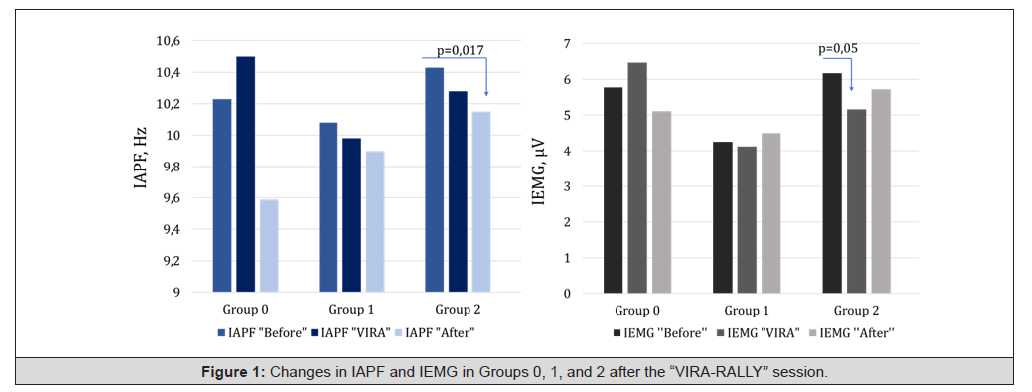
Figure 1:Changes in IAPF and IEMG in Groups 0, 1, and 2 after the “VIRA-RALLY” session.
In Group 2, IAPF significantly decreased (Figure 1) following the “VIRA-RALLY” biofeedback session-from 10.41 ± 0.80 to 10.07 ± 0.85 Hz (p=0.017). Notably, the decrease in IAPF was already observed after the “VIRA” session and continued during the “RALLY” session. After the “VIRA” gaming scenario, the IEMG significantly decreased from 6.11 ± 2.10 to 5.08 ± 1.58 (p=0.05). However, by the end of the “RALLY” session, the change in IEMG was only at a trend level (p=0.07), as a slight increase in IEMG was observed during “RALLY”-from 5.08 ± 1.58 to 5.56 ± 2.05 (p=0.08). The typical EEG profile of a subject from Group 2 is presented in Figure 2.
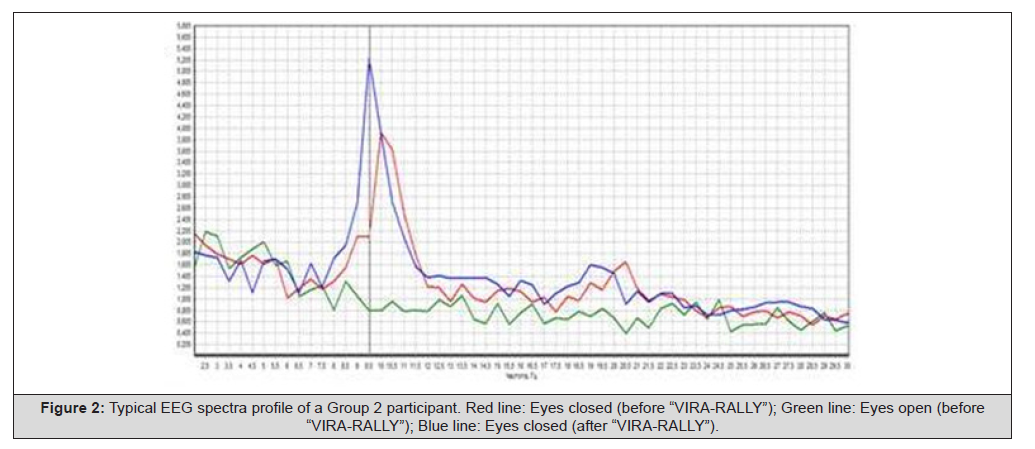
Figure 2:Typical EEG spectra profile of a Group 2 participant. Red line: Eyes closed (before “VIRA-RALLY”); Green line: Eyes open (before “VIRA-RALLY”); Blue line: Eyes closed (after “VIRA-RALLY”).
For additional analysis, a subgroup labelled “Successive impairment of results” was identified in Group 1 based on the “VIRA” results, comprising 9 individuals. Although the changes in IAPF and IEMG in this group were not statistically significant, the group’s profile is of interest. First, the group primarily consisted of low-frequency subjects (IAPF below 10 Hz before the “VIRA-RALLY” session in 7 participants). Both after “VIRA” and after “RALLY”, the IAPF remained practically unchanged. Members of this group initially had low IEMG levels, which also showed almost no change following the “VIRA-RALLY” session. The study of IAPF changes as a neurophysiological correlate of autonomic stress indicators during the single “VIRA-RALLY” session yielded interesting results. For subjects in Group 0 (with ineffective self-regulation strategies in stressful gaming situations) no statistically significant changes in IAPF or IEMG were detected. This result was expected and suggests a lack of motivation to complete the task or that the subject made no effort to engage with the challenges in either the “VIRA” or “RALLY” scenarios. Subjects in Group 1 showed similar results. It can be said that individuals with intermediate self-regulation efficiency applied minimal cognitive effort to solve the training tasks, which is reflected in their psychophysiological profile-no changes in either IAPF or IEMG. The most interesting findings were observed in Group 2 (with effective self-regulation strategies during the “VIRA- RALLY” session). As known from the literature [1], task-related alpha frequency shifts are functionally significant: IAPF increases with task difficulty [14]. In our study, Group 2 participants exhibited a decrease in frequency after the “VIRA-RALLY” session, suggesting that the biofeedback training task was subjectively easy for them.
On the other hand, the statistically significant decrease in IAPF alongside reduced IEMG after the “VIRA” scenario may indicate a state of relaxation, supported by literature findings on IAPF shifts toward lower values during relaxation techniques and mindful meditation [5]. However, the non-significant trend of increased EMG after the “RALLY” scenario may reflect significant attentional engagement [15,16] and focus on simultaneously solving two ingame tasks (pulse control and obstacle avoidance). Thus, we cannot definitively conclude that the IAPF decrease was solely due to relaxation. Notably, all Group 2 participants had baseline IAPF values above 10 Hz. We hypothesize that with a larger sample size, it will be possible to track IAPF dynamics in both high- and low-frequency subjects within this group. It should be noted that, in general, literature data on the relationship between IAPF and autonomic nervous system indicators are fragmented and contradictory. The small sample size in this study also prevents definitive conclusions about the nature of this interdependence. Therefore, further in-depth research with a larger sample is needed, which may become the focus of our future studies.
Conclusion
The dynamics of individual EEG alpha rhythm frequency were expressed differently in groups with various stress-response profiles during a single session of the “VIRA-RALLY” game-based biofeedback, which initiates the development of emotional stress. Modeling a virtual environment with a stress-inducing scenario allowed for a more detailed assessment of the neurophysiological mechanisms regulating autonomic stress indicators using a simple yet sufficiently informative EEG monitoring method during testing. The results obtained in this study can contribute to a more comprehensive understanding of the neurophysiological mechanisms underlying stress response development. Involving a larger number of participants in the research will help develop personalized biofeedback protocols for the prevention and correction of stress-induced conditions, taking into account individual EEG frequency patterns.
Acknowledgements
The study was supported by project FGMU 2025-0004, #125031203556-7.
Conflict of interest
Authors declare no conflict of interest exist.
References
- Mierau A, Klimesch W, Lefebvre J (2017) State-dependent alpha peak frequency shifts: Experimental evidence, potential mechanisms and functional implications. Neuroscience 360:146-154.
- Fumoto M, Sato Suzuki I, Seki Y, Mohri Y, Arita H (2004) Appearance of high-frequency alpha band with disappearance of low-frequency alpha band in EEG is produced during voluntary abdominal breathing in an eyes-closed condition. Neurosci. Res 50(3): 307-317.
- Chan AS, Cheung MC, Sze SL, Leung WW, Shi D (2011) Shaolin dan tian breathing fosters relaxed and attentive mind: a randomized controlled neuro-electrophysiological study. Evid Based Complement Alternat Med 2011:180704.
- Zhang JZ, Zhao J, He QN (1988) EEG findings during special psychical state (Qi Gong state) by means of compressed spectral array and topographic mapping. Comput Biol Med 18(6): 455-463.
- Saggar M, King BG, Zanesco AP, Aichele SR, Jacobs TL et al. (2012) Intensive training induces longitudinal changes in meditation state-related EEG oscillatory activity. Frontiers in Human Neuroscience 6: 256.
- Sarnthein J, Stern J, Aufenberg C, Rousson V, Jeanmonod D (2006) Increased EEG power and slowed dominant frequency in patients with neurogenic pain 129(1): 55-64.
- Nir R R, Sinai A, Raz E, Sprecher E, Yarnitsky D (2010) Pain assessment by continuous EEG: Association between subjective perception of tonic pain and peak frequency of alpha oscillations during stimulation and at rest. Brain Research 1344: 77-86.
- Kostyunina MB, Kulikov MA (1996) Frequency characteristics of EEG spectra in the emotions. Neurosci Behav Physiol 26(4): 340-343.
- van Luijtelaar G, Verbraak M, van den Bunt M, Keijsers G, Arns M (2010) EEG findings in burnout patients. J Neuropsychiatry Clin Neurosci 22(2): 208-217.
- Bazanova OM, Balioz NV, Muravleva KB, Skoraia MV (2013) Voluntary alpha-power increasing training impact on the heart rate variability. Fiziol Cheloveka 39(1): 103-116.
- Bazanova OM, Nikolenko ED, Barry RJ (2017) Reactivity of alpha rhythms to eyes opening (the Berger effect) during menstrual cycle phases. Int J Psychophysiol 122: 56-64.
- Frazão YS, Manzi SB, Krakauer L, Berretin Felix G (2024) Effectiveness of orofacial myofunctional intervention to mitigate facial aging signs: a clinical trial. Efetividade da intervenção miofuncional orofacial para atenuar sinais do envelhecimento facial: ensaio clínico // CoDAS 36: 5. e20230016.
- Jafarova O, Mazhirina K, Sokhadze E, Shtark M (2020) Self-regulation Strategies and Heart Rate Biofeedback Training. Appl Psychophysiol Biofeedback 45(2): 87-98.
- Haegens S, Barczak A, Musacchia G, Lipton ML, Mehta AD et al. (2015) Laminar Profile and Physiology of the Rhythm in Primary Visual, Auditory, and Somatosensory Regions of Neocortex. J Neurosci 35(42): 14341-14352.
- Jang H, Reeve J, Deci EL (2010) Engaging students in learning activities: It is not autonomy support or structure but autonomy support and structure. Journal of Educational Psychology 102(3): 588-600.
- Jann K, Koenig T, Dierks T, Boesch C, Federspiel A (2010) Association of individual resting state EEG alpha frequency and cerebral blood flow. NeuroImage 51(1): 365-372.




 We use cookies to ensure you get the best experience on our website.