
Mini Review 
 Creative Commons, CC-BY
Unlocking Immunity: ELECTROCIDE™ - A Novel Approach
*Corresponding author:Leonard Sonnenschein, The Sonnenschein Institute, 6617 NW 24th Ave. Boca Raton, Florida 33496 USA.
Received:July 01, 2025; Published:July 08, 2025
DOI: 10.34297/AJBSR.2025.27.003594
Abstract
The global landscape of human health is increasingly pathogen challenged including many infectious respiratory diseases. Traditional therapeutic approaches often face limitations, necessitating the exploration of novel interventions. This article introduces ELECTROCIDE™, a unique aqueous solution, and synthesizes current research suggesting its role as a multifaceted immunomodulator. Research suggests Electrocide, a hypotonic oral antipathogen, may boost immunity when taken orally, with studies showing wellness benefits. It seems likely that combining nasal and oral administration could enhance protection against respiratory viruses like COVID-19, Flu, and Respiratory Syncytial Virus (RSV) by targeting both gut and respiratory mucosa. ELECTROCIDE™ antipathogenic mechanism potential to activate key immune cells like T-cells, enhances the body’s defence against respiratory pathogens.
Keywords:ELECTROCIDE™, Immunomodulator, Respiratory pathogens, Mucosal Immunity, Nasal administration, Oral administration, Gut-Associated Lymphoid Tissue (GALT), Nasal-Associated Lymphoid Tissue (NALT), Secretory Iga (Siga), T-Cell activation, COVID-19, Influenza, RSV, Antipathogenic, Systemic immunity, Hypotonic solution, Mineral-Based composition, Vaccine Adjuvant, Inflammation reduction, Post-COVID, Wellness benefits
Abbreviations:APCs: Antigen-Presenting Cells, GALT: Gut-Associated Lymphoid Tissue, NALT: Nasal-Associated Lymphoid Tissue, RSV: Respiratory Syncytial Virus, Siga: Secretory Iga
Introduction
The human immune system, a complex network of cells, tissues, and organs, can protect the body from harmful pathogens while maintaining tolerance to self-components. Disruptions to this delicate balance can manifest as increased susceptibility to infections, particularly in the respiratory tract. The ongoing search for innovative strategies to enhance immune resilience and restore immune homeostasis is paramount. Conventional approaches to respiratory disease prevention heavily rely on vaccinations and antiviral treatments, while autoimmune conditions are often managed with immunosuppressants or targeted biologics. However, these methods sometimes present challenges, including the emergence of resistant pathogens, the need for continuous vaccine development against evolving viruses, and bacterial pathogens.
This article examines ELECTROCIDE™, an emerging solution that harnesses unique electrical properties to interact with biological systems. Drawing on recent preclinical studies and theoretical propositions, is a hypothesis that ELECTROCIDE™ may offer a dual benefit; strengthening immune defences against respiratory pathogens and providing a novel mechanism for immune modulation.
This is an in-depth exploration of the potential benefits of combining nasal and oral administration of Electrocide®, a hypotonic oral antipathogen, for immunization against respiratory pathogens such as SARS-CoV-2 (COVID-19), influenza A and B (Flu A & B), and Respiratory Syncytial Virus (RSV). The analysis is grounded in preclinical studies and scientific literature aiming to address the mechanisms, benefits, and challenges of this combined approach, with a focus on enhancing mucosal and systemic immunity.
Background and Context
Electrocide® is described as a revolutionary electrolyte nutraceutical that balances body minerals to boost the immune system, leveraging its hypotonic nature and mineral-based composition to resist gut degradation. It is primarily administered orally, targeting Gut-Associated Lymphoid Tissue (GALT) to induce secretory IgA (SIgA) in the gut mucosa and moderate systemic immunity, including IgG and CD4+ T regulatory cells (Tregs). The article proposes extending its application to nasal delivery, harnessing Nasal-Associated Lymphoid Tissue (NALT) to enhance respiratory protection, and combining both routes for synergistic effects.
The rationale for this combination stems from the need for robust mucosal and systemic immune responses against respiratory pathogens, which primarily infect via mucosal surfaces like the respiratory tract. Nasal vaccines have gained attention for their ability to induce SIgA at entry points, while oral immunization can support gut health and systemic immunity, potentially complementing each other.
Administration Approaches
Electrocide is primarily an oral solution that targets Gut-Associated Lymphoid Tissue (GALT), potentially boosting gut mucosal immunity and moderate systemic responses. A study from 2021 found it improved vital signs and reduced physiological issues, suggesting it supports recovery from respiratory infections like COVID-19 by reducing inflammation [1].
While direct studies on Electrocide’s nasal use are scarce, research on nasal vaccines for respiratory pathogens shows they can induce strong mucosal immunity, particularly secretory IgA, which blocks viruses at entry points. A 2025 review highlights nasal vaccines’ potential to prevent infections like COVID-19 and Flu by enhancing respiratory protection [2].
Combining oral and nasal administration could offer comprehensive defence, with oral use supporting gut health and systemic immunity, and nasal use targeting respiratory mucosa. Studies on mucosal vaccines suggest this dual approach could enhance both local and systemic responses [3].
Mechanisms of Combined Administration
a. Oral Administration: Electrocide® targets GALT, inducing SIgA in the gut mucosa and moderate systemic immunity (IgG, CD4+ Tregs). Its hypotonic solution enhances antigen uptake by intestinal cells, and its mineral-based composition ensures stability against gut degradation. This supports general mucosal health and reduces systemic inflammation, indirectly aiding respiratory recovery.
b. Nasal Administration (Proposed): The nasal delivery could target NALT, stimulating SIgA in nasal secretions and systemic immunity. The hypotonic formulation may enhance antigen uptake in nasal mucosa, directly blocking respiratory pathogens at entry points. This is expected to elicit strong IgG and T cell responses, complementing oral systemic effects.
c. Combined Effect: The synergy lies in dual mucosal coverage— oral for gut mucosa and nasal for respiratory mucosa— enhancing overall barrier function. Systemically, it could lead to additive effects on IgG and T cell responses, with oral Tregs reducing inflammation and nasal T cell priming enhancing pathogen-specific immunity.
Scientific Basis and Supporting Evidence
The concept of combining oral and nasal immunization is supported by several studies on mucosal vaccines. For instance, a 2025 study in Nature Communications demonstrated that an intranasal subunit vaccine induces protective systemic and mucosal antibody immunity against respiratory viruses in mouse models, highlighting the potential of nasal delivery to enhance mucosal protection [3,4]. This aligns with the article’s focus on nasal administration for pathogens like COVID-19, Flu A & B, and RSV [3]. Additionally, a 2022 study in Science Translational Medicine showed that intranasal vaccination with lipid-conjugated immunogens promotes antigen transmucosal uptake to drive mucosal and systemic immunity, supporting the idea that nasal administration can complement oral routes [5].
For oral immunization, a 2021 study on Electrocide® in the American Journal of Biomedical Science & Research evaluated its wellness benefits, showing significant improvements in vital signs and reduction in physiological and emotional conditions through oral administration [1]. This supports the article’s claim of oral Electrocide® supporting recovery, particularly for COVID-19, by reducing inflammation and boosting systemic immunity.
Pathogen-Specific Advantages
Below is the synopsis of the benefits for specific pathogens:
a. COVID-19: Oral Electrocide® is proven effective for recovery
by reducing inflammation and supporting systemic immunity,
as seen in the 2021 study [1]. Nasal delivery could prevent initial
infection by inducing SIgA in nasal mucosa, reducing viral
entry and transmission, supported by a 2023 study [Steimle,
et al., 2023].
b. Influenza A & B: Oral use supports recovery with repeated
dosing, boosting systemic IgG and Tregs, while nasal delivery
mimics live attenuated nasal vaccines like FluMist, providing
strong mucosal protection. A 2000 study in the Journal of Pediatrics
demonstrated the efficacy of intranasal influenza vaccine
against variants, supporting this approach [6].
c. RSV: Oral administration reduces inflammation and supports
immune regulation in vulnerable populations, while nasal delivery
targets respiratory mucosa to prevent infection. A 2001
study in the Journal of Infectious Diseases showed intranasal
immunization with a replication-deficient adenoviral vector
expressing RSV G protein protects against RSV challenge in
mice, supporting nasal use [7].
d. The “ ELECTROCIDE™,” case study: The Effect of an Aqueous
Electricidal Solution on General Well Being on general health
and COVID-19 symptoms. ELECTROCIDE™ significantly improved
wellness parameters (energy, focus, sleep, pain, respiratory
issues, mental health) and normalized vital signs with
no reported side effects. Rapid COVID-19 symptom resolution
suggests potential as an antipathogenic therapy. Benefits likely
stem from mineral cofactors, micro-electric currents, and
increased oxygen bioavailability. The ELECTROCIDE™ shows
promise as a safe, effective dietary supplement for enhancing
general well-being and managing COVID-19 symptoms [1].
e. Post-COVID-19 infection (Long COVID): An Initial Evaluation
of the Effectiveness of a Dietary Supplement Regimen on
the Effects of Post-COVID Infection. The study evaluated the effectiveness
of a dietary supplement regimen, specifically Electrocide
® (liquid and capsule forms) combined with a protein
enzyme formula, in alleviating symptoms of post-COVID-19 infection
(Long COVID) and vaccine-related effects over a 7-day
treatment period. The 7-day Electrocide® regimen, combined
with the protein enzyme formula, effectively alleviated Long
COVID symptoms and vaccine-related effects, including peripheral
neuropathy, eye blurriness, and heart issues. The protocol
was safe with no reported side effects), and promotes rapid
recovery, potentially by annihilating pathogens, improving oxygenation,
and reducing inflammation. The findings suggest
potential for broader wellness protocols targeting post-viral
syndromes. The limitations was the small sample size (n=15)
and exploratory statistical significance (80% confidence level)
indicate the need for larger, more robust studies [8].
Synergistic Benefits and Implementation Considerations
A combined (nasal & oral administration) approach offers comprehensive mucosal protection, with oral delivery providing robust SIgA in the gut and nasal delivery inducing SIgA in respiratory mucosa, reducing pathogen spread and transmission. Systemically, it enhances IgG and T cell responses, with non-invasive delivery improving patient compliance and suitability for mass administration. Implementation considerations include developing a dual-purpose formulation suitable for both oral (liquid) and nasal (spray) delivery, maintaining hypotonicity and mineral stability. Dosing regimens could combine daily oral doses for systemic support with periodic nasal doses for mucosal protection, using simple tools like oral droppers and nasal spray bottles [9-13].
Comparative Analysis
To illustrate the benefits, consider the following table comparing the routes:
This table highlights how combining routes leverages the strengths of each, addressing the article’s focus on comprehensive immunity (Table 1).

Table 1:Comparative Analysis of different routes.
Understanding ELECTROCIDE™: Mechanism of Action
ELECTROCIDE™ is described as an aqueous solution with specific electrical charge properties that underpin its proposed biological activities. While the precise molecular mechanisms are still under active investigation, current hypotheses and preliminary findings suggest several pathways:
Antipathogenic Effects
Research results listed here shows that ELECTROCIDE™ has significant antipathogenic properties against a range of microorganisms, including viruses, bacteria, fungi, and protozoa as shown in (Table 2).
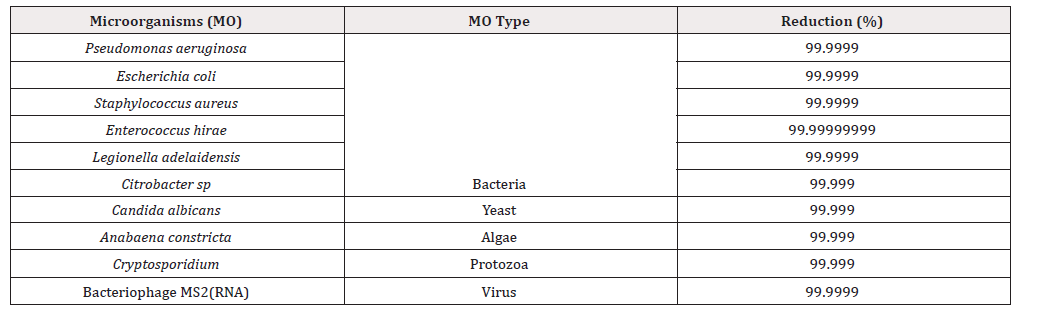
Table 2:The list of microorganisms is a compilation of 5 years of independent laboratory results for in vitro testing of the Electrocide product and the related disinfection effectiveness for each species.
Immune Cell Activation (e.g., T-Cell Activation)
Crucially, studies suggest that ELECTROCIDE™ may act as an immunomodulator by stimulating specific immune responses. Notably, there is a theoretical proposition and observation from preclinical studies that T-cell activation may begin rapidly (e.g., within one hour) following ELECTROCIDE™ administration. T-cells are central to adaptive immunity, responsible for recognizing and eliminating infected cells and coordinating broader immune responses. The proposed mechanism involves:
a. Modulation of Antigen Presentation: The degradation of
pathogens by ELECTROCIDE™ could influence how antigens
are presented to antigen-presenting cells (APCs), potentially
enhancing the initiation of adaptive immune responses.
b. Altering Cytokine Milieu: ELECTROCIDE™ might impact the
local cytokine environment, which are signalling molecules
crucial for T-cell activation, differentiation, and function.
c. Indirect Micro-effects: By controlling pathogen load or altering
inflammatory conditions, ELECTROCIDE™ could indirectly
influence the overall immune response and subsequent T-cell
activation.
d. Neutrophil Stimulation: Some observations suggest immediate
stimulation of neutrophil processes (key innate immune
cells) and fibroblast production, which are involved in wound
healing and tissue repair.
ELECTROCIDE™ in Respiratory Protection
Respiratory diseases, ranging from common viral infections to more severe conditions, pose significant public health challenges. The potential antipathogenic and immunomodulatory effects of ELECTROCIDE™ suggest several avenues for its application in respiratory protection:
Direct Pathogen Mitigation
By directly targeting and disrupting respiratory pathogens, ELECTROCIDE™ could help reduce viral or bacterial load in the respiratory tract, potentially shortening the duration or severity of infections. This could be particularly relevant for preventing pathogen replication at early stages of exposure.
Enhancing Innate Immune Response
The proposed stimulation of neutrophils and other initial immune responses by ELECTROCIDE™ could bolster the body’s first line of defense against inhaled pathogens, preventing their establishment and spread within the respiratory system.
Adjuvant for Vaccination Strategies
If ELECTROCIDE™ consistently demonstrates T-cell activation and effective antigen presentation modulation, it could be explored as a novel immune adjuvant when co-administered with existing or new vaccines for respiratory diseases. An adjuvant helps to strengthen and prolong the immune response generated by a vaccine, potentially leading to more robust and durable protection. This could be especially beneficial for vulnerable populations or against rapidly mutating viruses where current vaccine efficacy may be suboptimal.
Post-Infection Support
Early studies, such as those related to post-COVID-19 wellness, suggest ELECTROCIDE™ might contribute to symptom recovery, possibly by supporting immune function and overall well-being during and after respiratory bacterial and viral challenges.
Conclusion
Combining oral and nasal administration of Electrocide® leverages oral delivery for gut mucosal immunity and systemic support, and nasal delivery for respiratory mucosal protection and enhanced systemic immunity. This dual approach offers a versatile, synergistic immunotherapy for COVID-19, Flu A & B, and RSV, with non-invasive delivery ensuring accessibility. While specific studies on nasal Electrocide® are limited, general research on mucosal vaccines supports its potential, with future clinical trials needed to validate efficacy and optimize formulations. ELECTROCIDE™ represents a compelling, novel approach in the field of immune health, offering a dual promise in combating respiratory diseases and potentially modulating autoimmune conditions. Its proposed antipathogenic action, coupled with its ability to influence key immune components like T-cells, positions it as a versatile immunomodulator. ELECTROCIDE™ may be a significant addition to the arsenal of strategies for unlocking and optimizing human immunity, leading to improved global health outcomes against both bacterial and viral infectious threats.
Acknowledgement
None.
Conflict of Interest
None.
References
- Sonnenschein L, Etyang T (2021) The Effect of An Aqueous Electricidal Solution on General Well Being. American Journal of Biomedical Science Research 13(4): 477-483.
- Kiyono H, Ernst PB (2025) Nasal vaccines for respiratory infections. Nature 641(8062): 321-330.
- Holmgren J, Czerkinsky C (2005) Mucosal immunity and vaccines. Nature Immunology 6(10): 967-973.
- Shattock RJ, Moore PL (2025) Nasal vaccines for respiratory infections. Nature 643(8073): 296-304.
- Paraskevi C Fragkou, Charalampos D Moschopoulos, Rieke Reiter, Thilo Berger, Chrysanthi Skevaki, et al. (2022) Host immune responses and possible therapeutic targets for viral respiratory tract infections in susceptible populations: a narrative review. Clinical Microbiology and Infection 28(10): 1328-1334.
- Tamura S (2001) Efficacy of vaccination with live attenuated, cold-adapted, trivalent, intranasal influenza virus vaccine against a variant (A/Sydney) not contained in the vaccine. The Journal of Pediatrics 138(6): 844-848.
- Tuggle DL, Robert W (2001) Intranasal immunization with a replication-deficient adenoviral vector expressing the respiratory syncytial virus (RSV) G protein is protective against RSV challenge in BALB/c mice. The Journal of Infectious Diseases 184(12): 1557-1565.
- Sonnenschein L, Etyang T, Manga S, Wong E (2023) An Initial Evaluation of the Effectiveness of a Dietary Supplement Regimen on the Effects of Post-COVID Infection. Am J Biomed Sci Res 18(6).
- Liu Y, Sawalha AH, Lu Q (2021) COVID-19 and autoimmune diseases. Current Opinion in Rheumatology 33(2): 155-162.
- Sonnenschein L, Etyang T (2024) Connecting Microbiomes: From Soil to Human Health across Ecosystems. WSEAS Transactions on Environment and Development 20: 924-939.
- Béré K Diallo, Caitlín Ní Chasaide, Ting Y Wong, Pauline Schmitt, Katherine S Lee, et al. (2023) Intranasal COVID-19 vaccine induces respiratory memory T cells and protects K18-hACE mice against SARS-CoV-2 infection. npj Vaccines 8(1): 68.
- Suguru O (2025) An intranasal subunit vaccine induces protective systemic and mucosal antibody immunity against respiratory viruses in mouse models. Nature Communications 16(1): 4053.
- Yamauchi S (2023) Intranasal vaccination with lipid-conjugated immunogens promotes antigen transmucosal uptake to drive mucosal and systemic immunity. Science Translational Medicine 15(681): eabn1413.




 We use cookies to ensure you get the best experience on our website.