
Mini Review 
 Creative Commons, CC-BY
Why is Gaseous Water Lighter than Liquid Water?
*Corresponding author: Prof. Dr. Konstantin Meyl, Professor, Electric Drives and Power Electronics, Furtwangen University, Germany.
Received:May 24, 2025; Published:May 27, 2025
DOI: 10.34297/AJBSR.2025.27.003536
Abstract
Clouds are lighter than the water they are made of. When they become gaseous (e.g. by heating), the volume increases by a factor of
1672. This makes the gas lighter than the air.
The question has been occupying scientists for over 200 years, when water rises from a large surface as fog to form clouds. A publication
by the Italian Avogadro (1811) had prompted the French scholar Ampère to write a letter to Count Berthollet and to publish
it immediately (1814) in the Annals of Chemistry [1].
The Magnetic Field of an Atom
Of course, at that time, due to ignorance, everyone defined for themselves what they wanted to understand as a particle or what they wanted to regard as a component of an atom or a molecule. Today, the 8 particles are recognized as shell electrons that form an electron ring around the nucleus.
The electric field ensures order among the electrons in the shell. These in turn rotate around their own axis under the electron spin (v).
As a result, they form a north pole in one direction and a south pole in the opposite direction. The spheres thus become magnetic dipoles (Figure 1).

Figure 1:Electrons in the atomic shell of a gas.
The North Pole is looking for a South Pole to connect and vice versa. Each dipole strives to compensate for its charge. The particle thus no longer exerts a magnetic force on the outside and behaves as if it were non-magnetic.
At least for all those who “believe” Bohr’s “laws” and postulates, gas has no magnetic field. In return, they accept that the important connections of electrical engineering lose their validity.
In fact, the magnetic field provides order among the numerous swirling envelope electrons; for example, for the exactly 8 pieces that are characteristic of gas, as Ampere established 200 years ago on the basis of simple observation [1].
For the quantum number n = 2, the 2.n2 = 8 electrons form the magnetically tightly coupled ring. But 100° Celsius is necessary for this. Due to the increased temperature, the electrons in the shell are lifted by their inertia onto the path further out.
There they are magnetically held by other envelope electrons and effectively prevent them from falling back into the nucleus (to d2 = 424 pm).
At the same time, a floating state is reached, as each individual particle has increased enormously in volume at the same weight, i.e. with reduced density. This means that 1 liter of water converted to gas at 100° increases its volume to 1672 liters.
Gaseous Water
The water molecule has 10 electrons, 8 of which form a ring from about 100°C. The 2 remaining electrons form the inner shell in the oxygen atom.
The two hydrogen atoms retain their dipole character when they become gaseous. At the same time, a magnetic force is exerted by the other ring electrons, which traps them in the ring. There is no longer an electrical bond with the core.
If the temperature drops just a little below 100°, the water (H2O) recedes (and it rains) (Figure 2).
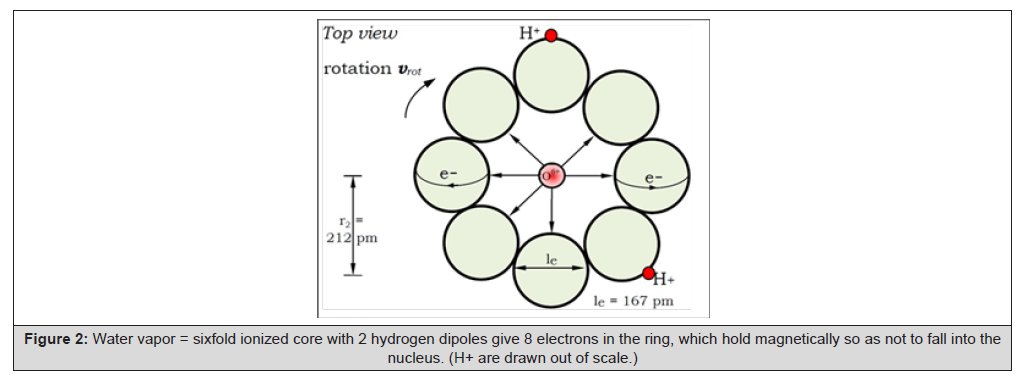
Figure 2:Water vapor = sixfold ionized core with 2 hydrogen dipoles give 8 electrons in the ring, which hold magnetically so as not to fall into the nucleus. (H+ are drawn out of scale.)
This does not yet explain the fogging of the mirror during a shower (at about 30° Celsius).
Cold water (4°C to 40°C)
Cold water is assumed. It should not be more than 40°C, at which the water colloids disintegrate, and not less than 4°C, at which water freezes into ice.
In the range between 4° and 40°Cesius, stacked water dipoles can be seen as structure-creating colloids. They arrange themselves in a circle and thus form a layer of water.
This molecular structure is known as polywater and is under discussion [2] (Figure 3).
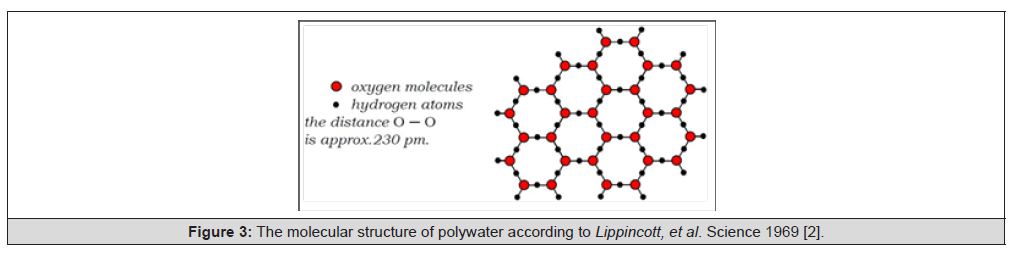
Figure 3:The molecular structure of polywater according to Lippincott, et al. Science 1969 [2].
Further layers can form above and below it. The planes can by no means hold together electrostatically, as some mistakenly imagine [3]. The electric field is comparatively weak compared to the dominant magnetic field, which is perpendicular to it and also points to the neighboring plane (e.g. from oxygen to oxygen).
One layer can be magnetically attracted to the other, even with the same electrical charge. On the one hand, it explains why water has the greatest density at 4°C, and on the other hand, it explains why a fusion of two water molecules is possible.
The Fusion Process in Water
Water exhibits the usual behavior: its density increases the colder the water is, or in other words, the smaller the thermal movement. As a result, the molecules come closer to each other and do not repel each other. Below 4°C, however, the water changes its structure and density. Its volume increases when it freezes into ice.
That’s why the ice floats on the water.
Molecularly, the reduced density can be explained by hydrogen nuclei that slide between the layers of polywater, between two oxygen molecules. The reason for this is the magnetic field that holds the layers together. At the freezing point, however, it loses its effect, especially the magnetic attraction, because the movement comes to a standstill.
Let’s stay with the liquid water between 4° and about 40°C. Here, the magnetic field, which is perpendicular to the electric field, dominates. The layer above or below must have field pointers pointing in the same direction, which means that the layers are always stacked on top of each other.
If, for example, an oxygen atom has the North Pole above, it sees the neighboring atom from below. He sees his South Pole and feels magnetically attracted (Figure 4).

Figure 4:
Due to the magnetic attraction, but also due to the open design, one water core comes very close to the core of another, which is why fusion can occur spontaneously.
An O2 is formed as a new core. Each O still remains connected to the H2, so that the result is H4O2. It always occurs in gaseous form (n = 2).
Fog and Clouds
An extensive and cold sea surface fulfils the prerequisite for fusion. The gas rises as a fog and then becomes relatively stable as clouds. They consist mainly of H4 O2 (Figure 5).

Figure 5:the development of a fog in clouds in the gaseous state as H4 O2.
While the four protons initially take up space inside, they move one by one to the outside, thereby enlarging the ring and reducing its density.
During the conversion, the fog rises and the clouds can collect at an altitude of approx. 1000 metres.
Let us consider the stations that two hydrogen atoms can assume as stable forms (Figure 6)
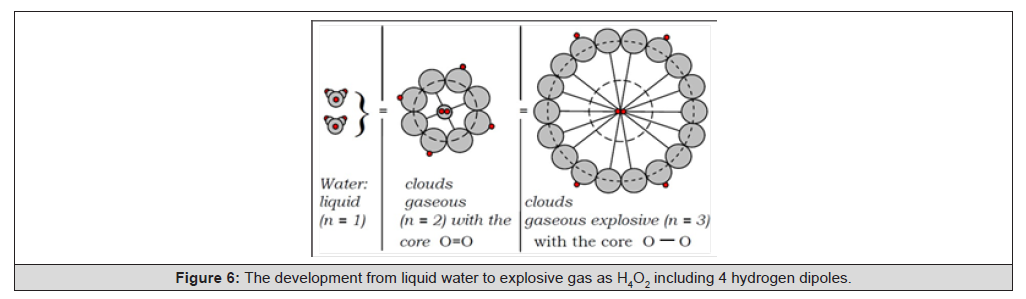
Figure 6:The development from liquid water to explosive gas as H4 O2 including 4 hydrogen dipoles.
As already mentioned, they are very stable as clouds. However, if they are disturbed, e.g. compressed, they disintegrate into water (It rains)
Lightning and Thunder
Figure 6 shows another gaseous and explosive structure that occurs at the quantum number n = 3. This requires 2.n2 = 18 electrons, which H4 O2 can also provide. One pair of electrons is still left, which binds the two oxygen atoms to each other (Figure 6). There is lightning and thunder, they say.
The lightning is the optical sign, the thunder the acoustic sign that the volume is increasing here. However, this requires a high level of tension, which does not occur in the clouds.
The lightning must be ignited with ozone. In ozone, three oxygen atoms have to fuse. They have already reached their critical temperature at -12°Celsius [4], at which they change their state from n = 2 to n = 3. At such temperatures, as they occur in clouds, a pre-discharge can take place (even with ozone-containing water: H6 O3 in n = 3).
Due to the increase in volume, there is an increase in temperature, which is necessary for the gaseous explosive form. Now (at more than TKrit = 374°C) the actual lightning can occur.
This is always associated with some rain, when the H6 O3 gas breaks down into H4 O2 + H2 O and further into 3 H2 O, it rains. (q.e.d.).
References
- Letter from Mr. Ampère to Count Berthollet (1814): on the determination of the proportions in which bodies combine according to the number and respective arrangement of the molecules of which the integral parts are composed. Annales de chimie 90(1): 43-86.
- Lippincott ER, Stromberg RR, Grant WH, Cessac GL (1969) Polywater. Science 164(3887): 1482-1487.
- Pollack GH, Wasser VAK Verlags GmbH (2010) Seite 81, ISBN 978-3-86731-158-8.
- Riesenfeld EH (1927) Das Ozon, seine Bildung und Verwendung. Naturwissenschaften 15: 777-784.




 We use cookies to ensure you get the best experience on our website.