
Research Article 
 Creative Commons, CC-BY
Financial Assessment of the Mango Processing Industry: A Case of Dehydrated Mango Cubes in Pune, Maharashtra
*Corresponding author:Neha A Godase, Research Scholar, College of Management, MIT Pune, Pune, Maharashtra, India.
Received:August 14, 2025; Published:September 16, 2025
DOI: 10.34297/AJBSR.2025.28.003694
Abstract
Background: The fruit and vegetable processing industry holds significant potential in enhancing the value of agricultural produce. India ranks
third globally in the production of dried fruits and vegetables, yet the sector remains largely decentralized, dominated by small-scale units with
capacities of up to 250 tons per annum. Despite abundant raw material availability, commercial processing accounts for only about 2.2% of total
food production. Expanding this industry can substantially benefit the economy by improving agricultural yields, increasing productivity, generating
rural employment, and uplifting living standards. Dehydration technology offers a viable value addition strategy, extending shelf life, reducing storage
space requirements, and facilitating easier transportation. Given the seasonal availability of many fruits and vegetables, dehydration provides
a sustainable means of ensuring year-round supply, meeting consumer demand, and reducing post-harvest losses. This study focuses on evaluating
the economic potential of dehydrated fruit and vegetable processing, with special reference to dry mango cubes in Pune District, Maharashtra.
The findings aim to provide insights for enhancing operational efficiency, improving profitability, and fostering sustainable growth in the dehydration-
based value chain.
Objectives: The research outlook was studied with following points.
a) To analyze the procurement practices and supply chain management of mango for processing.
b) To estimate the capital investment requirements of the mango processing industry.
c) To evaluate the operational performance and economic feasibility of the processing industry.
Methodology: Research Conducted at Naturals Agro Private Limited, located at Manjari Budruk in Pune district of Maharashtra. The dehydration
unit was purposively selected to analyze the economics of dehydrated fruits and vegetables, with a specific focus on Dry Mango powder. Primary data
were obtained through personal interviews with the company’s Managing Director and operational staff, while secondary data were sourced from
annual reports, company records, and relevant online resources.
Analysis of Data: This is done with the help of various type of mathematical & statistical tools like graph, table, charts & various formulas. The data
phased on fixed cost, variable cost, Net Present worth, Breakeven point, Benefit cost ratio and payback period to work out the efficiency and feasibility
of processing industries.
Result:
a) Total capital investment required for processing unit of fruits and vegetables is Rs.51,83,000.
b) Processing cost of Mango Cubes is Rs. 3,714/Kg and its sale price is Rs 6000/Kg. Company gets profit of Rs 2,286/Kg.
c) B:C Ratio of Mango Cubes is 1.6.
Keywords:Dehydrated products, Project cost, Processing, Financial ratio, Breakeven point
Introduction
India is the world’s second-largest producer of fruits and vegetables, after China, contributing approximately 15% of global vegetable production. For several crops, the country ranks either first or second in production. Despite this remarkable output, the highly perishable nature of fruits and vegetables results in substantial post-harvest losses-estimated at 20–30%-across the supply chain, largely due to inadequate post-harvest management and storage infrastructure. Furthermore, only about 2% of the total produce is processed into value-added products, while the majority is consumed fresh. This underlines a significant opportunity for the food processing sector to reduce wastage, enhance value addition, and contribute to income generation and employment creation, particularly in rural areas [1].
Agro-processing is increasingly recognized as a sunrise sector in the Indian economy, given its high growth potential and socio- economic relevance. In developed nations, up to 14% of the workforce is engaged-directly or indirectly-in agro-processing, underscoring its importance as an employment driver. In India, the cultural preference for fresh produce has historically been supported by the seasonal abundance and affordability of fruits and vegetables. However, recent years have witnessed a growing demand for processed products such as canned pineapple, mango slices and pulp, grapes, apples, and peaches, as well as value-added forms like concentrated juices, fruit powders, jams, and jellies.
Processing techniques such as dehydration extend the usability of seasonal produce, enabling long-term storage-often up to five years or more when hermetically sealed-while retaining much of the nutritional value. Dehydrated products can be consumed directly, used in cooking, or serve as ingredients in instant noodles, soups, snacks, and convenience foods. This not only helps stabilize market supply during off-seasons but also supports food security and reduces dependency on imports [2].
About Mango and Mango Cube
Mango is a tropical fruit of high economic and cultural importance, often referred to as the “King of Fruits.” India is the largest producer globally, with Maharashtra being a significant contributor, particularly in cultivars like Alphonso, Kesar, and Totapuri.
However, due to its high perishability (post-harvest losses of 20–25%), value addition through dehydration into mango cubes is an effective strategy for shelf-life extension, reducing wastage, and enabling year-round consumption.
Dehydrated mango cubes are small, uniformly cut mango pieces (typically 1–2 cm³) processed to reduce moisture content from ~80–85% in fresh fruit to 10–15% in the final product [3].
They retain much of the natural colour, flavour, and nutrients,
and are used in:
a) Breakfast cereals and snack bars
b) Bakery products
c) Dairy products (yogurt mix-ins, ice creams)
d) Confectionery and trail mixes
e) Ready-to-eat (RTE) snacks
Nutritional & Functional Benefits
a) Rich in β-carotene (Pro-vitamin A): Supports vision and immunity.
b) Dietary fiber: Promotes digestive health.
c) Polyphenols and antioxidants: Offer anti-inflammatory and anti-
aging benefits.
d) Low water activity: Inhibits microbial growth, extending shelf
life.
Objectives
The research outlook was studied with following points.
a) To analyze the procurement practices and supply chain management
of mango for processing.
b) To estimate the capital investment requirements of the mango
processing industry.
c) To evaluate the operational performance and economic feasibility
of the processing industry.
Methodology
The dehydration unit “Naturals Agro Private Limited” located at Manjari Budruk in Pune district has been selected purposively for working out economics of dehydration of Moringa. Primary data were collected with the help of personal interaction with the Company’s Managing Director and Workers. Secondary data were collected from annual report, internet and company records [4].
Analytical Tools
The collected data were analyzed by using simple statistical
techniques such as average, percentage and presented in tabular
and graphical methods. Data Analysis is done with mathematical &
statistical tools like –
a) Table
b) Formulas
Results and Discussion
Dehydrated Products Range
There is wide range of agricultural products which can be dehydrated and marketed locally or internationally. The information on dehydrated products viz; vegetables, from selected unit is given in Table 1,2,3, respectively (Table 1,2,3,).

Table 1: Dehydrated Vegetable Products produced in Naturals Agro unit.

Table 2: Dehydrated Fruit products produced in Naturals Agro unit.

Table 3: Dehydrated Medicinal plant products produced in Naturals Agro unit.
Procurement of Fresh Mango in Kg and prices at different time period in (2021-22) In order to cover the objective of calculating the processing cost of Dry mango the data of total procurement of fresh mango made by the company was collected and given in (Table 4).
The Table 4, provides the information about the quantity of fresh mango is procured 50 kg and 13 kg with the price Rs.500 for Alphanso and Rs.350 keshar, per kg in the month of may and June respectively [5].

Table 4: Procurement prices at different time period of Fresh Mango.
From above, it was observed that the procurement of mango is done only in the month of May and June, as it is a seasonal fruit it is only available in summer season and there is optimum availability of mango from the month of March on words but as the company gets mango in affordable prices in the month of june and july that’s why the company prefer to procure mango in those two months from kokan region [6].
Project Cost
This research suggests a plant with an average capital investment Rs. 51,83,000, with minimum human resource requirement of five people, where at least one manager is mandatory. The average electricity and water costing for processing unit is 3,90,000 (Table 5).
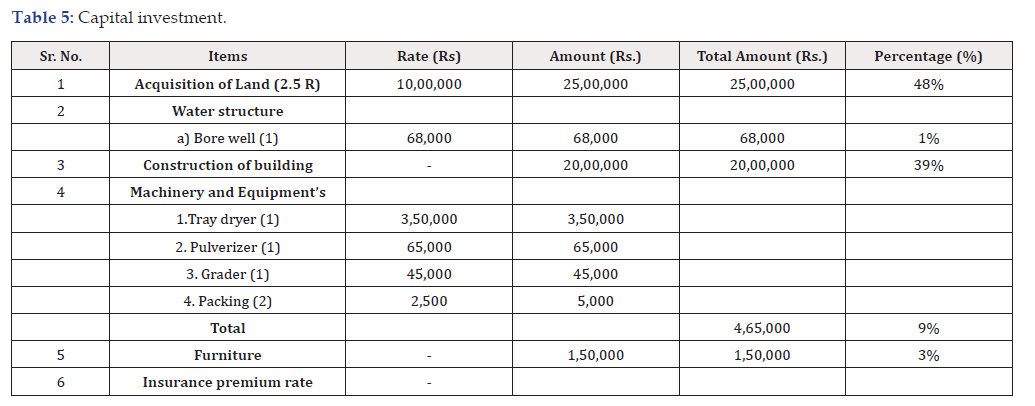
Table 5: Capital investment.
Human Resource Requirements
For running a small processing unit, a single manager is sufficient for managing all the activities which are carried out in processing unit and minimum human resource requirement is as follows (Table 6A).
Electricity and Water Charges
The fruits and vegetables processing unit average electricity and water charges as given below (Table 6B).
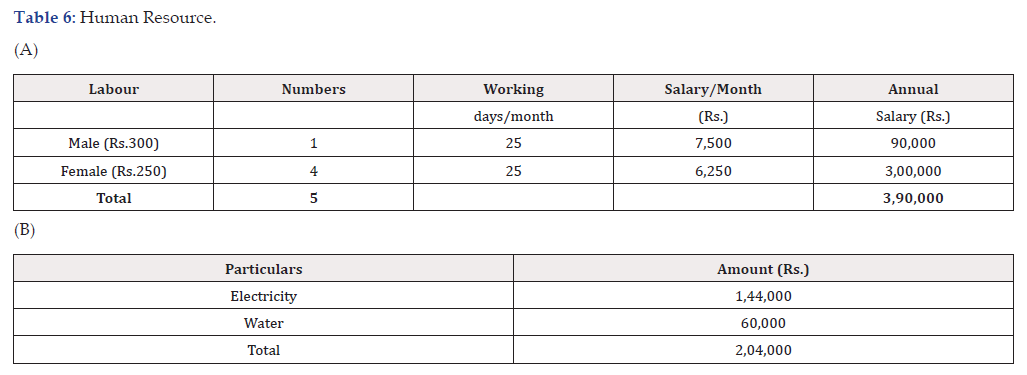
Table 6:Human Resource
Mango Cubes
Processing Quantity of dry cubes and price of fresh mangos mentioned in the (Table 7).
The Table 7, provides the information about the quantity of dry mango cubes is processed
8 kg, and 2 kg in the month of May and June respectively. 40 kg and 10 kg fresh mango is required for making 8 kg and 2 kg dry mango cubes respectively. The processing of mango cubes is done only in the month of May and June, as it is a seasonal fruit it is cultivated in summer season and there is optimum availability of mango from the month of March on words but as the company gets mango in affordable prices in the month of June and July that’s why the company prefer to procure mango in those two months from kokan region [7].

Table 7: Processing Quantity of Mango cubes (2021-22).
Per Unit Cost of Processing of Dry Mango Cubes
Some cost required to process the product. Per unit Cost of processing of Dry Mango cubes mentioned in the following (Table 8)
The above table shows that fixed cost and variable cost required for processing. Total fixed cost and variable cost required for processing is Rs.1825.65 and Rs.35,576.8 respectively. The fixed cost and variable cost per kg is Rs. 182.56 and Rs. 3557.6 [8].
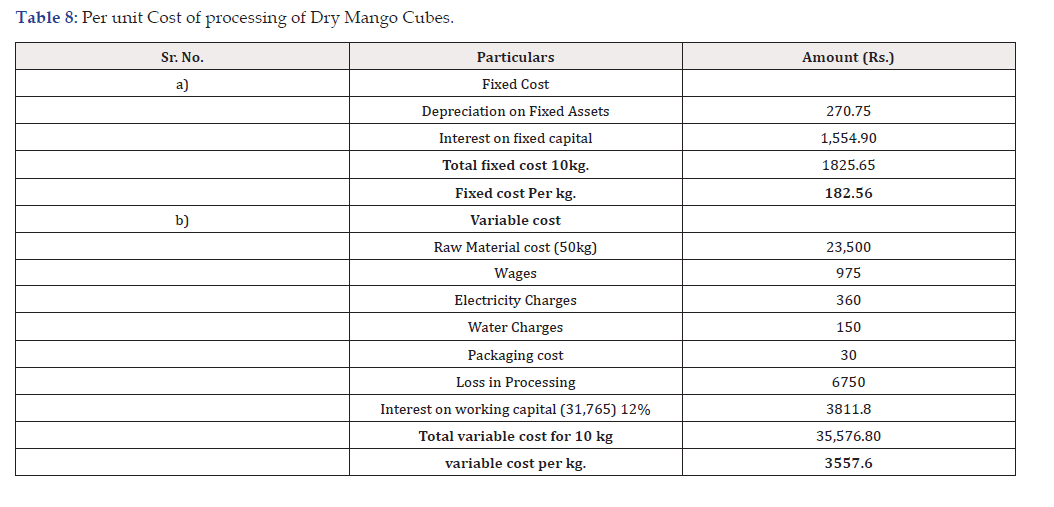
Table 8: Per unit Cost of processing of Dry Mango Cubes.
Total Cost for Processing
Total cost for processing mentioned in the following (Table 9)

Table 9: Total cost for processing.
Income During the Year 2021-22
Income during the year 2021-22 is given in (Table 10)
From Table 10, it is observed that company gets profit Rs 22,598.35 by sale of 10 kg of dry mango cubes. Price per kg of dry mango cubes is Rs.6000 and cost of production is Rs. 3740.16 hence total cost is also Rs 37,401.65. and total income is Rs 60,000.
Benefit Cost Ratio of Dry Mango Cubes BCR
= Gross income / Total cost of production BCR
= 60,000/ 37,401.65
BCR = 1.6
Here, we compare the Present worth of Gross income with Present worth of Cost. BCR was more than one, i.e. 1.6 was indicate Project was satisfactory. B:C Ratio indicates the, how much amount of money is received after investing Rs 1/-. For Natural agro project B:C Ratio is 1.6 means, when we investing Rs 1/- then we received Rs 1.6/-

Table 10: Income during the year.
Conclusion
a) The total procurement of Mango was 63kg which cost Rs.
30,250 which was procured in the month of May and June
(2021-22).
b) Total capital investment required for processing unit of fruits
and vegetables is Rs.51,83,000.
c) Processing cost of Mango Cubes is Rs. 3,714/Kg and its sale
price is Rs 6000/Kg. Company gets profit of Rs 2,286/Kg.
d) B:C Ratio of Mango Cubes is 1.6.
Acknowledgment
None.
Conflict of Interest
None.
References
- Deshmukh SA (2011) Productivity and Supply of Food grains in India. Chapter in book Towards a Food Secure India-Issues and Policies edited by S. Mahendra Dev, K.P. Kannan and Nira Ramachandran: Pp 33-58, Institute of Human Development and Centre for Economic and Social Studies, New Delhi.
- Hossain (2002) Productivity and Sources of Growth for Groundnut and Rapeseed & Mustard in India. Indian Journal of Agricultural Economics 57(3): 387.
- Praduman Kumar (1998) Market Prospects for Horticultural Products in India. Agricultural Economic Research Review 11 (1): 35-47.
- Praduman Kumar (2003) Crop Diversification in India: Analysis by State and Farm Size Group. Agricultural Situation in India, Special Number, August, 2003. Directorate of Economics and Statistics, Ministry of Agriculture, Government of India 273-280.
- Praduman Kumar (2012) Literacy, Technology Adoption, Factor Demand and Productivity: An Econometric Analysis. Indian Journal of Agricultural Economics 55(3): 490-499 Conference issue.
- Nwankwo S, Chibuzo (2021) Technological advancements in the drying of fruits and vegetables: A review.’ African Journal of Food Science 15(12): 367-379.
- Sagar VR, PS Kumar (2010) Recent advances in drying and dehydration of fruits and vegetables a review. Journal of Food Science Technology 47: 15-26.
- Wladimir E Soto-silva (2016) Operational research models applied to the fresh fruit supply chain. European Journal of Operational Research 251 (2): 345-355.




 We use cookies to ensure you get the best experience on our website.