
Case Report 
 Creative Commons, CC-BY
From Surrogates to Signals: Regulatory Biomarker Interpretation in a Real-World Case of Tirzepatide (Mounjaro) Therapy
*Corresponding author:John Bolodeoku, Centre for Pharmaceutical Medicine Research, Faculty of Life Sciences & Medicine, King’s College London, UK, john.1.bolodeoku@kcl.ac.uk.
Received:October 13, 2025; Published:October 23, 2025
DOI: 10.34297/AJBSR.2025.28.003735
Introduction
The escalating global prevalence of obesity has emerged as a critical public health challenge, with profound implications for morbidity, mortality, and healthcare systems worldwide. Recognized as a chronic, relapsing, and multifactorial disease, obesity is strongly associated with an increased risk of cardiovascular disease, type 2 diabetes mellitus, non-alcoholic fatty liver disease, and several malignancies. Its complex pathophysiology encompassing genetic, metabolic, behavioural, and environmental factors necessitates a multifaceted therapeutic approach.
In response to this growing burden, the development of pharmacologic agents aimed at weight reduction has accelerated, transitioning from traditional appetite suppressants to more targeted and mechanistically sophisticated therapies. Among the most promising are incretin-based agents, particularly Glucagon-Like Peptide-1 (GLP-1) receptor agonists, which have demonstrated efficacy not only in weight loss but also in improving glycaemic control and cardiovascular outcomes.
Central to the development, evaluation, and regulatory approval of these therapies is the role of biomarkers. Biomarkers serve as critical tools for assessing pharmacodynamic responses, predicting therapeutic efficacy, monitoring safety, and elucidating mechanisms of action. Their integration into clinical trials and regulatory frameworks enhances the precision and efficiency of drug development, enabling more tailored and evidence-based interventions.
To systematically evaluate the utility of biomarkers in the context of anti-obesity pharmacotherapy, this review applies the U.S. Food and Drug Administration’s BEST (Biomarkers, EndpointS, and other Tools) Resource classification. This framework categorizes biomarkers into distinct functional types diagnostic, prognostic, predictive, pharmacodynamic, safety, and surrogate endpoints each with specific applications in clinical and regulatory decision-making. By mapping current and emerging biomarkers against the BEST taxonomy, the aim is to provide a structured overview of their roles in the development and monitoring of weight-reducing agents, and to identify gaps and opportunities for future research and innovation.
FDA Biomarker Classification
The FDA defines biomarkers as measurable indicators of biological
processes, pathogenic processes, or pharmacologic responses.
The six major categories are:
a. Diagnostic biomarkers: Identify the presence of disease or
condition.
b. Prognostic biomarkers: Predict disease progression or outcome.
c. Predictive biomarkers: Forecast response to a specific therapy.
d. Pharmacodynamic/response biomarkers: Indicate biological
response to intervention.
e. Safety biomarkers: Signal potential adverse effects.
f. Surrogate endpoint biomarkers: Substitute for clinical endpoints
to predict therapeutic benefit [1].
Application to Weight-Reducing Drugs
a. Diagnostic Biomarkers: Body Mass Index (BMI) remains the
primary diagnostic biomarker for obesity. However, its limitations
in distinguishing fat from lean mass have prompted in
terest in waist circumference, visceral adiposity via imaging,
and circulating adipokines such as leptin and adiponectin [2].
b. Prognostic Biomarkers: Markers such as fasting insulin, HOMA-
IR, and inflammatory cytokines (e.g., IL-6, CRP) predict
metabolic risk and progression to type 2 diabetes. These biomarkers
help stratify patients likely to benefit from early pharmacologic
intervention [3].
c. Predictive Biomarkers: Genetic variants (e.g., FTO, MC4R)
and gut microbiome signatures may predict responsiveness
to weight-loss drugs. For example, GLP-1 receptor polymorphisms
have been associated with differential response to
semaglutide [4].
d. Pharmacodynamic/Response Biomarkers: Changes in appetite-
regulating hormones (GLP-1, GIP, ghrelin), resting energy
expenditure, and body composition (via DEXA or MRI) serve as
response biomarkers. These are increasingly used in trials to
monitor therapeutic impact beyond weight alone [5].
e. Safety Biomarkers: Liver enzymes (ALT, AST), renal function
markers (creatinine, eGFR), and cardiovascular indicators
(BP, ECG changes) are routinely monitored to detect adverse
effects. Emerging safety biomarkers include cardiac troponins
and NT-proBNP in high-risk populations [6].
f. Surrogate Endpoint Biomarkers: Weight loss percentage and
reduction in waist circumference are accepted surrogate endpoints.
However, the FDA’s 2025 guidance emphasizes sustained
reduction in adiposity and preservation of lean mass as
more meaningful endpoints [7].
Case Study
A non-diabetic volunteer started on tirzepatide and after 4 months treatment had the following results, his results pre and post treatment were compared applying the categories where possible [8].
Surrogate Endpoint Biomarkers
Over the course of tirzepatide therapy, the patient demonstrated clinically meaningful improvements across key surrogate endpoint biomarkers. Body weight decreased by nearly 10 kg, accompanied by a reduction in BMI from 31.9 to 30.2 kg/m²-approaching the threshold between obesity and overweight. Fat mass declined by 3.6 kg, indicating a targeted reduction in adiposity. Triglyceride levels fell from 0.83 to 0.6 mmol/L, reflecting enhanced lipid metabolism. Systolic blood pressure dropped significantly from 149 to 124 mmHg, suggesting improved cardiovascular risk profile. Collectively, these changes signal a favourable therapeutic response and align with regulatory surrogate endpoints for metabolic health improvement (Table 1).
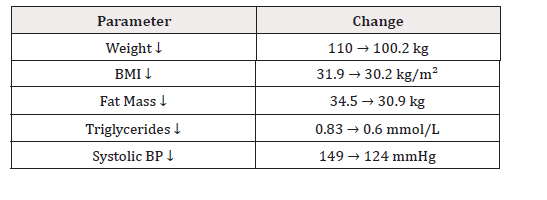
Table 1:
Pharmacodynamic/Response Biomarkers
Following tirzepatide therapy, the pharmacodynamic biomarker profile reveals a complex but biologically active response. Fasting glucose decreased markedly from 5.03 to 3.73 mmol/L, indicating improved glycaemic control. Paradoxically, insulin levels rose from 82 to 101.9 pmol/L, suggesting enhanced β-cell stimulation or reduced insulin clearance. C-peptide declined from 2.56 to 1.53 ng/mL, which may reflect reduced β-cell stress or improved insulin efficiency.
Adipokine remodelling was evident: leptin increased fourfold (4.9 to 20.9 μg/L), and resistin more than doubled (4.04 to 10.31 ng/mL), despite reductions in fat mass-highlighting possible compensatory signalling or transient inflammatory activation. Muscle mass declined modestly from 68.7 to 65.9 kg, warranting attention to lean tissue preservation during weight loss. Overall, these biomarkers reflect active metabolic recalibration with both expected and paradoxical shifts (Table 2).
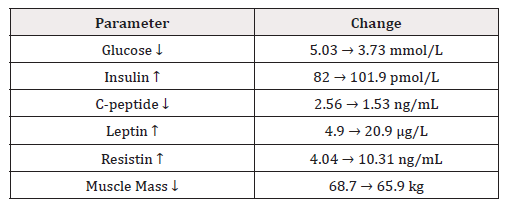
Table 2:
Safety Biomarkers
The safety biomarker profile following tirzepatide therapy indicates stable hepatic function and mild inflammatory fluctuation. Liver enzymes-ALT, AST, and GGT-all declined modestly, suggesting no evidence of hepatocellular injury or oxidative stress. In contrast, High-Sensitivity C-Reactive Protein (hsCRP) increased slightly from 0.91 to 1.12 mg/L, which may reflect transient adipose tissue remodelling or low-grade systemic inflammation. Overall, the safety profile remains favourable, with no biochemical signs of organ toxicity (Table 3).
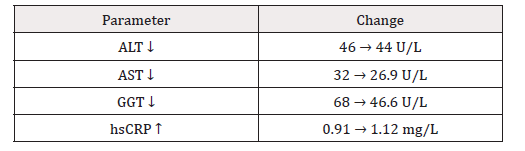
Table 3:
Diagnostic and Prognostic Biomarkers
The diagnostic and prognostic biomarker profile shows a modest rise in HbA1c from 38.72 to 40.98 mmol/mol, suggesting a slight increase in average blood glucose over the preceding weeks. This contrasts with the observed drop in fasting glucose, indicating possible glycaemic variability or delayed biomarker response. Pancreatic enzyme levels amylase and lipase rose slightly but remained within normal physiological ranges, reflecting stable pancreatic function with no biochemical evidence of pancreatitis or exocrine dysfunction. Overall, these changes warrant continued monitoring but do not indicate overt pathology (Table 4).

Table 4:
Interpretation and Clinical Implications
a. Weight and adiposity reductions confirm tirzepatide’s efficacy,
aligning with surrogate endpoints used in regulatory trials.
b. Glycaemic and lipid improvements reflect pharmacodynamic
response, though the rise in insulin and leptin suggests complex
endocrine remodelling.
c. Liver and pancreatic biomarkers remain stable, supporting a
favourable safety profile.
d. Inflammatory and adipokine shifts (hsCRP, resistin) may indicate
tissue remodelling rather than adverse inflammation.
There are some paradoxes, but these do not undermine therapeutic
efficacy but highlight the complexity of endocrine and immunometabolic
adaptation. They underscore the need for:
a. Temporal biomarker mapping: Single time-point comparisons
may miss dynamic trajectories.
b. Functional assays: Beyond quantity, assessing biomarker activity
(e.g., leptin sensitivity) may yield deeper insights.
c. Integrated interpretation: Biomarkers must be contextualized
within clinical outcomes, imaging, and patient-reported metrics.
Acknowledgments
None.
Conflict of Interest
None.
References
- (2016) FDA-NIH Biomarker Working Group. BEST (Biomarkers, EndpointS, and other Tools) Resource. U.S. Food and Drug Administration. Available from: https://www.ncbi.nlm.nih.gov/books/NBK326791/.
- Bray GA, Kim KK, Wilding JPH (2017) World Obesity Federation. Obesity: a chronic relapsing progressive disease process. A position statement of the World Obesity Federation. Obes Rev 18(7): 715-723.
- Weyer C, Bogardus C, Mott DM, Pratley RE (1999) The natural history of insulin secretory dysfunction and insulin resistance in the pathogenesis of type 2 diabetes mellitus. J Clin Invest 104(6): 787-794.
- Nauck MA, Quast DR, Wefers J, Meier JJ (2021) GLP-1 receptor agonists in the treatment of type 2 diabetes - state-of-the-art. Mol Metab 46: 101102.
- Pi Sunyer FX (2005) Weight loss in type 2 diabetic patients. Diabetes Care 28(6): 1526-7.
- Wilding JPH, Batterham RL, Calanna S, Davies M, Van Gaal LF (2021) STEP 1 Study Group. Once-Weekly Semaglutide in Adults with Overweight or Obesity. N Engl J Med 384(11): 989-1002.
- (2025) FDA. Draft Guidance for Industry: Developing Drugs and Biological Products for Treatment of Obesity. Available from: https://www.fda.gov/media/175432/download.
- Clayton A, Dehn (2024) Advancing FDA Guidance on Weight Management Products: Prioritizing Body Composition in Obesity Therapies, J. Endocrinology and Disorders 8: 5.




 We use cookies to ensure you get the best experience on our website.