
Mini Review 
 Creative Commons, CC-BY
Impact of Dietary Nitrate from Beetroot Juice on Hemodynamics and Physical Performance: A Systematic Review and Meta-Analysis
*Corresponding author:Akash Kumar, Medical Research Center, Liaquat University of Medical and Health Sciences Jamshoro, Sindh, Pakistan.
Received:October 18, 2025; Published:October 30, 2025
DOI: 10.34297/AJBSR.2025.28.003743
The Faculty of Listening at the Source of Human Mind
Beetroot Juice (BRJ) has gained popularity among athletes due to its high nitrate (NO₃⁻) content, which can boost nitric oxide production and enhance exercise performance. However, the nitrate concentration in beets can vary widely, making it challenging to determine the exact amount of NO₃⁻ in any given product [1]. After consumption, dietary nitrate is converted into nitrite within the body, which is then stored and circulated in the bloodstream. Under low-oxygen conditions, nitrite can be further converted into nitric oxide—a molecule that plays a key role in regulating vascular function and metabolism [1]. Supplementation with dietary nitrate has been shown to increase plasma nitrite levels and lower resting blood pressure [1]. Interestingly, it also appears to reduce the oxygen demand of submaximal exercise and, in some cases, may improve exercise endurance and performance [2]. Nitric oxide has been found to enhance mitochondrial efficiency by increasing the amount of oxygen reduced per ATP produced—a measure known as the mitochondrial P/O ratio [3]. This mechanism may help explain the benefits observed in prior studies examining the cardiorespiratory aspects of aerobic exercise [3]. Evidence from a recent meta-analysis indicates that BRJ supplementation over periods ranging from 2 to 56 days can reduce Systolic Blood Pressure (SBP) by approximately 3.55 mm Hg and Diastolic Blood Pressure (DBP) by about 1.32 mm Hg in populations with and without arterial hypertension [4]. These findings are clinically significant, as even a modest 2 mm Hg decrease in blood pressure is associated with a 7% reduction in mortality from ischemic heart disease [4]. Some studies suggest that BRJ lowers blood pressure—particularly in individuals with hypertension—and may improve exercise performance, possibly by enhancing blood flow and muscle function. However, other studies have found no significant effects on blood pressure or exercise capacity, especially in healthy individuals. The objective of this analysis is to systematically assess the overall impact of beetroot juice supplementation on blood pressure, exercise performance, and nitrate levels by synthesizing data from multiple studies in athletes. It aims to determine whether BRJ consistently influences these outcomes, and to quantify both the extent and direction of its effects.
Methods
The search was performed across the Cochrane, Scopus, and PubMed databases without applying any language restrictions. The only studies that were included were randomized control trials and cohort studies with the intervention of beetroot juice. The mean age of participants across all studies was in between 17-31 years. Comparison was made in between beetroot juice group and the control group. The outcomes reported were diastolic blood pressure, systolic blood pressure, plasma nitrites, plasma lactates, heart rate, muscle power and oxygen demand. Baseline characteristics and outcomes were noted down on a excel spreadsheet. Data extraction and quality assessment were carried individually by 2 reviewers. For each outcome mean difference with 95% Confidence Intervals (CI) were extracted and pooled using the Mantel– Haenszel random- effects inverse variance model. Heterogeneity was evaluated using Higgins’ I² statistic, with a threshold of 50% or lower deemed acceptable. Sensitivity analyses were conducted by excluding studies identified as outliers in the forest plot. All statistical analysis was done using review manager.
Results
This meta-analysis included a total of 20 studies, comprising both randomized controlled trials and cohort studies [3,5-23]. to evaluate the differences in outcomes between the beetroot juice group and the control group. The pooled analysis showed a significant increase of plasma nitrites levels in the beetroot juice group compared to the control group (MD: 6.80; [95% CI: 3.17, 10.43]; P=0.0002; Figure 1A). Moreover use of beetroot juice supplementation increased diastolic blood pressure (MD: 2.14; [95% CI: -4.33, 8.62]; P = 0.5167; Figure 1B), decreased heart rate (MD: -0.44; [95% CI: -2.85, 1.97]; P = 0.7219; Figure 1C), decreased plasma lactate levels (MD: -0.14; [ 95% CI: -0.71, 0.43]; P = 0.6249; Figure 1D), increased muscle power (MD: 6.06; [95% CI: -2.03, 14.14]; P = 0.1420; Figure 1E), and decreased systolic blood pressure (MD: -2.50; [95% CI: -5.31, 0.30]; P = 0.0806; Figure 1F) but these results were statistically insignificant. Furthermore, no difference was seen in oxygen demand in both groups (MD: -0.00; [95% CI: -0.01, 0.00]; P = 0.0837; Figure 1G).
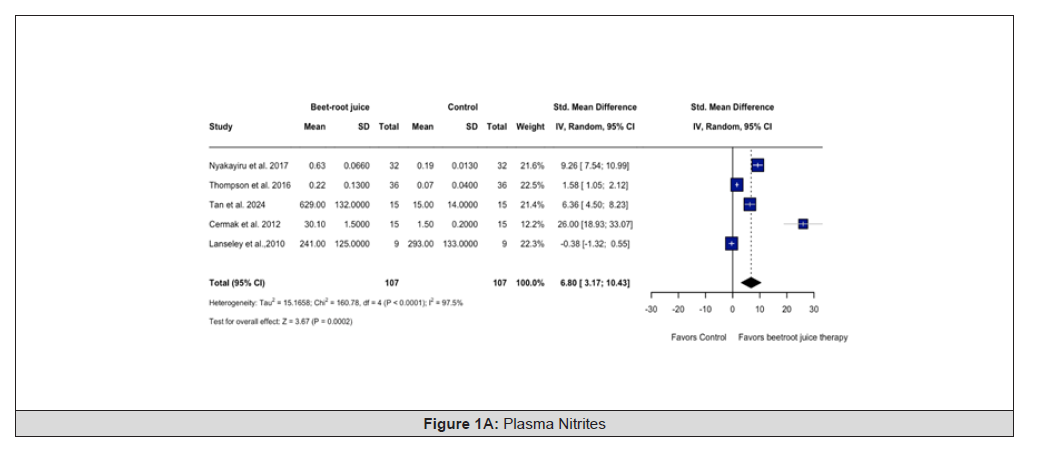
Figure 1A:Plasma Nitrites
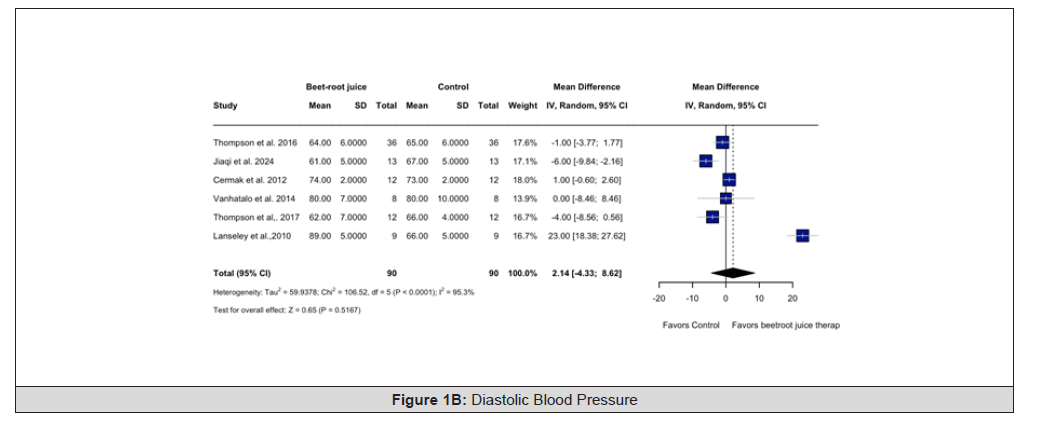
Figure 1B:Diastolic Blood Pressure
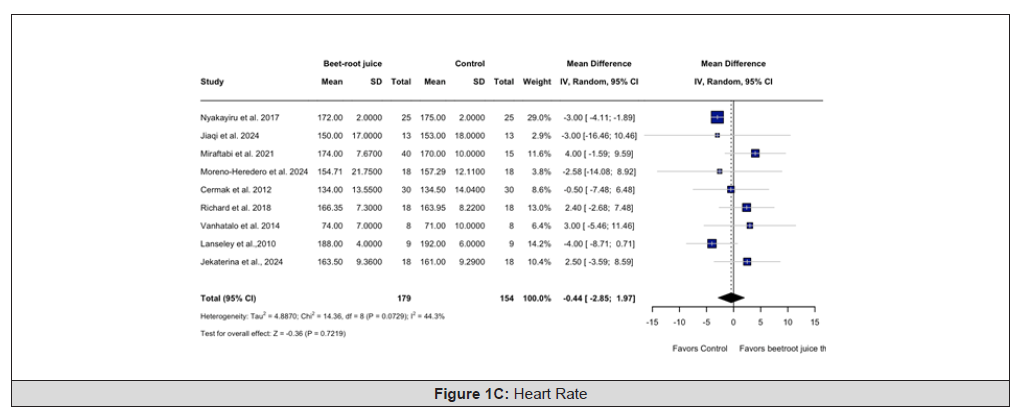
Figure 1C:Heart Rate
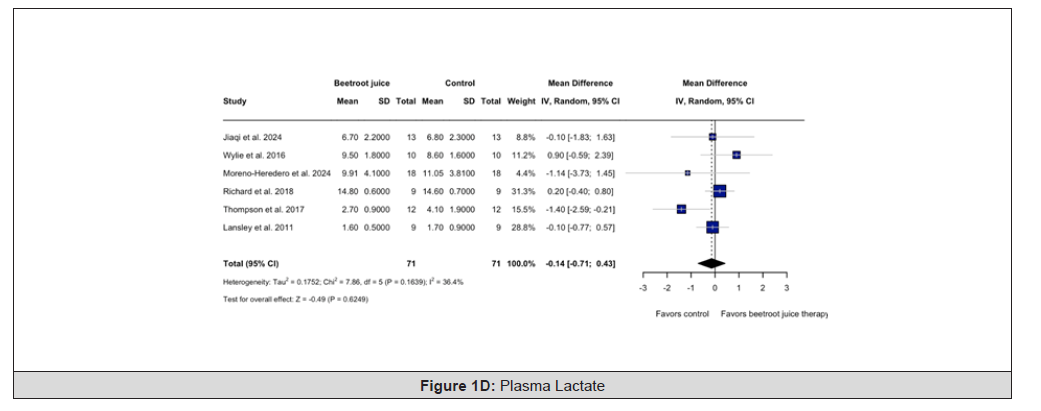
Figure 1D:Plasma Lactate
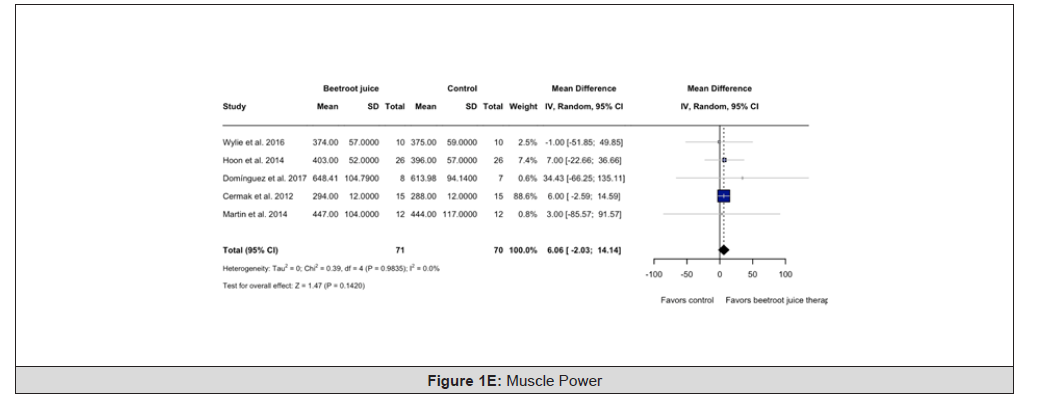
Figure 1E:Muscle Power
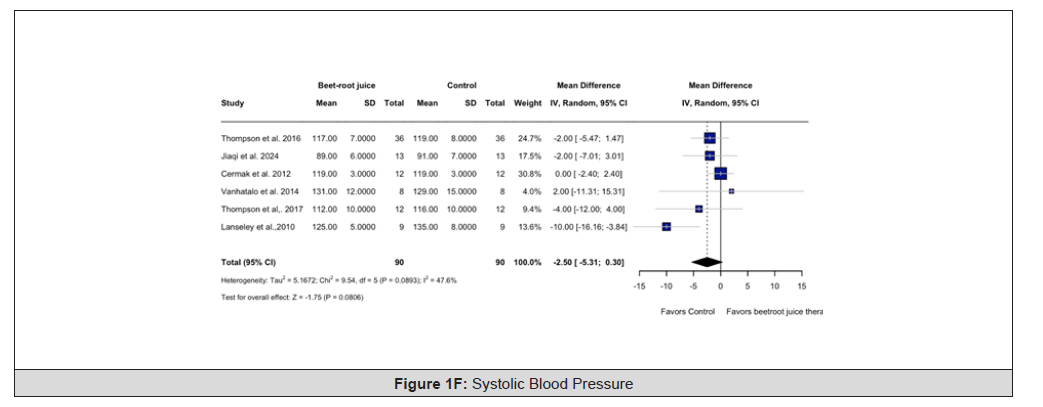
Figure 1F:Systolic Blood Pressure
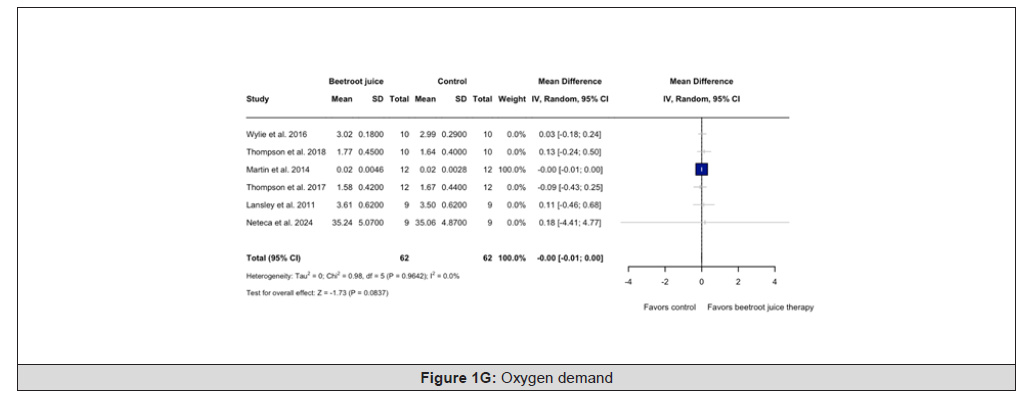
Figure 1G:Oxygen demand
Discussion
The systematic review and meta-analysis showed that beetroot juice supplementation increased plasma nitrite levels by approximately 6.8 μM more than control (95% CI, 3.17–10.43), confirming effective nitrate delivery and NO bioavailability. However, this biochemical effect did not translate into consistent physiological or performance benefits. No significant changes were observed in systolic or diastolic blood pressure, heart rate, or exercise performance metrics such as muscle power, blood lactate, or oxygen demand compared to placebo. These findings indicate that while beetroot juice activates the nitrate–nitrite–NO pathway, its functional effects on hemodynamics and exercise capacity in healthy individuals are minimal.
This robust increase in plasma nitrite is biologically plausible, as beetroot provides inorganic nitrate that is converted to nitrite via oral bacteria and subsequently to NO in vivo [24,25]. NO plays a central role in exercise physiology, affecting vascular tone, mitochondrial respiration, and muscle contractility [26]. While previous research shows nitrate can lower resting BP and reduce the oxygen cost of exercise [24], the absence of such effects in our study likely reflects the normotensive status of participants, where endothelial function and NO production are already optimal. Indeed, the hypotensive effects of nitrate appear more pronounced in hypertensive individuals, with meta-analyses showing ~3–5 mmHg systolic BP reductions in this population [27]. Similarly, no consistent improvements in exercise performance were observed, aligning with previous findings that beetroot juice may not benefit all exercise types or populations [26,28]. Some studies have reported performance improvements in nitrate “responders,” with variability in outcomes likely due to differences in nitrite bioavailability [29]. However, these effects may be diluted in meta-analyses that include non-responders. Also, many studies assessed short-duration or maximal efforts where NO-mediated enhancements (e.g., blood flow, efficiency) may have limited impact. Evidence suggests the greatest ergogenic effects occur in middle-distance efforts (2–10 minutes) or under hypoxic conditions [30].
Significant heterogeneity across studies further complicates interpretation. Trials varied widely in nitrate dose (5–15 mmol), supplementation duration, and exercise protocols, and included diverse participant types from sedentary to elite athletes. A meta-regression of 123 trials found that nitrate benefits were most evident in events lasting 2–10 minutes and when NO synthesis was compromised, such as under oxygen stress [31]. Moreover, highly trained individuals may derive less benefit due to already-optimized NO production [29]. Our review’s strengths include comprehensive database searches, duplicate screening, and use of the Hartung– Knapp random-effects model for pooled estimates. Sensitivity analyses showed no single study unduly influenced outcomes. However, limitations include small sample sizes, male predominance, short intervention durations, and inconsistent control of dietary nitrate or oral microbiome factors. With few trials per outcome, publication bias remains possible.
Conclusion
In conclusion, beetroot juice reliably increases nitrate and nitrite levels, confirming NO pathway activation, but does not significantly affect blood pressure or exercise performance in healthy adults. Future trials should examine longer interventions, diverse populations, and mechanistic biomarkers to clarify individual responses and long-term effects. For now, BRJ may serve as a safe, situational ergogenic aid rather than a broadly effective intervention.
Declaration of Competing Interest
The authors state that they do not have any known conflicting financial interests or personal relationships that could have influenced the work documented in this paper.
Data availability statement
All data sources utilized are available in the result and supplementary section and cited in the references.
Funding
Not applicable.
Acknowledgement
None.
References
- Jones AM, Thompson C, Wylie LJ, Vanhatalo A (2018) Dietary nitrate and physical performance. Annu Rev Nutr 38: 303-328.
- (2021) Harvard Health Publishing. How does exercise affect blood pressure? Harvard Medical School.
- Domínguez R, Cuenca E, Maté Muñoz JL, Pablo García Fernández, Noemí Serra Paya, et al. (2018) Effects of beetroot juice supplementation on cardiorespiratory endurance in athletes Nutrients 9(1): 43.
- Siervo M, Lara J, Ogbonmwan I, Mathers JC (2013) Inorganic nitrate and beetroot juice supplementation reduces blood pressure in adults: a systematic review and meta-analysis. J Nutr 143(6): 818-826.
- Nyakayiru J, Jonvik KL, Trommelen J, Philippe J M Pinckaers, Joan M Senden, et al. (2017) Beetroot juice supplementation improves high-intensity intermittent type exercise performance in trained soccer players. Nutrients 9(3): 314.
- Jiaqi Z, Zihan D, Heung Sang Wong S, Chen Z, et al. (2024) Acute effects of various doses of nitrate-rich beetroot juice on high-intensity interval exercise responses in women: a randomized, double-blinded, placebo-controlled, crossover trial. J Int Soc Sports Nutr 21(1): 2334680.
- Wylie LJ, Bailey SJ, Kelly J, Blackwell JR, Vanhatalo A, et al. (2016) Influence of beetroot juice supplementation on intermittent exercise performance. Eur J Appl Physiol 116(2): 415-425.
- Thompson C, Wylie LJ, Blackwell JR, Jonathan Fulford, Matthew I Black, et al. (2017) Influence of dietary nitrate supplementation on physiological and muscle metabolic adaptations to sprint interval training. J Appl Physiol (1985) 122(3): 642-652.
- Hoon MW, Hopkins WG, Jones AM, David T Martin, Shona L Halson, et al. (2014) Nitrate supplementation and high-intensity performance in competitive cyclists. Appl Physiol Nutr Metab 39(9): 1043-1049.
- Jodra P, Domínguez R, Sánchez Oliver AJ, Veiga Herreros P, Bailey SJ (2020) Effect of beetroot juice supplementation on mood, perceived exertion, and performance during a 30-second Wingate test. Int J Sports Physiol Perform 15(2): 243-248.
- Miraftabi H, Avazpoor Z, Berjisian E, Amir Sarshin, Sajjad Rezaei, et al. (2021) Effects of beetroot juice supplementation on cognitive function, aerobic and anaerobic performances of trained male taekwondo athletes: a pilot study. Int J Environ Res Public Health 18(19): 10202.
- Thompson C, Vanhatalo A, Kadach S, et al. (2018) Discrete physiological effects of beetroot juice and potassium nitrate supplementation following 4-wk sprint interval training. J Appl Physiol (1985) 124(6): 1519-1528.
- Tan R, Merrill C, Riley CF, Maya A Hammer, Ryan T Kenney, et al. (2024) Acute inorganic nitrate ingestion does not impact oral microbial composition, cognitive function, or high-intensity exercise performance in female team-sport athletes. Eur J Appl Physiol 124: 3511-3525.
- Jonvik KL, Nyakayiru J, Van Dijk JW, K Maase, S B Ballaket, al. (2018) Repeated-sprint performance and plasma responses following beetroot juice supplementation do not differ between recreational, competitive and elite sprint athletes. Eur J Sport Sci 18(4): 524-533.
- Moreno Heredero B, Morencos E, Morais JE, Barbosa TM, Veiga S (20) 2A single dose of beetroot juice does not enhance performance during intervallic swimming efforts. J Sports Sci Med 23(1): 228-235.
- Cermak NM, Gibala MJ, van Loon LJ (2012) Nitrate supplementation’s improvement of 10-km time-trial performance in trained cyclists. Int J Sport Nutr Exerc Metab 22(1): 64-71.
- Martin K, Smee D, Thompson KG, Rattray B (2014) No improvement of repeated-sprint performance with dietary nitrate. Int J Sports Physiol Perform 9(5): 845-850.
- Richard P, Koziris LP, Charbonneau M, Catherine Naulleau, Jonathan Tremblay, et al. (2018) Time-trial performance in world-class speed skaters after chronic nitrate ingestion. Int J Sports Physiol Perform 13(10): 1317-1323.
- Vanhatalo A, Jones AM, Blackwell JR, Winyard PG, Fulford J (2014) Dietary nitrate accelerates postexercise muscle metabolic recovery and O2 delivery in hypoxia. J Appl Physiol (1985) 117(12): 1460-1470.
- Wylie LJ, Mohr M, Krustrup P, Sarah R Jackman, Georgios Ermιdis, et al. (2013) Dietary nitrate supplementation improves team sport-specific intense intermittent exercise performance. Eur J Appl Physiol 113(7): 1673-1684.
- Lansley KE, Winyard PG, Bailey SJ, Anni Vanhatalo, Daryl P Wilkerson, et al. (2011) Acute dietary nitrate supplementation improves cycling time trial performance. Med Sci Sports Exerc 43(6): 1125-1131.
- Lansley KE, Winyard PG, Fulford J, Anni Vanhatalo, Stephen J Bailey, et al. (2011) Dietary nitrate supplementation reduces the O2 cost of walking and running: a placebo-controlled study. J Appl Physiol (1985) 110(3): 591-600.
- Neteca J, Veseta U, Liepina I, Volgemute K, Dzintare M, et al. (2024) Effect of beetroot juice supplementation on aerobic capacity in female athletes: a randomized controlled study. Nutrients 17(1):63.
- Benjamim CJR, Porto AA, Valenti VE, Andressa Crystine da Silva Sobrinho, David M Garner, et al. (2022) Nitrate Derived From Beetroot Juice Lowers Blood Pressure in Patients With Arterial Hypertension: A Systematic Review and Meta-Analysis. Front Nutr 15(9): 823039.
- Coggan AR, Broadstreet SR, Mikhalkova D, Indra Bole, Joshua L Leibowitz, et al. (2018) Dietary nitrate‐induced increases in human muscle power: high versus low responders. Physiol Rep 6(2): e13575.
- Curtis KJ, O Brien KA, Tanner RJ, et al. (2015) Acute Dietary Nitrate Supplementation and Exercise Performance in COPD: A Double-Blind, Placebo-Controlled, Randomised Controlled Pilot Study. PLOS ONE 10(12): e0144504.
- Jones AM (2014) Dietary Nitrate Supplementation and Exercise Performance. Sports Med 44(1): 35-45.
- Eric Tsz-Chun Poon, Jason Chun-Kit Iu, Wesley Man-Kuk Sum, Po-San Wong, Kenneth Ka-Hei Lo, et al. (2025) Dietary Nitrate Supplementation and Exercise Performance: An Umbrella Review of 20 Published Systematic Reviews with Meta-analyses. Sports Med 55(5):1213-1231.
- Wong TH, Sim A, Burns SF (2021) The Effect of Beetroot Ingestion on High-Intensity Interval Training: A Systematic Review and Meta-Analysis. Nutrients 13(11): 3674.
- Zoughaib WS, Fry MJ, Singhal A, Coggan AR (2024) Beetroot juice supplementation and exercise performance: is there more to the story than just nitrate? Front Nutr 11: 1347242.
- Silva KVC, Costa BD, Gomes AC, Saunders B, Mota JF (2022) Factors that Moderate the Effect of Nitrate Ingestion on Exercise Performance in Adults: A Systematic Review with Meta-Analyses and Meta-Regressions. Adv Nutr 13(5):1866-1881.




 We use cookies to ensure you get the best experience on our website.