
Review Article 
 Creative Commons, CC-BY
Impact of Expanded Chronic Care Model on Chronic Disease Management. Results of a Systematic Review with Meta-Analysis of the Scientific Literature
*Corresponding author:Riccardo Calvani, Università Cattolica del Sacro Cuore di Roma, Largo F. Vito, 1, 00168 Roma (RM), Italia.
Received:August 04, 2025; Published:August 13, 2025
DOI: 10.34297/AJBSR.2025.28.003642
Abstract
Introduction: Chronic diseases represent a growing burden for health care systems, significantly impacting patients’ quality of life and contributing
to increasing care costs [1]. Traditional models of nursing care often lack a proactive, integrated approach, which may lead to frequent relapses,
hospitalizations, and suboptimal health outcomes [2]. The Expanded Chronic Care Model (ECCM) is an evolution of the Chronic Care Model, aimed
at improving care delivery through proactive interventions, patient empowerment, prevention strategies, and interdisciplinary collaboration [3].
Despite its conceptual strength, evidence regarding ECCM’s effectiveness compared to traditional care models remains limited and fragmented [4].
Methods: This protocol outlines a systematic review and meta-analysis that will follow PRISMA-P 2015 [5] guidelines. A comprehensive literature
search will be conducted in PubMed, Scopus, Web of Science, CINAHL. Eligible studies will include randomized controlled trials and observational
studies comparing ECCM-based interventions to traditional nursing care in adults with chronic conditions. Primary outcomes will include clinical
indicators, health-related quality of life, and hospitalization rates. Secondary outcomes will include patient empowerment, adherence to treatment,
and cost-effectiveness. Data extraction, risk of bias assessment (ROB 2, ROBINS-I), and meta-analyses (where feasible) will be conducted by independent
reviewers.
Results (Expected): A narrative synthesis and, when applicable, meta-analyses will be conducted. Standardized mean differences (SMD) and risk or
odds ratios (RR, OR) will be used to assess outcomes. The GRADE approach will be applied to evaluate the certainty of the evidence.
Discussion: The findings of this review will contribute to understanding the effectiveness of ECCM in managing chronic diseases and its implications
for clinical practice, patient engagement, and health policy. Results are expected to support the development of more integrated and sustainable
chronic care models.
Keywords:Congenital hyperinsulinism, Newborn, Insulin, Child treatment
Introduction
Rational
Chronic diseases represent a growing burden for health care systems worldwide, significantly impacting patients’ quality of life and increasing the demand for long-term care resources. Despite advances in clinical management, traditional models of nursing care often remain fragmented, reactive, and focused on acute episodes, which contributes to frequent exacerbations, poor therapeutic adherence, and repeated hospitalizations [6].
The Expanded Chronic Care Model (ECCM) evolves from the original Chronic Care Model (CCM), broadening its scope to include community engagement, health promotion, and an interdisciplinary approach [7]. In addition to emphasizing care coordination and proactive interventions, the ECCM promotes active patient involvement, prevention strategies, and population-level planning to address the multifactorial nature of chronic conditions [8].
Although the ECCM is theoretically well-founded, evidence of its practical advantages over standard models remains limited and scattered. There is a need for a comprehensive synthesis of studies evaluating its clinical effectiveness, economic impact, and influence on patient empowerment.
This systematic review aims to address these gaps by comparing the ECCM to traditional models of care in chronic disease management.
By consolidating the available evidence, this study seeks to inform future nursing practices and policy decisions, supporting the shift toward more integrated, sustainable, and patient-centered chronic care strategies.
Objectives
The objective of this systematic review is to evaluate the impact of the Expanded Chronic Care Model (ECCM) compared with traditional nursing care models in adult patients with chronic diseases. Specifically, the review will assess:
The effectiveness of ECCM in improving clinical outcomes and health-related quality of life.
The model’s capacity to reduce hospital readmissions and acute exacerbations, with potential economic implications.
The influence of ECCM on patient empowerment and adherence to therapeutic regimens.
The organizational and policy implications of implementing ECCM in chronic disease management.
This review aims to fill gaps in the existing literature by synthesizing quantitative and qualitative evidence on ECCM, supporting evidence-based decisions in chronic care planning and nursing practice.
Methods
Eligibility Criteria
This review will include both randomized controlled trials (RCTs) and non-randomized studies (e.g., cohort studies, controlled clinical trials) that compare the Expanded Chronic Care Model (ECCM) to traditional nursing care models. Only peer-reviewed studies with sufficient methodological quality will be included.
Adults (≥18 years) diagnosed with one or more chronic conditions, such as type 2 diabetes mellitus, hypertension, chronic obstructive pulmonary disease (COPD), cardiovascular diseases, or other comparable chronic illnesses. Studies involving pediatric populations or patients with acute or terminal conditions will be excluded.
Care programs explicitly based on the Expanded Chronic Care Model (ECCM), integrating elements such as proactive management, patient empowerment, multidisciplinary collaboration, and community involvement.
Usual care, traditional nursing models, standard care, or primary care approaches that do not explicitly incorporate ECCM components.
Only studies published in English or Italian will be considered, to ensure accurate comprehension and analysis.
Primary Outcomes
i. Improvement in clinical indicators related to the chronic condition(
s)
ii. Health-related quality of life (HRQoL)
iii. Reduction in hospitalizations and acute exacerbations
Secondary Outcomes
i. Patient empowerment and self-management
ii. Therapeutic adherence
iii. Cost-effectiveness or economic impact (when available)
Sources of information
Electronic bibliographic databases to search literature: Medline, Scopus, Web of Science and Cinahl. The databases were searched using the following search strings on March 7, 2025.
Search Strategy
i. P= Patients with chronic diseases over 18 years of age
ii. I= Expanded chronic care model
iii. C= Traditional nursing care models
iv. O= Effectiveness of the ECCM model
The MeSH terms related to the elements of the PICO were identified and the facet Analysis carried out, shown below (Table 1).
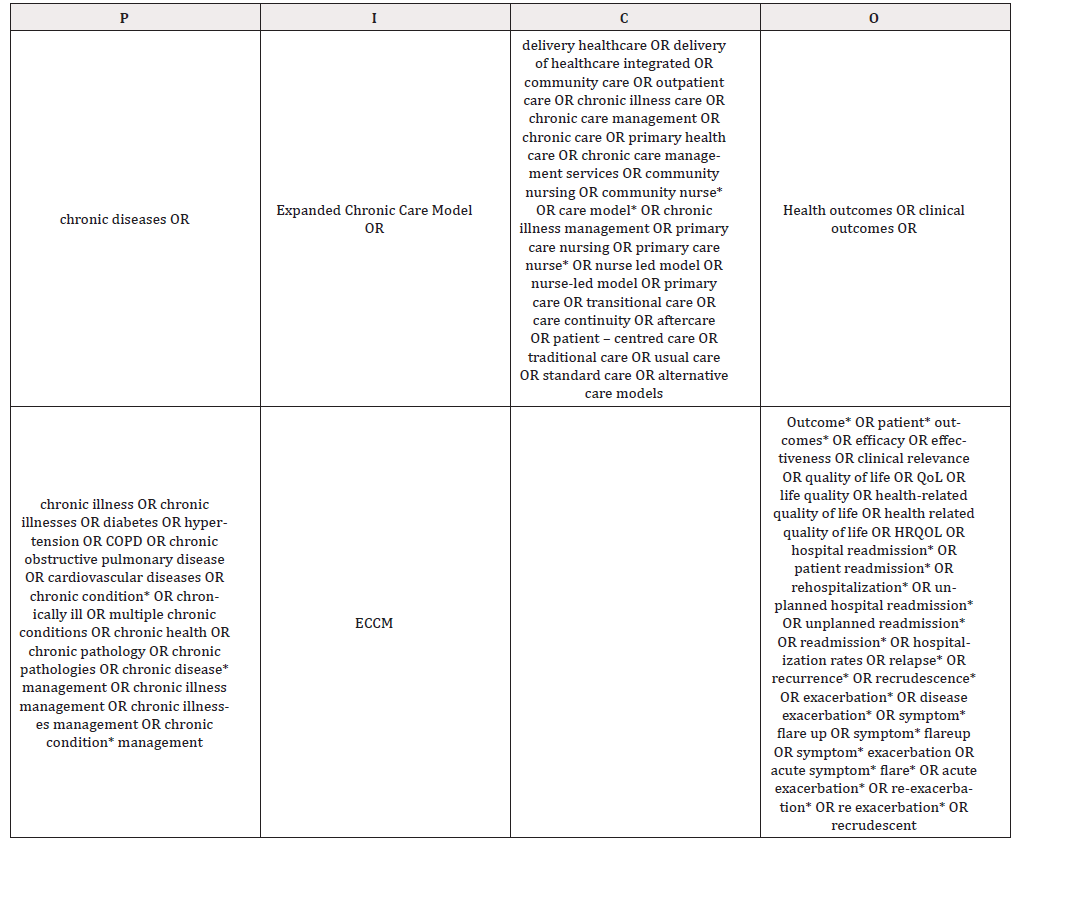
Table 1:PICO.
MEDLINE
((chronic disease* OR chronic illness* OR diabetes OR hypertension OR chronic obstructive pulmonary disease* OR COPD* OR cardiovascular disease* OR chronic condition* OR chronically ill OR chronically ill patient* OR chronically ill people OR multiple chronic condition* OR chronic health OR chronic patholog*) AND (Expanded Chronic Care Model OR ECCM ) AND (healthcare delivery OR integrated healthcare delivery OR care model* OR community care OR outpatient care OR primary care OR chronic disease* care OR chronic disease* management OR chronic illness* care OR chronic illness* management OR chronic condition* care OR chronic condition* management OR chronic care OR chronic care management OR community nurs* OR primary care nurs* OR nurse led model OR nurse-led model OR transitional care OR care continuity OR aftercare OR patient – centred care OR traditional care OR usual care OR standard care) AND (health outcome* OR clinical outcome* OR patient* outcome* OR health impact* OR clinical impact* OR patient* impact* OR efficacy OR effectiveness OR clinical relevance OR quality of life OR QoL OR life quality OR health-related quality of life OR health related quality of life OR HRQOL OR readmission* OR hospital readmission* OR patient readmission* OR unplanned readmission* OR unplanned hospital readmission* OR unplanned patient readmission* OR rehospitalization* OR rehospitalization rates OR relapse* OR recurrence* OR recrudescence* OR exacerbation* OR acute exacerbation* OR disease exacerbation* OR re-exacerbation* OR reexacerbation* OR symptom* exacerbation OR symptom* flare up OR symptom* flareup OR acute symptom* flare up OR acute symptom* flareup))
SCOPUS
ALL ((“chronic diseases” OR “chronic illness” OR “diseases diabetes” OR “hypertension” OR “COPD” OR “chronic obstructive pulmonary disease” OR “cardiovascular diseases” OR “chronic condition*” OR “chronically ill” OR “multiple chronic conditions” OR “chronic health” OR “chronic pathology” OR “chronic pathologies” OR “chronic disease* management” OR “chronic illness management” OR “chronic illnesses management” OR “chronic condition* management” ) AND ( “Expanded Chronic Care Model” OR “ECCM” ) AND ( “delivery healthcare” OR “delivery of healthcare integrated” OR “community care” OR “outpatient care” OR “chronic illness care” OR “chronic care management” OR “chronic care” OR “primary health care” OR “chronic care management services” OR “community nursing” OR “community nurse*” OR “care model*” OR “chronic illness management” OR “primary care nursing” OR “primary care nurse*” OR “nurse led model” OR “nurse-led model” OR “primary care” OR “transitional care” OR “care continuity” OR “aftercare” OR “patient-centered care” OR “traditional care” OR “usual care” OR “standard care” OR “alternative care models” ) AND ( “Health outcomes” OR “clinical outcomes” OR “Outcome*” OR “patient* outcomes*” OR “efficacy” OR “effectiveness” OR “clinical relevance” OR “quality of life” OR “life quality” OR “health-related quality of life” OR “health related quality of life” OR “hospital readmission*” OR “patient readmission*” OR “rehospitalization*” OR “unplanned hospital readmission*” OR “unplanned readmission*” OR “readmission*” OR “hospitalization rates” OR “relapse*” OR “recurrence*” OR “recrudescence*” OR “exacerbation*” OR “disease exacerbation*” OR “symptom* exacerbation” OR “acute exacerbation*”))
WEB OF SCIENCE
TS=(( “chronic diseases” OR “chronic illness” OR “chronic illnesses” OR “diabetes” OR “hypertension” OR “COPD” OR “chronic obstructive pulmonary disease” OR “cardiovascular diseases” OR “multiple chronic conditions” OR “chronic disease management” OR “chronic illness management” ) AND ( “Expanded Chronic Care Model” OR “ECCM” OR “nurse-led care model” OR “primary care nursing” OR “community nursing” OR “integrated chronic care” OR “case management” ) AND ( “clinical outcomes” OR “patient outcomes” OR “quality-of-life” OR “hospital readmission” OR “disease exacerbation” OR “rehospitalization” OR “care continuity” ))
CINAHL
((MH “Chronic Disease”) OR “chronic disease*” OR “chronic illness*” OR diabetes OR hypertension OR “chronic obstructive pulmonary disease” OR COPD OR “cardiovascular disease*” OR “chronic condition*” OR “multiple chronic condition*” OR “chronic patient*” OR “chronically ill”) AND (“Expanded Chronic Care Model” OR ECCM OR “chronic care model*” OR “integrated care model*” OR “care model*” OR “collaborative care” OR “case management”) AND (“healthcare delivery” OR “integrated care” OR “primary care” OR “community care” OR “outpatient care” OR “chronic care management” OR “nurs* care” OR “nurse-led care” OR “transitional care” OR “continuity of care” OR aftercare OR “usual care” OR “standard care”) AND (“health outcome*” OR “clinical outcome*” OR “patient outcome*” OR “treatment outcome*” OR effectiveness OR efficacy OR QoL OR “quality of life” OR “health-related quality of life” OR HRQOL OR readmission* OR rehospitalization* OR relapse* OR recurrence OR exacerbation*)
Results
Selection Process
As a first step, titles and abstracts of all papers retrieved by the search strategy will be screened for relevance and all those that are clearly irrelevant will be discarded. If the record is not clearly irrelevant, the full text will be downloaded. Potentially relevant studies will be reviewed in their full text for selection or final exclusion. As a second step, two review team members will independently assess the eligibility of the studies using the predefined inclusion and exclusion criteria. Any disagreements on wheter or not to include a specific study will be resolved by discussion between the reviewers or consulting a third reviewer.
Studies screened by one person (or a machine) and checked by at least one other person (or machine).
The article analysis process will be summarized in the PRISMA 2020 flow chart [9].
Data Extraction
The software tool used for reference management will be Rayyan.
Data extraction will include the following information: author, publication year, study design, country, participants’ characteristics, sample size, interventions, outcome measurement and main findings.
Reporting Bias
Quality assessment of studies will be carried out using the ROB II tool.
Assessment of Reporting Bias
To assess the risk of reporting bias across studies, we will examine the presence of publication bias through visual inspection of funnel plots if at least 10 studies are included in a meta-analysis. Additionally, statistical tests such as Egger’s test or Begg’s test will be used to detect asymmetry. Selective reporting within studies will be evaluated by comparing the outcomes reported in trial protocols (if available) with those presented in the published reports.
Certainty Assessment (GRADE approach)
The overall certainty of evidence for each primary outcome will be assessed using the GRADE (Grading of Recommendations Assessment, Development and Evaluation) approach. This includes evaluation of risk of bias, inconsistency, indirectness, imprecision, and publication bias. GRADEpro software will be used to generate summary of findings tables, which will be included in the final systematic review.
Data Summary
A systematic literature review with narrative synthesis of the results will be conducted. Based on the results, a meta-analysis will be conducted using the forest plot.
Discussion
Anticipated Discussion
Upon completion of the systematic review, the findings will be interpreted in the context of existing literature on chronic care models, particularly the application of the Expanded Chronic Care Model (ECCM). We expect to identify whether ECCM offers measurable improvements in clinical outcomes, quality of life, and care efficiency compared to traditional nursing care approaches.
Potential limitations of the included evidence may involve heterogeneity in ECCM implementation, variation in outcome definitions, and possible publication bias. In addition, the review process itself may face limitations related to language restrictions and incomplete data reporting in the primary studies.
The results will have implications for clinical practice by guiding the design and implementation of integrated care models. Furthermore, the review could inform policy makers on effective strategies for chronic disease management, and highlight directions for future research, particularly in evaluating cost-effectiveness and patient-centered outcomes.
Other Information
This is the first version of the protocol; no amendments have been made.
Funding
Review has no specific/external funding but is supported by guarantor/review team (non-commercial) institutions. No funding was received for the development of this protocol or for the planned systematic review.
Conflict of Interest
Review has no conflict of interest.
Crono Program
(Table 2)
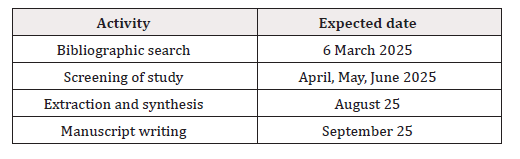
Table 2:Crono program.
References
- (2020) World Health Organization. Noncommunicable diseases.
- Wagner EH, Austin BT, Von Korff M (1996) Organizing care for patients with chronic illness. Milbank Q 74(4): 511-544.
- Barr VJ, Robinson S, Marin Link B, Underhill L, Dotts A, et al. (2003) The Expanded Chronic Care Model: An integration of concepts and strategies from population health promotion and the Chronic Care Model. Hosp Q 7(1): 73-82.
- Coleman K, Austin BT, Brach C, Wagner EH (2009) Evidence on the Chronic Care Model in the new millennium. Health Aff (Millwood) 28(1):75-85.
- Moher D, Shamseer L, Clarke M, Ghersi D, Liberati A, et al. (2015) Preferred reporting items for systematic review and meta-analysis protocols (PRISMA-P) 2015 statement. Syst Rev 4(1): 1.
- Joo JY (2023) Fragmented care and chronic illness patient outcomes: A systematic review. Nurs Open 10(6): 3460-3473.
- Gee PM, Greenwood DA, Paterniti DA, Ward D, Miller LM (2015) The eHealth Enhanced Chronic Care Model: A theory derivation approach. J Med Internet Res 17(4): e86.
- Pomey MP, Schaad B, Lasserre-Moutet A, Böhme P, Jackson M (2024) Towards a new integrated model for taking into account the experiential knowledge of people with chronic diseases, integrating mediation, therapeutic education and partnership: The Expanded Chronic Care Patient-Professional Partnership Model. Health Expect 27(5): e70054.
- Page MJ, McKenzie JE, Bossuyt PM, Boutron I, Hoffmann TC, et al. (2021) The PRISMA 2020 statement: An updated guideline for reporting systematic reviews. J Clin Epidemiol 134: 178-189.




 We use cookies to ensure you get the best experience on our website.