
Case Report 
 Creative Commons, CC-BY
Multiple Bilateral Infected Chalazia Lower Eye Lids: Uncommon Ocular Manifestation in Living Donor Renal Transplant Recipient 3 Years After Transplant
*Corresponding author:Khin Phyu Pyar, Professor and Head, Senior Consultant Physician, Department of Medicine, Department of Nephrology, Defence Services Medical Academy/No. (1) Defence Services General Hospital (1000-Bedded), Myanmar.
Received:July 31, 2025; Published:August 06, 2025
DOI: 10.34297/AJBSR.2025.28.003634
Case Summary
A fifty-years-old man had painful swelling of both lower eye lids for one month. He had received living donor kidney from his younger brother 3 years ago. He had been on same dose of prednisolone, mycophenolate mofetil and tacrolimus for 9 months. Multiple bilateral infected chalazia lower eye lids were seen. We did successful treatment over 2 weeks with oral doxycycline and topical ciprofloxacin eye drop. It is uncommon ocular manifestation in living donor renal transplant recipient. Multispecialty approach among ophthalmologists, transplant physician and infection specialists are essential with regular ophthalmic follow up.
Keywords:Chalazions, Renal transplant recipient, Ocular manifestation
Introduction
Patients with chronic kidney disease has been growing as well as kidney transplant population. Living donor renal transplant is the best form of renal replacement therapy. Eye disease is common in both patients with chronic kidney disease and renal transplant recipients [1,2]. And, their management is challenging. Ocular manifestations in renal transplant recipients were reported as hypertensive retinopathy, diabetic retinopathy, dry eye, cataract and change in refractive error. Chalazia (plural of chalazion), are the most common inflammatory lesions of the eyelid in general population. However, multiple bilateral infected chalazia in renal transplant recipients was rarely reported.
Case Presentation
The patient was 50 years old; he received living kidney from his younger brother 3 years ago. He had painful swelling of both lower eye lids for one month. He was given basiliximab as induction therapy and post operative period was uneventful. He also took anti- viral therapy for hepatitis C viral infection; and, he achieved viral clearance prior to transplant. Immunosuppression consisted of He was on 3 immunosuppressants; prednisolone, myfortic and pangraf. The dosage was tailored 9 months ago as prednisolone 5mg OD, myfortic 360mg BD, pangraf 2mg in the morning & 1mg in the evening. Other medications were atovastatin 10mg HS, carvedilol 12.5mg OD and clopidogrel 75mg OD. On examination, he was afebrile. Blood pressure was 130/80mmHg. Multiple infected chalazia on both lower eye lids were seen; three in left lower eye lid and one in right lower eye lid. (Figures 1-4) illustrate them.
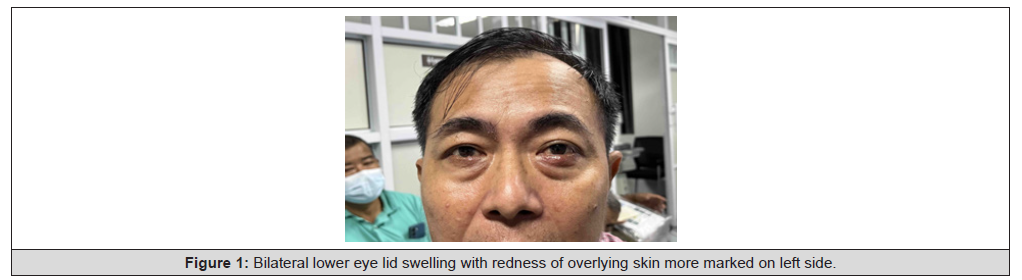
Figure 1:Bilateral lower eye lid swelling with redness of overlying skin more marked on left side.

Figure 2:conjunctival swelling in both lower eye lids.
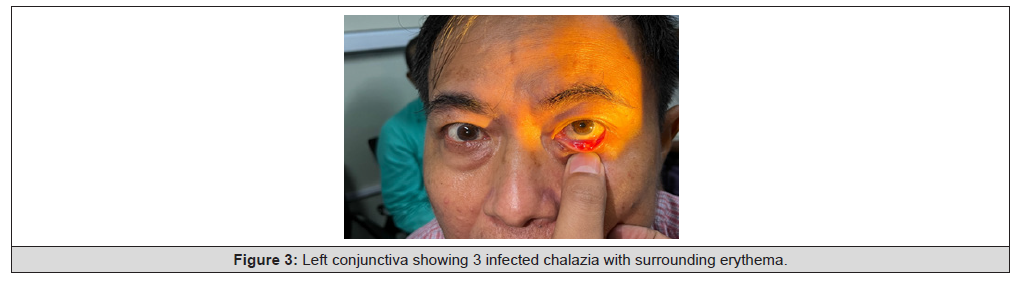
Figure 3:Left conjunctiva showing 3 infected chalazia with surrounding erythema.
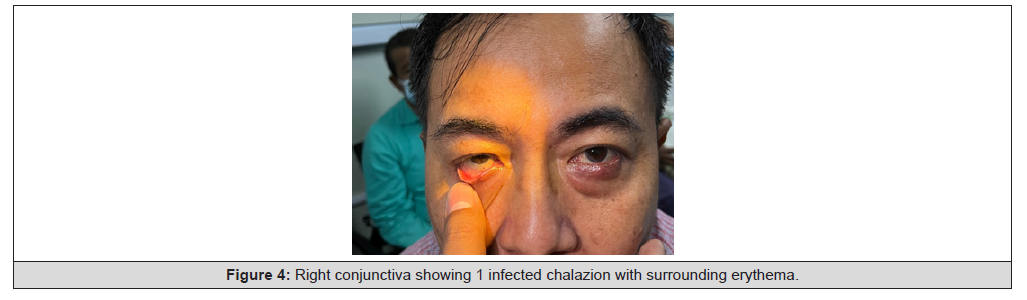
Figure 4:Right conjunctiva showing 1 infected chalazion with surrounding erythema.
After treatment with oral doxycycline 100mg BD for 2 weeks and application of topical ciprofloxacin eye drop, they were back to normal. Figure 5 shows normal eye lids.
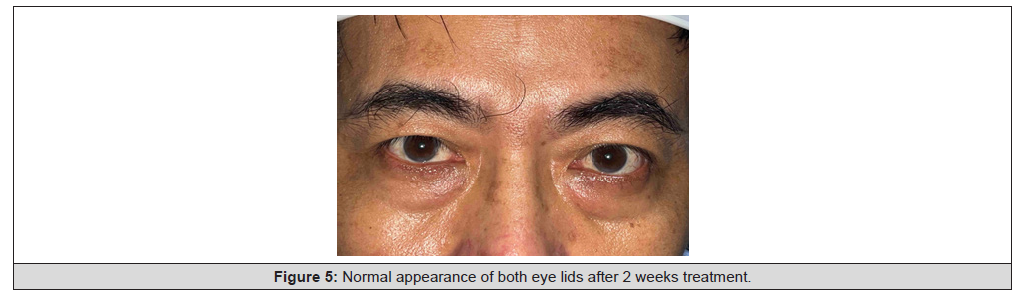
Figure 5:Normal appearance of both eye lids after 2 weeks treatment.
Serum creatinine was stable at 1.2mg%. And hemoglobin was 15.6gm%; total WBC count was 5.9X10⁹/L (differential count was normal) and platelet count was 250X109/L. Immunosuppressants were kept was same dose.
Discussion
Patients with chronic kidney diseases have been growing globally due to increasing incidence of non-communicable disease, primary glomerular diseases and frequent use of nephrotoxic drugs. Eye disease is common among kidney transplant recipients. They already have ocular complications prior to transplant as chronic kidney disease is associated with various systemic disorders like diabetes mellitus, hypertension and SLE etc. Moreover, the effect of chronic immunosuppression resulted in long-term ocular issues; infections, malignancies, and other immunosuppression-specific side effects [3]. And, their management is challenging [1,2].
Jain, et al. did cross sectional study on various ocular manifestations among renal transplant recipients, one hundred and twenty- three eyes of 62 patients. They found that hypertensive retinopathy was the most frequent ophthalmic manifestation, followed by diabetic retinopathy, dry eye, cataract and change in refractive error [4].
Ilyas, et al. reported that cutaneous manifestations secondary to drug toxicity was seen in solid organ transplant recipients; and, they were related with antithymocyte globulin, azathioprine, cytomegalovirus, rapamycin, mycophenolate mofetil [3]. However, this patient was maintained with same dosage of immunosuppressants which was tailored 9 months ago.
Genu, et al. did comprehensive ophthalmic evaluation in 152 renal allograft recipients for the ocular findings. and hypertensive retinopathy was the commonest ocular finding. Posterior subcapsular cataract, nuclear sclerosis and diabetic retinopathy were common [5,6]. Chalazia (plural of chalazion), are the most common inflammatory lesions of the eyelid. They are typically slowly enlarging, non-tender eyelid nodules. Chalazia are typically benign and self-limiting, though they can develop chronic complications. Chalazion was rarely found; only one case was reported [6]. Therefore, this case was uncommon.
According to Zheng, et al, multiple chalazia were common among younger children in southeast China; multiple chalazia were found bilaterally and internally [7]. They highlighted awareness to get successful treatment. However, there was no report on renal transplant recipient with multiple chalazia. Hence, this case report highlighted awareness on chalazion. It is one reasons for case reporting.
A chalazion is one of the most common eye conditions presenting as a mass lesion of the eyelids. It is seen in all age groups. Chalazion is a non-inflammatory process and develops due to retained secretion of the meibomian or Zeis glands. Various form of treatments is application of warm compress onto eyelids, lid hygiene, local antibiotic ointment, topical steroids, injecting steroid solution (triamcinolone acetonide) into the lesion, surgical removal of the lesion by incision and curettage, injection of botulinum toxin, tarsal trephination, removal of chalazion by application of CO2 laser or cryogenic action [8]. In Zheng’s report, patients with multiple chalazia were treated by incision and curettage surgery. In this patient, oral doxycycline and topical ciprofloxacin eye drop cleared infected multiple bilateral chalazia lower eye lids. No surgery was necessary. Moreover, we did not decrease the dosage of immunosuppressants. If the infection element was severe, we would have decreased the dose of immunosuppressants. This is the message we want to share. This patient had transplant 3 years ago. There was no association between ocular findings and duration of transplant [5]. One ocular finding was recorded at an average of 3-5 years interval after transplant [5]. And, patient’s serum creatinine was stable at 1.2mg%. They also found that ocular finding was not related with renal function status [6].
Conclusion
Chalazion is a non-inflammatory process and uncommon in renal transplant recipients. However, it can be infected in renal transplant recipients as they are vulnerable to infection. Early recognition and timely intervention of chalazion are important. Regular ophthalmic examination of the renal transplant recipients is recommended.
Ethical Approval
Our institution does not require ethical approval for reporting cases.
Funding
The authors received no financial support for publication of this article.
Informed Consent
The informed consent for publication in this article was obtained from patient.
Acknowledgements
The authors would like to thank the patient for giving consent to this article. The authors acknowledged Professor Thet Naing, Professor Myint Zaw, Professor Aung Myat Kyaw, Professor Kyaw Zay Ya and Professor Ko Ko Lwin for administrative support.
Conflict of Interest
The authors declared no potential conflicts of interests with respect to authorship and publication of this article.
References
- Koenig K, Briese S, Wiemann D, Haffner D, Querfeld U (2004) Post-transplantation swelling of the lower eyelid. Nephrology Dialysis Transplantation 19(4): 1001-1003.
- MULTANI E, Bajwa D, MULTANI P, NOBAKHT E, RAJ D, Paul R (2021) Eye disease in kidney transplantation: Clinical challenges in a unique patient population. Survey of Ophthalmology 67(4): 1252-1269.
- Ilyas M, Colegio OR, Kaplan B, Sharma A (2017) Cutaneous Toxicities from Transplantation-Related Medications. American Journal of Transplantation 17(11): 2782-2789.
- Jain A, Jain A, Sen S, Bhadauria D, Imchen MT (2024) The Spectrum of Ocular Manifestations among Renal Transplant Recipients. Indian Journal of Transplantation 18(1): 63-67.
- Thapa M, Shrestha G, Gautam P, Sigdel M (2023) Ocular Findings among the Patients of Renal Transplantation. Nepalese Journal of Ophthalmology 15(29): 5-13.
- Ginu PM, Sati A, Murari T, Kaushik J, Mishra SK, Sharma VK (2021) Ocular manifestations in renal allograft recipients: An Indian perspective. Indian Journal of Ophthalmology 69(4): 900-905.
- Zheng XY, Dorazio RM, Choy BNK, Wang TY, Zhao SJ, et al. (2022) Distribution of multiple chalazia in eyelids of pediatrics requiring surgery in southeast China: A hospital-based cross-sectional study. World Journal of Pediatric Surgery 5(3): e000408.
- Tashbayev B, Chen X, Utheim TP (2024) Chalazion Treatment: A Concise Review of Clinical Trials. Current Eye Research 49(2): 109-118.




 We use cookies to ensure you get the best experience on our website.