
Review Article 
 Creative Commons, CC-BY
Numerical Simulation of Fluid Flows in Rotating Discs: A Review
*Corresponding author:Dragan Mandić, Belgrade Power Plant, Savski nasip 11, Belgrade, Serbia.
Received:October 01, 2025; Published:October 28, 2025
DOI: 10.34297/AJBSR.2025.28.003739
Abstract
This paper presents a numerical analysis of fluid flow velocity parameters in four distinct physical models of pipe flows with rotating bodies. A key factor influencing velocity is the role of frictional forces between the contact surfaces of the rotating discs and the surrounding fluid. For each physical model, specific relationships between flow rates and fluid pressures were observed at an identical theoretical pipe cross-section. The study suggests that the interdependence of these variables can be applied in the design of pump impellers for external cardiovascular circulation—an area of critical importance. Motivated by this potential, the work aims to contribute to the continued development of impeller modeling. Flow velocity distributions are presented for selected positions of the rotating discs within the pipeline, serving as illustrative confirmation of the findings.
Keywords:Fluid, Rotating disc, Impeller, Translational flow, Friction
Nomenclature:Pa, N/m²: Pascal; B,m: Width; b,m: Distance between plates; L,m: Length; β,° : Angle; δ, m: Thickness; ∇p, Pa: Pressure drop due to friction; τ: Shear stress or sub-grid scale molecular stress tensor; ρ, kg/m³: Density; ϕ, kg/m·s: Additional variable (non-reacting scalar); V, m³: Control Volume; Gϕ, kg/m·s: Dynamic Diffusivity of additional variable; A, m²: Surface Area; Sϕ, kg/m³·s: Mass Source Term; U, m/s: Velocity Magnitude
Abbreviations:Ref: Reference; Static: Static; Abs: Absolute
Introduction
Numerical simulations using ANSYS software aim to reproduce, with high fidelity, the complex motion of fluids in systems with varying geometrical configurations and hydraulic conditions. Particular attention is given to the initial boundary conditions, including flow regimes, pressures, and fluid-structure interactions on selected geometrical surfaces. These simulations provide insights into the dynamic behavior of fluid flows in the presence of rotating discs, highlighting both the challenges and opportunities for accurate modelling [1,2].
Problem Statement
Geometric Models of Rotating Bodies
For the geometric models of rotating bodies (Figures 1 and 3), a rotational speed of 4 rad/s was assumed for the discs.
Mathematical Flow Models
The general conservation (transport) equations for mass, mo mentum, energy, and scalar quantities were solved over a set of control volumes [1]:

where:
ρ, kg/m³ - density
ϕ, kg/m·s - additional variable (non-reacting scalar)
V, m³ - control volume
A, m² - surface area
Γϕ, kg/m·s - dynamic diffusivity of the additional variable
Sϕ, kg/m³·s - mass source term
The individual terms of Equation (1) represent:
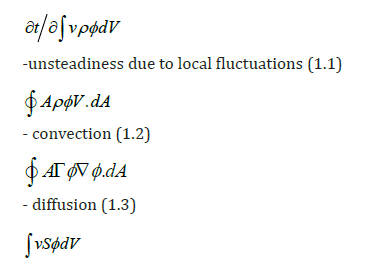
- generation (1.4)
Results of Numerical Simulations on Elementary Discs
Elementary Discs with External Fluid Supply
The following figures illustrate the variations of fluid velocity vectors between rotating discs (Figures 1-4).
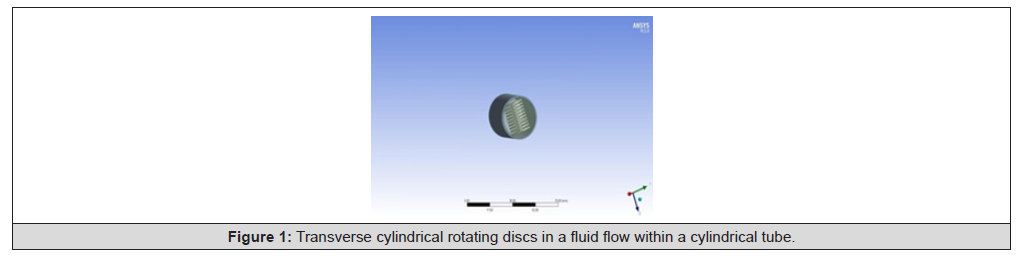
Figure 1:Transverse cylindrical rotating discs in a fluid flow within a cylindrical tube.
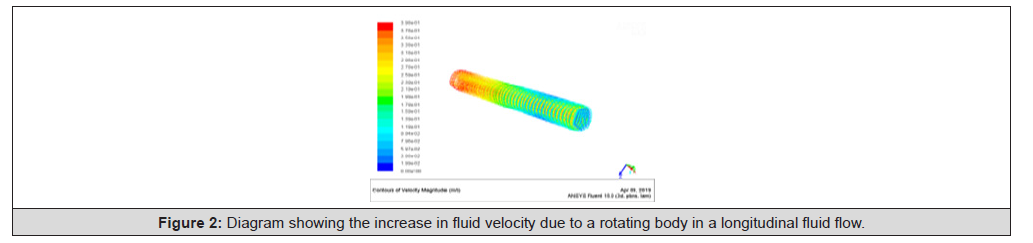
Figure 2:Diagram showing the increase in fluid velocity due to a rotating body in a longitudinal fluid flow.
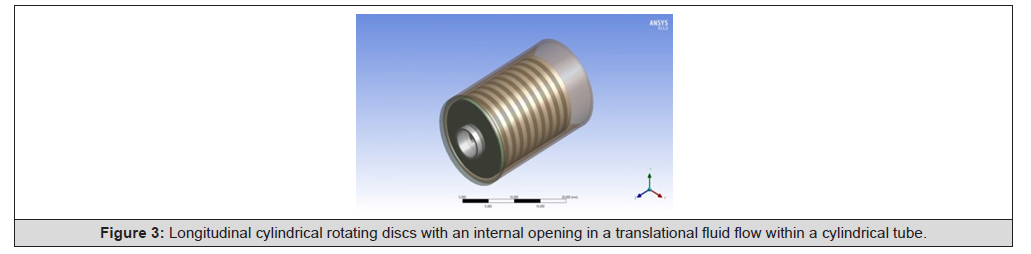
Figure 3:Longitudinal cylindrical rotating discs with an internal opening in a translational fluid flow within a cylindrical tube.

Figure 4:Diagram of fluid velocity changes along a pipeline.
Analysis of Results
Along the pipeline, increases in collective fluid velocities were observed, with intensities proportional to the distance from the rotating discs (Figures 2 and 4). Simultaneously, turbulence zones were detected, with intensities directly dependent on flow velocity [3,4]. Maximum fluid flow velocities were found in regions immediately adjacent to the exit sections between circulation rings. When complex flow velocities were considered (combining rotational and translational motion), the observed speed increments were significantly higher than those with translational motion alone.
Conclusion
Numerical simulations of fluid velocities in pipelines with rotating discs provide a reliable method for identifying flow regimes and fluid pressures pre-conditioned for specific technological processes. These simulations establish the necessary conditions for accurate process execution and can serve as a foundation for selecting optimized technological procedures [5].
Acknowledgments
None.
Declaration of Interest
None.
References
- ANSYS (2006) Introduction to CFD Analysis, Introductory FLUENT Notes, FLUENT 6(3).
- Tesla N (1913) Fluid Propulsion U.S. Patent 1, 061,142.
- Mandić D, CFD Modeling of Turbulence in Channels of Plate Heat Exchangers, 5th International Conference of Fluid Flow, Heat and Mass Transfer (FFHMT’18), Niagara Falls.
- Mandić D (2017) CFD Modeling of Hydrodynamic Phenomena and Heat Transfer in Channels of Plate Heat Exchangers, 4th International Conference of Fluid Flow, Heat and Mass Transfer (FFHMT’17), Toronto, Canada, 22-23.
- Lukic B (2018) A Passively-Suspended Tesla Pump Left Ventricular Assist, The Pennsylvania State University, US National Library of Medicine - National Institutes of Health, Nov 2010, Canada.




 We use cookies to ensure you get the best experience on our website.