
Case Report 
 Creative Commons, CC-BY
Successful ICU Management of Generalized Tetanus Arising from Minor Trauma Without Booster Immunization in a Third Category Hospital in Cameroon: A Case Report
*Corresponding author:Philippe Albert Lingo, Emergency Medicine Resident, Faculty of Health Sciences/University of Buea-Cameroon.
Received:September 28, 2025; Published:October 10, 2025
DOI: 10.34297/AJBSR.2025.28.003722
Abstract
Even though the number of tetanus cases has dramatically dropped due to vaccines, Tetanus is still a public health issue in underdeveloped regions.
Thus, in this article we shall describe the case of a 20-year-old man, single, university student, incompletely immunized with a history of neglected
wound on the left hallux was referred to Limbe Regional Hospital for better management of generalized tetanic spasms. The physical examination
found: dysautonomia with high blood pressure 170/98 mmHg, Temperature 40°C, Pulse 140 bpm, trismus, generalized clonic spasms and a necrotic
wound at the dorsal face of the left hallux.
A diagnosis of generalized tetanus was made. Nevertheless; other workups were carried on such as Full Blood Count, hemoculture, renal function
tests, malaria parasite and lumbar puncture were carried out. The main axis of management of this patient in the intensive care unit was control of
spasms and dysautonomic, neutralization of the toxin and germ eradication with subsequent vaccination of the patient against tetanus. The outcome
of the management was favorable without any adverse event. This case highlights the issue of inadequate immunization against Tetanus in adult
male population in our country and importance of intensive care in the management of such patients.
Keywords:Tetanus, Immunization, Intensive care unit
Introduction
Tetanus is an acute and potentially fatal disease resulting from an infection from bacteria clostridium tetani. This disease is exotoxin mediated and can occur after a variety of tissue injuries such as clean or contaminated wounds, soft tissue infections, dental in fections, surgical procedure and delivery. The disease though rare in developed countries is still a public health concern in underdeveloped countries because of poor hygiene conditions and inadequate immunization of the population. It is proven that the risk is increased in adolescent and adult males who undergo circumcision due to waning immunity and limited opportunity for receiving booster doses in males in many countries [1].
A study conducted in Limbe Regional Hospital in Cameroon showed that 81.8% of cases of tetanus where males and mortality rate was 48.5%. Complications like respiratory dysfunction and autonomic dysfunction accounted for the high mortality [2]. These findings are close to the study of Nkouonlack, et al in Buea who found that males constituted 95.5% of cases of tetanus and though the mortality rate was 22.7% [3]. Thus, this article will illustrate the case of a 20 years man with known incomplete immunization status who had a neglected necrotic wound at the left hallux who presented with generalized tetanus.
Case Presentation
A 20-year-old man was referred from a district hospital for better management of generalized clonic spasms preceded by trismus that began 1 week before presentation. The spasms were intermittent. The family mentioned an “abscess” at the left hallux which was pierced at home with a needle and left untreated without professional medical care. Concerning immunization, he was received antitetanic immunization at birth according to his parents and no booster was given. The family and the patient denied any past medical history or ongoing medication or any surgical history. He is a known cigarette smoker and heavy alcohol consumer. On physical exam, the Glasgow Coma scale was 15, blood pressure 170/100, tachycardia of 133 bpm, temperature 39°C, oxygen saturation 92 % on room air. There was mild agitation, and no neck stiffness was observed between spasms. Generalized clonic spasms were observed intermittently. a dry necrotic wound measuring 3 cm × 1 cm on the dorsal surface of the left hallux. The rest of physical examination was normal (Figure).
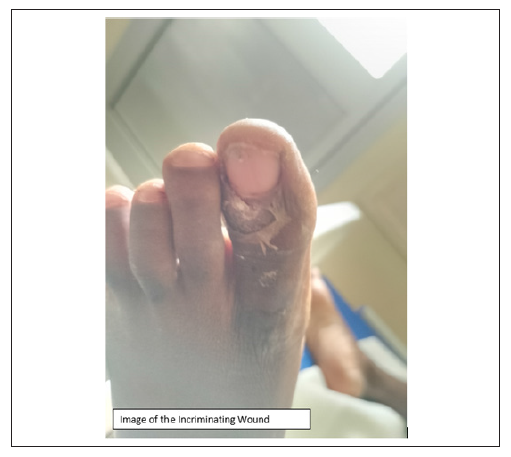
With these clinical findings, a working diagnosis of Generalized Tetanus established.
Nevertheless, investigations were carried out to exclude other pathologies or for therapeutic purposes: full blood count showed hyperleukocytosis at 12000/mm3 predominantly granulocytic, CRP 96 mg/l, renal function tests and serum electrolytes were normal. Blood culture was negative and malaria parasite test was negative. The patient was directly admitted in the Intensive Care Unit (ICU) and the following treatment was initiated immediately:
a) Airway protection
b) Antitetanus immunoglobulin 6000 UI IM
c) Antibiotics: Metronidazole 500mg/6h IV, Ceftraiaxone
2g/12h IV
d) Spasm control: Diazepam 5mg/h IV infusion through electric
pump; Magnesium Sulphate 2g/h through infusion after a 2 g
bolus IV
e) Antipyretic: Paracetamol 1g/6h IV
f) Gastric protection: Omeprazole 40 mg/24 h IV
g) Isolation from light and noise
h) Surgical debridement of the necrotic wound at the left hallux.
i) Anti-tetanus Vaccination of the patient was done at the 3rd day
Evolution of treatment was characterized by gradual decrease in the intensity of spasms which led to the gradual weaning of muscle relaxants drugs. By the 10th day, the spasms had completely ceased. The patient was transferred on day 14th to the surgical ward for continuation of management and discharged by the 28th day.
Discussion
Tetanus is an acute and often fatal disease caused by a toxin known as tetanospasmin produced by Clostridium tetani which is a bacterium. It usually manifests by progressive generalized spasms and rigidity in muscles. The global estimated incidence is one million cases annually. In the United States of America, tetanus cases declined by over 95% and tetanus-related deaths by about 99% since 1947 [4]. The marked reduction in tetanus incidence and mortality rate in high-income countries is due to the widespread use of tetanus toxoid-containing vaccines, improved wound care, and the use of Tetanus Immunoglobulin (TIG) for post-exposure prophylaxis and management of tetanus cases [2]. Conversely, tetanus is a significant cause of death in sub-Saharan Africa, with a case fatality rate ranging from 26% to 64% in neighboring Nigeria [5]. In Nigeria, Uganda, and Tanzania, the case fatality rates were respectively 64%, 47%, and 43.1% [6]. Tetanus may lead to complications such as airway obstruction, respiratory failure and renal failure thus worsening the prognosis in the absence of a standard intensive care unit. Moreover, autonomic instability and more recently, high urinary excretion of several catecholamines has been associated with poorer prognosis in patients with tetanus as shown by Thwaites, et al [7].
This case reports exposes the problematic of the issue of inadequate or absent immunization of adult male population in Cameroon and the importance of urgent intensive care in the management of such patients. Our patient presented with generalized tetanic spasms preceded by trismus and had signs of autonomic dysfunction like high blood pressure and tachycardia added to neglected wound. These findings are consistent with data from the literature asserting that generalized forms of tetanus are more common than localized forms [8]. According to the patient’s family, he had received vaccination when he was born and during his first year of life but no document was available to confirm it. No other antitetanic vaccine booster was received by the patient. Despite this insufficient coverage in conformity to WHO guidelines [1], a case was reported of patient with tetanus despite having received immunization in Japan [9]. This also raises concerns about the quality of vaccines being administered to the Cameroonian populations and particularly in the South West region. The patient upon arrival at the emergency unit was directly transferred to the intensive care unit. There, the main axis of management consisted of spasm control with the benzodiazepine Diazepam and Magnesium sulphate, germ eradication with antibiotics Metronidazole and Ceftriaxone; and toxin neutralization with Antitetanic Immunoglobulin. These are consistent with the recommended pharmacological methods for the management of generalized tetanus [10].
Although there is no official guideline recommending the addition of ceftriaxone to metronidazole, the rationale lies in their synergistic action and the capacity to accelerate the attenuation of toxin production, and wound healing in this patient. Ceftriaxone is anti-excitotoxic and increases glutamate uptake by effect on glutamate transporter-I and cysteine/glutamate exchanger transporter [11]. By its anti-depressant effects, it stands to aid in the upregulation of GABAergic mechanisms and eventual patient recovery. Additionally, the institution of metronidazole + ceftriaxone combination is in good stead to prevent sepsis and pneumonia in tetanus patients [12]. The tetanus toxin’s effect on the central nervous system cannot be reversed but the circulating ones can be neutralized by the tetanus immunoglobulin. Human Tetanus Immunoglobulin (HTIG) given IM does not affect that is already bound to the central nervous system but removes the released tetanospasmin. In the case of generalized tetanus as the one in this article, therapeutic doses of 3000-6000 U are recommended. Wound debridement is also a critical step as it permits controlling the source of toxin production [8]. In addition to benzodiazepines like diazepam, Magnesium sulphate was also used for the control of spasms. The latter also permits to reduce dysautonomic signs like tachycardia and high blood pressure. In addition to these, magnesium sulphate use in tetanus management is associated with reduced need for mechanical ventilation and shorter hospital stay [13]. With the therapeutic measures mentioned above, the outcome was favorable with gradual to complete control of spasms and dysautonomic signs. Anti tetanus vaccination was scheduled in order to ensure complete immunization of the patient. This is because infection does not confer natural immunity against tetanus [14]. Therefore, patients require a full course of primary immunization [15].
Conclusion
This case of tetanus in a 20-year-old man who was incompletely immunized once again raised the issue of inadequate antitetanus vaccination coverage in the male population of developing countries and Cameroon in particular. The successful outcome of the management highlights the importance of well-equipped intensive care units and effective treatment protocols for the management of patients with tetanus.
Authors Contributions
All the mentioned authors have contributed to writing, data extraction and literature review of the manuscript.
All the authors have approved the final version of the manuscript.
Acknowledgement
Non applicable.
Conflicts of Interest
None.
References
- who.int/fr/news-room/fact-sheets/detail/tetanus.
- Sangwe Clovis N, Palle JN, Linwa EMM, Ndung Ako F, Tabe Benem Orock V, et al. (2023) Factors associated with mortality in patients with tetanus in Cameroon. Sci Prog 106(1): 00368504221148933.
- Nkouonlack C, Nkoke C, Teuwafeu D, Verla VS, Mokake NM, et al. (2020) Clinical characteristics and outcome of adult tetanus in Buea Regional Hospital, South West Region of Cameroon. Afr J Integ Health 10(02): 31-36.
- Tiwari TSP. Surveillance Manual (2017) Tetanus. Vaccine Preventable Diseases. CDC.
- Onwuchekwa Arthur Chukwubike, sekomeh Eshiofe God spower (2009) A 10-year review of outcome of management of tetanus in adults at a Nigerian tertiary hospital. Ann Afr Med 8: 168-172.
- Sanya EO, Taiwo SS, Olarinoye JK, A Aje, O O M Daramola, et al. (2007) A 12-year Review of cases of adult tetanus managed at the university college hospital, Ibadan, Nigeria. Trop Doct 37(3): 170-173.
- Thwaites CL, Yen LM, Cordon SM, N T Binh, Ngoc Nga, et al. (2006) Urinary catecholamine excretion in tetanus. Anaesthesia 61(4): 355-359.
- Bae C, Bourget D Tetanus (2024) In: StatPearls [Internet]. Treasure Island (FL): StatPearls Publishing.
- Okuda M, Morizane A, Asaba S, Tsurui S, Tsuno R, et al. (2024) An unexpected case of tetanus in a fully immunized 20-year-old female: a case report. Int J Emerg Med 17(1): 59.
- Rodrigo C, Fernando D, Rajapakse S (2014) Pharmacological management of tetanus: an evidence-based review. Crit Care 18(2): 217.
- Goodrich GS, Kabakov AY, Hameed MQ, Dhamne SC, Rosenberg PA, et al. (2013) Ceftriaxone treatment after traumatic brain injury restores expression of the glutamate transporter, GLT-1, reduces regional gliosis, and reduces post-traumatic seizures in the rat. J Neurotrauma 30(16): 1434-41.
- Oriaifo S, Oriaifo N, Oriaifo M, Okogbenin E, Omogbai E (2015) Adjunctive Use of Ceftriaxone and Sodium Valproate in the Management of Tetanus: A Case Report and Literature Review.
- Nepal G, Coghlan MA, Yadav JK, Kharel S, Ka Shing Y, et al. (2021) Safety and efficacy of Magnesium Sulfate in the management of Tetanus: A systematic review. Trop Med Int Health 26(10): 1200-1209.
- Karnad D (2017) Tetanus. Conn’s Current Therapy 2019.
- Karnad DR, Gupta V (2021) Intensive Care Management of Severe Tetanus. Indian J Crit Care Med 25(2): S155-S160.




 We use cookies to ensure you get the best experience on our website.