
Research Article 
 Creative Commons, CC-BY
Sexual and Transgender Orientations of 62 Adolescents Adopted by Lesbian Mothers, Gay Fathers, and Heterosexual Parents Soon After Birth: Associations with Parental Sexual Orientation, Adolescent Natal Gender, Parental and Child Race, and Residential Location
*Corresponding author:Walter R Schumm, Department of Applied Human Sciences, Kansas State University, USA.
Received:February 13, 2026; Published:February 19, 2026
DOI: 10.34297/AJBSR.2026.30.003900
Abstract
Quantitative data were extracted from several qualitative reports published by Abbie Goldberg and her colleagues representing 62 adolescents adopted near birth by heterosexual, gay, and lesbian families. Results often differed when predicting transgender orientations compared to sexual orientations. Girls were more likely to report non-heterosexual or transgender orientations, across all three family structures, supporting gender fluidity theory. Adolescents living on East or West coasts in comparison to those living in the Midwest or South were more likely to report non-heterosexual orientations. Notably, among heterosexual families living outside coastal areas, none of their adolescents reported nontraditional orientations, results that support both sexual minority theory and social exchange theory. Gay and lesbian families were more likely to have nontraditional adolescents, but the effects were weak and never statistically significant. The apparent effect of adolescents’ age was inconsistent, negative for nontraditional orientations among lesbian and heterosexual families but positive among gay father families. The apparent effects of parental divorce status, parental race, and adolescent’s race (White vs. non-White) were minimal and seldom significant. The results tend to support sexual minority theory. However, rates of nontraditional orientations generally were 50% or higher across all family structures in this study, affirming some of the concepts of queer family theory and queer family building. This research features numerous limitations, including families with very high levels of income and education, that suggest that further testing in larger and more representative samples of adoptive families is needed, as would be suggested by intersectionality theory.
Keywords: Parental sexual orientation, Adolescent sexual orientation, Adopted children, Adoptive parents, Transgender status of children, Sexual minority theory, Adolescent gender
Introduction
Goldberg and her colleagues [1-38] have been conducting extensive longitudinal, predominately qualitative studies of adoptive parents and their children, including parents who are gay fathers or lesbian mothers. Recently, they [33,34,37,38] provided publicly available, detailed information on the sexual orientation and transgender status of a subset of 62 of those children between the ages of 13 and 19, allowing for independent assessment, via secondary data analysis, of any possible associations between those identities and predictor variables of interest, including adolescent natal gender, age, race, residential location, and parents’ races.
Literature Review
Background
Gay and lesbian parenting has been for a long time a controversial reality. On one side, there are advocates who argue that gay and lesbian parents are no less effective as parents than heterosexual parents in raising children with positive outcomes, if not even better outcomes [39-43]. Others have expressed caution, fearing that nontraditional family forms might harm children [44,45]. The issue is complex. Same-sex parents may not be gay, lesbian, or bisexual, as some parents may foster or adopt children as mother/adult daughter or other heterosexual pairings. Some parents, of any form, may be more stable than others and most scholars agree that caretaker instability can be detrimental to children [46]. It is also possible that parental structures may influence children at different stages of development, possibly more so at certain times than others. It is also possible that cultural, economic, or educational factors may influence how well parents are supported in caring for their children. In other words, if children are being harmed, it could be for a variety of important reasons having less to with parental structure than other factors, including family relationship processes [39-41]. Regardless, it is clear that same-sex couples are far more likely to adopt children than are heterosexual couples [47]. However, some scholars insist that research on LGBTQ+ families “is still in its infancy, and is largely characterized by convenience samples” (48: 239). Haden & Applewhite [49] also stated that “Research on LGBT parents is in its infancy” (p. 2).
Theories. Some [33,38] espouse queer theory [50], which is an extension of sexual minority theory [51] in which distress felt by sexual minorities is related to their experiences of stigma, discrimination, or prejudice. Furthermore, as Goldberg, et al., [33] state “Queer family theory functions to challenge both heteronormativity, which is the belief that heterosexuality is the preferred system of sexuality, and the only “normal” way to be, as well as bio normativity, which privileges biogenetic relationships between parents and children, conflates biological with legal parenthood, and devalues families formed via other means” (p. 2397). Studying family structures that cross both of those social boundaries (sexual and genetic) might be of particular interest; such as is the case for children adopted by nonbiologically-related lesbian and gay parents. As they note, such “parents might have particularly expansive ideas about family building, and families in general, due to their non-(hetero) normative family structure and origin story” and “they may be primed to “queer” family building” (33: 395). However, in addition to sexual minority stressors, adoptive lesbian and gay families “also face challenges from outsiders regarding the legitimacy of their relational-familial ties – especially those that are more visibly different from dominant family ideals” and “are necessarily affected by dominant pronatalist, cis-heteronormative, and gendered values and beliefs surrounding families and formation, insomuch as they live in a broader culture that privileges certain types of families and devalues others” (33: 2397). However, queer theory and sexual minority theories are not the only theories applied to the study of different family structures – life course theory, intersectionality theory, and social constructionist theory have also been used [2,7], as well as attachment theory and family systems theory [8,11]. However, Farr, et al., [52], Jensen and Sanner [53], and Mazrekaj, et al., [48] agree that the use of theory in the area of same-sex parenting is often more implicit than explicit. The use, additionally, of social exchange theory, along with time preference, has also been suggested [54:33-42; 55]. Regardless of the theories used or not used, the research methodologies used in same-sex parenting research have been vigorously questioned [54,56-62] along with calls for theoretical and methodological improvements in such research [48,52,53,63-69].
Hypothesis Development
Recognizing that “children of lesbian mothers [may] acquire a unique and more expansive understanding of sex and sexuality due to growing up in a lesbian-parent family specifically” (38:360), some of our hypotheses will compare differences across lesbian, gay, and heterosexual parent families.
Hypothesis 1 was developed from Schumm’s [70] theory about women – mothers and daughters – having greater flexibility regarding gender and sexual identity norms and Diamond’s [71] research on gender fluidity, which has been found to be greater for women. Others might mention the greater ease for girls to be tomboys than for boys to be “sissies” as a reason girls might be more flexible with regard to sexual orientations (e.g., girls more tend to be bisexual than boys). Thus, we expected a higher percentage of adolescent girls would identify as non-heterosexual, regardless of parental structures. This study did not measure sexual attractions or behaviors, so such hypotheses could not be tested.
H1. Female adolescents will report higher rates of nonheterosexual Sexual Orientations (SO), Transgender status/ Orientations (TO), and combined non-heterosexual/Transgender Orientations (TRO) than male adolescents in general and across different family structures.
Hypothesis 2 was based on contrasting theories. Some scholars [39,40] have argued that parental sexual orientation has little to do with child outcomes; maybe for gender roles but not for sexual/ trans orientations [72]. Schumm [70] theorized that daughters of lesbian mothers would be more likely to adopt LGBTQ+ identities or behaviors than would the sons of gay fathers, with other parent/child gender combinations in between. In contrast to other researchers, Schumm and Crawford [56,67,73] found evidence for higher rates of non-heterosexuality among the children of nonheterosexual parents.
H2. Non-heterosexual parents’ adolescents will report higher rates of SO, TO, and TRO than heterosexual parents’ adolescents. Family structure will be measured as heterosexual, gay, and lesbian or as heterosexual/non-heterosexual.
Hypothesis 3 uses the age of the adolescents to predict SO, TO, and TRO. One argument would be that older adolescents would be more likely to report non-cisgender or non-heterosexual identities because they have had more time for those to develop; Carone, et al., [74] found higher rates of non-heterosexuality among their 30-33 year-old offspring of lesbian mothers than they had found among their 17- and 25-year olds. On the other hand, some younger adolescents might be experimenting with nontraditional orientations and after testing them out for a while, they might desist. It is also possible that hypothesis 3 results might vary as a function of the type of family structure.
H3. Older adolescents will report higher rates of nonheterosexual and/or non-cisgender status.
Hypothesis 4 was developed on sexual minority theory [51] and common sense that East and West Coast communities would, on average, being more politically liberal, and be more supportive of LGBTQ+ families (adoptive families in this study) and their children, reducing disincentives (stigma, prejudice, discrimination, microaggressions) for adolescent children to come out as nonheterosexual or transgender.
H4. Adolescents from West or East Coast regions will report higher rates of SO, TO, and TRO. Hypothesis 5a was developed because no literature was found to indicate that the race/ethnicity of an adolescent would be related to their sexual orientation [29]. Hypothesis 5b was developed from research that has found transracial adoptions to be more common among White same-sex couples than White heterosexual couples [4,13,47,75].
H5a. Adolescent race was not expected to correlate significantly with sexual orientation or transgender status.
H5b. Non-heterosexual parents are expected to have a higher rate of minority racial adopted children; since all of the study’s parents had at least one White parent, this is equivalent to testing if non-heterosexual parents have a higher rate of transracial adoptions.
Hypothesis 6 was developed from previous studies in which lesbian women had been more likely to adopt girls (53% vs. 40%) while gay men were the opposite (60% boys, 40% girls) [14,15]; Goldberg, et al., [11] found a similar pattern, with 47% of lesbians adopting girls (vs. 35% boys) while gay men adopted 77% boys and 23% girls (heterosexual couples were split 50/50). The authors did not explain why the results for lesbian couples did not add up to 100%, but one possibility is that nonbinary and transgender adolescents were counted as neither boys nor girls [28]. Simon and Farr [47] also found a higher adoption rate of girls by lesbian mothers (64%) compared to gay fathers (38%) or heterosexual parents (51%).
H6. Non-heterosexual parents will tend to have adopted children of their same sex.
Hypothesis 7 was developed under controversy. Some scholars have argued that instability rates are not different between heterosexual and non-heterosexual parents [76]. However, Gates [46], Schumm [54], and Allen and Price [77] have reported higher rates of instability for same-sex parents.
H7. Rates of divorce will be associated with parental sexual orientation, being least for heterosexual parents and highest for lesbian mothers.
H8. Depending on the results of hypotheses 1 to 7, multivariate analyses will be conducted, predicting TO, SO, and STO from the strongest predictors found, using binary logistic regression and linear ordinary least squares regression analyses. The objective is to determine, from the best predictors, which are stronger when controlling for each other’s apparent effects.
Methods
Samples. Goldberg and her colleagues [28,34-37] recruited adoptive couples from different family structures from across from numerous adoption agencies as well as LGBT organizations, including the Human Rights Campaign [7]. States that prohibited LGBT adoptions were not included in their sampling plan. In one report, Goldberg and Virginia [28] reported a total sample size of 125 adoptive families, which they reduced to 20 each families of lesbian, gay, and heterosexual parents. Goldberg, et al., [33] sample included 12 two dads, 19 two moms, and 17 heterosexual parent couples for a total of 48 families with adopted adolescents. Goldberg, et al., [38] sample did not include any heterosexual couples but added five two moms families and seven two dads families allowing for a total sample of 60 families with adopted adolescents. Goldberg and Gabriele-Black [34] provided information on two additional adolescents (n=62). The data for our analyses were collected between 2022 and 2024 (38: 350).
This study adopts a mixed-methods approach (quantitative and qualitative), descriptive and explanatory.
There are several major advantages attached to this data set. First, most of the children were adopted shortly after birth; when older children are adopted, they have often experienced severe trauma that can interfere with attachment to their new parents (8: 148; 11: 228). As one example, Goldberg, et al., [15] studied 18 families who had adopted children at least two years of age or older and found that almost 89% of the children had learning disorders, autism, placement below grade level, behavior problems, ADHD, Downs syndrome, dyslexia, blindness, reactive attachment disorder, or sensory integration issues – many experienced multiple such issues. Thus, studying children adopted near birth avoids confounds associated with previous trauma that often has led to their need for foster care and/or adoption. Furthermore, the transition to parenthood can be challenging for any type of family structure, taking time for recovery; but with this sample of adolescents adopted at or near birth, the time since that transition is far longer, presumably reducing its long-term impact on the families and their children. Furthermore, as Patterson [39] noted “it was important to study children who had never lived with heterosexual parents” (p. 241); if infants are adopted near birth by gay or lesbian parents, that rules out the influence of their biological or heterosexual parents as a developmental factor.
A second major advantage is the inclusion of lesbian, gay, and heterosexual parents as part of the same sample. Furthermore, as lesbian couples were included, it allows for tests of a family structure that involves a “double dose” of mothering care [78,79] with women whose parental role is probably more salient than for men [2].
A third major advantage of this sample is that, aside from a few couples that divorced, most couples were in stable relationships; some previous studies have been compromised by high rates of parental instability [45,80].
A fourth major advantage is that the study not only measured adolescent sexual orientation (in several levels) but also adolescent transgender status, including a variety of types of transgender status.
A fifth major advantage is that the study’s secondary data also included the adolescents’ natal sex, their current age, and their race/ethnicity, their region of residence, and their parents’ divorce status.
A limitation of the sample, in accord with intersectionality theory, is that the parents reported higher than average levels of income (from nearly $96.000 to over $197,000) and education (80% or more had college educations) (14); Goldberg et al. (13) also reported similarly high incomes (averages from $104,000 to $184,000) and levels of education (48% had graduate degrees) for adoptive parents. Similarly, Goldberg et al. (11) reported adoptive family incomes from nearly $78,000 to nearly $131,000.
Measures. Family type was measured as either two moms, two dads, or mom and dad families. While it is possible to have heterosexual same-sex adoptive parents (e.g., mother and an adult biological child; two sisters, etc.), Goldberg et al. (33: 2398) report that they interviewed all of their parents multiple times and described their two moms and two dads couples as LGBTQ+ while describing their different sex families as heterosexuals. For example, Goldberg et al. (33: 2393) stated that their data came “from a diverse range of family structures (i.e., lesbian, gay, and heterosexual parent families)”. Pseudonyms, which varied across their published articles, were used for the names of the adolescents. Adolescent age was measured in years, from 13 to 19 (mean = 14.98, SD = 1.27). Adolescent race was measured as White, Asian, Black, Latinx, Biracial (B/W or W/L0, or Multiracial, which were recoded to White/Non White (71% Non White). The race of the parents was generally Both White (85.5%). Gender was coded as natal sex (45.2% female) where AFAB was coded as female for gender but yes for transgender, with AMAB as male and yes. Sexual orientation was coded as heterosexual and non heterosexual (not sure, unsure, questioning, unlabeled, bisexual, gay, lesbian, pansexual, gay/ queer, omnisexual, or asexual. Consolidating multiple categories of ordinal variables into binary format has also been used by Goldberg et al. (2016, p. 294) because of small sample sizes. Goldberg et al. (33: 2393; also 38: 350) stated that “more than half of the sample [of adolescents] identified as LGBTQ+” even though they also reported that “at least one in four high school students identify as LGBTQ+ (38: 346, citing [81]. Their research is not the first to find a majority of children of LGBTQ+ parents to also be LGBTQ+ [82,83]. Of the adolescents, 58.1% were non-heterosexual, 19.4% were transgender, and 61.3% were either non-heterosexual or transgender. The region in which the adolescent was living was coded as 0 (Midwest, Southern, 25%) or 1 (East Coast, West Coast, Canada, 75%) while outside the U.S. (n = 2) was treated as missing data. Previous parental divorce was coded yes/no (16.1% divorced) based on data from Goldberg, et al., [33,37,38]. Family structures were heterosexual (29.0%), gay (30.6%), and lesbian (40.3%).
Analyses. Goldberg et al. (14: 618) indicated that they did not test for statistical differences within their samples of adopted adolescents “due to the small group sizes”. Consequently, they have most often used qualitative methods for assessing the meanings within their data sets. While recognizing the issue, we were more hopeful that by combining data across several different studies [33- 38] we might obtain a larger (n = 62) sample, more amenable to quantitative analysis with greater statistical power. SPSS version 29.0 was used for calculations. Frequencies were obtained for the variables used, with means and standard deviations where appropriate. Categorical variables were reported in percentages. Chi-square tests were used to assess crosstabulations from categorical variables. Pearson zero-order correlations were used to assess associations among the variables. To conduct a multivariate assessment for predicting adolescent sexual and transgender orientations, we used binary logistic regression and linear ordinary least squares regression; the binary nature of the dependent and independent variables made binary logistic regression more appropriate with more accurate significance levels, but linear regression provided us with beta coefficients that corresponded more closely to our SESOI and effect sizes.
Criteria for SESOI, Effect Sizes. With small samples, it is possible to have statistically non-significant effects in the presence of meaningful effect sizes. It has become more common for researchers to determine SESOI (smallest effect size of interest) for research before testing their hypotheses [84-87]. One approach, usually deemed the least useful, is to select one of Cohen’s small, medium, or large effect sizes; for social science this might lead to selecting r = .10 (88: 407) or d = between .10 and .20, with .15 as a compromise between the two effect sizes, although some have argued for d = .50 [84]. Others have suggested a minimum sample size of 100 or of 120 (this author’s recommendation, when feasible). Many researchers using small samples have increased the required level of significance to .10 or even .20 [88,89], which would increase the chances of finding any given effect size to be “significant”.
Researchers have noted that “the SESOI is useful when researchers are limited to small sample sizes, whether due to working with a highly specific population, resource constraints, or secondary data” [87: 96], as was the case with this study. Furthermore, many scholars of SESOI recommend considering effect sizes in terms of the context of the specific field of study [87]. Farr and Patterson [75] with a sample of 106 participants involved in adoption found percentage differences of 8% to 16% to be significant or close to significant. In the area of sexual orientation differences among 75 adult children Carone, et al., [74] found differences of 10-25% to be significant. Samples of 120 allow for division of the sample into four groups of 30 each, allowing for tests of two-way interaction effects and enough statistical power to detect small to medium effects. Combining this information with a frequent recommendation to use unstandardized effects (86, here, percentages), tests were conducted with chi-square tests of samples of 120 simulated cases with differences of 20% vs. 10% for binomial variables and 80% vs. 60% and 60% vs. 40%. The 10% difference yielded a one-sided Fisher’s Exact Test result of p = .10 and r = .140 (d = .27) while the 20% difference tests yielded r = .218 (p < .05, d = .45) with two-sided Fisher’s Exact Test of p < .05. Thus, assuming differences of 10 to 20% are substantially meaningful, with effect sizes of .27 to .45 our SESOI becomes .27 (or r > .134) or greater in terms of effect size, even though statistical significance may not be obtained with a sample of only 62 cases. Correlations of .243 or greater represent Cohen’s d of .50 or greater; correlations of .371 or greater represent d of .80 or greater. For consistency across our analyses, zero-order correlations will be used to indicate relative effect sizes.
Results
H1. Female adolescents will report higher rates of SO, TO, and STO than male adolescents. Female adolescents reported 71.4% SO, compared to 47.1% of male adolescents (chi-square test value of 3.75, p < .054, r = .246, p < .055). Female adolescents reported 32.1% TO compared to 8.8% of male adolescents (chi-square test value of 5.35, p=.021, r=.294 (p=.02). Female adolescents reported a 75.0% rate of STO compared to 50.0% of male adolescents (chisquare test value of 4.05, p < .05, r=.255. p < .05).
Female adolescents will also report higher rates of either nonheterosexual sexual orientation or transgender orientation than male adolescents across different family structures (heterosexual, gay, lesbian parents). In terms of SO, the respective results were 75.0% vs. 30.0%, 75.0% vs. 45.5%, and 66.7% vs. 61.5%, with a chisquare of 3.60 (p < .06) for heterosexual parents and correlations of .447 (p < .07), .295, and below SESOI, respectively. Across the family structures of heterosexual parents, gay fathers, and lesbian mothers, TO differed, respectively, in terms of natal sex as 50% vs 0.0%, 25.0% vs. 18.2%, and 25.0% vs. 7.7%, all larger for adolescent girls, the only significant chi-square result being for heterosexual parents, 6.43 (p < .02), while the respective correlations were .598 (p < .01), below SESOI, and .236. For STO, the respective results were 75% vs. 30.0%, 75% vs. 54.5%, and 75% vs. 61.5% with the only notable chi-square result occurring for heterosexual parents, 3.60 (p < .06), with correlations of .447 (p < .07), .209, and .144. The strongest effect for gender was observed among heterosexual parents.
H2. Non-heterosexual parents’ adolescents will report higher rates of SO, TO, and STO. The difference for SO was 61.4% vs. 50.0% with r = .11, below our SESOI. The difference for TO was in the opposite of expected, 18.2% vs. 22.2%, with r = -.05, below our SESOI. The difference for STO was 65.9% vs. 50.0%, with a chi-square test value of 1.36, r = .148). Thus, results for SO and TO were below SESOI. Comparing across the three family stypes, for STO, the respective percentages were 50.0, 63.2, and 68.0 with a nonsignificant chi-square test value of 1.47 but with r = .149. The correlations comparing only lesbian mothers with heterosexual parents for SO were (.140), for TO (below SESOI), and for STO (.182). None of the correlations between gay fathers and heterosexual parents exceeded SESOI.
H3. Older adolescents will report higher rates of SO, TO, and STO. Contrary to our hypotheses, with non-significant results, age of the adolescents was negatively associated with TO (-.123, below SESOI), SO (-.192), and STO (-.246, p < .06). Gender differences were slight – for boys, correlations ranged from -.153 to -.276 while for girls, the range was -.149 to - .273. However, the correlations between age and the outcomes differed by the status of the parents when considered as heterosexual, lesbian, or gay. For heterosexual parents, the correlations were -.322 with TO and -.441 (p < .07) for both SO and STO, indicating that older adolescents were less likely to report being transgender or non-heterosexual. For lesbian mothers, adolescent age was negatively correlated with each status, -.141 for TO, -.453 (p < .03) for SO, and -.359 (p < .08) for STO. Thus, our results agreed for both heterosexual and lesbian parents. However, for the gay fathers, the correlations were positive, .122 (below SESOI) for TO, .139 for SO , and .215 for STO.
H4. Adolescents from West or East Coast regions will report higher rates of SO, TO, or STO. While this did not prove to be correct for TO (r < -.01), the correlations with SO (69.6% for coasts, 20.0% for other, chi-square test value 11.36, p < 001, r = .432, p < .001) and with STO (69.6% vs. 33.3%, chi-square test value = 6.22, p < .02, r = .319, p < .02) were significant and above our SESOI. Results varied as a function of family type. For heterosexual parents, all adolescents were cisgender and heterosexual if they lived in the Midwest or South with correlations of .308 (30.8% with the coasts), .523 (61.5%, p < .05), and .523 (61.5%, p < .05) for TO, SO, and STO, respectively. For gay father families, the correlations for TO, SO, and STO were .073 (23.1% vs. 16.7%, below SESOI), .567 (76.9% vs. 16.7%, p < .02), and .420 (76.9% vs. 33.3%, p < .08). For lesbian mother families, the correlations were -.327 (10.0% vs. 40.0%, p = .11), .250 (70.0% vs. 40.0%), and .086 (70.0% vs. 60.0%, below SESOI).
H5a. Adolescent race was not expected to correlate significantly with their sexual orientation or transgender status. TO was not correlated with race (r = -.046, below our SESOI); however, race was correlated -.184 with SO (80.8% of heterosexual adolescents were non-White compared to 63.9% of non-heterosexual adolescents). Race was related to STO (65.8% of all sexual minorities were non- White compared to 79.2% of others, r = -.144). The correlation between parental and child race was modest (.163). Boys were more likely (79.4%) than girls (60.7%) to be non-White (r = -.205, p = .11).
H5b. Nonheterosexual parents were expected to have a higher rate of minority racial adopted children; however, comparing the three levels of family structure against child race yielded no results greater than our SESOI, even though the percentages reflected our hypothesis (61.1%, 73.7%, and 76.0%, respectively).
H6. Nonheterosexual parents will tend to adopt children of their same sex. None of the percentages for the three types of families differed by more than 5% with r = -.04 (below our SESOI). The percentages of adopted girls were, respectively, 44.4, 42.1, and 48.0. This hypothesis was rejected with respect to this sample.
H7. Rates of divorce will be associated with parental sexual orientation, being least for heterosexual parents and highest for lesbian mothers. Rates of divorce for heterosexual parents, gay parents, and lesbian parents were 5.9%, 10.5%, and 29.2%, respectively, yielding a chi-square test value of 4.53 (p < .11) with r = .259 (p < .05). Comparing divorce levels between heterosexual and lesbian families yielded a chi-square test value of 3.49 (p = .062) and r = .285 (p = .064). Associations between divorce and our TO, SO, and STO did not exceed our SESOI. We also tested whether for lesbians mothers and gay fathers the sex of their child was associated with divorce (our expectation was that a samesex child would be less stressful). The percentage patterns fit our expectations with divorce higher for gay fathers with daughters (12.5%) than sons (9.1%) and higher for lesbian mothers with sons (38.5%) than daughters (16.7%), but the results were not significant and only exceeded our SESOI for lesbian mothers (r = -.243).
H8. Multivariate analyses. Here we predicted SO, TO, and STO using both linear regression and binary logistic regression with independent variables of region, parental sexual orientation, and natal gender of the adolescents, because those variables seemed to be the strongest predictors from hypotheses one to seven. Binary logistic regression fits the categorical nature of the variables the best, so its significance levels are more accurate, but linear regression provides beta values that allow comparison with our effect sizes relative to our SESOI.
Discussion
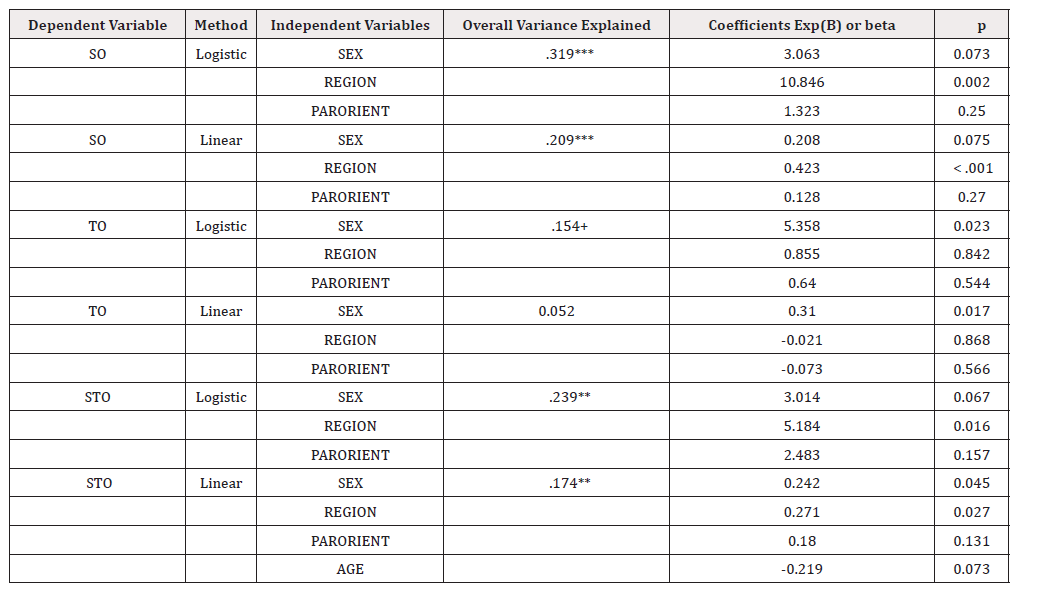
Table 1:Predicting adolescent sexual and transgender orientations from their sex, region of country, and parental sexual orientation using both binary logistic regression and linear ordinary least squares regression.
Note*: SO = sexual orientation of adolescent (heterosexual/non-heterosexual)
TO = transgender orientation of adolescent (cisgender/non-cisgender)
STO = Either non-heterosexual sexual orientation or transgender orientation
SEX = Adolescent’s natal sex (1= male, 2= female)
REGION = Region of adolescent (1 = Midwest/South, 2 = East/West coast or CANADA)
PARORIENT = Parents sexual orientation (1 = heterosexual, 2 = nonheterosexual)
Nagelkerke R square used with binary logistic regression; Adjusted R2 used with linear Regression
Exp(B) used with binary logistic regression; standardized regression (β) used with linear Regression
Age was not a strong variable for predicting TO and SO with linear regression.
+p = .10; *p< .05; ** p < .01; *** p< .001
In evaluating results, both the strength of effect sizes and consistency of effects are important considerations. Overall, results for transgender status often differed from results for sexual orientation, which may reflect apparently greater public concerns with respect to transgenderism. For example, in contradiction of sexual minority theory, region did not predict rates of transgender orientation among the adolescents yet in support of sexual minority theory, region did predict rates of sexual orientation, especially for heterosexual families. Remarkably, in less supportive regions, rates of TO, SO, and STO for heterosexual families were zero. Race of the adolescent was not related to TO, but was associated with SO and SRO. Results for age were inconsistent; for gay fathers, older age meant a greater percentage of children that were nontraditional (except for transgender orientation), but for heterosexual and lesbian families, older age meant a lower percentage of nontraditional children. For predicting STO, age was nearly significant but did not detract from the strength of the other three variables (Table 1). Developmental theory might be used to try to explain these inconsistent results but it seems that, except for gay fathers, older adolescents were less likely to report non-heterosexual orientations, possibly because of increased peer or societal pressures, which could be explained by sexual minority theory rather than developmental theory per se. Adding adolescent’s race, parental race, and divorce status to our linear regression model for SO in Table 1, or to linear regression models for TO and SO, yielded non-significant results with none of those added variables being more significant than p < .26. From Table 1, it is apparent that, except for TO, region is the strongest predictor of SO and STO, followed by sex of adolescent. Parental sexual orientation is a weak predictor at best, which contradicts [70], although one cannot dismiss the very high rates of nontraditional orientations as meaningless simply because the association with family structure per se was weak. In terms of adolescent transgender orientation, the sex of the adolescent was the only significant predictor (p < .05) in Table 1; notably the apparent effect of gender on transgender orientation was strongest for the heterosexual families. The important role of natal sex in predicting nontraditional orientations supports the concept of greater female sexual fluidity.
Results were weak or inconsistent for most of the other independent variables. Divorce rates seemed higher for nontraditional families but only one result reached significance (p < .05). Possibly social exchange theory can explain this in terms of comparison levels for alternatives. If a lesbian leaves her partner and has a child, other lesbian woman may still consider her a potential mate. On the other hand, since men tend to value parenting less in general and gay men may value parenting even less, if a gay father leaves his partner and has a child, his market value may be much lower and his alternatives for finding a new partner far fewer. Non-White adolescents were less likely to be girls (38.5%) than were Whites (61.1%) and less likely to report nontraditional sexual orientations (52.3% vs. 72.2% for Whites). Larger sample sizes would be useful for investigating these matters further.
Limitations and Objections
The sample used here was not drawn randomly; thus results cannot be generalized to larger populations, not even to those of current gay fathers and lesbian mothers (37: 11); as they noted, small nonrandom studies, though useful qualitatively, feature a “cost of unknown external validity”. Furthermore, the data are based on children adopted near birth; data might be quite different for children adopted later or during adolescence. Since the parents in Goldberg, et al., [33,38] were a selection of participants in a larger study and since those participants had to agree to participate in a longitudinal study over many years, there is potential for selection bias, if those adoptive parents who are willing to share their time and effort over many years (at least ten years, 38:352) are different from those who were not willing. As Patterson [39] has observed, selection bias can elicit responses from “especially well adjusted” respondents, which may reflect the situation of these adoptive parents regardless of their sexual orientation. Goldberg et al. (38: 361) stated that “The participants of this study did not give written consent for their data to be shared publicly”; some readers might object that their data was sensitive and some participants might have or might in the future object to the publication of even some of their sensitive information; this issue was reported to the IRB prior to approval. Because of the small sample size, varieties of sexual orientation and transgender status were combined into binary levels, limiting the richness of the data used and possibly obscuring relevant details that might be associated with different types of those orientations. Not all lesbian or gay families have adopted children; many have their own biological children (from one parent, at least) or have children obtained through surrogacy; thus, the results here cannot be expected to generalize to all types of lesbian, gay, or bisexual parent families. Because some adoptive families may be “same-sex” without being LGBTQ+, the results should not be generalized to those types of “two mom” or “two dad” types of families. The studies were based on families living in the United States or Canada, not including those from states that prohibited LGBT adoptions, and may not generalize within or outside the USA or Canada. The families in this study were mostly White, highly educated, with above average incomes; future research with nontraditional families needs to take intersectionality more into account (13: 295), as adoptive motivations, timing, and success may differ for those family structures with fewer resources [7]. The families also appear to have been living primarily in urban areas, limiting the relevance to families from rural areas (38: 360). Another limitation is that adolescents, from a developmental perspective (33: 2393), may continue to develop as they venture into young adulthood, which may include changes in their transgender or sexual orientations [74]. While our SESOI was based on logic and previous literature, others might have argued for a higher required effect size (e.g., d = .50), although given the limited sample size of the data set used here, the statistical power for detecting larger effect sizes would be limited. While we obtained data for 62 adolescents, Goldberg and Smith (2011) originally had data on hand for 52 lesbian and 38 gay adoptive families, such that our sample is only a subsample of their total adolescent data. The limitations of this study suggest that the results should be interpreted cautiously and as exploratory rather than as definitive. Any errors in our analyses are not the responsibility of Goldberg, et al., [33,38].
Conclusion
Results found here often differed when predicting transgender orientations compared to sexual orientations, indicating that researchers should not generalize from one type of orientation to another. Girls were more likely to report non-heterosexual or transgender orientations, across all three family structures, supporting gender fluidity theory. Adolescents living on East or West coasts in comparison to those living in the Midwest or South were more likely to report non-heterosexual orientations. Notably, among heterosexual families living outside coastal areas, none of their adolescents reported nontraditional orientations, results that support both sexual minority theory and social exchange theory. Gay and lesbian families were more likely to have nontraditional adolescents, but the effects were weak and never statistically significant. The apparent effect of adolescents’ age was inconsistent, negative for nontraditional orientations among lesbian and heterosexual families but positive among gay father families. The apparent effects of parental divorce status, parental race, and adolescent’s race (White vs. non-White) were minimal and seldom significant. Rates of nontraditional orientations generally were 50% or higher across all family structures in this study, affirming some of the concepts of queer family theory and queer family building. This research features numerous limitations, including families with very high levels of income and education, that suggest that further testing in larger and more representative samples of adoptive families is needed, as would be suggested by intersectionality theory.
Funding
Preparation of this article involved no external funding.
Ethics
A proposal entitled, “Predicting adopted adolescents’ selfreported sexual and transgender orientations from their adoptive parents’ sexual orientations and adolescents’ natal and gender identity, age, and geographic locations within the United States: A secondary data analysis of data published openly in 2024 and 2026 in the journal Family Relations, authored by Dr. Abbie Goldberg and colleagues”, proposal number IRB-13544, was approved on February 3, 2026 by the Kansas State University Committee on Research Involving Human Subjects and deemed exempt from further review under the criteria set forth in the Federal Policy for the Protection of Human Subjects, 45 CFR 104(d), Exempt Category 4, Subsection ii. The reporting of data in public academic sources, that would allow for secondary data analysis by independent scholars, by Goldberg, et al., is greatly appreciated.
Acknowledgment
None.
Conflict of Interest
None.
References
- Goldberg AE, Downing JB, Sauck CC (2007) Choices, challenges, and tensions: Perspectives of Lesbian prospective adoptive parents. Adoption Quarterly 10(2): 33-64.
- Goldberg AE, Downing JB, Sauck CC (2008) Perceptions of children’s parental preferences in lesbian two-mother households. Journal of Marriage and Family 70(2): 419-434.
- Goldberg AE, Downing JB, Richardson HB (2009) The transition from infertility to adoption: Perceptions of lesbian and heterosexual couples. Journal of Social and Personal Relationships 26(6-7): 938-963.
- Goldberg AE, Smith JAZ (2009) Perceived parenting skill across the transition to adoptive parenting among lesbian, gay, and heterosexual couples. Journal of Family Psychology 23(6): 861-870.
- Goldberg AE, Smith JAZ, Kashy DA (2010) Preadoptive factors predicting lesbian, gay, and heterosexual couples’ relationship quality across the transition to adoptive parenthood. Journal of Family Psychology 24(3): 221-232.
- Goldberg AE, Smith JAZ (2011) Stigma, social context, and mental health: Lesbian and gay couples across the transition to adoptive parenthood. Journal of Counseling Psychology 58(1): 139-150.
- Goldberg AE, Downing JB, Moyer AM (2012) Why parenthood, and why now? Gay men’s motivations for pursuing parenthood. Family Relations 61(1): 157-174.
- Goldberg AE, Moyer AM, Kinkler LA (2013) Lesbian, gay, and heterosexual adoptive parents’ perceptions of parental bonding during early parenthood. Couple and Family Psychology: Research and Practice 2(2): 146-162.
- Goldberg AE, Moyer AM, Weber ER, Shapiro J (2013) What changed when the gay adoption ban was lifted? Perspectives of lesbian and gay parents in Florida. Sexuality Research and Social Policy 10(2): 110-124.
- Goldberg AE, Smith JAZ (2013) Predictors of psychological adjustment in early placed adoptive children with lesbian, gay, and heterosexual parents. Journal of Family Psychology 27(3): 431-442.
- Goldberg AE, Kinkler LA, Moyer AM, Weber E (2014) Intimate relationship challenges in early parenthood among lesbian, gay, and heterosexual couples adopting via the child welfare system. Professional Psychology: Research and Practice 45(4): 221-230.
- Goldberg AE, Smith JAZ (2014) Predictors of parenting stress in lesbian, gay, and heterosexual adoptive parents during early parenthood. Journal of Family Psychology 28(2): 125-137.
- Goldberg AE, Sweeney K, Black K, Moyer A (2016) Lesbian, gay, and heterosexual adoptive parents’ socialization approaches to children’s minority statuses. The Counseling Psychologist 44(2): 267-299.
- Goldberg AE, Black KA, Manley MH, Front R (2017) ‘We told them that we are both really involved parents’: Sexual minority and heterosexual adoptive parents’ engagement in school communities. Gender and Education 29(5): 614-631.
- Goldberg AE, Frost RL, Black KA (2017) “There is so much to consider”: School-related decisions and experiences among families who adopt noninfant children. Families in Society: The Journal of Contemporary Social Sciences 98(3): 191-200.
- Goldberg AE, Smith JAZ (2017) Parent-school relationships and young adopted children’s psychological adjustment in lesbian-, gay-, and heterosexual-parent families. Early Childhood Research Quarterly 40: 174-187.
- Moyer AM, Goldberg AE (2017) We were not planning on this, but…”: Adoptive parents’ reactions and adaptations to unmet expectations. Child & Family Social Work 22: 12-21.
- Goldberg AE, Frost RL, Miranda L, Kahn E (2019) LGBTQ individuals’ experiences with delays and disruptions in the foster and adoption process. Children and Youth Services Review 106: 104456.
- Frost RL, Goldberg AE (2020) People said we were nuts…. I understand what they were saying now: An exploration of the transition to parenthood in sibling group adoption. Children and Youth Services Review 116: 105209.
- Frost RL, Goldberg AE (2020) Adopting again: A qualitative study of the second transition to parenthood in adoptive families. Adoption Quarterly 23(2): 85-109.
- Goldberg AE, Frost RL, Manley RH, McCormick NM, Smith JAZ, Brodzinsky DM (2020) Lesbian, gay, and heterosexual adoptive parents’ experiences with pediatricians: A mixed-methods study. Adoption Quarterly 23(1): 27-62.
- Lee BR, Wyman Battalen A, Brodzinsky DM, Goldberg AE (2020) Parent, child, and adoption characteristics associated with post-adoption support needs. Social Work Research 44(1): 21-32.
- Allen KR, Goldberg AE (2021) Lesbian adoptive mothers’ emotional responses and adaptation in the wake of relational dissolution. Journal of Women & Aging 33(2): 184-200.
- Goldberg AE, McCormick N, Frost N, Moyer A (2021) Reconciling realities, adapting expectations, and reframing “success”: Adoptive parents respond to their children’s academic interests, challenges, and achievement. Children and Youth Services Review 120: 105790.
- Goldberg AE, McCormick N, Virginia H (2021) Parenting in a pandemic: Work-family relationships, well-being, and intimate relationships among adoptive parents. Family Relations 70(1): 7-25.
- Goldberg AE (2022) LGBTQ family building: A guide for prospective parents. Washington, DC: American Psychological Association.
- Goldberg AE, Allen KR (2022) “Failed” matches, child removals, and disrupted placements: Devastating and invisible losses during the family-building journey for LGBTQ adoptive parents. Journal of Family Nursing 28(4): 368-380.
- Goldberg AE, Virginia H (2022) Lesbian, gay, and heterosexual parents’ perspectives on their adopted children’s puberty and approaches to puberty-related communication. Journal of Family Communication 22(3): 248-279.
- Goldberg AE, McCormick N, Kironde E, Virginia H, Logan M (2022) White parents of adopted Black children in an era of racial reckoning: Challenges, tensions, and strategies. Journal of Marriage and Family 84(5): 1314-1340.
- Goldberg AE (2023) LGBTQ-parent families: Diversity, intersectionality, and social context. Current Opinion in Psychology 49: 101517.
- Goldberg AE, Grotevant H (2023) What do teachers know about adoptive families, and how to they use it to serve adopted children? Adoption Quarterly 26(1): 51-76.
- Goldberg AE, Virginia H, Logan M, Silvert L (2023) “If only we knew…”: An exploratory study of parents of adoptive adolescents seeking residential treatment. Children and Youth Services Review 151: 107053.
- Goldberg AE, Silvert L, Farr RH (2024) Family-building desires among adopted adolescents with lesbian, gay, and heterosexual parents. Family Relations 73(4): 2392-2414.
- Goldberg AE, Gabriele-Black KA (2024) To tell or not to tell: Disclosure experiences and perceived microaggressions among adopted adolescents with lesbian, gay, and heterosexual parents. Journal of Adolescent Research, online advance.
- Goldberg AE, Smith JAZ (2024) Predictors of parenting stress in lesbian, gay, and heterosexual adoptive parents during parenthood. Journal of Family Psychology 28(2): 125-137.
- McCormick N, Goldberg AE (2024) Social competence, school engagement, and school performance among US children adopted through private domestic, international, and foster care adoption. Adoption Quarterly, online advance.
- Goldberg AE, Brodzinsky DM (2025) Thinking about the birth father: Loss, longing, ambivalence, and indifference among adopted adolescents with lesbian mothers. Infant and Child Development 34(1): e2561(1-14).
- Goldberg AE, Silvert L, Siracusa L (2026) Experiences with school-based sexuality education among adopted adolescents with sexual minority parents. Family Relations 75(1): 342-364.
- Patterson CJ (2006) Children of lesbian and gay parents. Current Perspectives in Psychological Science 15(5): 241-244.
- Patterson CJ (2017) Parents’ sexual orientation and children’s development. Child Development Perspectives 11(1): 45-49.
- Farr RH, Tornello SL, Rostosky SS (2022) How do LGBTQ+ parents raise well-adjusted, resilient, and thriving children? Current Directions in Psychological Science 31(6): 526-535.
- Golombok, S (2015) Modern families: Parents and children in new family forms. Cambridge, UK: Cambridge University Press.
- Golombok S (2017) Parenting in new forms. Current Opinion in Psychology 15: 76-80.
- Wardle LD (1997) The potential impact of homosexual parenting on children. University of Illinois Law Review 1997: 833-919.
- Regnerus M (2012) How different are the adult children of parents who have same sex relationships? Findings from the New Family Structures Study. Social Science Research 41(4): 752-770.
- Gates, GJ (2015) Marriage and family: LGBT individuals and same-sex couples. The Future of Children 25: 67-87.
- Simon KA, Farr RH (2022) Identity-based socialization and adopted children’s outcomes in lesbian, gay, and heterosexual families. Applied Developmental Science 26(1): 155-175.
- Mazrekaj D, Palmaccio S, De Witte K (2024) Research on children with LGBTQ parents: Challenges and a way forward. In G Kaufman, M. Stambolis Ruhstorfer, S Roberts, B Ralph (Eds.). Research Handbook on the Sociology of Gender. Cheltenham, UK: Edward Elgar Publishing 239-252.
- Haden SC, Applewhite K (2020) Parents who are lesbian, gay, bisexual, or transgender. In S Hupp & JD Jewell (Eds.), The encyclopedia of child and adolescent development (pp. 1-10). New York: Wiley.
- Oswald RF, Blume LB, Marks SR (2005) In VL Bengston, AC Acock, KR Allen, P Dilworth-Anderson, DM Klein (Eds.), Decentering heteronormativity: A model for family studies. In Sourcebook of family theory and research. Los Angeles, CA: Sage 143-166.
- Meyer IH (2003) Stigma, stress, and mental health in lesbian, gay, and bisexual populations: Conceptual issues and research evidence. Psychological Bulletin 129(5): 574-697.
- Farr RH, Tasker F, Goldberg AE (2017) Theory in highly cited studies of sexual minority parent families: Variations and implications. Journal of Homosexuality 64(9): 1143-1179.
- Jensen TM, Sanner C (2021) A scoping review of research on well-being across diverse family structures: Rethinking approaches for understanding contemporary families. Journal of Family Theory & Review 13(4): 463-495.
- Schumm WR (2018) Same-sex parenting: A critical assessment. London: Wilberforce Publications.
- Schumm WR (2025) A thought experiment using social exchange theory to interpret possible reasons underlying advantages for transgenderism. American Journal of Biomedical Science & Research 29(4): 432-437.
- Schumm WR (2013) Intergenerational transfer of parental sexual orientation and other myths. International Journal of the Jurisprudence of the Family 4: 267-433.
- Schumm WR (2015) Navigating treacherous waters – One researcher’s forty years of experience with controversial scientific research. Comprehensive Psychology 4(24): 1-40.
- Schumm WR (2020) Challenges in predicting child outcomes from different family structures: A further note. Psychology and Behavioral Science International Journal 14(2): 85-89.
- Schumm WR (2021) Confirmation bias and methodology in social science: An editorial. Marriage & Family Review 57(4): 285-293.
- Schumm WR, Crawford DW (2020) Is research on transgender children what it seems? Comments on recent research on transgender children with high levels of parental support. Linacre Quarterly 87(1): 9-24.
- Schumm WR, Crawford DW (2023) Difficulties with methodology in social science research with controversial issues regarding human sexuality. Linacre Quarterly 90(2): 194-216.
- Schumm WR, Crawford DW (2024) Sixteen approaches for deconstructing theory, research, or literature reviews claiming a “no difference” (null) result in the social sciences. The Natural Family: A Journal of Research and Public Policy 36(3-4): 155-176.
- Carone N, Bos HM, Shenkman G, Tasker F (2021) LGBTQ parents and their children during the family life cycle. Frontiers in Psychology 12: 643647.
- Carone N, Rothblum ED, Bos HM, Gartrell NK, Herman JL (2021) Demographics and health outcomes in a US probability sample of transgender parents. Journal of Family Psychology 35(1): 57-68.
- Smock PJ, Schwartz CR. (2020) The demography of families: A review of patterns and change. Journal of Marriage and Family 82(1): 9-34.
- Schumm WR. (2014) Challenges in predicting child outcomes from different family structures. Comprehensive Psychology 3: 3-17.
- Schumm WR (2020a) Avenues for future LGBT theory and research. JSM Sexual Medicine 4(2): 1031, 1-8.
- Schumm WR (2020b) Changes over the decades in selected LGBTQ research findings. SMS Sexual Medicine 4(2): 1-7.
- Suarez MI, Stackhouse EW, Keese J, Thompson CG (2023) A meta-analysis examining the relationship between parents’ sexual orientation and children’s developmental outcomes. Journal of Family Studies 29(4): 1584-1605.
- Schumm, WR (2010) Children of homosexuals more apt to be homosexuals? A reply to Morrison and to Cameron based on an examination of multiple sources of data. Journal of Biosocial Science 42(6): 721-742.
- Diamond LM, Villicaña Á, Burton R. (2024) The development of diversity in gender/sexual identity and expression. Developmental Science 17:453-483.
- Goldberg AE, Gartrell NK, Gates GJ. (2014) Research report on LGB-parent families. Los Angeles: Williams Institute.
- Schumm WR, Crawford DW (2021) Sexual orientation differences between children of same-sex parents and children of heterosexual parents: A brief report using a meta-analysis. Journal of Human Sexuality 12: 123-130.
- Carone N, Rothblum ED, Koh AS, Bos HM, Gartrell NK (2024) Sexual orientation and gender identity among donor-conceived offspring in the US National longitudinal lesbian family study from adolescence to adulthood. Sexuality Research and Social Policy 21(2): 704-16.
- Farr RH, Patterson CJ (2009) Transracial adoption by lesbian, gay, and heterosexual couples: Who completes transracial adoptions and with what results?. Adoption Quarterly 12(3-4):187-204.
- Manning WD, Fettro MN, Lamidi E (2014) Child well-being in same-sex families: Review of research prepared for the American Sociological Association amicus brief. Population Research & Policy Review 33(4): 485-502.
- Allen D, Price J (2020) Stability rates of same-sex couples: With and without children. Marriage & Family Review 56(1): 51-71.
- Biblarz TJ, Stacey J. (2010) How does the gender of parents matter?. Journal of Marriage and Family 72(1): 3-22.
- Stacey J, Biblarz TJ (2001) (How) does the sexual orientation of parents matter? American Sociological Review 66(2): 159-83.
- Cheng S, Powell B (2015) Measurement, methods, and divergent patterns: Reassessing the effects of same-sex parents. Social Science Research 52: 615-626.
- Levesque B (2023) CDC: A quarter-plus of U.S. high school students identify LGBTQ. Los Angeles Blade.
- Zweig R (1999) The relationship among psychological androgyny and the well-being of adult children of traditional and nontraditional families of origin. (Unpublished doctoral dissertation, Hofstra University, Hempstead, New York). Dissertation Abstracts International 60: 07B. UMI number 9936941.
- Easterbrook R (2019) “This is all normal and normal is relative to you”: LGBTQ+ parents’ experiences discussing sex and sexuality with their children. Master’s thesis, University of Guelph, Canada.
- Lakens D, Scheel AM, Isager RM (2018) Equivalence testing for psychological research: A tutorial. Advances in Methods and Practices in Psychological Science 1(2): 259-269.
- Riesthuis P (2024) Simulation-based power analyses for the smallest effect size of interest: A confidence-interval approach for minimum-effect and equivalence testing. Advances in Methods and Practices in Psychological Science 7(2): 1-14.
- Riesthuis P, Cribbie RA (2025) When are scientific findings deemed practically or theoretically relevant? A literature review on minimum-effect testing. The Quantitative Methods for Psychology 21(3): 82-94.
- Riesthuis P, Otgaar H, Setiawan T, Sumampouw N, Bucken C (2025) From p-values to practical relevance: An introduction to effect sizes through a legal psychological example. Psychological Research on Urban Society 8(2): 89-103.
- Larzelere RE, Gunnoe ML, Pritsker J, Ferguson CJ (2024) Resolving the contradictory conclusions from three reviews of controlled longitudinal studies of physical punishment: A meta-analysis. Marriage & Family Review 60(7): 395-433.
- Schumm WR, Pratt KK, Hartenstein JL, Jenkins BA, Johnson GA (2013) Determining statistical significance (alpha) and reporting statistical trends: Controversies, issues, and facts. Comprehensive Psychology 2(10): 1-6.




 We use cookies to ensure you get the best experience on our website.