
Research Article 
 Creative Commons, CC-BY
An Analysis of the Implications for Non-Participation in Sports
*Corresponding author:Temba Hlasho, Division of Student Affairs at the University of Free State, Bloemfontein, South Africa.
Received:February 09, 2026; Published:February 17, 2026
DOI: 10.34297/AJBSR.2026.30.003891
Abstract
Background and Study Aim: South African history of apartheid has led to persistent inequalities in sports participation, particularly in areas that were previously disadvantaged. (HDA’s). Non-participation in sports could have far reaching consequences on communities and individuals.
Hypothesis: The purpose of this study aims to investigate the implications of non-participation in sports, identifying enablers and prohibitors that will influence participation in sports.
Study Design: Systematic Review
Material and Methods: A qualitative research design will be used, employing semi-structured interviews with individuals sampled from historically disadvantaged areas who have participated or not participated in sports. The research will also draw inspiration from the SPLISS method, determining few key factors such as resources for sport, governance in sport, sport policies regulating sport, foundation and participation, and sport training facilities.
Results: White and coloured participants believe judo has transformed and is fairly accessible and inclusive compared to few years ago. Black participants expressed divergent views citing financial support and international participation as still an issue for disadvantaged athletes. Findings suggest that athletes from historically disadvantaged areas attribute their success to functional competition structures, community sport access, scholarships and bursaries, clubs, coaching support and mentorship. The study findings highlighted complexities relating to multi-faceted barriers and facilitators that encourages or discourages participation in judo. Interesting, gender did not seem to have influenced the perception for all the groups.
Clinical Relevance: Understanding the implications of non-participation in sports amongst historically disadvantages areas is crucial for developing targeted interventions leading to amicable solutions through aligned policy direction.
What is already known on this topic: Judo is still a developing sport in South Africa and comparatively less popular than other sporting codes. The sport is popular worldwide and over 20 million people practice judo globally.
What this study adds: Identify inhibitors and recommending intervention to promote participation in South Africa to catch up with the rest of the world.
Keywords: Talent identification, Participation, Non-Participation, SPLISS, Athletes, Resources
Introduction
Existing body of knowledge reveals that participation in sport improves psychological wellbeing of abled bodies. Complementing study of the effects of participation in sport on psychological well-being of athletes with disability reflect that participation in sport by athletes with disability enhanced their psychological well-being. This literature by McVeigh et al. is substantiated by Coenders et al. (2017) [1] proposing that a firmer relationship occur between sport participation and the condition of health [2]. Contextually, diminishing participation in judo will have devastating consequences for the federation and particularly its role to contribute to physical well-being of athletes, population in general and health living standards. Harrison and Narayan (2003) [3], argues that involvement is extra- curricular activities and schools sport has mental health as well as psychosocial benefits leading to healthy minds and body. Further studies by Eime, Young, Harvey, Charity and Payne [4], corroborate Harrison and Narayan sentiments on benefits to participation in sport and reaffirming psychosocial and health benefits [4]. Kanning and Schlicht [5] argue that physical engagement influence quality of life through social, psychological and biological mechanism. Existing scientific evidence confirms that Physical Activity (PA) reduces the risk of disease and contributes majorly to mental and physical functioning. Maddux (1995) corroborates Kanning and Schlicht suggesting that regular participation in exercise programs can enhance selfefficacy, migrating to improved confidence, motivation, and overall individual well-being.
Von Mackensen, Harrington, Tuddenham, Littley, Will, Fareh, Hays & Khair [6], in their study on men with haemophilia, found that sport participation improved participants health status. Andersen, Ottesen and Thing [7], in their review of a wide range of international research literature, discovered that there was a general agreement across research literature on team sport participation as being linked to improved social and psychological health. This observation, though based on team sport participation, is congruent to sentiments expressed by Von Mackenseb, et al., [6] & Maddux [8] who both linked participation in sport as positively impacting well-being and health status of sports participants. Volf, Kelly, Bengoechea, Casey, Gelius, Messing, Forberger, Lakerveld, Braver, Zukowska and Woods [9] corroborate Von Mackense bel al. & Maddux suggesting that physical participation is lined with a wide range of positive health outcomes. This has been associated with reduced all-cause mortality. To this effect, non-participation in physical activity yields negative health outcomes and increased mortality [9].
Literature suggests that vocational education featured as the most common denominator for physical inactivity and nonparticipation in sport. In a study among Norwegian adolescents involving girls and boys, it was reported that low parental education and low economic well- being correlated with physical inactivity and non-participation in sport respectively [10]. Piatkowska and Biernat (2023) argue that lack of time, interest and preference of passive leisure activity contributes to non-participation in sport. Further cited reasons are medical condition and the age of potential participants [11]. Non-participation in sport may have devastating consequences for the federation as revenues generation depends on participants and participation in organizational activities [12]. According to Maddux [8] Social Cognitive Theory is an approach to understanding human cognition, action, motivation and emotion that assumes that people are capable of self- reflection, selfregulation and that they are active creators of their environments rather than simply passive responder to them. To that effect, the decision to participate or not to participate in sport is an informed decision. Kamphuis, (2008), argue that the level of socio-economic standing result in skewed physical activity and dietary choices by the two groups. The groups on higher socio-economic level, he argues, are likely to be physically active and consume fruit and vegetables resulting in good and positive healthy life style. Contrary, the groups from lower socio-economic back group are less likely to eat fruits and vegetable and engage in reasonable physical activity. Accordingly, the inequality in health and mismatched access to tangible benefits result in the lower socio-economic group not having an appetite to participate in physical activities [13].
Methodology
This groundbreaking study employed a mixed-methods approach to delve into the real-life experiences, perceptions, and opinions of Judo South Africa’s stakeholders, including athletes, coaches, and officials. By exploring the barriers to judo participation in South Africa, the research aimed to uncover the underlying factors influencing involvement [14]. Through in-depth, semi-structured interviews and comprehensive questionnaires, the study gathered rich, contextual data on the challenges faced by Judokas. Key areas of focus included transportation, dojo accessibility, coaching quality, socioeconomic factors, and social support networks [15]. Data was collected through a sampled group of judokas constituted by athletes, coaches and technical officials using standardized questionnaires [16]. The findings, analyzed through a rigorous evaluation process, offer valuable insights into the complexities of judo participation in South Africa. By shedding light on these critical issues, this research provides a foundation for developing targeted strategies to increase participation, improve athlete support, and grow the sport of judo in the region (Figure 1).
South African government’s national budget for sport, arts, culture and recreation amounted to R6,3 billion for the period 2023/2024 with R1.4 billion allocation to sport promotion and recreation development (DSAC, 2024). With three years towards Los Angelos Olympic Games, the government prioritizes training programmes for elite athletes who will be participating in the 2028 Olympic Games [17]. In 2020, Brazil allocated US$ 4.9 billion for sports development and elite athlete support. This is allocation constitute .06% of the total federal budget (Eiras de Castro, Moretti de Souza, Rocha de Camargo and Mezzadri, 2025 [18]. In the same period, Japanese government allocated $160 million for athletes’ support, sports initiatives, and sports organizations. Comparatively, Japan and Brazil have won, on numerous occasions, and South Africa have never won an Olympic medal for judo since its inception [19]. The skewed funding allocation explains why these countries may never be comparable in terms of elite performance pathways and medal tallies at high level world competition and Olympics [20]. Government prioritizes corporative governance in ensuring implementation of the prescripts of The White Paper which embodies the governments vision of entrenching its key objective, that of creating “an active and winning nation”. The improvement of the management of sport and the delivery thereof is paramount to ensure functioning of sports structures at optimal levels.
To that effect, the government created National sport and Recreation Plan aimed at implementing the White Paper on sport. Evidently, the government created conducive environment for sport federation and management to thrive and optimally support athletes to develop to their full potential Jacobs, De Bosscher and Venter [21]. In other countries, inter alia, Government of Montenegro, politicians are allowed to be elected as members of federations (Government Montenegro, 2014, which in my view blurs the oversight aspect if funders of sports are operationally involved in sport. Fortunately, in South Africa, The Department of Sports, Arts and Culture acts as an oversight structure and DSAC staff may not form part of sports federations (DSAC, 2025).
Financial Support
Premised on Nelson Mandela’s notion that sport has the power to change the world, and the apartheid history of sport segregation, the South African government committed to fund sport to bring about social cohesion, unify and keeping the nation active. (DSAC, 2010; Jacobs, De Bosscher, Venter and Schroeder, 2018). The White Paper served as a basis for the creation of the National Sport and Recreation Plan (NSRP) which was presented as an implementation proposal for high level athletes and mass-participation aimed at creating equal opportunities promoting fairness in the distribution of resources [22]. To that effect, Department of Sport, Arts and Culture funds each federation based on their respective business plan and priorities federations present in line with DSAC’s rural and transformative imperatives (DSAC NDRP, 2012) [23]. A study conducted by Swart, Swanepoel and Surujlal (2014) aimed at critical evaluating government spending on sport revealed that government spends a huge budget on sport administration as opposed to promoting elite sport, mass-participation including schools’ sport. These findings were evidenced, inter alia, by government’s own documents, Sport and Recreation South Africa Strategic Plan, Annual Performance Plans and Annual reports [24]. Globally, sport commodification and professionalization, amongst others, created personal meaning and nuanced identity and provided lucrative career path for many people [25].
Organization and Structure of Sport Policies
Sports, nationally and internationally, is a leisure-time physical activity as well as a professional engagement leading to massparticipation and elite performance [26]. Participation in sport is voluntary and may be facilitated by various factors, inter alia, health, family and friends influence and passion for recognition [27]. In Europe, as documented in the Sport for All Charter of the Council of Europe, across all states, sport is used as a worthwhile pastime activity [26]. Governments, in order to pique sport through policy directions, depend on the socio- ecological reasoning [28]. Corroborating existing knowledge, Sam (2009) argue that sport policy issues are complex and sometimes create uncertainties. Contrary, sport has been positioning itself as an insulator for wicket sport problems.
Foundation and Participation
Participation in sport offers various benefits that shape the wholeness of the participant, inter alia, boost self-esteem, fundamentally enhance health and fitness, help reduce stress and promotes social cohesion [29]. Sports participation not only benefits athletes, it contributes towards development of competent human resource as the more sport becomes commercialized and globalized the competent coaches, managers and administrators are required leading to countries receive recognition as athletes achieve at national and international levels [30]. Contrary to the facilitators mentioned by Dahri, et al. 2021 [29]; & Mulyana, et al. 2022 [30], Hulteen, Smith, Morgan, Barnett, Hallal, Colyvas & Lubans [31] in the study to determine the physical activities most commonly participated by children, adolescents and adults globally found that participation rates revealed consistent patterns in lifelong activities and football amongst adults. However, a significant change in adolescents and child leisure-time patterns was observed signaling a nuanced impact on the diverse groups.
Training Facilities
Hlasho, 2024, citing Professor Kano, 1986, indicates that improvement of training ways and facilities is critical for the growth of elite athletes. Access to high quality standard training venues facilitates more effective training for judokas leading to impactful performance at high level competitions [32]. Existing literature reveals that athletes from previously disadvantaged areas struggled to get to training and competition venues due distance, lack of money and poor transport system [27]. This deficiency contributed to non- participation in sport as athletes were inconvenienced and, in most cases, could not reach training and competition venues or arrive late. Interestingly, post-apartheid policies created conducive sporting environment through development support funding which assisted athletes with transportation and necessary sporting equipment, but this intervention did not significantly increase participation in sport [27]. In a global context, racial discrimination affected minority ethnics groups including black people and such groups were affected negatively as all forms of suppression exposed them to poor facilities, severe racial stereotypes and subjected them to continued reinforcement of inferiority complex [33]. Despite government intervention through developing National Development Plans and sport transformation policies aimed at improving sport infrastructure in the townships, the system has not successfully addressed lack of sports facilities in previously disadvantaged areas [33].
Implications for Non-Performance in Sport
Stronger relationship between health and participation in sport exist, therefore lack of participation in sport contributes to various factors, among others, diminishing role of sport federation, negative impact of revenue stream, and reduced mass participation pool from which talent is identified making it difficult to qualify and quantify talent identification [32]. Formal and structured sport plays a critical role in the development of youth and the nation at large leading to, inter alia, health and well-being, cognitive, moral and social development benefits [34]. Emmonds, et al. in their study aimed at evaluating participation of youth in sport across Europe by both males and females found that participation of males in sport was marginally higher than females. Contrary to this finding, females were found to be participating more in volley ball and netball. This observation is very important for future research as one wonders why people choose to play a particular sport and not the other. This gap requires more research to determine reasons for choosing to participate in a particular sport. Existing knowledge confirms that the reduction of numbers may handicap the organization from growing and developing leading to diminishing new talent pool and compromised resources. Sponsors majorly look at the number of participations before deciding on whether to fund a federation or not. Logic dictates that a greater number of participations will attract more sponsorship as companies want value for money [35,36].
Data Analysis
Demographic Profile of Participants
The study involved 75 judo participants sampled from judo community in South Africa constituted by athletes, coaches, technical officials, and judo volunteers. The gender split composed of 68% males (n=51) and females 32% (n=24). The age spread was between 34 years and 60 years, with a mean of 46.7 years (SD+- 3.7). Racial composition was 56% Black (n=42), 28% White (n=21), and 16% Coloured (n=12). Participants were further stratified by roles: 54.7% athletes (n=41), 24% coaches (n=18), and 21.3 % judo volunteers (n=16). Table 1 illustrates the demographic profile of participants involved in the study, including gender, race, roles within judo, and average years of experience involved in judo. The table gives an overview of the sample distribution by category (Figures 1-4).
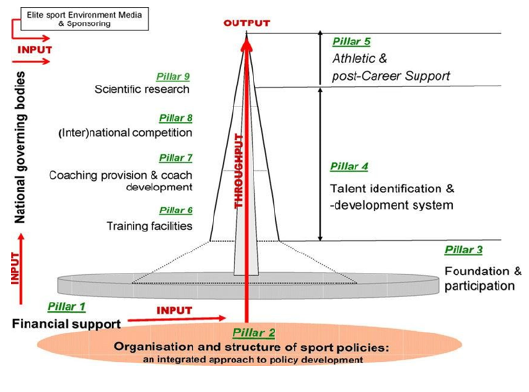
Figure 1:Adopted from “Theory of Sports Policy Factors Leading to International Sporting Success (De Bosscher, 2015).
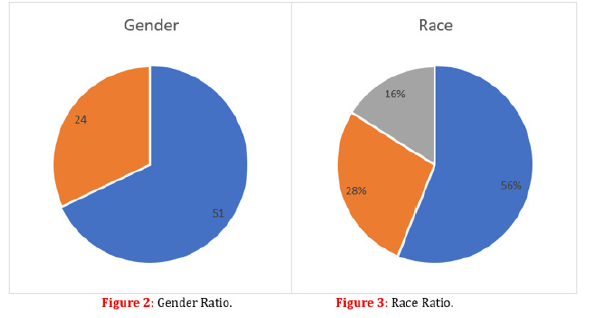
Figure 2:
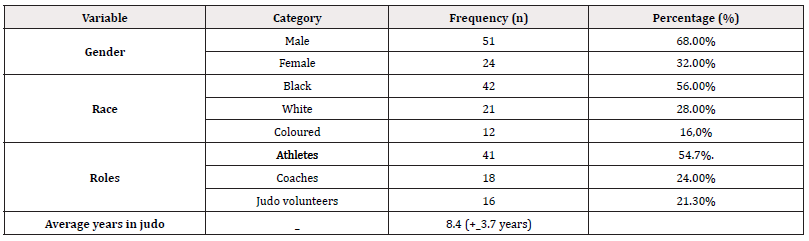
Figure 4:Participants Roles Ratio.
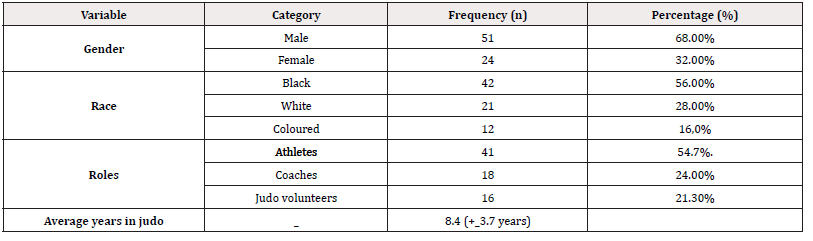
Table 1:

Table 2:Themes.
Interpretation and Discussion
Participants reported numerous factors preventing from participating in judo, inter alia, financial constraints, limited facilities access, poor visibility and marketing of sport, administration challenges and racial inequality. However, some participants highlighted recurring facilitated such as self-defence training, discipline the sport instil and youth development opportunities in the sport. Themes that frequently arose are summarize and illustrated in the Table 2 below:
Discussion and Conclusion
The majority of coaches, athletes and volunteers are of the view that judo barriers are occasionally overstated and see judo as an inclusive sport with a fair access to facilities. Additionally, they believe judo has transformed overtime and is reflective of broader demographics. Interestingly, expressed perceptions were not influenced by the gender of the participants, an encouraging cue given the apartheid history of South Africa. When perceptions based on race, “white” and “coloured” respondents shared more or less similar sentiments, while “blacks” respondents expressed different perspectives, especially on matters relating to finances and international participation. Generally, athletes flagged psychological and cultural factors as having shaped their engagements with judo for many years. The research underscores the criticality in ensuring the creation of an inclusive judo environment and more welcoming sporting platforms responsive to athletes’ unique challenges across racial lines. The findings further serve strong and valuable guide to the national federation and related stakeholders to positively reimagine recruitment, marketing and resource mobilization for the organization.
Recommendations
Informed by current findings, future research should conduct an in-depth examination of the barriers and facilitators influencing access to judo facilities, including their availability, affordability, quality, and societal perceptions. Specifically, investigation should explore stereotypes surrounding judo participation, the impact of media representation, and cultural attitudes. Additionally, the role of family, friends, and peer support in promoting or discouraging judo participation warrants further analysis. By building upon these findings, future studies can provide a more comprehensive understanding of the factors influencing judo participation and inform strategies to promote inclusivity and accessibility. Policy reviews to address access and quality issues will be critical to create an attractive judo environment leading to more participation in judo.
Acknowledgement
I extend my sincere gratitude to my wife, Tebogo Hlasho, for her understanding and support and by allowing me time to do this work.
Conflict of interest
None.
References
- Coenders F, Van Mensvoort C, Kraaykamp G, Breedveld K (2017) Does sport participation improve health? A panel analysis on the role of educational attainment, economic deprivation and work-family load. European Journal for Sport and Society 14(1): 45-59.
- McVeigh SA, Hitzig SL, Craven BC (2008) Influence of Sport Participation on Community Integration and Quality of Life: A Comparison Between Sport Participants and Non-Sport Participants with Spinal Cord Injury. Spinal Cord Med 32(2): 115-124.
- Harrison PA, Narayan G (2003) Differences in Behavior, Psychological Factors, and Environmental Factors Associated with Participation in School Sports and Other Activities in Adolescence. Journal of School Health 73(3): 113-120
- Eime RM, Young JA, Harvey JT, Charity MJ, Payne W, (2013) A Systematic review of the psychological and social benefits of participation in sport for children and adolescences: informing development of a conceptual model of health through sport. International Journal of Behavioral Nutrition and Physical Activity.
- Kanning M, Schlicht W (2008) A bio-psychological model of successful aging as shown through the variable “physical activity” Eur Rev Aging Phys Act 5: 79-87.
- Von Mackensen S, Harrington C, Tuddenham E, Littley A, et al. (2016) The impact of sport on health status, psychological well-being and physical performance of adults with haemophilia. The Official journal of the World Federation of Haemophilia, European Association for Haemophilia and Allied Disorders and Hemostasis & Thrombosis Research Society.
- Andersen MH, Ottesen L, Thing LF (2019) The social and psychological health outcomes of team sport participation in adults: An integrative review of research. Scandinavian Journal of Public Health 47(8): 832-850.
- Maddux JE (1995) Self-Efficacy Theory In: Maddux JE (eds) Self-Efficiency, Adaptation, and adjustment. The Plenum Series in Social/Clinical Psychology. Springer, Boston, MA.
- Volf K, Kelly L, Bengoechea EG, Casey B, Gelius P, et al. (2022) Evidence of the impact of sport policies on physical activity and sport participation: a systematic mixed studies review. International Journal of Sport Policy and Politics 14(4): 687-712.
- Heradstveit O, Haugland S, Hysing M, Stormark KM, Silvertsen B, et al. (2020) Physical inactivity, non-participation in sports and socioeconomic status: a large based study among Norwegian adolescents. BMC Public Health 20(1): 1010.
- Piatkowska M, Biernat E (2023) Participation and Reasons for non-participation in Sport and Recreation Activities Before and After the Outbreak of Covid 19: Analysis of Data From the 2016 And 2021 Poland National Sports Participation Survey. Physical Culture and Sport Studies and Research (101): 63-75.
- Nagel S, Schlesinger T, Bayle E, Giauque (2015) Professionalization of sport federations a multi-level framework for analyzing forms, causes and consequences. European Sport Management Quarterly 15 (4): 407-433.
- Kamphuis CBM (2008) Socioeconomic inequalities in health behaviours – the role of environmental factors. Thesis Erasmus, MC, University Medical Centre Rottedam.
- Hammond C (2005) The wider benefits of adult learning: An illustration of the advantages of multi-method research. International Journal of Social Research Methodology 8(3): 239- 255.
- Heyvaert M, Hannes K, Maes B, Onghema P (2013) Critical appraisal of mixed methods studies. Journal of mixed methods research 7(4): 302-327.
- Jaarsma EA, Dekker R, Geertzen JH, Dijkstra P (2016) Sports participation after rehabilitation: barriers and facilitators. Ournal of rehabilitation medicine 48(1): 72-79.
- Department of Sport, Arts and Culture (2025) Strategic Plans 2025/2030. An active, creative, winning and socially cohesive nation.
- Eiras de Castro SB, Moretti de Souza JV, Rocha de Camargo P, Mezzadri FM (2025) Government budget and priorities for sports in Brazil (2024-2020). Managing Sport and Leisure 30(3): 487-505.
- Hlasho TS, Mathunjwa M, Shaw B, Shaw I (2025) Factors Affecting Recruitment and Retention of Different Race Groups in Judo South Africa. J. Biomed Res Environ Sci 6(1): 098.
- Nolte PL (2018) Management of Judo Federations: A Comparative Analysis. PhD (Chemistry)/ M.Sc. (Physics)/M.A.(Philosophy)/ M.Com. (Finance). University of Johannesburg.
- Jacobs S, De Bosscher V, Venter R (2021) Inter-organisational Relationships between Governmental Stakeholders in South African elite sport: Resource dependency and interorganisational theoretical perspectives. International Journal of Sport Policy and Politics 13 (1): 123-142.
- Jacobs S, De Bosscher V, Venter R, Scheerder J (2018) Country profile: sport in South Africa. International Journal of Sport Policy and politics 11(1): 175-191.
- SRSA NSRP (Department of Sport and Recreation South Africa) (2012) The national sport and recreation plan [online].
- Swart JJ, Swanepoel MJ, Surujlal J (2014) A critical analysis of government spending on sport: mass participation and school allocation: sport administration. African Journal for Physical Health Education, Recreation and Dance 20: 2.
- Stewart B (2015) Sport Funding and Finance. 2nd Edition. Routledge. Taylor & Francis Group. London and New York.
- Hoekman R, Scheerder J (2021) Sport policy practice and outcome: theoretical and empirical approaches. European Journal for Sport and society 18(2): 103-113.
- Hlasho TS, Mathunjwa M, Shaw B, Shaw I (2024) Effects of apartheid legacy on South African judo. A systematic review. American Journal of Science.
- Bronfenbrenner, Urie (1917) The ecology of human development. Experiments by nature and design. Havard University Press.
- Dahri AJ, Khatoon A, Arain SS, Dahri KH, Muneer R (2021) The Factors Effecting Sports Growth and Development in Secondary Level. PalArch’s Journal of Archaeology of Egypt / Egyptology (PJAEE). 18(18): 588-593.
- Mulyana FR, Hidayat C, Hanief YN, Juniar DT, Millah H, et al. (2022) Analysis of inhibiting factors in regional sports achievement development. Journal of Physical Education and Sport (JPES) 22(12): 3009-3015.
- Hulteen RM, Smith JJ, Morgan PJ, Barnett LM, Hallal PM, et al. (2017) Global participation in sport and leisure-time physical activities: A Systematic Review and meta-analysis. Preventative Medicine (95): 14-25.
- Hlasho TS (2024) An Investigation and Analysis of the Barriers and Facilitators Relevant to Participation in Judo in South Africa. PhD. University of Zululand (South Africa).
- Dodo OE, Van Niekerk RL, Lyoka PA (2020) Transformation-Infrastructure keys to Equality and Inclusivity in Sport: Policy Trajectory in Post-apartheid South African Sports. South Africa Journal for Research in Sport, Physical Education and Recreation 42(3): 91-110
- Edmmonds, SE, Weaving D, Burton A Lara Bercial S (2024) Youth Sport Participation Trends Across Europe: Implications for Policy and Practice. Research Quarterly for Exercise and Sport. 95(1): 69-80.
- De Bosscher, Simon Shibili, Hans Westerbeek, Maarten van Bottenburg (2016) Convergence and Divergence of Elite Sport Policies: Is There a One-Size-Fits-All Model to Develop International Sporting Success? Journal of Global Sport Management 1(3-4): 70-89.
- Geeraert A (2018) National Sport Governance Observer. Final Report. Aarhus: Play the Game: Danish Institute for Sports Studies.




 We use cookies to ensure you get the best experience on our website.