
Letter to Editor 
 Creative Commons, CC-BY
An Interface at Which we Can Import Magnesium Sulfate Salt to Downregulate Body Metabolism for Suspicious Heatstroke Attack
*Corresponding author:Yong Tan, Independent Researcher in China.
Received:January 24, 2026; Published:February 03, 2026
DOI: 10.34297/AJBSR.2026.30.003872
Letter to Editor
Editors, I am pleasure to share my experience that is utilizing an interface to downregulate systemic metabolism which is featured at least with atraumatic, safe, or less cost. The significance of this approach is available to protect the Central Nervous System (CNS) from overexcitation due to body in hyperpyrexia.
Motivated us to do this is our friend, Shirly Wang, who is a lady living in Nanning, the capital of GX, China, shared her experience of applying 50 ML of cold saline to douse her nasal cavity for get through her mental stress in July 2025 that undergoing the scorching summer attack with atmosphere temperature up to 38 Degrees Celsius (DC); and what she did, made her sober again off away from a series of symptoms like malaise, fatigue and anxiety you can ascribe all to suffering a suspicious heatstroke.
Accordingly, a bold idea we conceive that via cooling nasal mucosa to regulate the Autonomic Nervous System (ANS) and its hypermetabolism that is always reckoned as the neuropathological evidence [1,2] for CNS malfunction in heatstroke; correspondingly, so far in Emergency Departments (ED), where practitioners still lack the specific guideline [3] serving their interference with pathological progression of patients. Overall, Physical Rapid Cooling Body (PRCB) is most often carried out almost as the unique option in attempt to relieve such feverishly systematicity attack withal, the following procedure we call evidence-based supportive care which likely applied aims to treat viscera disorder induced by such aberrant hypermetabolism that finally possibly elicits failure. Refractory is presented short of systematicity [4]; on the other hand, nobody thus far can make a precise predication at any time in presence of patients with various conditions or underlying diseases. Consequently, CNS disorder is therein the chief we concern in management.
The ANS which region where covers thalamus and inferior and the neuron of the X cranial nerve which head residing in the medulla oblongata is the headquarter for manage autonomic activity including saliva secretion, body temperature, and heart beating rate via secreting hormones or a/efferent bioelectric impulse to communicate with everywhere outside cranium. To influence ANS, the method we employ derives from Ruan Xin Magnesium Trial reported in [5] coating nose with Magnesium Sulfate for ANS importing cation: A cascading reaction kick-starts at cooling nasal mucosa with cold saline for enable itself metabolism decline amounting to reduce glucose transferred into ventral brain via decreasing supply to draw down the glucose metabolism overheating in ANS. This nasal pathway applied is likely the venous-dura network withal, cavernous sinus may be the interface of the transcranial traffic [5]. In this interference, magnesium cation we look forwards to its accessing that may relieve those neurons [6] whereby to inhibit nervous overexcitation further to reduce communication between CNS and viscera involved.
Our design seems a bit of crazy. In our scenario trying to prove that is hiking at 1-2 hours on afternoon with a temperature exceeding 38 DC and Body Temperature (BT) or sphygmic counter gets a remarkable rising than finish walking. After cooling nasal cavity for two minutes per lateral of nasal cavity and then seating for measure various physiological data in 10 minutes as interval within one hour; in addition, any measure done but cooling body. The first applying cold solution is normal saline (1% NaCl, w/v, denoted by 1Na(L) herein that denotes 0 DC with symbol (L)). Interesting is outcome in availably drawing down BT which dynamic pilot presented in the Figure 1 in which, compare with another adding same weight of Magnesium Sulphate (herein denotes with 1Mg); with either number of BT declining or persistent time within an hour, normal saline clearly presents itself disadvantage for almost half to solutions that mixed of magnesium in Figure 2.
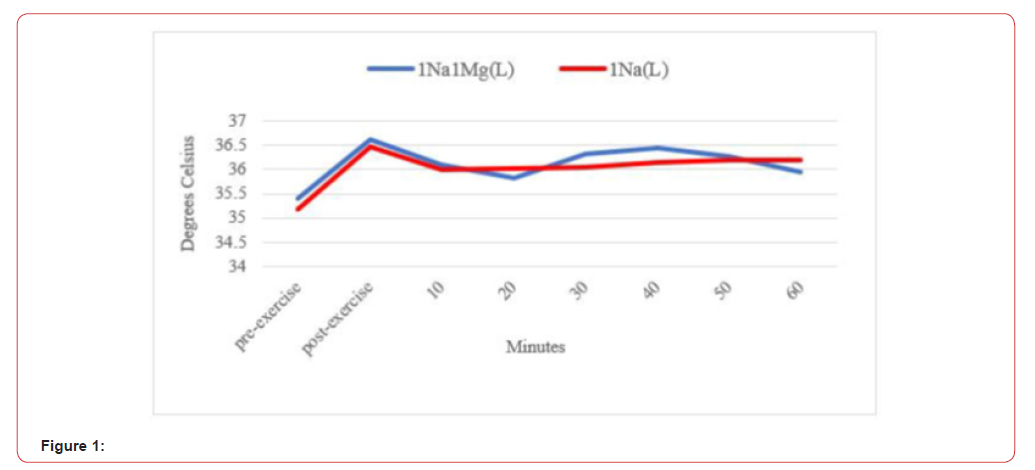
Figure 1:
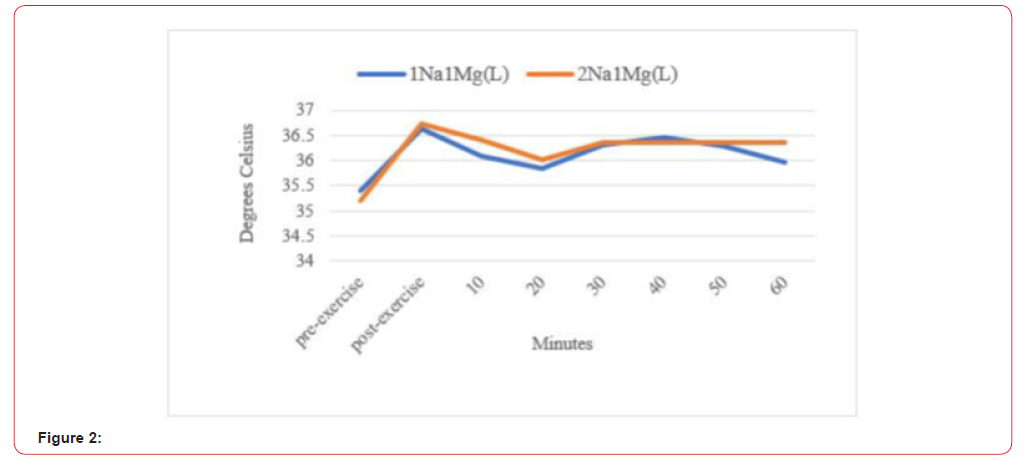
Figure 2:
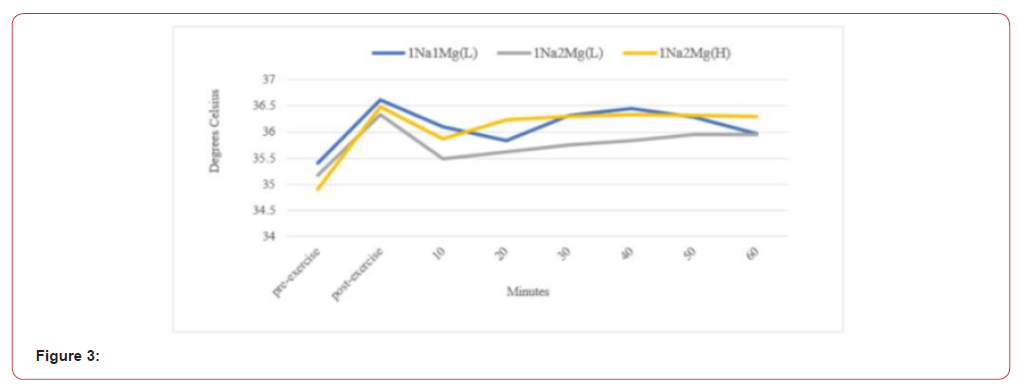
Figure 3:
Nonetheless increasing the concentration of sodium to twofold denoted with 2Na, that is unable to elevate cooling efficacy a bit, conversely, seems worse than normal; conversely, the discrepancy into two magnesium concentrations is noteworthy in Figure 3.
The importance is comparative warm solution 1Na2Mag(H) with (> 5 DC marked with uppercase H) still presents itself the effectiveness to draw down BT which warm character inclines to avoid tissues frostbitten that may be the adverse affecting lower temperature brings on, sounding a safe option in clinical management. If recapitulate our essay above-mentioned, the distinct from the mainstream approach in fixing high BT the PRCB, is a small physical momentum utilizing in a 100 ML cold solution; yet leverage the systemic overheating metabolism. The current PRCB is pushing a cool hub with liquid nitrogen to quickly draw down BT. This solution, besides great expensive because of needing of professional team to maintain and operate so that the minority of elite athletes can afford, a potential risk is approach itself the cooling body can bring vasoconstriction in skin or muscles that is sure to change circulatory system dynamic. Such incitation may be a great menace to patients who have been vulnerable with poor circulations or other underlying conditions. Such as the hypertension it is sensitive to peripheral vasculature change most often in favour of vasodilation to improve BP.
Well, what significance does our proposal imply in regulating ANS metabolism?
Frankly speaking, body overheating, the most cases in everyday life should be suspicious from exertional fever possibly without BT up to 40 degrees the criterion of heatstroke diagnosis; nevertheless, the potential risk is still able to deteriorate underlying conditions. The character of economic and easy-operation in medical interference means easily deployed not only in EDs, but the home, offices, gyms or stadiums, workshops, or etc.; and in-place rescue even more practitioners may be nonspecialist. The importance is small-momentum interference applied can overcome the barrier set by side effects the inherent residing in present therapies for which, in the most case, the treatment job must be specialists to take. Well, upper respiratory tract is amazing for not only the respiring portal but the interface we can rule in for interfere with the systemic metabolism. On the other hand, the limitation in our trials is obvious that is rather rough and slapdash without much more data or with less representativeness. However, we hope this primary trial as an inspiration to expedite the study at the aspect of regulating systemic metabolism.
Acknowledgment
None.
Conflict of Interest
None.
References
- Byung Hoon Lee (2020) Atypical brain imaging findings associated with heat stroke: A patient with rhabdomyolysis and acute kidney injury: A case report. Radiology Case Reports 15(5): 560-563.
- Yoneda K, Hosomi S, Hiroshi Ito, Yuki Togami, Sayaka Oda, et al. (2024) How can heatstroke damage the brain? A mini review. Front Neurosci 18: 1437216.
- Rublee C, Dresser C, Catharina Giudice, Jay Lemery, Cecilia Sorensen (2021) Evidence-Based Heatstroke Management in the Emergency Department. West J Emerg Med 22(2): 186-195.
- Zhe Zhang, Xiaopeng Wu, Zheng Zou, Mingzhi Shen, Qiong Liu et al. (2024) Heat stroke: Pathogenesis, diagnosis, and current treatment. Ageing Res Rev 100: 102409.
- Tan Y (2025) Upper Respiratory Infection Responsible to Systemic Hypometabolism Leading to Myriad Viscera Dysfunction Plausibly Explains Why Neuropsychiatric Symptoms Manifest in COVID or Long COVID. Med Discoveries 4(8): 1271.
- Yamanaka R, Shindo Y, Oka K (2019) Magnesium Is a Key Player in Neuronal Maturation and Neuropathology. Int J Mol Sci. 20(14): 3439.




 We use cookies to ensure you get the best experience on our website.