
Research Article 
 Creative Commons, CC-BY
Analysis of Polymorphism of the Folate Methionine Cycle Gene MTRR Ile22Met 66 A>G in Pregnant Women with Spina Bifida in the Republic of Karakalpakstan
*Corresponding author:Mavlyanova NN, Republican Specialized Scientific and Practical Medical Center for Mother and Child Health, Ministry of Health of the Republic of Uzbekistan.
Received:February 11, 2026; Published:February 24, 2026
DOI: 10.34297/AJBSR.2026.30.003906
Abstract
The problem of Fetal Developmental Abnormalities (FDA) remains relevant and socio-economically significant in the practice of obstetricians-gynecologists and pediatricians. Studies have established that chromosomal imbalance plays a special role in the etiology of fetal abnormalities.
Research objective: To evaluate the detectability of the association between the folate cycle gene polymorphism (rs1801394) of the MTR R Ile22Met 66 A>G gene and the development of spina bifida in pregnant women in the Uzbek population.
Materials and methods: 88 pregnant women with spina bifida were examined. The patients’ ages ranged from 24 to 41 years. All patients underwent general clinical and molecular genetic PCR studies. The control group consisted of 30 pregnant women with a physiological course of pregnancy.
Research Results: Analysis of the association of the MTRR Ile22Met 66 A>G folate cycle gene polymorphism showed that in pregnant women with spina bifida, the heterozygous A/G variant was detected in 24.7% (22/89), and in the healthy control group - in 3.3% (1/30). (x2=10.24; p<0.006; OR=9.52; 95%CI 1.22 - 74.03). The mutant genotype G/G was identified in 7.8% (7/89) of the main group and was not detected in the control group. (x2=10.24; p<0.006; OR=5.5; 95%CI 0.31 - 100.05).
Conclusions: Thus, the G allele and heterozygous A/G and mutant homozygous G/G genotypes of the MTRR gene polymorphism are significant markers of increased risk of fetal abnormalities in pregnant women in the Uzbek population. The A allele and the functionally favorable A/A genotype are reliable protective markers against the development of pathology.
Keywords: Spina bifida, Fetal anomaly, Genetics, Folate cycle genes, (rs1801394), MTRR gene Ile22Met 66 A>G
Introduction
The problem of fetal abnormalities remains relevant and socially significant in the practice of obstetricians, gynecologists, and pediatricians. In the structure of early reproductive losses, the frequency of non-developing pregnancies and/or fetal abnormalities is 27.3-36.6% [1-14]. The causes of fetal abnormalities are numerous and often occur in combination. To date, numerous studies have not formed a consensus on the etiology and pathogenesis of fetal abnormalities [2,4-9]. Studies have shown that chromosomal imbalance plays a special role in the etiology of fetal abnormalities. Thus, among first-trimester abortions, about 50% have an abnormal karyotype [5,7,11]. It has been noted that in half of the cases, chromosomal abnormalities are the cause of pregnancy loss in the first trimester, while the cause of death of the other half of the fetuses may be multifactorial in nature.
One of the factors in the development of obstetric complications, including fetal abnormalities, is a deficiency of folic acid and B vitamins associated with dietary characteristics and defects in folate metabolism genes, which in turn leads to excessive accumulation of homocysteine in the blood of the mother and fetus. It is known that homocysteine has an indirect and pronounced direct embryotoxic effect due to the binding of Nitric Oxide (NO), the main factor in vasodilation, thereby stimulating the adhesion of lymphocytes to the endothelium in excessive amounts and disrupting the proliferation of endothelial cells [2,6,10]. Hyperhomocysteinemia is a risk factor for embryo implantation defects, chronic fetoplacental insufficiency, the development of severe malformations, growth retardation, or fetal death [4,12-14].
Folates are necessary for the synthesis and methylation of DNA, RNA, proteins, phospholipids, and neurotransmitters; they participate in the repair of double-strand DNA breaks, otherwise cell apoptosis mechanisms are triggered. Folates are necessary for the regulation of gene expression through DNA methylation. Another significant factor in obstetric complications is the disruption of the implantation process of the fertilized egg due to the disruption of the formation of a complete vascular system of the chorion and placenta. Another important factor in placentation and trophoblast invasion is vascular endothelial growth factor A (VEGF-A, angiogenesis factor), which is the main inducer of angiogenesis. VEGF- A stimulates proliferation, migration, permeability, and homeostasis of vascular endothelial cells, and stimulates cytotrophoblast differentiation. In this regard, genetic studies of major mutations in genes responsible for folic acid metabolism are of particular interest.
Research objective
To evaluate the detectability of the association between the folate cycle gene polymorphism (rs1801394) and the MTRR gene Ile22Met 66 A>G with the development of spina bifida in pregnant women in the Uzbek population.
Materials and Methods
We examined 88 pregnant women with spina bifida. The patients’ ages ranged from 24 to 41 years. All patients underwent general clinical, instrumental, functional (ultrasound, Dopplerometry), ELISA, and molecular genetic PCR studies. All examined women were consulted by related specialists (therapist, neurologist, infectious disease specialist, dermatologist, endocrinologist, etc.). The control group consisted of 30 pregnant women with a physiological course of pregnancy. Molecular genetic testing of biomaterials was performed at the Russian Scientific Center for Preventive Medicine and Health from 2021 to 2023. DNA/RNA was extracted from all blood samples using the Ribo- Prep kit (Interlabservice, Russia).
To identify genotype polymorphism consisting of alleles of the MTRR Ile22Met 66 A>G gene, allele-specific primers from the manufacturer were selected from DNA samples. For genotyping of DNA samples by Polymerase Chain Reaction (PCR), 200 DNA samples were studied. For this purpose, the 96-well automated amplifier Applied Biosystems Veriti was optimized according to the following program: initial denaturation once at 180 sec 94°C, 94°C for 10 seconds, 64°C for 10 seconds, 72°C for 20 seconds. We performed these steps 40 times in the program to induce a polymerase chain reaction. Statistical analysis of the results was performed using the OpenEpi 2009, Version 2.3 statistical software package.
Research Results
The average age of pregnant women in the main group was 29.2±2.3 out of 88 examined, while in the control group it was 29.4±2.5, respectively, which explains the lack of statistical significance of the difference between the examined groups. (P>0.005). With informed consent, molecular genetic studies were conducted on patients to determine the prevalence of allelic variants and the association of gene polymorphism (rs1801394) of the MTRR Ile22Met 66 gene using the PCR method (Table 1).
As can be seen from the table, in the control group of healthy pregnant women, the detection rate of the functional allele A of the MTRR gene was 98.3% of cases (59/60), while in the main group of pregnant women with AP pregnancy, allele A was detected in 79.7% of cases (142/178) cases, which was 1.2 times lower than in the control group. (x2=11.7; p<0.0006; OR=0.07; 95%CI 0.01-0.50).
The mutant G allele was identified in 20.2% (36/178) of the main group, while in the control group it was identified in 1.6% (1/60), which was 12.6% higher than in healthy pregnant women. (x2=11.7; p<0.0006; OR=14.9; 95%CI 2.00-111.6). The data obtained indicate a significant association between the allele frequency of the studied polymorphism and the development of fetal abnormalities in women of the Uzbek population.

Table 1:Frequency distribution of allele variants and polymorphism of the MTRR Ile22Met 66(rs1801394) A>G gene in pregnant women with spina bifida and a control group of healthy pregnant women
Note*: N - number of patients examined; *n - number of alleles examined; * - significance level relative to the control group (P<0.05).
Analysis of the distribution of genotypic variants of the MTRR gene polymorphism Ile22Met 66 A>G showed that the favorable A/A genotype in the control group of healthy pregnant women was 96.6% (29/30), while in the main group of patients it was 67.4% (60/89), which was 1.4 times lower than in the control group. (x2=10.24; p<0.006; OR=0.07;95%CI 0.01-0.55). Meanwhile, the heterozygous variant A/G was detected in 24.7% (22/89) of patients, while in the healthy control group it was detected in 3.3% (1/30) of patients which was 7.5 times higher than in the control group. (x2=10.24; p<0.006; OR=9.52; 95%CI 1.22 - 74.03) (Table 1). The mutant genotype G/G was determined in the main group - 7.8% (7/89) and was not detected in the control group. (x2=10.24; p<0.006; OR=5.5; 95%CI 0.31 - 100.05).
Analysis of the results of molecular genetic studies indicates that the mutant G allele and the heterozygous genotype A/G and the unfavorable homozygous genotype G/G of the MTRR gene are genetic determinants of folate metabolism disorders - the risk of fetal abnormalities, and its carriage is a protector of predisposition to the development of this pathology, increasing its risk by 14.9 times (OR=14.9).
Thus, the results of molecular genetic studies of the MTRR gene showed a link between the unfavorable variant allele “G” and the association of polymorphism of the A/G genotypes of the MTRR gene Ile22Met 66, leading to the replacement of adenine (A) at position 119 with guanine (G) in the amino acid sequence, with the development of fetal anomaly (spina bifida) in pregnant women. The results of the study showed that the risk of developing spina bifida in the presence of the
variant allele G polymorphism in the genome is increased by 14.9 times (OR=14.9) and in the heterozygous variant - A /G - 9.52 (OR=9.5) and in the homozygous mutant variant of genotypes G/G - 5.5 (OR=5.6), respectively. The data obtained indicate that when carrying the unfavorable variant of the A/G genotype of the MTRR Ile22Met 66 gene, the risk of developing spina bifida ( ) and anencephaly ( ) in the fetus increases by 1.7 times compared to the homozygous variant of the MTRR gene (OR=9.52).
A statistically significant association was found between the functionally unfavorable G allele and the heterozygous A/G genotype of the MTRR gene and the mutant homozygous A/A genotype of the MTR gene of the studied polymorphism with the pathogenesis of spina bifida.G and the mutant homozygous variant A/A of the MTR gene of the studied polymorphism with the pathogenesis of fetal anomaly may indicate a high probability of association of this pathology with both heterozygous and homozygous non-functional variants of the MTR gene genotypes (Table 2).
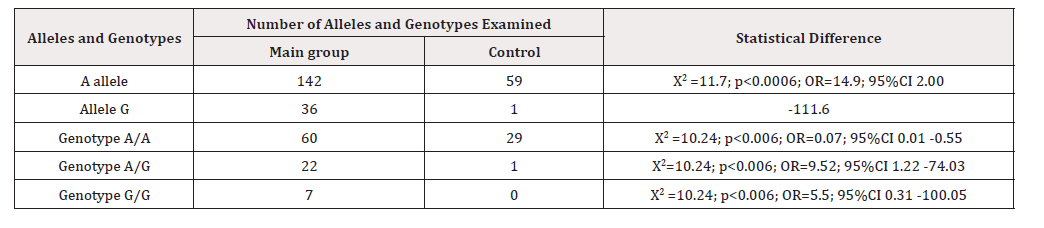
Table 2:Indicators of differences in the frequency of alleles and genotypes of the MTRR Ile22Met 66 gene polymorphism in the main and control groups of pregnant women.
We conducted a study on the relationship between folate cycle gene polymorphism in pregnant women with spina bifida in the fetus, which characterized the association of the MTRR Ile22Met 66 gene with a predisposition to fetal developmental abnormalities (spina bifida), which confirms the link between the folate cycle and dysembryogenesis.
In this regard, an important step in the study of polymorphic genes potentially associated with the development and pathogenesis of diseases is the analysis of the expected and observed frequency of genotypes of the studied polymorphisms and the compliance of the frequency distribution with the Hardy-Weinberg Equilibrium (HWE) (Table 3).

Table 3:Expected and observed frequency distribution of genotypes according to HWE for the MTRR Ile22Met 66 A>G gene polymorphism in the main group of pregnant women with spina bifida.
As can be seen from the table, the frequency distribution of genotypes according to the MTRR Ile22Met 66 A>G polymorphism in the main group of pregnant women with fetal abnormalities showed that the observed frequency of favorable A/A genotypes was 67.4%, heterozygous genotypes A/G-24.7%, and mutant homozygous genotypes G/G-7.8% of cases, respectively, while the expected frequency of favorable genotypes A/A decreased 1.3 times and amounted to 53.01%, and heterozygous genotypes A/G amounted to 39.6%, which was increased by 1.6 times, and the observed and expected homozygous mutant genotypes G/G amounted to 7.8% and 7.4% of cases, respectively.
The data obtained indicate that the frequency of the expected occurrence of fetal abnormalities in pregnant women with heterozygous variants of the MTRR Ile22Met 66 A>G gene increases by 1.6 times, respectively. The results obtained are statistically significant (P <0.05). The results of the study were analyzed in a group of control patients with a physiological course of pregnancy (Table 4). While in the control group, the observed frequency of functional A/A genotypes was 96.7%, and the expected frequency was 60.6%, the heterozygous variant A/G of the MTR gene was observed in 3.3% of cases, and the expected frequency was 34.5%, which was 10.5 times higher than the indicators with the observed genotypes (P <0.05). Meanwhile, the unfavorable G/G mutant genotype was not observed in the observed frequency, but was observed in 4.9 cases in the expected frequency. The data obtained are important for predicting the risk of obstetric complications, in particular fetal abnormalities (Table 4).

Table 4:Expected and observed frequency distribution of genotypes according to the MTRR Ile22Met 66 A>G gene polymorphism in the control group of patients with physiological pregnancy.
A comparative analysis of the expected and observed frequencies of genotypes for this polymorphism revealed statistically significant deviations (P<0.05) in all study groups. This fact indicates that the observed proportion of genotypes in the study samples is consistent with the Hardy-Weinberg equilibrium.
Thus, the G allele and heterozygous A/G and mutant homozygous G/G genotypes of the MTR gene polymorphism are significant markers of an increased risk of fetal abnormalities in pregnant women in the Uzbek population. (x2=11.7; p<0.0006; OR=14.9; 95%CI 2.00- 111.6). Allele A and the functionally favorable A/A genotype are reliable protective markers against the development of pathology (X2=11.7; p<0.0006; OR=0.07; 95%CI 0.01 - 0.50). Analysis of the results obtained indicates that pregnant women who are carriers of the G allele variant and heterozygous A/G genotype of the MTRR Ile22Met 66 A>G gene are at risk of fetal abnormalities.
Thus, the results published in the literature and our own research indicate that the folate cycle gene MTRR Ile22Met 66 A>G plays an important role in the development of fetal abnormalities in pregnant women in the Uzbek population. When analyzing the nature of multifactorial pathology in the family histories of the examined pregnant patients with fetal abnormalities, a predominance of cardiovascular pathology (myocardial infarction, stroke, varicose veins), the presence of oncological pathology, and endocrine pathologies (polycystic ovary syndrome, diabetes mellitus, endemic goiter). The data obtained corresponds with the literature data of foreign authors, which shows that the hereditary predisposition to cardiovascular and oncological diseases in the examined women who are carriers of polymorphic variants of folate cycle genes corresponds to global data on possible complications associated with the SNP of these genes. Aliyeva T.D. 2013].
Studies indicate that in the pedigrees of women at risk of developing reproductive pathology with thyroid disease, there is a deficiency of an important biogenic element, iodine, which is regional in nature. Thus, the results of studies published in the literature and our own research indicate that the folate cycle gene MTR Asp919Gly (rs 1805087) A>G plays an important role in the development of reproductive pathologies, including fetal abnormalities.
Conclusion
a) Analysis of the association of the MTRR Ile22Met 66 A>G
folate cycle gene polymorphism showed that the favorable
A/A genotype in the control group of healthy pregnant women
was 96.6% (29/30), while in the main group of patients it was
67.4% (60/89), which was 1.4 times lower than in the control
group. (x2=10.24; p<0.006; OR=0.07; 95%CI 0.01 - 0.55).
b) The heterozygous variant A/G was detected in 24.7% (22/89),
and in the healthy control group - 3.3% (1/30), which was 7.5
times higher than the control group, respectively. (x2=10.24;
p<0.006; OR=9.52; 95%CI 1.22 - 74.03). The mutant genotype
G/G was determined in the main group in 7.8% (7/89) of cases,
while it was not detected in the control group. (x2=10.24;
p<0.006; OR=5.5; 95%CI 0.31 - 100.05)
c) The data obtained indicate that carriage of the unfavorable
allele G of the MTRR Ile22Met 66 A>G gene may be a diagnostic
marker of predisposition to the formation of spina bifida in the
fetus, increasing its risk by 9.5 times (OR=9.52).
d) Thus, the G allele and heterozygous A/G and mutant
homozygous G/G genotypes of the MTRR Ile22Met 66 A>G gene
polymorphism are significant markers of increased risk of fetal
abnormalities in pregnant women in the Uzbek population.
(x2=11.7; p<0.0006; OR=14.9; 95%CI 2.00-111.6). Allele A and
the functionally favorable genotype A/A are reliable protective
markers against the development of pathology (x2=11.7;
p<0.0006; OR=0.07; 95%CI 0.01 - 0.50).
Acknowledgement
None.
Conflict of Interest
None.
References
- Bespalova O H (2009) Genetic risk factors for pregnancy loss: abstract of dissertation. Doctor of Medical Sciences. St. Petersburg 40.
- Dobrolyubov AC, Lipin M A (2006) Polymorphism of folate metabolism genes and human diseases Bulletin of New Medical Technologies 4: 71-73.
- Derevyanchuk EG (2011) Epigenetic, molecular genetic, and biochemical criteria for human embryogenesis disorders: abstract of dissertation. Candidate of Biological Sciences. Stavropol 18.
- Efremova OA (2020) Study of the association of polymorphic loci of folate cycle genes with the development of grade 2-3 fetal growth restriction syndrome. Scientific results of biomedical research 6(1): 37-50.
- Lifanov Al (2013) Association of MTHFR, MTR, and MTRR gene polymorphisms with the development of hyperhomocysteinemia in athletes Scientific Notes of Lesgaft University 8: 98-101.
- Makatsaria AD (2011) Thrombohemorrhagic complications in obstetric and genetic practice: a guide for doctors. MIA 1056.
- Ozheva R Sh (2012) The influence of environmental factors on the health indicators of children and adolescents in the North Caucasus region New Technologies. Maykop 1: 229-234.
- Olenev AS, Baranova EE, Sagaydak OV, Kuznetsova ES, Galaktionova A M, et al. (2021) Results of prenatal screening for trisomy of chromosomes 21, 18, and 13 using non-invasive prenatal testing in Moscow. Reproduction Problems 27(1): 114-123.
- Shin Young Kim, So Yeon Park, Ji Won Choi, Do Jin Kim, Shin Yeong Lee, et al. (2011) Association between MTHFR 1298A>C polymorphism and spontaneous abortion with fetal chromosomal aneuploidy Am. J. Reprod. Immunol 66(4) 252-258.
- Ji Hyang Kim, Young Joo Jeon, Bo Eun Lee, Hojeong Kang, Ji Eun Shin, et al. (2013) Association of methionine synthase and thymidylate synthase genetic polymorphisms with idiopathic recurrent pregnancy loss Fertil Steril 99(6): 1674-1680.
- Jaroslav A Hubacek, Jitka Rynekrova, Dita Kasparova, Vera Adamkova , Michael V Holmes, et al. (2015) Association of MTHFR genetic variants C677T and A1298C on predisposition to spontaneous abortion in Slavonic population Clin. Chim Acta 104-107.
- Fabio L Lino, Évelyn Traina, José Augusto Barreto, Antonio Fernandes Moron, Rosiane Mattar, et al. (2015) Thrombophilic mutations and polymorphisms, alone or in combination, and recurrent spontaneous abortion Clin Appl. Thromb. Hemost 21(4) 365-372.
- U Isaoglu, P Ulug, I B Delibas, M Yilmaz, Y Kumtepe, et al. (2014) The association between inherited thrombophilia and recurrent pregnancy loss in Turkish women Clin. Exp Obstet Gynecol 41(2): 177-181.
- Mei Yang, Tian Gong, Xiaofang Lin, Ling Qi, Yiyang Guo, et al. (2013) Maternal gene polymorphisms involved in folate metabolism and the risk of having a Down syndrome offspring: a meta¬analysis Mutagenesis 6: 661-671.




 We use cookies to ensure you get the best experience on our website.