
Research Article 
 Creative Commons, CC-BY
Construction of a Theoretical Model of Humanistic Nursing Care in Methadone Clinics
*Corresponding author:Junhui Yan, Department of Critical Care Medicine, The Third Affiliated Hospital of Shenzhen University, Shenzhen, China.
Received:March 11, 2026; Published:March 17, 2026
DOI: 10.34297/AJBSR.2026.30.003942
Abstract
Objective: To construct a scientific and feasible theoretical model of humanistic nursing care in methadone clinics, so as to provide standardized guidance and theoretical basis for the practice of humanistic nursing care in methadone clinics, improve the medical experience of patients receiving Methadone Maintenance Treatment (MMT), enhance treatment compliance and reduce the relapse rate.
Methods: Based on the group standard Management Specification for Humanistic Care of Outpatients, semi-structured interviews were conducted to collect the cognition, experience and demands of humanistic care from medical staff, patients and their family members in methadone clinics. Grounded theory was adopted for data coding and analysis, and combined with the Delphi method for expert letter consultation, a theoretical model of humanistic nursing care in methadone clinics was constructed.
Results: The effective recovery rates of the two rounds of Delphi consultation questionnaires were 93.3% and 96.7% respectively; the authority coefficients of the two rounds of consultation were 0.88 and 0.89 respectively; the Kendall’s concordance coefficients for the necessity, rationality and feasibility of the indicators in the first round of consultation were 0.352, 0.398 and 0.263 (all P<0.001), and those in the second round were 0.548, 0.407 and 0.386 (all P<0.001). The finally constructed theoretical model included 4 first-level indicators, 12 second-level indicators and 58 third-level indicators, covering four core dimensions: care subject, care content, care process and care guarantee.
Conclusion: The construction process of the theoretical model is scientific, the content setting is in line with the particularity of patients in methadone clinics and the needs of clinical practice, and the indicators are specific and feasible with certain scientificity and reliability. It can provide support for the standardized development of humanistic nursing care work in methadone clinics.
Keywords: Methadone Clinic, Humanistic Nursing Care, Theoretical Model, Grounded Theory, Delphi Method
Introduction
Methadone Maintenance Treatment (MMT) is a drug replacement therapy clinically adopted for opioid addicts such as heroin abusers [1]. Based on the bio-psycho-social medical model, it uses legal, safe and effective methadone to replace drugs, which significantly reduces addicts’ dependence on heroin and other drugs, and decreases drug-related illegal and criminal activities as well as the transmission of infectious diseases such as HIV and hepatitis C. It is an important measure to solve public health problems related to drug hazards [2]. By 2020, there were 1.801 million drug abusers in China, among whom 734,000 were opioid addicts, accounting for 40.8% of the total number of drug abusers, and the demand for nursing services for a large number of MMT patients is urgent to be met [3].
Humanistic nursing care refers to nurses’ sincere care for patients’ life and health, rights and demands, personality and dignity with a humanitarian spirit. In addition to providing necessary diagnostic and therapeutic technical services, it also involves offering spiritual, cultural and emotional services to meet patients’ physical and mental health needs [4,5]. The Action Plan for Further Improving Nursing Services (2023-2025) issued by the National Health Commission of China in 2023 explicitly emphasizes the importance of humanistic nursing, pointing out that it plays a vital role in improving patients’ medical experience, promoting a harmonious nurse-patient relationship, boosting the development of the nursing profession and advancing the construction of Healthy China [6].
As a special group, patients in methadone clinics are prone to negative emotions such as inferiority, anxiety and depression due to their addiction experience, and often face problems such as social exclusion and family alienation. Their psychological and emotional needs are more prominent, and the demand for humanistic nursing care is more urgent [7,8]. However, the current nursing work in China’s methadone clinics mostly focuses on the implementation of drug treatment, and the practice of humanistic nursing care lacks systematic theoretical guidance and standardized criteria. There are problems such as a single way of care, care content not meeting patients’ needs, and uneven humanistic care capabilities of medical staff, which make it difficult to meet the physical and mental needs of MMT patients and affect treatment compliance and relapse rate to a certain extent [9,10].
The group standard Management Specification for Humanistic Care of Outpatients defines the environment, facilities, processes and measures for humanistic care of outpatients, providing a basic framework for the practice of outpatient humanistic care [11,12]. Based on this, combined with the results of semi-structured interviews, this study uses grounded theory and Delphi method to construct a theoretical model of humanistic nursing care in methadone clinics. It provides ideas for the theoretical system of humanistic care in methadone clinics and scientific guidance for clinical nursing practice, which is of great clinical and social significance for improving MMT patients’ treatment compliance, alleviating their psychological state and reducing the relapse rate.
Methods
Establishment of the Research Group
The research group consisted of 9 members, including 1 chief pharmacist, 1 chief nurse, 2 associate chief nurses and 6 nursesin- charge, among whom 1 held a doctoral degree, 5 held master’s degrees and 4 held bachelor’s degrees. The group members were mainly responsible for literature retrieval and collation, designing semi-structured interview outlines, conducting interviews, organizing expert letter consultations, carrying out data coding and analysis, and processing data, so as to ensure the scientificity and standardization of the research process.
Literature Retrieval and Data Collation
With the search terms of “methadone clinic”, “humanistic nursing care”, “theoretical model”, “grounded theory” and “Delphi method”, literature retrieval was conducted in databases such as CNKI, Wanfang, PubMed and Web of Science. Meanwhile, the group standard Management Specification for Humanistic Care of Outpatients, relevant diagnosis and treatment specifications for methadone clinics and works on humanistic nursing care were collated to sort out the core connotation and practical key points of humanistic nursing care, as well as the characteristics and humanistic care demands of patients in methadone clinics, laying a theoretical foundation for the construction of the theoretical model [13].
Semi-Structured Interviews and Data Collection
Referring to the processes and requirements for humanistic care of outpatients in the Management Specification for Humanistic Care of Outpatients and combining with the particularity of patients in methadone clinics, a semi-structured interview outline was designed, covering the cognition, experience, demands and existing problems of humanistic care of three groups: patients, medical staff and family members. The interviewees were selected from medical staff (2 head nurses, 4 nurses, 2 doctors), 10 patients and 6 family members in methadone clinics of 2 Grade A tertiary hospitals. The inclusion criteria were as follows: medical staff were on-the-job personnel in methadone clinics with more than 1 year of relevant work experience; patients had received MMT for more than 1 month with clear consciousness and normal communication ability; family members were the main caregivers of patients and had lived with patients for more than 3 months. One-on-one faceto- face interviews were conducted, with each interview lasting 30- 60 minutes. The whole interview process was recorded by audio, and on-site records were made at the same time. The audio was transcribed into written data within 24 hours after the interview to ensure the integrity and authenticity of the data. A total of 24 valid interview data were collected, including 8 from medical staff, 10 from patients and 6 from family members.
Data Coding and Analysis Based on Grounded Theory
In accordance with the procedural grounded theory paradigm, the interview data were subjected to three-level coding analysis: open coding, axial coding and selective coding, and memo writing and constant comparison were carried out throughout the data analysis process [14]. ① Open coding: the interview data were coded word by word for conceptualization and categorization, and initial concepts were formed through constant comparison, revision, integration and induction, which were divided into corresponding categories; ② Axial coding: the initial concepts and categories were reorganized and summarized, the connections between different concepts and categories were concluded, first-level categories were formed by merging, and the subordinate or causal relationships between second-level categories and first-level categories were established; ③ Selective coding: the core category was selected, the story line was found and systematically connected with other supporting categories, and combined with literature supplementation, a draft theoretical model of humanistic nursing care in methadone clinics was initially formed [15].
Expert Letter Consultation Based on Delphi Method
Expert Selection: A total of 30 experts from the fields of humanistic nursing, clinical nursing, nursing management, mental health and drug dependence treatment were selected. The inclusion criteria for experts were as follows: ① Bachelor’s degree or above; ② Having the professional title of nurse-in-charge or above; ③ engaging in relevant fields for more than 10 years; ④ Having interest in the research topic and being willing to participate in the consultation. Finally, 27 experts were identified, covering 15 Grade A tertiary hospitals and 3 institutions of higher education in South China, Central China, East China and Southwest China, with good representativeness, high academic level and rich practical experience.
Questionnaire Design and Distribution: The expert consultation questionnaire consisted of three parts: ① Expert invitation letter, including research topic introduction, expert invitation letter and filling instructions; ② Consultation questionnaire on the theoretical model of humanistic nursing care in methadone clinics, which evaluated the necessity, rationality and feasibility of the first-level, second-level and third-level indicators of the model draft by using a 5-point Likert scale (1=strongly disagree, 5=strongly agree), and an opinion revision column was set after each indicator for experts to put forward revision suggestions; ③ Expert basic situation questionnaire, including experts’ general situation, familiarity with the consultation content and judgment basis. Questionnaires were distributed by a combination of e-mail and face-to-face distribution, and two rounds of expert letter consultation were carried out. After the recovery of questionnaires, the contents were checked one by one, and experts were timely verified for missing fills or unclear expressions to ensure the validity of the questionnaires [16].
Indicator Screening Principles: The indicator screening principles were as follows: the mean score of necessity, rationality or feasibility of indicators >3.50, Coefficient of Variation (CV) <0.25. Combined with experts’ opinions and the discussion results of the research group, the included indicators were determined, and the indicators that did not meet the requirements were revised, merged or deleted.
Statistical Methods
Excel 2021 and SPSS 26.0 software were used for data entry and analysis. The basic situation of experts was expressed by frequency and composition ratio; the enthusiasm of experts was expressed by the effective recovery rate of questionnaires; the degree of centralization of experts’ opinions was expressed by mean ± standard deviation; the authority degree of experts was expressed by authority Coefficient (Cr), where Cr=(Ca+Cs)/2 (Ca is the judgment basis, Cs is the familiarity coefficient); the coordination degree of experts’ opinions was expressed by Coefficient of Variation (CV) and Kendall’s concordance coefficient (Kendall’s W value). A P value <0.05 was considered statistically significant.
Results
Basic Situation of Experts
Among the 27 experts participating in the consultation, 3 (11.1%) were aged 30-39 years, 13 (48.1%) were aged 40-49 years, and 11 (40.7%) were over 50 years old; 4 (14.8%) had 10- 19 years of work experience, 11 (40.7%) had 20-29 years, and 12 (44.4%) had 30 years or more; 14 (51.9%) had a bachelor’s degree, 8 (29.6%) had a master’s degree, and 5 (18.5%) had a doctoral degree; 13 (48.1%) had associate senior professional titles and 14 (51.9%) had senior professional titles; 10 (37.0%) were engaged in nursing management, 6 (22.2%) in humanistic nursing, 7 (25.9%) in clinical nursing, 2 (7.4%) in mental health and 2 (7.4%) in drug dependence treatment.
Enthusiasm and Authority Degree of Experts
In the first round of consultation, 30 questionnaires were distributed and 28 valid ones were recovered, with an effective recovery rate of 93.3%, and 20 experts put forward revision suggestions; in the second round, 28 questionnaires were distributed and 27 valid ones were recovered, with an effective recovery rate of 96.7%, and 9 experts put forward revision suggestions. The Ca of the two rounds of consultation were 0.90 and 0.92 respectively, the Cs were 0.86 and 0.85 respectively, and the Cr were 0.88 and 0.89 respectively, all >0.70, indicating high expert authority and reliable consultation results.
Coordination Degree of Experts’ Opinions
The Kendall’s W values of the indicators in the first and second rounds of consultation were all statistically significant (all P<0.001), as shown in Table 1. In the first round of consultation, the CV ranges of necessity, rationality and feasibility of the indicators were 0.05-0.19, 0.04-0.16 and 0.05-0.23 respectively; in the second round, the CV ranges were 0.08-0.16, 0.04-0.13 and 0.07-0.19 respectively, all <0.25, indicating that experts’ opinions tended to be consistent with a good coordination degree (Table 1).
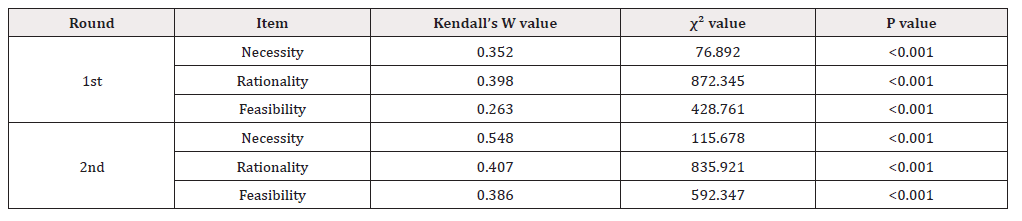
Table 1:Kendall’s concordance coefficients and their significance tests in two rounds of consultation.
Construction and Improvement of the Theoretical Model
After the first round of expert letter consultation, the research group revised the draft theoretical model combined with experts’ opinions and interview data: 5 third-level indicators that did not conform to the particularity of methadone clinics such as “general humanistic environment construction” were deleted; 5 third-level indicators such as “exclusive protection of patients’ privacy” and “guidance on family communication skills” were added; the language description of 15 indicators was revised (e.g., “respect patients’ personality” was revised to “respect patients’ personality, eliminate discrimination and treat them equally”); the attribution of some second-level indicators was adjusted, and “psychological counselling” was moved from “care content” to the waiting care link in “care process”.
After the second round of expert letter consultation, experts’ opinions tended to be consistent, and the research group adopted 5 reasonable suggestions, mainly optimizing the language description of indicators (e.g., “nurse humanistic care training” was revised to “specialized humanistic care training for nurses, focusing on the psychological characteristics and communication skills of MMT patients”) without adjusting the overall framework. The finally constructed theoretical model of humanistic nursing care in methadone clinics included 4 first-level indicators, 12 second-level indicators and 58 third-level indicators, and the specific contents are shown in (Table 2).

Table 2:Indicator system of the theoretical model of humanistic nursing care in methadone clinics.
Discussion
Scientificity of the Theoretical Model of Humanistic Nursing Care in Methadone Clinics
In constructing the theoretical model, this study took the group standard Management Specification for Humanistic Care of Outpatients as the basis, combined with the particularity of patients in methadone clinics, and integrated the core connotations of Maslow’s Hierarchy of Needs and Watson’s Theory of Human Caring to ensure the scientificity and standardization of the model content [17,18,19,20]. The grounded theory was adopted in the model construction process, and the real demands and experiences of front-line medical staff, patients and their family members were collected through semi-structured interviews to ensure that the model was in line with clinical practice. Meanwhile, the Delphi method was used to select authoritative experts from multiple fields for letter consultation. The effective recovery rates of the two rounds of consultation were both >90%, the authority coefficients were both >0.85, and the coordination degree of experts’ opinions was good, indicating that the model construction process was scientific and the consultation results were reliable [21,22].
The model covers four core dimensions: care subject, care content, care process and care guarantee, forming a complete framework of “subject-content-process-guarantee”, which not only reflects the common requirements of humanistic nursing care, but also highlights the particularity of methadone clinics. For example, “privacy protection” and “social support care” are specially set in the care content, which are in line with the core needs of MMT patients who fear discrimination and need social acceptance; the whole-process care of pre-clinic, in-clinic and post-clinic is refined in the care process, which conforms to the requirements of the Management Specification for Humanistic Care of Outpatients and the characteristics of long-term treatment in methadone clinics [13]./p>
Targeted Nature of the Theoretical Model of Humanistic Nursing Care in Methadone Clinics
As a special group, patients in methadone clinics have significant differences in humanistic care demands compared with ordinary outpatients, and they pay more attention to privacy protection, psychological support and social acceptance [23]. The interview transcripts show that MMT patients generally have feelings of inferiority and anxiety, worry about the disclosure of their illness, and yearn for respect and understanding; medical staff reflect that the current outpatient humanistic care lacks systematic norms and is difficult to meet the personalized needs of patients; family members hope to receive guidance on communication skills to better support patients’ treatment [24].
The theoretical model constructed in this study fully responds to these demands: in terms of privacy protection, it clearly requires the establishment of separate diagnosis and treatment areas, proper keeping of patients’ data and avoidance of disclosing patients’ information; in terms of psychological care, it emphasizes active assessment of patients’ psychological state, targeted counselling and helping patients establish treatment confidence; in terms of social support care, it proposes measures such as coordinating family relations, providing employment guidance and establishing peer support groups; at the same time, family members are included in the care subject, their care responsibilities are clarified, and communication skills guidance is provided to form a medical staff-family member collaborative care model [25]. All these contents are in line with the clinical reality of methadone clinics and have strong pertinence and operability.
Practical Significance of the Theoretical Model of Humanistic Nursing Care in Methadone Clinics
At present, the practice of humanistic nursing care in China’s methadone clinics lacks systematic theoretical guidance and standardized criteria, leading to scattered and inadequate care measures and affecting the treatment effect [26]. The theoretical model constructed in this study clarifies the core content, implementation process and safeguard measures of humanistic nursing care in methadone clinics, provides clear guidance for clinical nursing practice, and can effectively standardize the humanistic care behaviours of medical staff and improve the quality of humanistic care services.
The application of the model can effectively improve the medical experience of MMT patients, alleviate their negative emotions, enhance treatment compliance and reduce the relapse rate; it can also promote a harmonious nurse-patient relationship, reduce nurse-patient conflicts and improve the level of outpatient nursing services [18]. In addition, the model can also provide a basis for the training and assessment of humanistic nursing care in methadone clinics, help medical staff improve their humanistic care capabilities, and promote the development of nursing work in methadone clinics towards humanization, standardization and systematization, which is of great social significance for reducing drug-related hazards and promoting public health security [27, 28].
Research Limitations and Prospects
This study only selected methadone clinics of 2 Grade A tertiary hospitals for interviews, and the geographical and hospital grade coverage of the interviewees was not extensive enough, which may lead to certain limitations in the representativeness of the model; the construction of the model is based on the current clinical practice and research status, and with the continuous development of nursing work in methadone clinics, the content of the model needs to be further optimized and improved. In the next step, we will expand the geographical and hospital grade coverage of interviewees, include relevant personnel from community methadone clinics, and further verify the applicability and feasibility of the model; at the same time, the model will be piloted in some methadone clinics, and revised and improved according to the application effect to form a promotable specification for humanistic nursing care in methadone clinics, providing more powerful support for clinical practice.
Conclusion
Based on the group standard Management Specification for Humanistic Care of Outpatients, this study successfully constructed a theoretical model of humanistic nursing care in methadone clinics through semi-structured interviews, grounded theory analysis and Delphi method expert letter consultation. The model has a scientific structure, comprehensive content and strong targeting, with certain scientificity and reliability. It can provide theoretical guidance and practical basis for the standardized development of humanistic nursing care work in methadone clinics, and is of great significance for improving the medical experience of MMT patients, enhancing treatment compliance and reducing the relapse rate.
Acknowledgement
None.
Conflict of Interest
None
References
- WHO/IASO/IOTF. The Asia-Pacific perspective: Redefining obesity and its treatment. Sydney: Health Communications Australia; 2000. Available from: https://www.ncbi.nlm.nih.gov/pmc/articles/PMC11853003/.
- Benjafield AV, Najib T Ayas, Peter R Eastwood, Raphael Heinzer, Mary S M Ip, et al. (2019) Estimation of the global prevalence and burden of obstructive sleep apnoea: a literature-based analysis. Lancet Respir Med 7(8): 687-698.
- Senaratna CV, Jennifer L Perret, Caroline J Lodge, Adrian J Lowe, Brittany E Campbell, et al. (2017) Prevalence of obstructive sleep apnea in the general population: A systematic review. Sleep Medicine Reviews 34: 70-81.
- Kapur VK, Dennis H Auckley, Susmita Chowdhuri, David C Kuhlmann, Reena Mehra, et al. (2017) Clinical Practice Guideline for Diagnostic Testing for Adult Obstructive Sleep Apnea: An American Academy of Sleep Medicine Clinical Practice Guideline. Journal of Clinical Sleep Medicine 13(3): 479-504.
- Young T, Skatrud J, Peppard PE (2004) Risk factors for obstructive sleep apnea in adults. JAMA 291(16): 2013-2016.
- Peppard PE, T Young, M Palta, J Dempsey, J Skatrud (2000) Longitudinal study of moderate weight change and sleep-disordered breathing. JAMA 284(23): 3015-2021.
- Sutherland K, Lee RW, Cistulli PA (2012) Obesity and craniofacial structure as risk factors for obstructive sleep apnoea: impact of ethnicity. Respirology 17(2): 213-222.
- Sharma SK, Kumpawat S, Banga A, Ashish Goel (2006) Prevalence and risk factors of obstructive sleep apnea syndrome in a population of Delhi, India. Chest 130(1): 149-156.
- Dancey DR, Hanly PJ, Soong C, Bert Lee, John Shepard, et al. (2003) Gender differences in sleep apnea: the role of neck circumference. Chest 123(5): 1544-1550.
- Valipour A, Lothaller H, Rauscher H, Hartmut Zwick, Otto Chris Burghuber, et al. (2007) Gender-related differences in symptoms of patients with suspected breathing disorders in sleep: a clinical population study. Sleep 30(3): 312-319.
- Theorell Haglöw J, Millerova A, Lindberg E, Brendon J Yee, Hannah D Openshaw, et al. (2018) Gender differences in obstructive sleep apnoea, insomnia and restless legs syndrome in adults - What do we know? A clinical update. Sleep Medicine Reviews 38: 28-38.
- Netzer N, Eliasson AH, Netzer C, Kristo DA (2001) Overnight pulse oximetry for sleep-disordered breathing in adults: a review. Chest 120(2): 625-633.
- Chung F, Abdullah HR, Liao P (2016) STOP-Bang Questionnaire: A Practical Approach to Screen for Obstructive Sleep Apnea. Chest 149(3): 631-638.
- Johns MW (1991) A new method for measuring daytime sleepiness: the Epworth sleepiness scale. Sleep 14(6): 540-545.
- Mallampati SR, Gatt SP, Gugino LD, S P Desai, B Waraksa, et al. (1985) A clinical sign to predict difficult tracheal intubation: a prospective study. Canadian Anaesthetists' Society Journal 32(4): 429-434.
- Nieto FJ, Young TB, Lind BK, E Shahar, J M Samet, et al. (2000) Association of sleep-disordered breathing, sleep apnea, and hypertension in a large community-based study. Sleep Heart Health Study. JAMA 283(14): 1829-1836.
- James PA, Oparil S, Carter BL, William C Cushman, Cheryl Dennison Himmelfarb, et al. (2014) 2014 evidence-based guideline for the management of high blood pressure in adults: report from the panel members appointed to the Eighth Joint National Committee (JNC 8). JAMA 311(5): 507-520.
- Berry RB, Budhiraja R, Gottlieb DJ, David Gozal, Conrad Iber, et al. (2012) Rules for scoring respiratory events in sleep: update of the 2007 AASM Manual for the Scoring of Sleep and Associated Events. Deliberations of the Sleep Apnea Definitions Task Force of the American Academy of Sleep Medicine. Journal of Clinical Sleep Medicine 8(5): 597-619.




 We use cookies to ensure you get the best experience on our website.