
Review Article 
 Creative Commons, CC-BY
Malaria-Driven Genetic Selection and Chronic Ulceration in Sickle Cell Disease: Caribbean Insights in a Global Hematologic Context
*Corresponding author:Dr. Jonathan RT Lakey, PhD, MSM Professor Emeritus, Surgery and Biomedical Engineering, University of California Irvine, CA.
Received:April 14, 2026; Published:April 22, 2026
DOI: 10.34297/AJBSR.2026.30.003990
Introduction
Sickle Cell Disease (SCD) is a monogenic hemoglobinopathy due to a single base pair variant in β-globin (HBB p. Glu6Val), which produces haemoglobin S (HbS). Deoxygenation triggers HbS molecules to polymerize, forming rigid, crescent-shaped rigid Red Blood Cells (RBCs) and downstream microvascular injury [1]. The highly deleterious HBB p.Glu6Val allele is maintained at substantial frequency in multiple human populations, largely explained by balanced polymorphism under intense Plasmodium falciparum selection [2]. In these selective variation, heterozygous carriers (HbAS) experience a marked reduction in severe and fatal malaria [3].
Mechanistically, malaria protection is multi-component and context dependent. Parasitized HbAS erythrocytes are more likely to undergo sickling and be cleared, parasite growth and cytoadherence are perturbed, and host–parasite genetic interactions appear to modulate the magnitude of protection [4]. This is consistent with emerging evidence that parasite genotype can partially erode HbS-associated protection in some settings [5]. At the population level, the same selective logic creates a predictable trade-off. While HbAS confers survival advantage in malaria-endemic ecologies, homozygosity (HbSS) produces a chronic disease state characterized by haemolysis, sterile inflammation, and progressive vasculopathy, with morbidity patterns shaped by both genetic modifiers (e.g., HbF) and local environments [6]. Contemporary geostatistical mapping of sickle haemoglobin and predicted HbSS births demonstrates pronounced geographic clustering that tracks historical malaria exposure and African diaspora routes, reinforcing that SCD remains a major global hematologic burden long after malaria has waned in many regions [7,8]. In parallel, systematic burden estimation from the Global Burden of Disease (GBD) Study 2021 quantifies persistent, and in many places underestimated the prevalence and mortality burden from 2000–2021 [9]. The study emphasized that SCD is not simply a “rare disease” outside historically endemic zones but a sustained global health and haematology priority [10].
Among chronic vascular manifestations of SCD, leg and foot ulcers (sickle cell leg ulcers; SCLUs) represent a particularly debilitating phenotype that is increasingly conceptualized as an external marker of haemolysis-associated vasculopathy rather than an isolated cutaneous complication [11-13]. SCLUs typically occur in the peri-malleolar region, follow a relapsing course, and impose disproportionate burdens of pain, secondary infection, limited mobility, and reduced quality of life [14]. The pathobiology is plausibly convergent across patients but heterogeneous in expression: recurrent microvascular obstruction and ischemia–reperfusion injury intersects with intravascular haemolysis, Nitric Oxide (NO) consumption by cell-free haemoglobin, arginine dysregulation via arginase release, endothelial activation, and impaired reparative angiogenesis [1,15]. Collectively these processes establish a chronic, hypoxic, pro-inflammatory wound milieu [16,17].
Recent syntheses highlight ongoing controversies in causal weighting (e.g., relative contribution of venous incompetence vs haemolytic vasculopathy, and the roles of infection, thrombosis, and endothelial dysfunction), underscoring the need for rigorous phenotyping and mechanistically anchored clinical endpoints [18]. Clinically, ulcer prevalence varies substantially by geography and genotype (higher in HbSS than HbSC), and this variability is consistent with strong effect modification by haemolytic severity, environmental stressors (heat, dehydration, trauma), and access to comprehensive SCD and wound care [19,20].
The Caribbean offers an unusually informative natural experiment for these relationships because it is a post-malarial region with a high HbS allele frequency shaped by transatlantic forced migration from malaria-endemic Africa, and with long-standing cohort infrastructure that has clarified SCD natural history [21]. Caribbean HbS distributions and haplotypic backgrounds (often linked to lower HbF and more haemolytic phenotypes) plausibly increase susceptibility to vasculopathic complications, while local environmental and structural determinants (e.g., occupational skin trauma, prolonged standing, footwear access, delayed presentation, and wound-care capacity), can amplify ulcer initiation and chronicity [22]. In Jamaica, for example, leg ulceration risk has been linked to venous incompetence, haemolysis-associated biomarkers (LDH), and socioeconomic disadvantage, illustrating the joint action of biology and context in ulcer expression [22]. As malaria transmission waned and eradication programs succeeded across much of the Caribbean, the evolutionary “benefit” that selected HbS receded, but the inherited risk persisted. Today, this is expressed predominantly as chronic hemoglobinopathy morbidity within modern health systems. In this review, we use the Caribbean experience to integrate
a) malaria-driven evolutionary selection
b) genotype–phenotype variability and haemolysis/endothelial biology, and
c) contextual modifiers of wound outcomes, aiming to frame SCLUs as a tractable, mechanistically grounded target for improved haematology-
led multidisciplinary care and for inclusive translational research.
Keywords: Sickle cell disease, Leg ulcers, Homolysis-associated vasculopathy, Regenerative medicine, Peptide therapeutics
Evolutionary and Genetic Background
The HbS variant arises from a single nucleotide substitution in HBB that produces the β-globin amino acid change β6 Glu→Val, enabling deoxygenation-induced HbS polymerization, red cell dehydration, membrane damage, and accelerated RBC clearance [23]. From an evolutionary standpoint, the persistence of a highly deleterious allele is best explained by heterozygote advantage under intense Plasmodium falciparum selection. The classic epidemiologic observations of reduced severe malaria in HbAS carriers established the foundational premise [24], and subsequent work has clarified that protection is multifactorial and stagespecific rather than attributable to one dominant mechanism [25]. Mechanistic evidence supports contributions from
a) altered intraerythrocytic parasite development and impaired
parasite fitness in HbAS erythrocytes;
b) enhanced sickling and preferential splenic clearance of
parasitized cells under low-oxygen microenvironments;
c) reduced cytoadherence/rosetting and microvascular
sequestration, central drivers of severe falciparum malaria;
and
d) immune-mediated effects that may amplify parasite clearance
[26]. Importantly, newer transmission-focused studies
indicate that HbAS may also influence parasite transmission
biology (e.g., gametocyte and mosquito infection parameters),
reinforcing the view that selection pressure can act through
both protection from severe disease and impacts on infectivity/
transmission, depending on epidemiologic context [27]. These
layered mechanisms provide the underlying rationale for why
HbS rose to high frequency in malaria-endemic ecologies
and why the allele persists as malaria wanes: the selective
benefit historically operated at the population level, while
the homozygous cost is borne as chronic disease in modern
cohorts.
Although SCD is monogenic, clinical heterogeneity is substantial and is strongly shaped by genetic modifiers that change HbS polymerization kinetics, haemolysis burden, and downstream vasculopathy risk [28]. Among these, foetal haemoglobin (HbF) is the most consistent and clinically meaningful modifier [29]. HbF inhibits HbS polymerization by diluting intracellular HbS concentration and altering polymer formation dynamics, with higher HbF associating with fewer vaso-occlusive and haemolysisrelated complications across multiple settings [30]. Variation in HbF is driven by both cis effects near the β-globin cluster (including βS haplotypic background) and trans-acting quantitative trait loci [31]. Most reproducibly is BCL11A and the HBS1L–MYB intergenic region. These, which together account for a substantial fraction of HbF variance and are now directly leveraged by emerging HbF-reactivation therapies [32,33]. Classic βS haplotypes (Benin, Bantu/CAR, Senegal, Arab Indian, Cameroon) remain clinically useful shorthand for ancestral origin and “typical” HbF ranges, with Senegal and Arab Indian backgrounds generally associated with higher HbF and milder phenotypes relative to Benin/Bantu in many cohorts [34]. Caribbean populations, shaped by forced migration largely from West/Central Africa, commonly show haplotypic distributions historically associated with intermediateto- severe HbSS phenotypes when HbF-augmenting modifiers are not prominent [35]. This migration provides a biologically coherent rationale for studying Caribbean cohorts when interrogating complications linked to hemolysis/endothelial dysfunction (including chronic ulceration). That is, haplotypic background and HbF-modifier architecture can shift the baseline hemolytic/ vasculopathic set-point, while local environment and health-system factors determine whether that liability is expressed clinically [30].
Epidemiology of SCD-Associated Ulcers
Leg and foot ulcer prevalence in SCD varies substantially across regions, genotypes, and clinical settings, reflecting true biological heterogeneity plus important ascertainment/definition effects (eg, “active ulcer” vs lifetime history; minimum duration thresholds; inclusion/exclusion of mixed venous/arterial disease) [36]. Across studies, reported prevalence spans roughly the low single digits to >20–30% in some cohorts, with particularly high burdens historically reported in certain tropical settings [37]. Variability is biologically plausible because ulceration concentrates in patients with higher hemolytic burden and more severe vasculopathy, and programmatically plausible because prevalence is strongly influenced by access to preventive care (skin protection, compression for edema/venous insufficiency), early wound management, infection control, and disease-modifying therapy [38]. In parallel, contemporary global burden estimates underscore that SCD remains prevalent in many regions undergoing epidemiologic transition, implying a growing cohort of adults living long enough to manifest chronic complications, including ulcers, especially where comprehensive adult SCD care is limited [38,39].
A key conceptual advance over the last two decades has been the framing of leg ulcers within a haemolysis-associated vasculopathy subphenotype characterized by NO depletion/NO resistance, endothelial dysfunction, and co-segregation with complications such as pulmonary hypertension and priapism [7,11]. This framework is anchored in mechanistic biology: intravascular haemolysis elevates plasma cell-free haemoglobin, which scavenges NO, and releases arginase, which depletes L-arginine and constrains NO synthesis; together these perturb vascular tone, platelet activation, and endothelial homeostasis [40]. However, recent syntheses emphasize that haemolysis is necessary but not sufficient to explain ulcer occurrence across all settings: cohort data from parts of West Africa suggest that haemolysis markers do not always discriminate ulcer cases from non-cases, and mechanistic analyses highlight additional contributors such as venous stasis, autonomic dysfunction, edema, microthrombosis, and impaired angiogenesis [41]. This evolution in thinking is important for study design because it argues for multidimensional phenotyping (haemolysis biomarkers + venous competence/edema assessment + microvascular evaluation + infection/nutrition status) rather than reliance on any single biomarker pathway.
Caribbean cohorts, particularly in Jamaica, have repeatedly reported high ulcer burden and strong associations with both haemolysis biomarkers and social/structural determinants. In the Jamaican Cohort Study, chronic ulcers were associated with venous incompetence, lower socioeconomic status, and elevated serum LDH [42]. These results are congruent with the broader haemolysis/vasculopathy framework. LDH elevation, while not a perfect specificity marker, tracks haemolytic intensity in many SCD cohorts and correlates with leg ulceration alongside other vasculopathic endpoints [43]. At the same time, the Jamaica findings underscore that ulceration is a biosocial phenotype, in which haemolytic biology intersects with venous physiology (stasis/incompetence), occupation- and trauma-related exposures, resource constraints affecting wound care access, and living conditions that influence edema management, nutrition, and infection risk [44]. This interaction provides a strong scientific rationale for Caribbean-focused work: the region is a post-malarial setting where HbS/haplotype architecture and chronic haemolytic biology persist, while environmental and health-system variables can amplify or mitigate ulcer expression.
Pathophysiology of Chronic Ulcer Formation
Chronic ulceration in SCD reflects convergent downstream
injury pathways initiated by HbS polymerization and haemolysis,
with disproportionate vulnerability of the distal lower-extremity
microcirculation and peri-malleolar skin, i.e. regions exposed
to high hydrostatic pressures, lower soft-tissue buffering, and
frequent minor trauma [11,13]. Mechanistically, three interacting
axes dominate current models:
A. microvascular obstruction/ischemia–reperfusion injury,
B. haemolysis-driven NO depletion with endothelial dysfunction,
and
C. pro-adhesive/pro-thrombotic inflammation with impaired
repair/angiogenesis, all modulated by venous stasis/edema
and infection [45,46].
Microvascular obstruction and ischemia–reperfusion injury. RBC sickling reduces deformability and increases cellular adhesion to activated endothelium, promoting intermittent microvascular obstruction and low-flow states [47]. In skin and subcutaneous tissues, repeated cycles of ischemia followed by reperfusion generate oxidative stress and endothelial injury, damage the extracellular matrix scaffold needed for wound closure, and impair local perfusion reserve [48]. Recent reviews of ulcer bed histology and microcirculatory studies support a microvasculopathy phenotype including thrombosis/recanalization, neovascularization around occluded capillaries, and inflammatory infiltrates [49]. This is consistent with chronic ischemic remodeling rather than a purely superficial skin process [50].
Hemolysis-driven NO depletion and endothelial dysfunction. Intravascular hemolysis releases cell-free hemoglobin into plasma, where it rapidly consumes NO, diminishing vasodilatory, anti-platelet, and anti-inflammatory NO signaling [44]. This is compounded by erythrocyte arginase release, which reduces L-arginine availability and constrains endothelial NO synthase substrate supply, producing a state of NO insufficiency and vasomotor instability [44,51]. The hemolysis/NO axis has been linked to a cluster of SCD vasculopathic complications and provides a mechanistically coherent explanation for why leg ulcers frequently co-occur with pulmonary hypertension and priapism in some cohorts [14]. At the same time, contemporary discussions emphasize that NO-pathway impairment is best understood as part of a broader endothelial dysfunction network that also includes oxidative stress, dysregulated arginine metabolism, and impaired vascular reactivity [52]. Endothelial activation, inflammation, thrombosis, and impaired repair [53]. Hemolysis products (heme, iron), inflammatory cytokines, and ischemia–reperfusion signals shift endothelium toward a pro-adhesive, pro-inflammatory phenotype, enhancing leukocyte–platelet–endothelial interactions, microthrombus formation, and further flow limitation [54]. This environment also impairs the coordinated phases of wound healing thereby yielding clinically persistent ulcers with high recurrence [54]. Contemporary “controversies” syntheses highlight additional modifiers: venostasis from venous incompetence and autonomic dysfunction can increase peri-malleolar hydrostatic pressures; edema delays healing and increases infection risk; and living conditions and nutrition (e.g., low albumin, low BMI) can compromise tissue repair capacity [54]. These observations reinforce a key translational point i.e., even when hemolytic vasculopathy is central, local venous physiology and modifiable wound-context factors materially affect ulcer initiation and closure [55].
Genotype–Phenotype Correlations and Modifiers
Leg ulcers are reported most frequently in HbSS and less commonly in HbSC and HbS–β-thalassemia, broadly paralleling differences in haemolysis intensity, endothelial dysfunction, and the “haemolysis-associated vasculopathy” burden across genotypes [56]. In HbSS, higher rates of intravascular haemolysis increase plasma cell-free haemoglobin exposure and downstream NO scavenging, promoting vasomotor dysregulation, platelet activation, and microvascular dysfunction [57]. These pathways are repeatedly linked to ulceration and to co-segregating complications such as priapism and pulmonary hypertension [58]. In contrast, HbSC is often characterized by relatively less haemolysis and a more viscosity-dominant profile, which may shift complication patterns away from haemolysis-linked vasculopathy and toward different end-organ risks; this genotype-level biology provides a coherent rationale for lower ulcer prevalence in many HbSC cohorts even when overall disease burden remains high.
HbF is the major protective modifier across SCD subphenotypes and acts through a clear biophysical mechanism, i.e., dilution/ exclusion of HbS from the polymer phase, thereby decreasing polymer formation, haemolysis, and downstream vasculopathy risk [59,60]. Beyond classical βS haplotypic associations, HbF variability is strongly influenced by quantitative trait loci (notably BCL11A and HBS1L–MYB) and by treatment-related HbF induction (hydroxyurea), with emerging evidence that inherited HbFmodifier polymorphisms still shape clinical trajectories even in patients receiving hydroxyurea [61]. Additional modifiers plausibly relevant to ulcer risk include α-thalassemia co-inheritance (often associated with reduced haemolysis), individual variation in endothelial/adhesion biology, and pathways governing wound repair (angiogenesis, matrix remodelling, inflammation resolution).
Clinical Characteristics of SCD Ulcers
SCD-associated leg ulcers typically localize to the perimalleolar region (medial and/or lateral malleoli), where perfusion reserve is relatively constrained, hydrostatic pressures are higher, and minor trauma is common [62]. Clinically, ulcers are often painful, frequently recurrent, and complicated by secondary infection and slow or incomplete healing, creating a cycle of chronic inflammation, reduced mobility, work disruption, and diminished quality of life [63]. While many studies report onset in adolescence or early adulthood, timing and recurrence are strongly modified by local care pathways and environmental exposures (skin protection, edema control, early infection management) [62].
Leg ulcers increasingly function as clinical sentinels of systemic vasculopathy. Cohort analyses linking LDH (as a hemolysisassociated biomarker) to leg ulceration, priapism, pulmonary hypertension, and mortality support the view that ulcers often occur in patients with broader endothelial dysfunction and NOpathway impairment [16,53,58,64]. More recent commentary explicitly frames leg ulcers as indicators of “systemic dysfunction” in SCD, reinforcing that ulcer presence should trigger evaluation for co-morbid hemolysis-associated complications and not be managed as a purely local wound problem [11].
Caribbean Environmental and Clinical Modifiers
Caribbean environmental conditions can amplify sickling and microvascular injury through heat exposure and dehydration risk, both of which increase blood viscosity and promote HbS polymerization dynamics. This provides a biologically plausible pathway by which climate and occupational heat stress may increase ulcer initiation and delay healing in susceptible patients. At the same time, Caribbean ulcer burden is shaped by structural and socioeconomic determinants that directly affect the wound context, i.e., occupational skin trauma and prolonged standing, limited access to protective footwear and compression therapy, delayed presentation, variable availability of multidisciplinary wound care, and barriers to consistent disease-modifying therapy [11].
Jamaican cohort findings that link ulceration to poverty
indicators and venous incompetence highlight two important
refinements to the pathophysiologic narrative:
a) hemolysis-associated vasculopathy may set the systemic “risk
baseline,” while
b) local venous physiology (stasis/edema) and modifiable woundcontext
factors can determine whether that risk is expressed
clinically and whether ulcers recur [65]. This is consistent
with contemporary syntheses emphasizing that hemolysis
is often central but not universally discriminative across
all settings, motivating integrated phenotyping (hemolysis
markers + venous competence/edema + infection/nutrition +
environmental exposure history) in Caribbean studies.
Therapeutic and Translational Implications
Evidence-based management of SCD ulcers remains heterogeneous, reflecting both mechanistic complexity and limited trial-quality data. Current guidance recognizes leg ulcers as part of a chronic haemolytic/vascular complication cluster for which standardized pathways lag behind those for acute vaso-occlusive events [11]. A rational management framework therefore combines local wound best practices (debridement when appropriate, infection control, moisture balance, pain management, edema control/compression when tolerated and indicated, off-loading and skin protection) with systemic SCD optimization (hydroxyurea/HbF induction where appropriate, anaemia management, evaluation for hemolysis-associated vasculopathy, and multidisciplinary coordination) [66].
From a translational standpoint, therapies targeting NOpathway dysfunction are mechanistically compelling. Early clinical work suggested feasibility and physiological activity of topical sodium nitrite as a local NO donor, supporting progression to controlled trials. More recently, a phase 2 randomized trial of topical sodium nitrite in SCD patients with leg ulcers has been reported [67], directly operationalizing the hemolysis/NO rationale in a clinically meaningful endpoint.
The relationship of hydroxyurea to ulcer risk and healing remains debated, with observational studies reporting mixed associations [68]. Contemporary reviews emphasize heterogeneity in prevalence estimates and the need for standardized ulcer definitions and confounder control (disease severity, access to care, baseline vasculopathy). This uncertainty further supports embedding ulcer endpoints in prospective cohorts and interventional trials with rigorous phenotype characterization.
Integrating Stem Cell–Based Regenerative Therapy and Peptide Approaches for SCD-Associated Wound Healing.
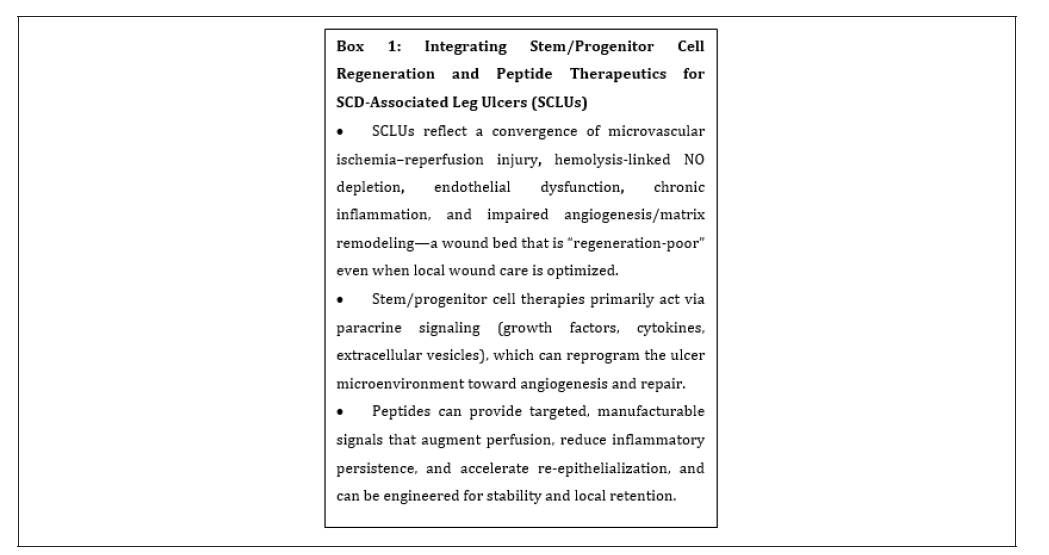
The chronicity and recurrence of SCD–associated leg ulcers underscore a central limitation of current management paradigms. To date, most available interventions address local wound care or systemic hemolysis in isolation, rather than the combined defects in vascular function, inflammation resolution, and tissue regeneration that characterize the ulcer bed in SCD. In this context, regenerative strategies, particularly stem cell–based therapies, potentially augmented by bioactive peptides, offer a mechanistically coherent and translationally attractive avenue to address the unmet need identified in prior sections (Box 1).
Rationale for Regenerative Approaches in SCD Ulcers
SCD ulcers arise in a wound microenvironment defined by impaired angiogenesis, chronic inflammation, endothelial dysfunction, and defective extracellular matrix remodelling [69]. This constellation resembles other ischemic or inflammatory chronic wounds, but with the added burden of hemolysis-driven NO depletion, oxidative stress, and recurrent microvascular injury. Stem cell–based regenerative therapies are uniquely positioned to address these deficits because their principal mechanisms of action are paracrine rather than purely structural. Mesenchymal Stromal/ Stem Cells (MSCs), Endothelial Progenitor Cells (EPCs), and related cell populations secrete a broad repertoire of growth factors, cytokines, extracellular vesicles, and microRNAs that promote angiogenesis, modulate inflammation, and stimulate resident fibroblast and keratinocyte function [70]. In SCD specifically, preclinical and translational evidence suggests that progenitor cell dysfunction contributes to impaired vascular repair. Circulating EPC numbers and function are reduced in many patients with SCD, correlating with endothelial dysfunction and vasculopathy severity. This provides a strong biological rationale for exogenous cell delivery or stimulation of endogenous progenitor pathways as a means of restoring reparative capacity in chronic ulcers.
Stem Cell Modalities Relevant to Wound Healing
Several stem or progenitor cell platforms are conceptually
relevant to SCD-associated ulcers:
a) MSCs derived from bone marrow, adipose tissue, or
umbilical cord sources have demonstrated pro-angiogenic,
immunomodulatory, and anti-fibrotic effects in chronic wound
models. Their ability to downregulate pro-inflammatory
cytokines (e.g., TNF-α, IL-1β), promote macrophage
polarization toward reparative phenotypes, and enhance
endothelial cell migration is particularly relevant in the
inflamed, ischemic SCD ulcer bed [71].
b) EPCs contribute directly to neovascularization and endothelial
repair. Given the central role of endothelial injury in hemolysisassociated
vasculopathy, EPC-based approaches, or strategies
that enhance EPC homing and survival, are attractive, though
challenges related to cell sourcing and dysfunction in SCD
must be addressed [72].
c) iPSC–derived vascular cells offer a theoretically unlimited,
autologous source of regenerative cells and allow for ex vivo
correction of genetic or functional defects. However, their use
in chronic wound settings remains experimental and raises
concerns regarding cost, scalability, and regulatory complexity
[73].
The goal of these approaches in SCD ulcers is not full tissue replacement but rather reprogramming of the wound microenvironment to permit endogenous healing processes to proceed.
Role of Peptides as Adjuncts and Synergistic Agents
Bioactive peptides represent a strategically important complement to stem cell–based regenerative therapies for SCD– associated ulcers, offering the ability to enhance, direct, or in some contexts partially substitute for stem cell paracrine activity [74]. Unlike living cell products, peptides can be engineered for stability, standardized manufacturing, and predictable pharmacokinetics, which simplifies storage, distribution, and regulatory pathways. These features are particularly salient for chronic wound indications and for use in resource-constrained settings. Mechanistically, peptides allow precise targeting of key biological deficits that define the SCD ulcer microenvironment, including impaired angiogenesis, NO depletion, dysregulated inflammation, and defective extracellular matrix remodelling.
Several functional classes of peptides are especially relevant in this context. Angiogenic peptides, including VEGF-mimetic sequences or peptides that stabilize Hypoxia-Inducible Factor (HIF) signalling, can directly promote endothelial migration, proliferation, and capillary sprouting within hypoxic wound beds, addressing one of the central barriers to healing in SCD ulcers. NO-pathway–modulating peptides offer a complementary vascular strategy by restoring local vasodilation and microvascular perfusion in a setting characterized by systemic NO scavenging due to intravascular hemolysis. These approaches are conceptually aligned with earlier nitrite-based therapies but may offer improved spatial precision, sustain local activity, and reduce systemic exposure. Matrix-interacting peptides further support wound repair by facilitating cell adhesion and migration, stabilizing provisional extracellular matrix, and promoting coordinated reepithelialization. In parallel, immunomodulatory peptides can attenuate persistent inflammatory signalling, bias macrophage and immune-cell activity toward reparative phenotypes and promote resolution rather than chronic activation.
When combined with stem cell therapies, peptides can play multiple synergistic roles. They may enhance stem cell survival and retention within the hostile ulcer microenvironment by improving perfusion, reducing oxidative stress, or providing matrix cues that support engraftment. Peptides can also influence stem cell behaviour by guiding differentiation trajectories or shaping paracrine output toward angiogenic and anti-inflammatory profiles most relevant to wound repair. Critically, peptide adjuncts can function as “off-the-shelf” biological signals that reduce reliance on high cell doses or repeated cell administration, thereby improving feasibility and scalability without abandoning regenerative intent.
From a translational perspective, integration rather than substitution of regenerative modalities is most likely to yield durable benefit. One promising paradigm is topical or scaffoldbased co-delivery, in which stem cells, or cell-free products such as extracellular vesicles, are embedded within biomaterials impregnated with pro-angiogenic or NO-modulating peptides. Such constructs create a localized regenerative niche that concentrates biological activity at the wound site while minimizing systemic exposure. An alternative approach is sequential therapy, in which peptide-based modulation of perfusion, inflammation, or infection control precedes or follows cell delivery to optimize timing relative to ischemia–reperfusion cycles and microbial burden. This strategy is particularly attractive in SCD ulcers, where poor perfusion or active infection may otherwise compromise early cell survival.
A third and increasingly attractive strategy involves cell-free regenerative approaches, including mesenchymal stromal cell– derived extracellular vesicles or secretomes that are naturally enriched in reparative peptides, growth factors, and microRNAs. These products capture many of the paracrine benefits of stem cells while avoiding some of the logistical, regulatory, and safety challenges associated with live-cell therapies. Their relative stability and ease of storage make them especially suitable for deployment in Caribbean and other low-resource settings, where cold-chain requirements, specialized facilities, and frequent followup may be limiting.
Taken together, peptide-based adjuncts and integrated delivery strategies provide a flexible and mechanistically grounded framework for regenerative wound therapy in SCD. By allowing regenerative signals to be tailored, localized, and scaled, these approaches directly address the biological complexity and implementation challenges that have historically limited ulcerdirected interventions. In doing so, they strengthen the translational bridge between advances in regenerative medicine and the realworld needs of patients living with chronic sickle cell–associated ulcers [75].
Challenges, Considerations, and Implications for Future Translation in SCD Contexts
Despite a strong and biologically coherent mechanistic rationale, the integration of stem cell–based regenerative therapies with peptide-enhanced wound healing in SCD faces several substantive challenges that must be addressed before such approaches can be adopted at scale. Foremost among these is the hostile wound microenvironment characteristic of SCD-associated ulcers. Ongoing intravascular hemolysis, recurrent microvascular ischemia–reperfusion injury, chronic inflammation, and heightened infection risk create conditions that are inherently unfavourable for cell survival, engraftment, and sustained paracrine activity. Without concurrent optimization of systemic disease control regenerative interventions may fail to achieve durable effects or may require impractically frequent reapplication. A second major challenge lies in the marked heterogeneity of the SCD population, which directly influences both ulcer risk and therapeutic responsiveness. Genotype-specific differences in hemolysis severity, variation in HbF levels driven by haplotypic background and modifier loci, coexisting venous incompetence or edema, and wide-ranging socioeconomic determinants all shape the ulcer phenotype and the biological milieu in which regenerative therapies must act. These factors argue strongly against a “one-size-fits-all” approach and instead support the need for careful patient stratification and phenotyping in both clinical practice and trial design. Failure to account for this heterogeneity risks obscuring true biological signals and may partially explain the inconsistent outcomes observed with prior ulcer-directed interventions. Scalability and equity represent equally critical consideration, particularly given that the highest burden of SCD-associated ulcers occurs in lowand middle-income settings, including parts of the Caribbean. Many stems cell–based therapies are resource intensive, requiring specialized infrastructure, cold-chain logistics, and highly trained personnel. Without deliberate adaptation, such approaches risk widening existing disparities in SCD care. This challenge reinforces the importance of exploring cell-sparing strategies, including peptide-based adjuncts, extracellular vesicle–based products, or locally deliverable biomaterial platforms that can preserve regenerative efficacy while reducing cost and operational complexity. Regulatory and long-term safety considerations also warrant particular attention in the SCD context. Patients with SCD live in a state of chronic inflammation and vascular fragility, raising theoretical concerns regarding ectopic or dysregulated angiogenesis, immune activation, or off-target effects following regenerative interventions. Robust preclinical evaluation, longterm follow-up, and harmonized safety endpoints are therefore essential, especially as these therapies move from proof-of-concept toward broader clinical application. Regulatory frameworks must balance innovation with caution, particularly when interventions are deployed in populations with limited access to advanced monitoring. Taken together, these challenges underscore the central importance of implementation science and pragmatic trial design in advancing regenerative strategies for SCD-associated ulcers. Integration of stem cell–based therapies with peptideenhanced wound healing represents a logical extension of the hemolysis–vasculopathy framework articulated throughout this review. Rather than approaching ulcers as isolated dermatologic entities, this paradigm explicitly targets the vascular, inflammatory, and reparative deficits that arise from malaria-driven genetic selection and are expressed as chronic morbidity in contemporary SCD populations.
Future research should therefore prioritize mechanistic clinical trials that embed regenerative endpoints alongside clinically meaningful ulcer outcomes. Inclusion of Caribbean cohorts is essential to capture genotype–environment interactions that are critical for global generalizability, particularly in post-malarial settings where HbS persists in the absence of its original selective pressure. Comparative effectiveness designs that rigorously evaluate regenerative strategies against optimized standard-ofcare wound management will be necessary to determine true incremental benefit and cost-effectiveness. If successful, integrated regenerative approaches combining stem or progenitor cell–based therapies with targeted peptide modulation have the potential to transform SCD-associated ulcers from a marker of advanced, irreversible vasculopathy into a modifiable and preventable complication. Such progress would align cutting-edge regenerative medicine with the equity-driven priorities of global haematology, offering biologically grounded and context-sensitive solutions to one of the most disabling chronic complications of SCD.
Acknowledgements
None.
Conflict of Interest
None.
References
- Inusa BPD, Hsu LL, Kohli N, Anissa Patel , Kilali Ominu Evbota, et al. (2019) Sickle Cell Disease-Genetics, Pathophysiology, Clinical Presentation and Treatment. Int J Neonatal Screen 5(2): 20.
- Gouagna LC, Bancone G, Yao F, Bienvenue Yameogo, Kounbobr Roch, et al. (2010) Genetic variation in human HBB is associated with Plasmodium falciparum transmission. Nat Genet 42(4): 328-331.
- Elguero E, Délicat-Loembet LM, Rougeron V, et al. (2015) Malaria continues to select for sickle cell trait in Central Africa. Proc Natl Acad Sci U S A 2;112(22): 7051-7054.
- Archer NM, Petersen N, Clark MA, Buckee CO, Childs LM, et al. (2018) Resistance to Plasmodium falciparum in sickle cell trait erythrocytes is driven by oxygen-dependent growth inhibition. Proc Natl Acad Sci U S A 10; 115(28): 7350-7355.
- Band G, Leffler EM, Jallow M, Fatoumatta SisayJoof , Carolyne M Ndila, et al. (2022) Malaria protection due to sickle haemoglobin depends on parasite genotype. Nature 602 (7895): 106-111.
- Zhang X, Wu J, Peng Y, Lan Luo, Lu Zhang, et al. (2025) Human genetic variations conferring resistance to malaria. J Transl Med 23(1): 997.
- Piel FB, Patil AP, Howes RE, Oscar A Nyangiri, Peter W Gething, et al. (2010) Global distribution of the sickle cell gene and geographical confirmation of the malaria hypothesis. Nat Commun 2:1:104.
- Egesa WI, Nakalema G, Waibi WM, Munanura Turyasiima, Emmanuel Amuje, et al. (2022) Sickle Cell Disease in Children and Adolescents: A Review of the Historical, Clinical, and Public Health Perspective of Sub-Saharan Africa and Beyond. Int J Pediatr 2022: 3885979.
- A Ejaz, S Liu, S Holliman, D Songdej, V Viprakasit, et al. (2023) Annual Sickle Cell & Thalassaemia Conference (ASCAT). Hemasphere 23(8).
- Van Hooff LC, Merz EM, Kidane Gebremeskel AS, de Jong JA, Burchell GL, et al. (2025) Balancing benefits and burdens: a systematic review on ethical and social dimensions of gene and cell therapies for hereditary blood diseases. BMC Med Ethics.; 26(1): 36.
- Jackson TA, Buscetta AJ, Ramirez HC, Bonham VL, Minniti CP (2024) Leg ulcers are indicators of systemic dysfunction in individuals with sickle cell disease. Am J Hematol 99(4): 767-769.
- Sahu T, Verma HK, Ganguly S, Sinha M, Sinha R (2021) Common, But Neglected: A Comprehensive Review of Leg Ulcers in Sickle Cell Disease. Adv Skin Wound Care 34(8): 423-431.
- Monfort JB, Senet PLeg (2020) Ulcers in Sickle-Cell Disease: Treatment Update. Adv Wound Care 9(6): 348-356.
- AlDallal SM (2019) Mini review: leg ulcers - a secondary complication of sickle cell disease. Int J Gen Med 12: 279-282.
- Hebbel RP, Belcher JD, Vercellotti GM (2020) The multifaceted role of ischemia/reperfusion in sickle cell anemia. J Clin (3): 1062-1072.
- Wilkinson HN, Hardman MJ (2020) Wound healing: cellular mechanisms and pathological outcomes. Open Biol 10(9): 200223.
- Aich A, Lamarre Y, Sacomani DP, Kashima S, Covas DT, et al. (2020) Microfluidics in Sickle Cell Disease Research: State of the Art and a Perspective Beyond the Flow Problem. Front Mol Biosci 7: 558-982.
- Lemma RB, Fuglerud BM, Frampton J, Gabrielsen OS (2024) MYB: A Key Transcription Factor in the Hematopoietic System Subject to Many Levels of Control. Adv Exp Med Biol 1459: 3-29.
- Santos E do C, Santana PVB, Jesus LLS de, Gabriela Imbassahy Valentim Melo, Setondji Cocou Modeste Alexandre Yahouedehou, et al. (2023) Leg Ulcers in Sickle Cell Disease: A Multifactorial Analysis Highlights the Hemolytic Profile. Hematol Rep 15(1): 119-129.
- Delaney KMH, Axelrod KC, Buscetta A, et al. (2013) Leg ulcers in sickle cell disease: current patterns and practices. Hemoglobin 37(4): 325-332.
- Knight Madden J, Asnani M, King L, Hardy Dessources (2023) Sickle cell disease in the Caribbean: progress in newborn screening, clinical care, and research through collaboration. Lancet Haematol 10(8): e581-e582.
- Cumming V, King L, Fraser R, Serjeant G, Reid M (2008) Venous incompetence, poverty and lactate dehydrogenase in Jamaica are important predictors of leg ulceration in sickle cell anaemia. Br J Haematol 142(1): 119-125.
- Mandal AK, Mitra A, Das R (2020) Sickle Cell Hemoglobin. Subcell Biochem 94: 297-322.
- Taylor SM, Parobek CM, Fairhurst RM (2012) Haemoglobinopathies and the clinical epidemiology of malaria: a systematic review and meta-analysis. Lancet Infect Dis12(6): 457-468.
- Allison AC (2009) Genetic control of resistance to human malaria. Curr Opin Immunol 21(5): 499-505.
- Ngou CM, Bayibéki AN, Abate L, Olesula S Makinde, Lionel B Feufack Donfack, et al. (2023) Influence of the sickle cell trait on Plasmodium falciparum infectivity from naturally infected gametocyte carriers. BMC Infect Dis 23(1): 317.
- Vazquez Prokopec GM, Perkins TA, Waller LA, Alun L Lloyd, Robert C Reiner J, et al. (2016) Coupled Heterogeneities and Their Impact on Parasite Transmission and Control. Trends Parasitol 32(5): 356-367.
- Starlard Davenport A Complexity within simplicity: (2025) Exploring the multifactorial nature of sickle cell disease. Am J Hum Genet 112(7): 1499-1503.
- Stephanou C, Menzel S, Philipsen S, Kountouris P, (2024) International Hemoglobinopathy Research Network (INHERENT). Genetic Polymorphisms Associated with Fetal Hemoglobin (HbF) Levels and F-Cell Numbers: A Systematic Review of Genome-Wide Association Studies. Int J Mol Sci 25(21): 11408.
- Akinsheye I, Alsultan A, Solovieff N, Duyen Ngo, Clinton T Baldwin, et al. (2011) Fetal hemoglobin in sickle cell anemia. Blood 118(1): 19-27.
- Dabke P, Colah R, Ghosh K, Nadkarni (2013) A Effect of Cis Acting Potential Regulators in the β Globin Gene Cluster on the Production of HbF in Thalassemia Patients. Mediterr J Hematol Infect Dis 5(1): e2013012.
- Shukla VK, Clausen J (1978) Linoleate and fatty acid patterns of serum lipids in multiple sclerosis. Acta Neurol Scand 57(3):270-274.
- Márquez Benitez Y, Osorio Garzon, Bernal Villegas JE, Briceno Balcazar I (2026) Fetal Hemoglobin Modulation in Sickle Cell Disease: βs Haplotypes, Key Polymorphisms Identified by GWAS, and Advances in γ-Globin Editing: An Updated Overview. Genes 17(2):135.
- Loggetto SR (2013) Sickle cell anemia: clinical diversity and beta S-globin haplotypes. Rev Bras Hematol E Hemoter 35(3):155-157.
- Lindenau JD, Wagner SC, Castro SM de, Hutz MH (2016) The effects of old and recent migration waves in the distribution of HBB*S globin gene haplotypes. Genet Mol Biol 39(4):515-523.
- Marti Carvajal AJ, Knight Madden JM, Martinez Zapata MJ (2021) Interventions for treating leg ulcers in people with sickle cell disease. Cochrane Database Syst Rev1(1):CD008394.
- GBD (2024)2021 Lower Respiratory Infections and Antimicrobial Resistance Collaborators. Global, regional, and national incidence and mortality burden of non-COVID-19 lower respiratory infections and aetiologies, 1990-2021: a systematic analysis from the Global Burden of Disease Study 2021. Lancet Infect Dis 24(9):974-1002.
- Bull RH, Clements D, Collarte AJ, Harding KG (2023) The impact of a new intervention for venous leg ulcers: A within-patient controlled trial. Int Wound J 20(6): 2260-2268.
- GBD 2021 (2023) Sickle Cell Disease Collaborators. Global, regional, and national prevalence and mortality burden of sickle cell disease, 2000-2021: a systematic analysis from the Global Burden of Disease Study 2021. Lancet Haematol 10(8): e585-e599.
- Friberg N, Arvidsson I, Tontanahal A, et al. (2024) Red blood cell-derived arginase release in hemolytic uremic syndrome. J Transl Med 22(1):17.
- Danwang C, Tochie JN, Mazou TN, Nzalie RNT, Bigna JJ (2019) Contemporary occurrence and aetiology of chronic leg ulcers in Africa: a systematic review and meta-analysis protocol. BMJ Open 9(5): e026868.
- Cumming V, King L, Fraser R, Serjeant G, Reid M (2008) Venous incompetence, poverty and lactate dehydrogenase in Jamaica are important predictors of leg ulceration in sickle cell anemia. Br J Haematol 142(1):119-125.
- Kato GJ, McGowan V, Machado RF, Jane A Little, James Taylor, et al. (2006) Lactate dehydrogenase as a biomarker of hemolysis-associated nitric oxide resistance, priapism, leg ulceration, pulmonary hypertension, and death in patients with sickle cell disease. Blood 107(6):2279-2285.
- Krizanova O, Penesova A, Hokynkova A, Pokorna A, Samadian A, et al. (2023) Chronic venous insufficiency and venous leg ulcers: Aetiology, on the pathophysiology-based treatment. Int Wound J 21(2): e14405.
- Yu H, Kalogeris T, Korthuis RJ (2019) Reactive species-induced microvascular dysfunction in ischemia/reperfusion. Free Radic Biol Med 135: 182-197.
- Conran N, Belcher JD (2018) Inflammation in sickle cell disease. Clin Hemorheol Microcirc 68(2-3): 263-299.
- Manwani D, Frenette PS (2013) Vaso-occlusion in sickle cell disease: pathophysiology and novel targeted therapies. Blood 122(24): 3892-3898.
- Murata E, Fujii J (2025) Ischemia/reperfusion-associated oxidative stress is an aggravating factor for pressure ulcers. J Clin Biochem Nutr 76(3): 221-232
- Hofmann AG, Deinsberger J, Oszwald A, Weber B (2024) The Histopathology of Leg Ulcers. Dermatopathology(Basel) 11(1): 62-78.
- Mamun AA, Shao C, Geng P, Wang S, Xiao J (2024) Recent advances in molecular mechanisms of skin wound healing and its treatments. Front Immunol 15:1395479.
- Schaer DJ, Buehler PW (2013) Cell-free hemoglobin and its scavenger proteins: new disease models leading the way to targeted therapies. Cold Spring Harb Perspect Med 3(6): a013433.
- Cyr AR, Huckaby LV, Shiva SS, Zuckerbraun BS (2020) Nitric Oxide and Endothelial Dysfunction. Crit Care Clin 36(2): 307-321.
- Theofilis P, Sagris M, Oikonomou E, Alexios S Antonopoulos, Gerasimos Siasos, et al. (2021) Inflammatory Mechanisms Contributing to Endothelial Dysfunction. Biomedicines 9(7): 781.
- Catella J, Guillot N, Nader E, Sarah Skinner, Solene Poutrel, et al. (2024) Controversies in the pathophysiology of leg ulcers in sickle cell disease. Br J Haematol 205(1):61-70.
- Hering K, Billenkamp G (1971) [Simulated double gallbladder]. Fortschr Geb Rontgenstr Nuklearmed 115(4): 542-543.
- Bender M, Carlberg K (2025) Sickle Cell Disease. Gene Reviews Internet. Published online February 13.
- Torres LS, Hidalgo A (2023) Neutrophils as drivers of vascular injury in sickle cell disease. Immunol Rev 314(1): 302-312.
- Kato GJ, Steinberg MH, Gladwin MT (2017) Intravascular hemolysis and the pathophysiology of sickle cell disease. J Clin Invest 127(3):750-760.
- Eaton WA, Bunn HF (2017) Treating sickle cell disease by targeting HbS polymerization. Blood 129(20): 2719-2726.
- Conran N High (2015) Foetal Haemoglobin in Sickle Cell Disease: Not so Protective? Ebio Medicine 2(2):102-103.
- Bashir K, Niazi UK, Shahzadi R, Kaynat Azam, Asma drees, et al. (2024) Associations between BCL11A and HBS1L-MYB polymorphisms and thalassemia risk. J Taibah Univ Med Sci 19(5):1039-1048.
- Minniti CP, Eckman J, Sebastiani P, Steinberg MH, Ballas SK (2010) Leg ulcers in sickle cell disease. Am J Hematol 85(10): 831-3
- Jose J, Soni B, Jose S, Kokkatt JK (2024) Medical Management to Treat Chronic Non-Healing Ulcers: A Case Series. Cureus16(1): e51449.
- Akkus NI, Rajpal S, Hilbun J, et al. (2021) Troponin Elevation in Sickle Cell Disease. Med Princ Pract Int J Kuwait Univ Health Sci Cent 30(5): 437-442.
- Stanek A, Mosti G, Nematillaevich TS, et al. (2023) No More Venous Ulcers-What More Can We Do? J Clin Med 12(19): 6153.
- Mayer DO, Tettelbach WH, Ciprandi G, et al. (2024) Best practice for wound debridement. J Wound Care 33(Sup6b): S1-S32.
- Minniti CP, Kato GJ, Garrett ME, Ashley Koch AE, Telen MJ (2024) A Phase 2 Prospective Randomized Trial of Topical Sodium Nitrite in Patients with Sickle Cell Disease and Leg Ulcers 2512-2513.
- Sirieix ME, Debure C, Baudot N, et al. (1999) Leg ulcers and hydroxyurea: forty-one cases. Arch Dermatol 135(7): 818-820.
- Coelho GA, Secretan PH, Tortolano L, Charvet L, Yagoubi N (2023) Evolution of the Chronic Venous Leg Ulcer Microenvironment and Its Impact on Medical Devices and Wound Care Therapies. J Clin Med 12(17): 5605.
- Gonzalez Gonzalez A, Garcia Sanchez D, Dotta M, Rodriguez Rey JC, Perez Campo FM (2020) Mesenchymal stem cells secretome: The cornerstone of cell-free regenerative medicine. World J Stem Cells 12(12): 1529-1552.
- Dabrowska S, Andrzejewska A, Janowski M, Lukomska B (2020) Immunomodulatory and Regenerative Effects of Mesenchymal Stem Cells and Extracellular Vesicles: Therapeutic Outlook for Inflammatory and Degenerative Diseases. Front Immunol 11 :591065.
- Kou F, Zhu C, Wan H, et al. (2020) Endothelial progenitor cells as the target for cardiovascular disease prediction, personalized prevention, and treatments: progressing beyond the state-of-the-art. EPMA J 11(4): 629-643.
- Klein D (2018) iPSCs-based generation of vascular cells: reprogramming approaches and applications. Cell Mol Life Sci CMLS 75(8): 1411-1433.
- Md Fadilah NI, Shahabudin NA, Mohd Razif RA, et al. (2024) Discovery of bioactive peptides as therapeutic agents for skin wound repair. J Tissue Eng 15: 20417314241280359.
- Boleti AP de A, Jacobowski AC, Frihling BEF, et al. (2025) Wound Healing: Molecular Mechanisms, Antimicrobial Peptides, and Emerging Technologies in Regenerative Medicine. Pharmaceuticals 18(10): 1525




 We use cookies to ensure you get the best experience on our website.