
Mini Review 
 Creative Commons, CC-BY
MOFs at the Frontier: Synthesis, Characterization, and Emerging Applications
*Corresponding author:Kejian Wang, College of Mechanical and Electrical Engineering, Beijing University of Chemical Technology, Beijing 100029, China.
Received:March 19, 2026 Published:March 26, 2026
DOI: 10.34297/AJBSR.2026.30.003956
Abstract
Metal-organic frameworks (MOFs) are an emerging class of porous, crystalline materials constructed from metal ions or clusters connected by multidentate organic linkers via coordination bonding, forming one, two, or three-dimensional networks. Due to their unique structural arrangement, MOFs possess unusually large internal surface areas and permanent void structures. Consequently, they have received enormous interest in recent years as highly versatile porous materials, leading to a wide range of potential applications, including gas storage, CO2 conversion, water splitting, fuel cells, solar cells, and drug delivery. In this mini review, the synthetic methods, characterization techniques, and key applications of MOFs are discussed.
Keywords: Metal-organic frameworks, Synthesis techniques, Gas storage, water splitting, Drug delivery
Introduction
The concept of Metal-Organic Frameworks (MOFs) was first introduced in 1990; nowadays, they are among the most promising materials. MOFs belong to a new class of crystalline materials that consist of coordination bonds between metal clusters (e.g., metal-carboxylate and metal-azolate clusters), metal atoms, or rod-shaped clusters and multidentate organic linkers containing oxygen or nitrogen donors, such as carboxylates, azoles, and nitriles; thus, a three-dimensional structure is formed [1,2]. The physical, structural, and morphological features of MOF networks, including porosity, pore size, and pore surface characteristics, are determined by the properties of both metal ions and organic linkers. Furthermore, these features, along with the chemical properties of the prepared frameworks, can be precisely controlled by adjusting synthesis parameters such as the solvent system, pH, metal-ligand ratio, and temperature [2]. Since MOFs possess high surface areas, large pore volumes within uniformly sized pores, and high metal content, they have emerged as promising materials for diverse applications in energy storage, CO2 adsorption, hydrocarbon adsorption/separation, catalysis, sensors, magnetism, drug delivery, luminescence, and other areas [1], [3-6]. Initially, MOFs were used to target Polycyclic Aromatic Hydrocarbons (PAHs) in environmental water samples, but over time, their applications expanded into analytical chemistry, including chromatographic separation and sample preparation, with notable success in Solid-Phase Extraction (SPE) and Solid-Phase Micro-Extraction (SPME). This growth is supported by the potential to design and synthesize an almost unlimited number of structures, making tunability one of MOFs’ most distinctive features. Additionally, they have been fabricated into various shapes, such as columns, fibers, and films,to address a wider range of analytical challenges and improve performance. Furthermore, designing advantageous composites or controllably incorporating defects has shown promise as a strategy for enhancing desirable properties and improving stability and reusability [2]. In this review, we assess the key MOFs widely used across various applications. This work provides a quick screening analysis of metal-organic frameworks, giving foundational knowledge and serving as an accessible entry point for newcomers. Based on extensive hands-on experience and a critical review of the literature, our overview provides researchers with essential insights into MOF synthesis, characterization, and applications.
Synthesis of Metal-Organic Frameworks (MOFs)
Synthesis of MOFs involves creating a crystalline framework by combining metal nodes and organic linkers under controlled conditions. Various methods are employed to control crystal size, shape, porosity, and stability, including the Solvothermal, Hydrothermal, Microwave-assisted, Ultrasound-assisted, Mechanochemical, and Electrochemical methods (Figure 1). The primary objective of synthesis is to produce MOFs with customized structures and properties tailored for specific applications [1]. Conversely, patterning focuses on arranging and structuring MOFs spatially on designated areas of a substrate. This can involve direct growth or post-synthetic processing to create films, arrays, or microand nanostructures. Patterning does not alter the fundamental chemistry of the MOF; rather, it organizes it for integration into devices such as sensors, membranes, and electronic or catalytic systems, where shape, orientation, and thickness are crucial. Overall, synthesis supplies the material itself, while patterning prepares it for functional use [1] (Table 1).

Figure 1:The typical synthetic strategies for MOFs and MOF composites: a) Solvothermal method; b) Hydrothermal method; c) Microwave-assisted method; d) Ultrasound-assisted method; e) Mechanochemical method; f) Electrochemical method [7].
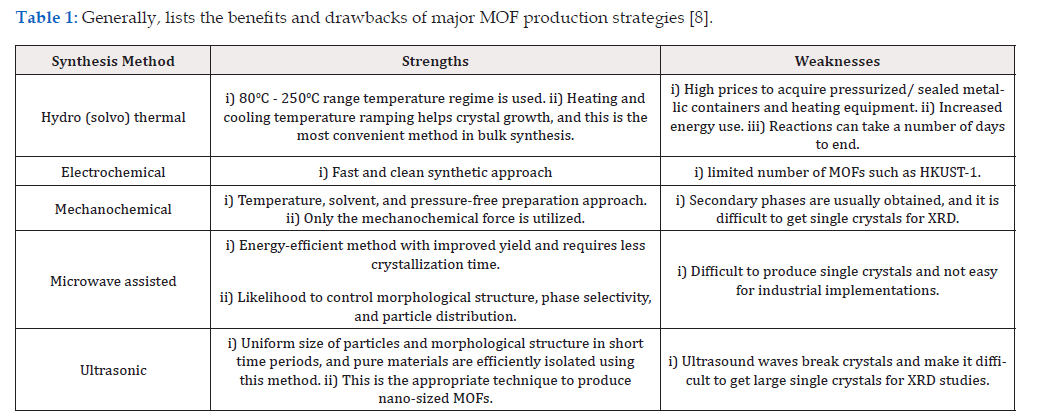
Table 1:Generally, lists the benefits and drawbacks of major MOF production strategies [8].
Characterization of the MOF’s Structure
Various validation methods are used to obtain a complete identification of the structure, shape, and size of the synthesized MOFs. The first characterization technique performed on the MOF powder involves HRTEM (for mean particle size determination), SEM (for Surface Morphology Identification), XRD (for crystallinity and crystal size determination), and EDX (for elemental and purity analysis), as shown in Figure 2a. The second characterization technique carried out on the MOF suspension involves Fluorescence Correlation Spectroscopy (FCS) for determining the hydrodynamic diameter of labelled MOFs, Dynamic Light Scattering (DLS) for identifying the particle size distribution, Zeta sizer for surface charge calculation, and FTIR for determining functional groups, as illustrated in Figure 2b. Additionally, some of the highly porous MOFs structures, along with their schematics and SEM micrographs (Figure 2c) [9].
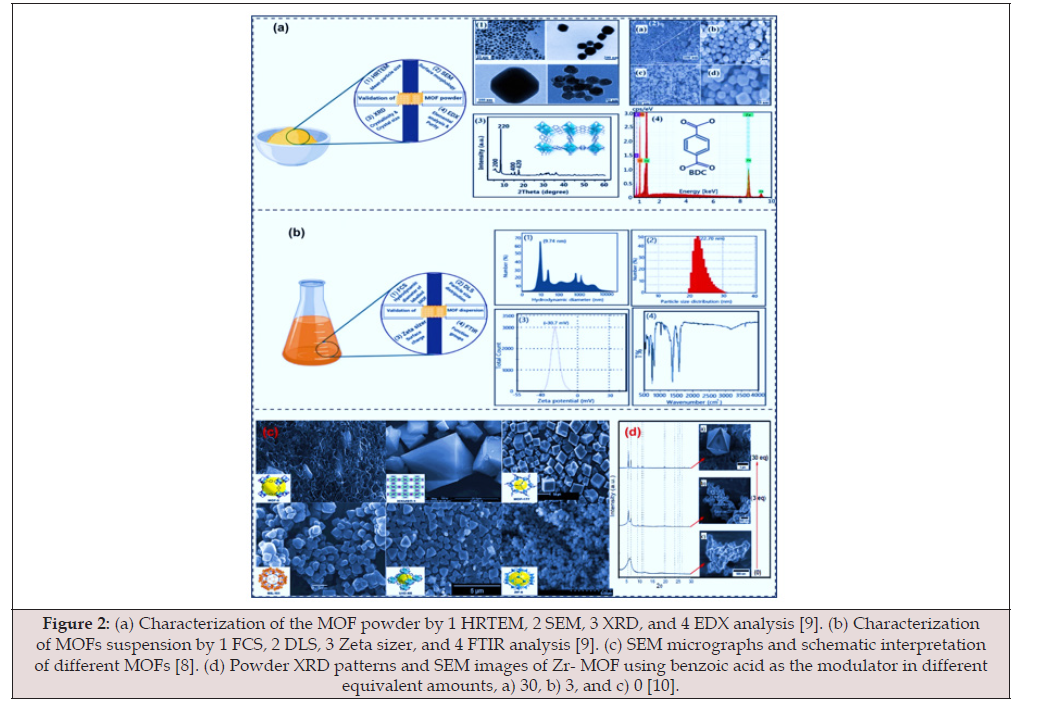
Figure 2:(a) Characterization of the MOF powder by 1 HRTEM, 2 SEM, 3 XRD, and 4 EDX analysis [9]. (b) Characterization of MOFs suspension by 1 FCS, 2 DLS, 3 Zeta sizer, and 4 FTIR analysis [9]. (c) SEM micrographs and schematic interpretation of different MOFs [8]. (d) Powder XRD patterns and SEM images of Zr- MOF using benzoic acid as the modulator in different equivalent amounts, a) 30, b) 3, and c) 0 [10].
Applications of MOFs
Due to their high porosity, suitable size, large specific surface area, tunable structure, easy functionalization, and chemical stability, MOFs have attracted extensive attention as promising candidates for various applications ranging from the chemistry industry, such as catalysis, adsorption, gas storage and separation, energy conversion and storage, electronics, sensing, to biomedicine, e.g., therapeutic agents and bioimaging as illustrated in (Figure 3) [11-13]. The materials we have included in the discussion mainly comprise the most widely used, newly discovered, and effective ones in their respective application areas so far. In-depth research into the applications of these materials can enhance our understanding of the practical and developmental aspects of MOFs.
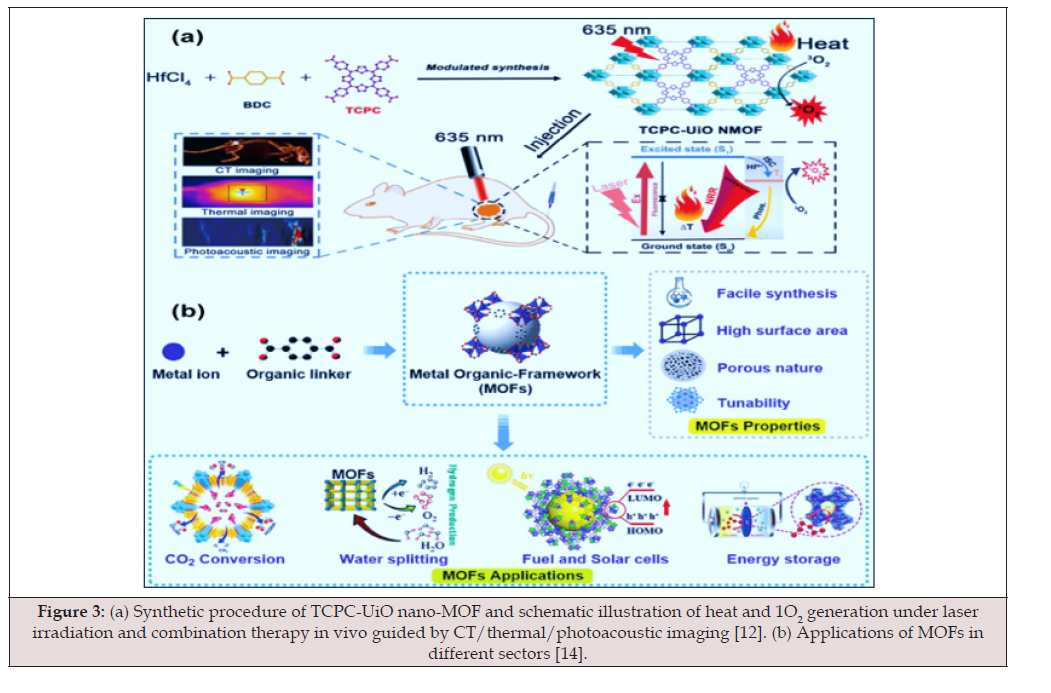
Figure 3:(a) Synthetic procedure of TCPC-UiO nano-MOF and schematic illustration of heat and 1O2 generation under laser irradiation and combination therapy in vivo guided by CT/thermal/photoacoustic imaging [12]. (b) Applications of MOFs in different sectors [14].
Conclusion and Future Outlook
Conclusion
Metal-organic frameworks have evolved from being a conceptual material in 1990 to becoming one of the most promising types of porous materials today. Their unique combination of high surface area, tunable porosity, structural diversity, and functional versatility has enabled applications in catalysis, energy storage, gas separation, sensing, and biomedicine. The ability to precisely control their synthesis parameters and analyze their structural features has been key to their rapid growth. Moreover, the development of advanced strategies such as composite formation, defect engineering, and patterning has further expanded their potential for real-world applications.
Future Outlook
Future MOF research must focus on six key areas: (1) scalable and sustainable synthesis using green, solvent-free methods; (2) improved stability by understanding degradation mechanisms; (3) advanced in-situ characterization to connect structure with performance; (4) new applications in energy devices, flexible electronics, and theragnostic; (5) thorough toxicity assessment for safe biomedical use; and (6) computational design with machine learning for rapid discovery. With ongoing interdisciplinary efforts, MOFs are poised to move from laboratory curiosities to practical technologies that address global challenges in energy, the environment, and health.
Acknowledgements
This work was supported by the China Scholarship Council (CSC) through Scholarship No. 2025SLJ016224 at the Beijing University of Chemical Technology (BUCT), and is greatly appreciated.
Credit Authorship Contribution Statement
Alemayehu Worku: Concept framework, writing the original draft, and developing methodology. Kejian Wang: designing conceptual frameworks and structures, and following and supervision. Yong Liu: provided related literature, proofreading, rewriting, outlines, and visualization. Mulugeta Tadesse: finalizing draft writing and reviewing. All authors have read and agreed to the published version of the manuscript.
Funding
Alemayehu disclosed the receipt of the following support for the research, authorship, and/or publication of the article: China Scholarship Council (CSC) supported this work under scholarship No. 2025SLJ016224.
Conflict of Interest
The authors declare that there are no known rival financial interests or work-related conflicts that could have influenced the work reported in this paper.
Generative AI and AI-assisted technologies in the writing process
The author used Grammarly and ChatGPT to check spelling and grammar. After using this tool/service, the authors reviewed and edited the content and took full responsibility for the publication’s content.
References
- N Manousi, G A Zachariadis, EA Deliyanni, VF Samanidou (2018) Applications of metal-organic frameworks in food sample preparation. Molecules 23(11): 2896.
- VF Samanidou, EA Deliyanni (2020) Metal Organic Frameworks: Synthesis and Application. Molecules 25(4): 960.
- J He, Karna Ramachandraiah, Tao Huang, Ting Yuan, Xinxin Liu, et al. (2023) Core-shell structured hollow copper sulfide@metal−organic framework for magnetic resonance imaging guided photothermal therapy in the second near-infrared biological window. Biochem Biophys Res Commun 638: 51-57.
- Y Zhao, Zhongxin Song, Xia Li, Qian Sun, Niancai Cheng, et al. (2016) Metal organic frameworks for energy storage and conversion. Energy Storage Mater 2: 35-62.
- L Wang, Y Han, X Feng, J Zhou, P Qi, et al. (2016) Metal–organic frameworks for energy storage: Batteries and supercapacitors Coord Chem Rev 307: 361-381.
- Yangyang Liu, Zhiyong U Wang, Hong Cai Zhou (2012) Recent advances in carbon dioxide capture with metal‐organic frameworks. Greenhouse Gases: Science and Technology 2(4): 239-259.
- Q Zhang, S Yan, X Yan, Y Lv (2023) Recent advances in metal-organic frameworks: Synthesis, application and toxicity. Sci Total Environ 902: 165944.
- MA Abdelkareem, Qaisar Abbas, Enas Taha Sayed, N Shehata, JBM Parambath, et al. (2024) Recent advances on metal-organic frameworks (MOFs) and their applications in energy conversion devices: Comprehensive review. Energy 299: 131127.
- EA Abdelrahman, GS El Sayyad (2024) Synthesis and characterization of metal–organic framework (MOF): importance in electro-catalysts for oxygen reduction reaction. Opt Quantum Electron 56(5): 884.
- Hussein Rasool Abid, Muhammad Rizwan Azhar, Stefan Iglauer, Zana Hassan Rada, Ahmed Al Yaseri, et al. (2024) Physicochemical characterization of metal organic framework materials: A mini review. Heliyon 10(1): e23840.
- J Meng, Xiong Liu, Chaojiang Niu, Quan Pang, Jiantao Li, et al. (2020) Advances in metal-organic framework coatings: versatile synthesis and broad applications. Chem Soc Rev 49(10): 3142-3186.
- X Cai, Z Xie, D Li, M Kassymova, SQ Zang, et al. (2020) Nano-sized metal-organic frameworks: Synthesis and applications. Coord Chem Rev 417: 213366.
- Q Zhang, H Yang, T Zhou, X Chen, W Li, et al. (2022) Metal–Organic Frameworks and Their Composites for Environmental Applications. Adv Sci 9(32): 2204141.
- A Zulfiqar, Baoji Miao, Fatima Khan, Nawab Ali, Shakeel Ahmed, et al. (2025) Metal-Organic Framework (MOF)-Based Catalysts for Sustainable Energy Technologies: A Review. Langmuir 41(36): 24049-24077.




 We use cookies to ensure you get the best experience on our website.