
Research Article 
 Creative Commons, CC-BY
Haemoparasitic Infections in a Coastal University Setting: A Study of Undergraduate Students at Olusegun Agagu University of Science and Technology, Okitipupa, Ondo State, Nigeria
*Corresponding author:Ayodeji Samson Bagbe, Department of Biological Sciences (Zoology Programme), School of Science, Olusegun Agagu University of Science and Technology, Okitipupa, Ondo State, Nigeria.
Received:April 19, 2026; Published:June 01, 2026
DOI: 10.34297/AJBSR.2026.31.004028
Abstract
This study examines the prevalence of haemoparasites among undergraduate students of Olusegun Agagu University of Science and Technology (OAUSTECH) from April to July 2023. A total of three hundred and twenty (320) newly admitted undergraduate students between ages 16-30 participated voluntarily in this study. Blood was collected by venipuncture into Ethylene-Di-Amine-Tetra-Acetic-Acid (EDTA) tubes and prepared for screening using standard procedures. Thick and thin blood films were used for the detection of haemoparasites and parasites were identified using key morphological characteristics. Out of 320 participants in the study, 83 (25.94 %) tested positive for malaria (Plasmodium falciparum). The highest prevalence was recorded among the males as 53 (16.56 %) tested positive and 30 (9.38 %) of the females tested positive. The highest prevalence was found in age group 16-20 years (19.38 %) while the lowest prevalence was between the ages of 26 and 30 (5.62 %). Two (0.62 %) newly admitted undergraduate students were positive for microfilaria (Loa loa), both of which were males between ages 16 and 20. The haemoparasites identified in this study were P. falciparum (100 %) and L. loa (100 %). Although the result of this study showed a low prevalence of haemoparasitic infection amongst the newly admitted undergraduate students, they were mostly asymptomatic and could serve as a reservoir for parasites and aid in their transmission. Hence, it is recommended that haemoparasite screening be included among other blood screening tests done by the University health center in order to administer treatment and curb the transmission of these parasites.
Keywords:Haemoparasitic Infection, Newly admitted undergraduate students, Prevalence, Coastal university setting
Introduction
A haemoparasite is a parasite that inhabits the bloodstream of the host or a parasitic animal that lives in the blood of a vertebrate. These parasites reside either in the blood cells or in the plasma. They encompass a diverse group of parasites, including protozoans and helminths, which can cause significant morbidity and mortality in humans and animals [24]. Malaria parasites and Babesia are haemoparasites that resides in the red blood cells, while Leishmania and filarial worms resides in the white blood cells and the plasma respectively. In Nigeria, malaria and filariasis are more prevalent and over the years varying prevalence has been recorded [12]. There are also many cases of asymptomatic infections due to constant exposure to these parasites and thus resistance or some level of immunity to these infections. These cases of asymptomatic infections have been one of the factors that has helped in the continuous transmission of these parasites, among others, including exposure to vectors, blood donation and transfusion [15].
Malaria is a life-threatening disease of human and animals caused by members of the genus Plasmodium and transmitted to humans through the bites of infected female Anopheles mosquitoes [1]. Malaria remains a significant global health concern, particularly in low and middle-income countries and is majorly found in tropical countries. According to the World Health Organization (WHO), there was an estimated 247 million cases of malaria and 619,000 deaths worldwide in 2021 [30]. Twenty-nine countries accounted for 96 % of malaria cases globally and four countries accounted for almost half of all cases globally. Nigeria had the highest occurrence with 27 %, followed by the Democratic Republic of the Congo (12 %), Uganda (5 %) and Mozambique (4%).
Filariasis is a parasitic disease caused by thread-like nematode filarial worms (and their larvae) of the superfamily Filarioidea which cause various kinds of filariasis. The disease is prevalent in tropical and subtropical regions, especially in parts of Africa, Asia, the Pacific Islands, and Central and South America [5]. Causative agents of human filariasis include Wuchereria bancrofti, Dirofilaria spp., Brugia spp., Mansonella spp., Onchocerca volvulus, and Loa loa. These worms are transmitted to humans through the bites of infected mosquitoes of the genera Culex, Aedes, Ochlerotatus, Mansonia, and Anopheles depending on their geographical distribution [10,5]. Among worldwide infections causing filariasis, 90% are reportedly caused by Wuchereria bancrofti, being more prevalent than infections caused by Brugia malayi, Brugia timori and other species [13,31].
Human African Trypanosomiaisis or sleeping sickness, is a parasitic disease caused by protozoan parasites of the genus Trypanosoma. There are two main causative agents of the disease; T. brucei gambiense and T. brucei rhodesiense, which occurs in different regions of sub-Saharan Africa. Another form of this disease, known as Chagas disease, is caused by Trypanosoma cruzi which is prevalent in specific regions of Central and South America [17].
Leishmaniasis encompasses a spectrum of diseases caused by protozoan parasites of the genus Leishmania. The infection is transmitted through the bite of infected female phlebotomine sandflies of the genera Phlebotomus and Lutzomyia, in the Old and New Worlds, respectively [23]. The disease affects some of the world’s poorest people and is associated with malnutrition, population displacement, poor housing, a weak immune system and lack of financial resources. An estimated 700 000 to 1 million new cases occur annually [4].
Haemoparasitic infections are often prevalent in tropical and subtropical regions, which are frequently the focus of global health initiatives. This study is imperative in order to identify and implement effective control measures, and plan for the participation of the targeted study group in the control, which is one of the cardinal tools for the success and sustainability of disease control programs. The main objective of this study was to assess the prevalence of haemoparasites among newly admitted undergraduate students of Olusegun Agagu University of Science and Technology (OAUSTECH).
Methodology
Study Design
This cross-sectional research was carried out at Olusegun Agagu University of Science and Technology (OAUSTECH), Okitipupa, Ondo State, Nigeria (6.45°N, 4.77°E) over the period of ten (10) weeks from April 2023 to July 2023. All potential participants were informed about the nature and the objectives of the study, and personal and demogrographic data were collected through the use of a structured questionnaire including the name, age, state of residence, religion, blood group, genotype, knowledge on blood parasites, and practices.
Study Population
It was a study of consenting newly admitted undergraduate students carrying out medical screening at the University’s health centre.
Sample size
The sample size of this study was calculated to be 320 students using the statistical method described by Yamane (1967). Participants were selected by voluntary sampling.
Ethical Approval
Permission to share samples and carry out analysis was given by the head of the University’s medical center. All participants were informed about the aims and objectives of the study and informed consent of individual students were also obtained. Ethical approval was obtained from the Ondo State Ministry of Health Research Ethics Committee (Protocol Number: OSHREC 14/08/2023/575).
Distribution of questionnaire
Questionnaire was administered to each participant in order to provide information on their sex, age, blood group, genotype, knowledge of blood parasites, and practices. A consent form was also given to obtain the approval of participants who agreed to have their blood samples taken for the purpose of the research.
Collection of Blood Samples
Plebotomists at the University’s health center assisted in the collection of blood samples from consented volunteers. Two (2) ml of venous blood was collected from each volunteer into tubes containing Ethylenediaminetetraacetic Acid (EDTA). The EDTA tubes were labelled with the code number on participant’s questionnaire. The blood samples were collected between 9.00am and 1.00pm. The University’s medical center laboratory was used to carry out blood tests immediately after sample collection.
Examination and detection of Microfilaria
The examination of microfilaria in blood samples was done by direct examination under the microscope. Using a calibrated micropipette, 10 μl of blood was placed on a clean and greasefree microscopic glass slide. The drop of blood was covered with a cover slip. Two slides were prepared per sample. The slides were then viewed under low power (x10 objective). 10-25 fields were observed before recording the sample as positive in the presence of microfilariae or negative in the absence of microfilariae. When microfilaria was observed on any of the slides, one extra slide was prepared, stained with Giemsa, viewed and used to confirm the parasite.
Examination and detection of Plasmodium spp.
Thick blood smears were prepared and stained as described by Olliaro [25]. Using a micropipette, 6 μl of blood was placed on a clean and grease-free microscopic glass slide. The corner of another slide or the bottom of a clean glass tube was used to spread the blood until a circle of at least 12mm diameter was made. The blood smear was left to air dry by keeping it on a flat surface, protected from dust and insects. After the smear was completely dried, the slide was stained by flooding it with 3% Giemsa solution and left to stain for 30 minutes. It was rinsed gently with tap water and left to air dry before viewing. The thin films were fixed with methanol before staining and viewing. Slides were examined for malaria parasites under the microscope using an oil immersion objective lens (x100 objective). 40-50 fields were examined before recording as negative or positive. Thin smears were prepared and used to confirm positive slides.
Examination and detection of other haemoparasites
Thick blood smears were made and stained with Giemsa as done for malaria. The slides were examined for Trypanosoma spp., and Leishmania spp. under x100 objective lens.
Identification of Haemoparasites
Haemoparasites were identified by using identification charts from WHO benchaids and morphological features as described by Liapis [19].
Quality Control
Microscopic slides were checked for dents, cracks or cotton wool remnants. Slides with dents or cracks were disposed of. Cotton wool remnants were removed from slides. Blood smears were checked for obvious signs of poor quality such as dust or dirt on the smear or if the smear was washed off during staining or rinsing and repeated if any such signs were seen.
Data Analysis
Data were entered into Microsoft Excel sheet, exported and analysed using Statistical Package for the Social Sciences (SPSS) version 20.0. The results were presented in simple descriptive statistics of frequency and percentage of prevalence. Statistical charts were also used to present relative frequencies. Pearson’s Chi square test used to determine the degree of association between haemoparasitic infection and independent variables. P-value ≤ 0.05 was considered statistically significant.
Results
Demographic Characteristics of Participants
A total of 320 newly admitted undergraduate students of Olusegun Agagu University of Science and Technology voluntarily participated in this study. The ages of the students were mostly between 16 and 20 constituting 73.12 % of the population while age groups 21 - 25 and 26 - 30 were 24.69 % and 2.69 % respectively; also, 197 newly admitted undergraduate students were males and 123 were females (Table 1).
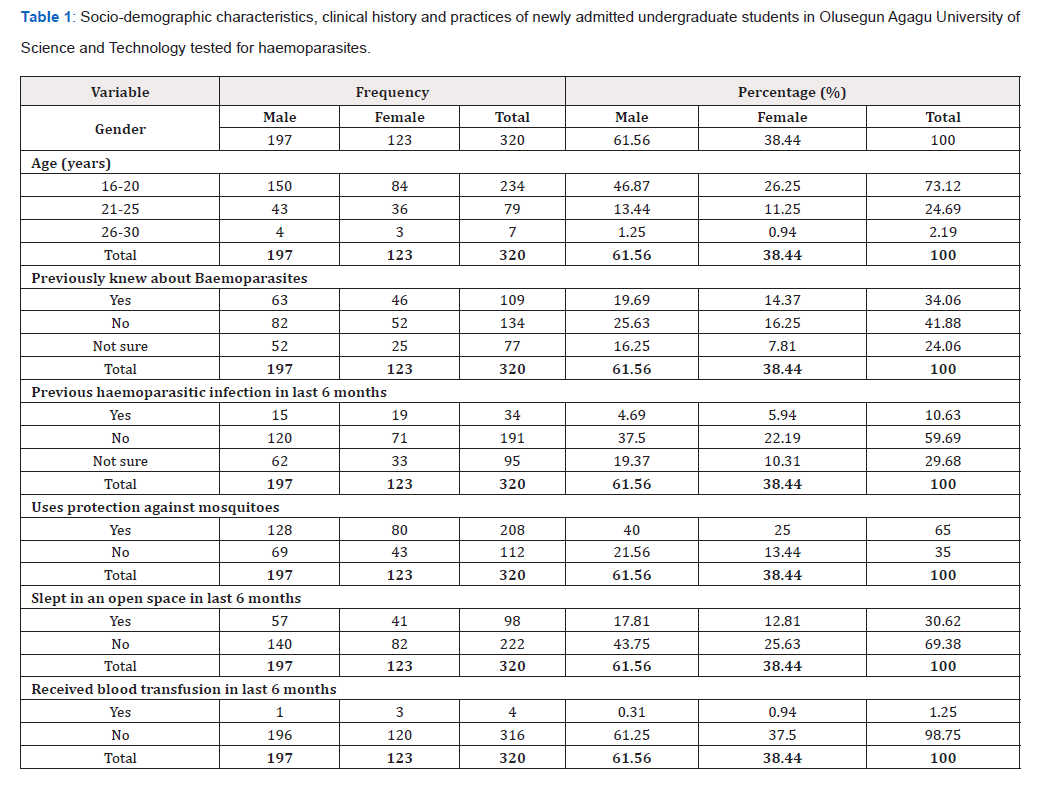
Table 1:Socio-demographic characteristics, clinical history and practices of newly admitted undergraduate students in Olusegun Agagu University of Science and Technology tested for haemoparasites.
Knowledge, Clinical History and Practices of Participants
Table 1 also shows the knowledge, clinical history and practices of the participants. This includes their previous knowledge of haemoparasites, previous haemoparasitic infection in the last six months, whether they use any form of protection against mosquitoes, whether they slept in an open space in the last six months and if they received blood transfusion in the last six months.
Prevalence of Malaria
The result of this study showed that the total prevalence of malaria infection was 25.94 % with a higher occurrence in male (newly admitted undergraduate students) (16.56 %) while the females made up 9.38 % of the infected population (Table 2). In terms of age, malaria infection was more prevalent in the age group 16 –20 years with 62 (13. 98 %) infected newly admitted undergraduate students, followed by age group 21 –25 which had 18 (5.62 %) and 3 (0.94 %) were between age group 26 – 30 (Figure 1). Plasmodium falciparum was the only malaria parasite detected among students positive for malaria with an overall prevalence of 100 % in infected newly admitted undergraduate students.

Table 2:Gender distribution in relation to Malaria infection.

Figure 1:Malaria infection in relation to age group.
Prevalence of Microfilaria
Two (0.62 %) out of 320 newly admitted undergraduate students were infected with microfilariae (Table 3). All infected newly admitted undergraduate students were males (Table 3) and between the age group 16 - 20 (Figure 2). There were no females infected with microfilariae. The microfilaria specie encountered in both positive cases was Loa loa.

Table 3:Gender distribution in relation to microfilariae infection.

Figure 2:Relationship between microfilaria infection and age group.
Association Between Haemoparasitic Infection and Variables
There were no associations between malaria infection and the age group and sex of the participants (Table 4). Differences between the age groups of the participants was not statistically significant (p-value = 0.47). Likewise, the difference in the gender of the participants was not statistically significant (p-value = 0.62). Also, there was no association between microfilaria infection and the age group and differences between them was not statistically significant (p-value = 0.33). However, differences in gender of the participants were statistically significant (p-value = 0.05).

Table 4:Association between haemoparasitic infection with independent variables of newly admitted undergraduate students of Olusegun Agagu University of Science and Technology (OAUSTECH).
Discussion
The prevalence of haemoparasites in this study is generally low with 83 (25.94 %) out of 320 being positive with asymptomatic malaria and only 2 (0.62 %) positive for microfilaria. The findings of this study is in contrast to that reported in other studies carried out in other parts of the country [14,8,29], within Ondo state [1,3,6] and in Tanzania [22] where a higher prevalence of malaria were recorded. This disparity in prevalence could be due to a number of reasons such as the time of study, blood transfusion history, previous treatment of malaria, exposure to vectors, the preventative measures taken by the students, and difference in proximity to vegetation or stagnant waterbodies around the hostels.
This study was carried out during the rainy season (April to July) with ranging amount of rainfall. Rainfall is one of the factors that can influence malaria infection. Rainfall creates breeding sites for Anopheles mosquitoes by filling puddles, ditches, and stagnant water bodies which can lead to an increase in mosquito populations. A study in Kenya found a positive correlation between rainfall and the abundance of Anopheles mosquitoes [21]. Also, heavy rainfall can force people to spend more time indoors, leading to a decrease in exposure to mosquito bites and a subsequent reduction in malaria transmission [27]. Conversely, during the rainy season, people might seek shelter in inadequate housing structures which may be breeding grounds for mosquitoes, potentially increasing malaria risk [16]. Haemoparasites can be transmitted through blood transfusion as well. Transfusion transmitted malaria is one the most prevalent transmissible infections followed by viral hepatitis and HIV [17]. Only 4 (0.94 %) out of 320 students received blood transfusion in the last six months which may have also contributed to the low prevalence observed in this study.
Characteristics of the study population showed a surprisingly high percentage of students who took preventative measures against haemoparasites vectors by not sleeping in an open space (69.38 %) and using protection against mosquitoes such as insecticides, mosquito repellents and treated mosquito nets (65 %). This is in contrast with the study of [7] in which only 24.7 % of the students used mosquito nets for protection. This observed high levels of the use of these preventative measures against haemoparasite vectors also contributes to the lower prevalence observed in this study. However, this study is similar to that of Olusegun-Joseph, et al. [26] who recorded a very much lower prevalence of 2 % in students of the University of Lagos, Lagos state, Nigeria and that of Afolayan, et al. [2] in which 72 (40.7%) out of 172 students from different institutions in Lagos state tested positive for malaria.
Prevalence of malaria was significantly higher among the age range 16-20 years followed by age range 21-25 years and least of all among age range 26-30 years. This suggests that infection rate decreases with increasing age meaning that the older population have more immunity than younger individuals which may be immunity as a result of repeated exposure over time. It is also an indication that age is a risk factor in asymptomatic malaria infection [29]. This agrees with the report of Mgbemena et al [20] and Erinle and Bada [6] who observed a higher prevalence among the smallest age group (15-20 years) but is contrary to the study of Awosolu, et al. [3] whose findings showed the highest prevalence among age group 20 -25 years.
This study revealed that newly admitted undergraduate male students have a higher prevalence rate 53 (15.6 %) than their female counterparts 30 (9.38 %). Similarly, observed higher male prevalence was also reported by Adepeju, Ezihe et al. and Erinle and Bada [1,7,6]. This is however in contrast to the 2009 study of Ibekwe and coworkers who recorded a higher prevalence (86.4 %) in newly admitted undergraduate female students of Nnamdi Azikwe University, Awka, Anambra state, Nigeria, than in their male counterpart (70.7 %). This is an indicator that gender is also a risk factor for infection with malaria, although there is no scientific evidence yet that links parasitaemia to gender [28]. Hormone production could influence gender-based immunity in that oestrogen produced by female have been shown to augment antiplasmodium immune response whereas testosterone suppresses anti–plasmodium immune response [18].
The determination of the genotype of the participants was hindered by lack of information, as most respondents were unaware of their blood genotype. Nevertheless, previous studies [9,11] have discussed the association between malaria infection and genotype. In a study conducted by Habiba and colleagues in Katsina state in 2022, it was found that participants with the AA genotype had the highest prevalence of parasitaemia (53.8%), while those with the SS genotype had the lowest prevalence (33.3%). Similarly, Faga et al. (2020) [9] reported that individuals with the AA genotype had the highest prevalence of malaria infection (46.7%) in Benue state. The elevated prevalence rate in individuals with the AA genotype may be attributed to the fact that malaria parasites exhibit a high rate of oxygen consumption and consume significant amounts of haemoglobin A (normal haemoglobin gene, HbA) during the peripheral blood stage of replication. In contrast, Haemoglobin S (HbS) in endocytic vesicles of the parasite is deoxygenated, polymerizes, and is poorly digested, thereby inhibiting the replication and survival of the parasite in red blood cells containing HbS. Individuals with the AS or AC genotype possess a combination of normal haemoglobin (HbA) and HbS, which affords them some protection against malaria. The presence of abnormal haemoglobin (HbS) inhibits parasite replication, enabling these individuals to better resist malaria infection compared to those with the AA genotype, who only produce HbA [9].
Considering that the focus of the study was young, educated students, levels of general knowledge about haemoparasites were lower than expected especially for an endemic country as only 109 (34.06 %) out of 320 newly admitted undergraduate students affirmed that they had previous knowledge of haemoparasites prior to the study. However, these participants came from different localities ranging from urban to rural areas, different background and social status which may have influenced their access to quality information and education on the subject matter.
Conclusion
This study on the prevalence of haemoparasites in newly admitted undergraduate students of Olusegun Agagu University of Science and Technology (OAUSTECH) has shed light on the significance of understanding the importance of healthiness among university students. Although the findings of this study have not uncovered any alarming trends revealing low prevalence of malaria infection and very low prevalence of microfilaria, these asymptomatic infected students may still serve as reservoirs for parasites transmission as vectors could acquire and transmit them to previously unaffected students.
Therefore, there is need for a pragmatic approach by the management of the university to include haemoparasitic screening as part of the medical tests carried out when students are newly admitted. It will help to make informed decisions and treatment will be administered early to combat infection and reduce transmission. Regular health check-ups and awareness campaigns among the student population should also be encouraged. General enlightenment on the biology, causative measures, transmission, and prevention of these common haemoparasites should be carried out, probably included in new students’ orientation in order to equip the students with knowledge and also encourage prevention strategy and control. I would also encourage continued vigilance in maintaining good health, both individually and as a university community, to ensure that our academic pursuits are supported by a foundation of well-being.
Acknowledgements
None.
Conflict of Interest
None.
References
- Adepeju I S (2017) Prevalence of Malaria Parasite among Asymptomatic and Symptomatic Students of Federal University of Technology, Akure, Ondo State. British Journal of Research 4(1): 5.
- Afolayan T, Tanimowo W O, Ibrahim A G and Oduwa H (2023) Assessment of the Knowledge, Attitude, Practices and Malaria Prevalence among Undergraduates. International Journal of Tropical Diseases 6(1): 069.
- Awosolu O, Adesina F, Afolabi O and Ogunsanya D (2020) Malaria parasite distribution and knowledge among Students of Federal University of Technology, Akure, Nigeria. Animal Research International 17(3): 3903-3910.
- Dires A, Kumar P, Gedamu S, Yimam W and Ademe S (2022) Knowledge, attitude and prevention measures of students towards cutaneous leishmaniasis in Delanta district, Northeast Ethiopia. Parasite Epidemiology and Control 17: e00241.
- Drews S J, Spencer B R, Wendel S and Bloch E M (2021) Filariasis and transfusion-associated risk: a literature review. Vox Sanguinis 116(7): 741–754
- Erinle B A and Bada E O (2023) Prevalence of malaria infection amongst students of a southwest Nigerian federal university. GSC Advanced Research and Reviews 15(1): 110–114
- Ezihe E K, Michael E C, Edith N N, Chikaodili U, Uche A J, et al. (2019) Malaria Vector abundance and the incidence of malaria parasite amongst students living in Nnamdi Azikiwe university hostels. International Journal of Tropical Disease and Health 37 (4): 1 –10.
- Ezugbo-Nwobi I K, Obiukwu M O, Umeanato P U and Egbuche C M (2011) Prevalence of malaria parasite among Nnamdi Azikiwe Students and Antimalaria drug use. African Research Review 5(4): 135-144.
- Faga D C, Obisike V U, Onah I E and Amuta E U (2020) Assessment of malaria parasitemia and genotype of patients attending two hospitals in Benue state, Nigeria. Animal Research International 17(2): 3640-3648.
- Famakinde D O (2018) Mosquitoes and the Lymphatic Filarial Parasites: Research Trends and Budding Roadmaps to Future Disease Eradication. Tropical Medicine and Infectious Diseases 3(1): 4
- Habiba Z, Abdullahi K and Aminu A (2022) Assessment of malaria parasitemia and genotype relationship of patients attending tertiary health care centre in katsina state, Nigeria. The Bioscientist 10(3): 348-356.
- Hassan A O, Adedokun A A and Omoju D (2022) Prevalence of Haemoparasites among Blood Donors in Livingspring Hospital, Igbogbo, Ikorodu, Lagos. Saudi Journal of Biomedical Research 7(8): 230-234.
- Hussaini A, Isaac C, Rahimat H, Inegbenosun C, Obasuyi C, et al. (2020) The Burden of Bancroftian Filariasis in Nigeria: A Review. Ethiopian Journal of Health Science 30(2): 301-310.
- Ibekwe A, Okonko I, Onunkwo A, Ogun A and Odeze A (2009) Comparative prevalence level of Plasmodium in freshmen (first year students) of Nnamdi Azikiwe University in Awka, South-Eastern, Nigeria. Malaysian Journal of Microbiology 5(1): 51-54
- Ike M E, Onuoha E C, Yohanna A J, Dakul A D, Damen G J, et al. (2019) Detection of Haemoparasites of Blood Donors in 9 Locations in and Around Plateau State, Nigeria. Journal of Biology, Agriculture and Healthcare 9(22): 1-6
- Kenea O, et al. (2019) High indoor-biting and parity rates of Anopheles mosquitoes in southern Ethiopia. Parasites & Vectors, 12(1): 1-11.
- Kenguele H M, Meye B, Mba T N and Mickala P (2022) Prevalence of Haemoparasites among Blood Donors Attending the Regional Hospital Center of Franceville (Southern Gabon). Journal of Infectious Diseases and Epidemiology 8(7): 270.
- Krucken J, Dkhil M A, Braun J V, Schroetel R M, EI-Khadragy M, et al. (2005) Testosterone suppresses protective responses of the liver to blood–stage malaria. Infection and Immunity 73(1): 436-
- Liapis K (2019) Microscopical Diagnosis of Blood Parasites. HAEMA 10(2): 68-112.
- Mgbemena IC, Ezea CO, Ebe JE, Udensi UJ, Nwachukwu AA, et.al (2016) Asymptomatic malaria among students of Federal University of Technology Owerri. Imo state. Nigeria. Biological Sciences and Pharmaceutical Research 4 (6): 50 -57.
- Munga S, Minakawa N, Zhou G, Barrack OO, Githeko AK, et.al (2006) Effects of larval competitors and predators on oviposition site selection of Anopheles gambiae sensu stricto. J Med Entomol 43(2): 221-224.
- Nyahoga Y, Bochkaeva Z (2018) Cross-study of malaria prevalence in history, bed net utilization, and knowledge about the disease among Tanzanian College Students. Malar Res Treat: 8137051.
- Ngouateu OB, Dondji B (2022) Leishmaniasis in Cameroon and neighboring countries: An overview of current status and control challenges. Curr Res Parasitol Vector Borne Dis 2:100077.
- Okpokam DC, Ukeme UI, Anthony EO (2019) Prevalence of Haemoparasites in Blood Donors; Calabar, Nigeria Perspective. Asian Journal of Biological Sciences 12: 385-395.
- Olliaro PL, Ramsay AR, Reeder JC (2015) Microscopy for the detection, identification and quantification of malaria parasites on stained thick and thin films. Geneva: World Health Organization.
- Olusegun-Joseph TS, Oboh MA, Uduak MU (2016) A Survey of Malaria Prevalence and Antimalarial Preventive Measures Amongst Students of University of Lagos, Nigeria. African Journal of Clinical and Experimental Microbiology 17 (4): 267-273.
- Tusting LS, Bottomley C, Gibson H, Kleinschmidt I, Tatem AJ, et.al (2017) Housing Improvements and Malaria Risk in Sub-Saharan Africa: A Multi-Country Analysis of Survey Data. PLOS Medicine 14(2): e1002234.
- Udeze AO, Nwokocha EJ, Okerentugba PO, Anibijuwon II, Okonko IO (2013) Asymptomatic Plasmodium parasitaemia in Ilorin, North Central, Nigeria. Natural Sciences 11: 24-28.
- Ukibe NR, Ukibe SN, Onwubuya IE (2019) Asymptomatic malaria infection undergraduate students. Asian Journal of Biomedical and Pharmaceutical Sciences 9(68): 1-4.
- WHO - World Health Organization (2022) World malaria report. Page xix-xxi Licence: CC BY-NC-SA 3.0 IGO.
- WHO - World Health Organization. (2023) Malaria. Accessed on July 30, 2023, 1.56am at https://www.who.int/news-room/fact-sheets/detail/malaria.




 We use cookies to ensure you get the best experience on our website.