
Review Article 
 Creative Commons, CC-BY
Prediction of Image of Polystyrene using AI Model to Match Experiments
*Corresponding author:Nandigana VR Vishal, Department of Mechanical Engineering, 206 Fluid Systems Laboratory, Indian Institute of Technology, Madras, Chennai 600036, Tamil Nadu, India.
Received:February 14, 2026; Published:May 28, 2026
DOI: 10.34297/AJBSR.2026.31.004025
Abstract
In this paper we predict the image of the polystyrene to match experiments for the first time. We consider five different sizes of the polystyrene. We use the features of four different sizes of the polystyrene for training our model. The training parameters are color, structure, geometry, grating number in the x-y direction, the number of gratings in the x direction and y direction, respectively. We use human perception method in our artificial intelligence model. We use computer image parameters in the model. The image properties are pixel dimension in x-y directions and Dot Pixels Per Inch (dpi) for the polystyrene. Our Similar Index (SSIM) for the image is calculated using the human visual method, image properties and geometry. We obtain good accuracy. Our model can be used to polymers. Our work can find applications in sensors, imaging, Computer Aided Design (CAD) and printing.
Introduction
Prediction of the image using computer models are challenging. The image of the object obtained from the camera matches the object in the isometric view. The physics used in the camera are complex. The electrical, optics, object, electronics, ink used to obtain the image from the object and interact with the forces and produce the image in the format to store in the camera. The electronics, semiconductor and many interactions are available in the storage tank inside the camera. The memory card in the camera is the storage tank. The memory card in the camera generates the camera image to display on the camera screen. This is not new. The isometric view of the image is produced in this form. The digitization of the image is also part of the camera capability. To model the isometric view of the camera image using software is the novelty of our work. We consider polystyrene polymer material [1-4]. The prediction of the image has to be accurate to match the camera image. Then, the next logical scope of the future work is towards the 2D and 3D printing of the camera image. The future to use frame rate and consider multiple camera images to produce the object with good accuracy should be made available.
Artificial intelligence helps to understand the generation of the image to match the experiments. Artificial intelligence is broader modelling platform to introduce the task to meet. The sub divisions of the artificial intelligence are the machine learning and deep learning. Machine learning is the ability of the machine to learn and use their structure to complete model for the object property. Deep learning is the capability of the machine to connect the object properties that are available in the object. The deep learning involves neural networks. The data in the object from the literature informs the model to give many of its properties. The data driven neural networks match the simulations to data in the literature. The physics informed neural networks uses the relations for the object using classical laws to match the experiments. Many properties of the object are well documented for the polymer [5-10].
The graph neural networks use the structure of the polymer to understand the color, gratings, spacings, vents, mass and geometry in digital language. The graph neural networks help predict the polymer properties [11-15]. Computer vision uses the computer to understand and predict the polymer image properties stored in the computer [16,17]. The artificial intelligence model to predict image using human perception instead of neural networks are needed [18-22]. The structure, color, grating spacings and number of gratings are important in the Similarity Image Index (SSIM). The ability of the model to match the image properties in the computer that includes the pixel dimensions and Dots Pixels Per Inch (dpi) are needed.
In this paper, we consider human perception model to generate and predict the image of polystyrene polymer to match experiments [23-27]. Our artificial intelligence model for the first time does not use neural network but predicts from physics of human perception vision models. We match the polystyrene structure, color, grating spacings, number of gratings, image properties that includes the computer pixel dimensions and dpi with SSIM good accuracy. We use the image properties from 4 different sizes of the polystyrene. We use them for the training data. We predict for size 5 of the polystyrene the image that matches experiments. (Figure 1) shows the schematic arrangement of the polystyrene that is photographed using camera. The different sizes of the polystyrene are considered. We model the image properties and match the model with experiments to good accuracy.

Figure 1:Schematic of the predict generate image of the polystyrene and compare with camera image.
The rest of the paper is outlined as follows. Section 2 discusses the materials and methods. The model and simulation details are given in section 3. A detailed discussion is provided in section 4. Finally, conclusions are presented in Section 5.
Materials and Methods
We purchase the polystyrene from Lakshmi electricals and hardware, India. We purchase the OM system camera from Kesari Scientific Chemicals, India. The camera has features for microscopy imaging. The polystyrene is cut using cutter. The cutter is purchased from Nimibind, India. We code using python. We model and run the code in Windows power prompt shell.
Physics informed AI simulation having human visual perception method
In the model, we consider grating number and grating spacing distance in horizontal x and vertical y directions. In the experiments the number of gratings in the x direction are 28 for the side that have length of 7.6 cm as shown in Figure 2a. The experiment number of gratings in the y direction are 17 for the side that have width of 4.6 cm as shown in Figure 2a. The grating number in x and y direction observed in the experiments matches the simulations as shown in Figure 2b. The grating spacing in the experiments for size 5 of the polystyrene are measured using plastic scale. The experimental grating spacing in the x direction is 3.2 mm and the grating spacing in the y direction is 2.7 mm. The theoretical grating spacing in the x direction is calculated using Eq (1).

where L is the length of the size 5 of the polystyrene and Gx is the number of gratings in the x direction

Figure 2:images of the polystyrene for various sizes.
The theoretical grating spacing in the y direction is calculated using Eq (2).
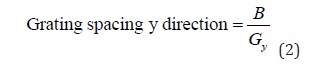
where B is the width of the size 5 of the polystyrene and Gy is the number of gratings in the y direction.
The theoretical grating spacing in the x direction is 3.2 mm and the grating spacing in the y direction is 2.7 mm that matches the experiments. The accuracy is good. We measure the pixel dimension of the experiment image. Pixel is defined as the single point of color on the monitor screen of the computer. The pixel can be regarded as the ink size used to display digital image on the monitor screen of the computer. We measure the Dot Pixels Per Inch (dpi) of the experiment image. The experiment image dpi are 96 pixels per inch. We model the dpi to match the experiments. We define the pixel using standard.
The pixel per cm (P) is given in Eq (3).
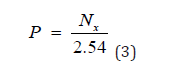
Where Nx are the number of pixels. Here Nx are 96. 2.54 is the relation between 1 inch and 2.54 cm.
The pixel dimensions for the experiment image are 960 pixels by 1280 pixels. We model the pixel dimensions hard code in python to 960 pixels to 1280 pixels to match experiments. We obtain good accuracy. Hence, we use more pixel ink than dpi to produce the simulation image that experiments. This reveals dpi 96 and pixel dimensions 960 pixels by 1280 pixels are two different storage pixel ink tanks in the central processing unit of the computer that can be independently used to display the experiment image on the monitor screen of the computer. Our model matches the experiments. The color of the simulated image is incorporated by human visual perception method. It is considered white in the Red, Blue and Green (RGB) color palette in the python. The weave pattern to make the gratings are coloured to (200, 200, 200) color code in python. This is equivalent to light Gray. We learn the polystyrene material dimension for size 5, color, weave grating lines color, physics of pixel dimension in x and y directions, dot pixel per inch, pixel per cm, grating number in the x and y direction for the size 5 of the polystyrene, grating spacings in the x and y direction for the size 5 of the polystyrene, colour, weave grating lines and weave colour of images provided for size 1 to size 4 in the model. Hence, we develop the model from the human visual perception method that learns the detailed parameter given. The model developed is physics informed AI simulation to predict image for the size 5 of the polystyrene.
The similar index of the image is calculated using Eq (4).

where SSIM is the similar index of the image. factual is the function for the actual image given in Eq (5).
factual = f (𝑐𝑜𝑙𝑜𝑟, 𝑔𝑟𝑎𝑡𝑖𝑛𝑔 𝑠𝑝𝑎𝑐𝑖𝑛𝑔𝑠, 𝑛𝑢𝑚𝑏𝑒𝑟 𝑜𝑓 𝑔𝑟𝑎𝑡𝑖𝑛𝑔𝑠, 𝑑𝑝𝑖, 𝑝𝑖𝑥𝑒𝑙 𝑑𝑖𝑚𝑒𝑛𝑠𝑖𝑜𝑛𝑠) (5)
where 𝑓 is the function that includes the physics of color, grating spacings, number of gratings, dot pixel per inch, pixel dimensions in x and y directions, respectively. 𝑓model is the function for the actual image given in Eq (6).
fmodel = fsim (𝑐𝑜𝑙𝑜𝑟, 𝑔𝑟𝑎𝑡𝑖𝑛𝑔 𝑠𝑝𝑎𝑐𝑖𝑛𝑔𝑠, 𝑛𝑢𝑚𝑏𝑒𝑟 𝑜𝑓 𝑔𝑟𝑎𝑡𝑖𝑛𝑔𝑠, 𝑑𝑝𝑖, 𝑝𝑖𝑥𝑒𝑙 𝑑𝑖𝑚𝑒𝑛𝑠𝑖𝑜𝑛𝑠) (6)
where fsim is the function used in the simulation that includes the physics of color, grating spacings, number of gratings, dot pixel per inch, pixel dimensions in x and y directions, respectively.
The SSIM value is good in our method. The human visual perception and physics from ai simulation parameters used during training and predict image matches the actual image from the experiments.
Results and Discussion
Figure 2 shows the images of different sizes of the polystyrene. Figure 2a shows the polystyrene of length 8 mm width 8mm and thickness 0.082 mm. Figure 2b shows the size 2 of polystyrene of length 2 cm, width 2 cm and thickness 0.082 mm. Figure 2c shows the size 3 of length 4.5 cm, width 4.5 cm and thickness 0.082 mm. Figure 2d shows the size 4 of length 4 cm, width 2 cm and thickness 0.082 mm.
Figure 3 shows the comparison between the experiment size 5 of the polystyrene and physics informed AI predicted image simulation. The size 5 of the polystyrene have length 7.6 cm, width 4.6 cm and thickness 0.082 mm. The predicted image from physics informed AI simulation have pixel dimensions 960 by 1280 same as the experiments. The accuracy is good. We calculate the SSIM without Gaussian blurs method. We develop codec having human visual perception method only.

Figure 3:Comparison of the experiment polystyrene image and the computer model
Conclusions
To conclude, we predict the image for size 5 of the polystyrene to match good accurately with the experiments. We use human visual perception method and physics from ai models. Our training models use the parameters of the experiment image for size 1 to size 4. The pixel image properties are also included in the model. We calculate the similarity index of the image using equations and obtain good accuracy. Our work can easily be extrapolated to many polymers and objects.
Acknowledgments
There is no funding for this work.
Author Contributions
Nandigana V. R. Vishal: Conceptualization, Data curation, Formal analysis, investigation, methodology, resources, software, supervision, validation, visualization, writing – original draft, writing – review and editing.
Conflicts of Interest
The authors declare no conflict of interest.
Data Availability
The data from the current study are available from the corresponding author upon reasonable request.
References
- M A Abkowitz (1992) Electronic transport in polymers. Philosophical Magazine B 65(4): 817- 829.
- A Babel, S A Jenekhe (2003) High Electron Mobility in Ladder Polymer Field-Effect Transistors. J Am Chem Society 125(45): 13656-
- K I Hong, A Kumar, A M Garcia, S Majumder, A R Carretero (2023) Electron spin polarization in supramolecular polymers with complex pathways. J Chem Phys 159:
- A Landi, M Reisjalali, J D Elliott, M Matta, P Carbone, et al. (2023) Simulation of polymeric mixed ionic and electronic conductors with a combined classical and quantum mechanical model. J Mater Chem C 11(24): 8062-8073.
- S Prodhan, A Troisi (2024) Effective Model Reduction Scheme for the Electronic Structure of Highly Doped Semiconducting Polymers. J Chem Theory Computation 20(22): 10147-
- J L Lenhart, D A Fischer, T L Chantawansri, J W Andzelm (2012) Surface Orientation of Polystyrene Based Polymers: Steric Effects from Pendant Groups on the Phenyl Ring. Langmuir 28(44): 15713-
- S A Hall, K C Jena, P A Covert, S Roy, T G Trudeau, et al. (2014) Molecular-Level Surface Structure from Nonlinear Vibrational Spectroscopy Combined with Simulations. J Phys Chem B 118: 5617-
- I M Ward, J Sweeney (2013) Mechanical Properties of Solid Polymers, Third Edition, John Wileyand Sons, Ltd.
- G D Wignall, D G H Ballard, J Schelten (1976) Chain conformation in molten and solid polystyrene and polyethylene by low-angle neutron scattering, Journal of Macromolecular Science Part B 12(1): 75-98.
- K Kik, B Bukowska, P Sicinska (2020) Polystyrene nanoparticles: Sources, occurrence in the environment, distribution in tissues, accumulation and toxicity to various organisms, Environmental Pollution 262: 1-9.
- Y B Tatek, M Tsige (2011) Structural properties of atactic polystyrene adsorbed onto solid surfaces. J Chem Phys 135(17):
- O Queen, G A McCarver, S Thatigotla, B P Abolins, C L Brown, et al. (2023) Polymer graph neural networks for multitask property learning. npj Computational Materials 9(1).
- B G Sumpter, D W Noid (1994) Neural networks and graph theory as computational tools for predicting polymer properties, Macromolecular Theory and Simulations 3(2): 363- 378.
- P Reiser, M Neubert, A Eberhard, L Torresi, C Zhou, et al. (2022) Graph neural networks for materials science and chemistry, Communications Materials 3(1): 1-18.
- R Gurnani, C Kuenneth, A Toland, R Ramprasad (2023) Polymer Informatics at Scale with Multitask Graph Neural Networks. Chem Mater 35(4): 1560-1567.
- S Uyanik, S Parkinson, G Killick, B Dutta, R Clowes, et al. (2025) Computer vision for polymer characterisation using lasers, Digital Discovery 4(10): 2816-2826.
- R S V D Hurk, B W J Pirok, T S Bos (2025) The role of artificial intelligence and machine learning in polymer characterization: emerging trends and perspectives. Chromatographia 88(5): 357- 363.
- T B Martin, D J Audus (2023) Emerging Trends in Machine Learning: A Polymer Perspective, ACS Polym Au 3(3): 239-
- S Anguissola, D Garry, A Salvati, P J O Brien, K A Dawson (2014) High Content Analysis Provides Mechanistic Insights on the Pathways of Toxicity Induced by Amine-Modified Polystyrene Nanoparticles, Plos One 19(9): 1-
- W Ge, R D Silva, Y Fan, S A Sisson, M H Stenzel (2025) Machine Learning in Polymer Research, Advanced Materials, 37(11):
- D C Struble, B G Lamb, B Ma (2024) A prospective on machine learning challenges, progress, and potential in polymer science, MRS Communications 14(6681): 1-19.
- S J Royer, H Wolter, A E Delorme, L Lebreton, O B Poirion, et al. (2024) Computer vision segmentation model-deep learning for categorizing microplastic debris. Front Environ Sci 12: 1-3.
- J C Vidal, J Midon, A B Vidal, D Ciomaga, F Laborda (2023) Detection, quantification, and characterization of polystyrene microplastics and adsorbed bisphenol A contaminant using electroanalytical techniques. Microchim Acta 190: 1-10.
- A Motalebizadeh, S Fardindoost, M Hoorfar (2024) Selective on-site detection and quantification of polystyrene microplastics in water using fluorescence-tagged peptides and electrochemical impedance spectroscopy. Journal of Hazardous Materials 480:
- C Mayorga, S M Athalye, M Boodaghidizaji, N Sarathy, M Hosseini, et al. (2025) Limit of Detection of Raman Spectroscopy Using Polystyrene Particles from 25 to 1000 nm in Aqueous Suspensions. Anal Chem 97(16): 8908-
- T A Meyer, C Ramirez, M J Tamasi, A J Gormley (2023) A Users Guide to Machine Learning for Polymeric Biomaterials, ACS Polym Au 3(2): 141-
- N Aloi, A Calarco, G Curcuruto, M D Natale, G Augello, et al. (2024) Photoaging of polystyrene-based microplastics amplifies inflammatory response in macrophages. Chemosphere 364: 143131.




 We use cookies to ensure you get the best experience on our website.