
Perspective 
 Creative Commons, CC-BY
Using Implicit Motor Learning and External Focus Strategies to Facilitate Core Function in Women with Diastasis Recti Abdominis: A Clinical Perspective
*Corresponding author:Tomás Bonino-Covas, Independent researcher, Batel 12 Bajo B, 28042 Madrid, Spain.
Received:July 31, 2026; Published:August 10, 2026
DOI: 10.34297/AJBSR.2026.31.004098
Abstract
Background:. Rehabilitation of Diastasis Recti Abdominis (DRA) in postpartum women has traditionally relied on explicit verbal instructions aimed at voluntary activation of deep abdominal muscles. Although widely used, this approach demands substantial body awareness, conscious motor control, and cognitive resources, which may limit its transfer to daily functional activities.
Clinical Rationale: Motor learning research indicates that implicit learning strategies and an external focus of attention facilitate more automatic, efficient, and robust motor performance than explicit, internally focused instructions. These principles are well established in sports and neurorehabilitation but have rarely been applied to pelvic health and core rehabilitation in women with DRA.
Purpose: This clinical perspective proposes a theory-informed framework for integrating implicit motor learning and external focus strategies into the rehabilitation of women with DRA, with the aim of facilitating functional core engagement while reducing cognitive load and reliance on voluntary muscle control.
Clinical Perspective: Women with DRA often present with altered proprioception, reduced movement confidence, and high cognitive and emotional demands during the postpartum period. Rehabilitation approaches that promote automatic motor responses and functional adaptability may therefore be particularly relevant. External focus cues, task-oriented exercises, and constraints-led strategies may allow clinicians to facilitate abdominal wall function without directing attention explicitly to muscle activation.
Clinical Application: This article outlines pedagogical principles and practical considerations for pelvic health physical therapists, including instruction wording, task design, progression strategies, and clinical decision-making criteria. Task-based examples commonly used in pelvic health practice illustrate how implicit learning and external focus can be incorporated into routine care.
Conclusion: Integrating implicit motor learning and external focus strategies may offer a valuable complement to traditional core rehabilitation in women with DRA. By shifting emphasis from voluntary muscle activation toward functional task performance, clinicians may support movement automaticity and the transfer of therapeutic gains to daily activities. Further research is warranted to evaluate the clinical outcomes associated with this framework.
Keywords:Diastasis recti abdominis, Pelvic health physical therapy, Implicit motor learning, External focus of attention, Core rehabilitation, Postpartum women
Introduction
Diastasis Recti Abdominis (DRA) is common among postpartum women and represents a frequent clinical challenge in pelvic health physical therapy. Although traditionally defined by an increased inter-rectus distance, DRA is increasingly understood as a multifactorial condition involving alterations in abdominal wall function, load transfer, and motor control [1,2]. Many women with DRA report difficulty not only during specific exercises but also during everyday activities that require coordination, postural control, and simultaneous task management [3]. Conventional rehabilitation approaches for DRA typically emphasize explicit verbal instructions aimed at the voluntary activation of deep abdominal muscles, particularly the transversus abdominis and pelvic floor, relying on internal attentional focus, body awareness, and conscious motor control. While such approaches may be effective in controlled therapeutic settings, their transfer to dailylife contexts can be limited [4]. Many postpartum women experience reduced proprioceptive awareness, high cognitive and emotional demands, and frequent multitasking, all of which may challenge the sustainability of consciously controlled motor strategies outside the clinic. Over the past two decades, motor learning research has highlighted the role of implicit learning processes and attentional focus in facilitating more automatic and adaptable motor behaviour. Implicit motor learning strategies aim to reduce reliance on conscious control by minimizing explicit movement instructions and directing attention toward the goal or effect of a task rather than toward specific muscle actions [5,6]. An external focus of attention, in particular, has been associated with more efficient and robust motor performance across a variety of contexts [7,8]. Despite growing evidence supporting implicit motor learning and external focus strategies in sports and neurorehabilitation 27, their application within pelvic health physical therapy-and specifically in the rehabilitation of women with DRA-remains limited. This clinical perspective proposes a theory-informed framework for integrating these principles into DRA rehabilitation, with the aim of supporting functional core engagement, reducing cognitive load, and enhancing transfer to everyday postpartum activities.
Limitations Of Explicit Motor Control Approaches in Postpartum Core Rehabilitation
Explicit motor control strategies have traditionally played a central role in postpartum core rehabilitation, including interventions for women with DRA [9]. These approaches commonly rely on detailed verbal instructions aimed at consciously activating specific muscles, such as the transversus abdominis and pelvic floor, often coordinated with breathing patterns, directing the patient’s attention inward toward muscle contraction, timing, and movement sequencing. While explicit instruction may be useful in early stages of skill acquisition or in controlled therapeutic environments, it presents several limitations when applied to postpartum women in real-world contexts [8]. Voluntary muscle activation requires sustained attention and cognitive resources that may be difficult to mobilize when proprioceptive awareness is reduced and fatigue, emotional stress, and caregiving demands are high. From a motor control perspective, internally focused instructions can increase reliance on conscious regulation of movement, potentially interfering with automatic motor processes [7,10]. Clinically, this may manifest as excessive effort, overcorrection, or difficulty integrating core control into functional tasks involving load transfer, balance, or dual-task demands. As a result, improvements observed during supervised exercise sessions may not consistently transfer to daily activities such as lifting, carrying, or responding to unexpected perturbations. Explicit approaches may also be less effective for women with limited body awareness or difficulty perceiving subtle muscular activity. In these cases, repeated verbal cues to “activate” or “engage” specific muscles may increase frustration or dependence on therapist feedback rather than promoting autonomy and confidence in movement [5,10]. Taken together, these observations suggest that rehabilitation strategies relying predominantly on conscious muscle control may not fully address the functional and contextual demands of postpartum life. This highlights the need for complementary approaches, grounded in motor learning theory, that facilitate more automatic and adaptable motor behaviour.
Motor Learning Principles Relevant to Pelvic Health Physical Therapy
Motor learning refers to the processes through which individuals acquire, refine, and retain movement skills [11]. In rehabilitation, these principles influence not only how exercises are performed during therapy sessions but also whether newly acquired movement strategies are retained and transferred to daily life. Understanding how movement is learned can inform both task design and instruction delivery [10-27].
Explicit and Implicit Motor Learning
Motor learning strategies are commonly described along a continuum from explicit to implicit. Explicit motor learning involves conscious awareness of movement execution and relies on verbal instructions, rules, and feedback that guide the individual on how to perform a task; in rehabilitation, this often includes detailed cues about muscle activation, sequencing, posture, and breathing. While explicit learning can support initial understanding of a task, it places substantial demands on attention and working memory.
Implicit motor learning, by contrast, aims to minimize conscious control of movement by reducing the amount of explicit information provided. Rather than focusing on how a movement is performed, implicit strategies emphasize task goals, environmental interaction, or problem-solving within the task itself, allowing movement patterns to emerge more automatically. This may be particularly relevant when the clinical goal extends beyond correct execution during therapy to the long-term retention and adaptability of movement strategies in complex, real-life situations.
Attentional Focus and Motor Performance
Attentional focus plays a central role in how motor skills are learned and performed. An internal focus directs the individual toward their own body movements or muscle activity, such as “engaging the core” or “contracting the transversus abdominis.” This type of focus is commonly used in core rehabilitation but can increase conscious control and effort during movement [12,13]. An external focus, by contrast, directs attention toward the effect of the movement or the interaction with an object or the environment, such as pushing, holding, reaching, or stabilizing an external load. External focus strategies are thought to promote more efficient motor coordination by allowing automatic control processes to operate with less conscious interference [11,12,28]. In rehabilitation contexts, particularly when working with functional tasks, directing attention externally may reduce overcontrol, decrease cognitive load, and facilitate smoother integration of movement patternsan especially relevant distinction in pelvic health physical therapy, where the goal is typically coordinated functional movement rather than isolated muscle activation. Together, implicit motor learning and external focus of attention provide a framework for facilitating motor behavior that is less dependent on conscious control and more adaptable to everyday demands [7,11,12].
Why women with diastasis recti abdominis may benefit from implicit learning strategies?
Women with DRA present with clinical characteristics that may make them particularly responsive to implicit motor learning approaches. Beyond the structural changes of the abdominal wall, many postpartum women exhibit alterations in proprioception, body awareness, and movement confidence, especially during tasks requiring coordinated trunk control-factors that can influence not only how movements are performed in therapy but also how effectively core function is integrated into daily life [2,14]. From a clinical perspective, women with DRA often report difficulty “feeling” or voluntarily activating their abdominal muscles despite repeated instruction, which can lead to frustration, increased dependence on therapist feedback, and reduced movement confidence. Implicit motor learning approaches, which emphasize task goals and environmental interaction over internal muscle cues, may support more intuitive engagement of the abdominal wall without requiring precise body awareness or conscious muscle recruitment. Implicit strategies may also facilitate better transfer of therapeutic gains to functional contexts, as movements learned with minimal explicit control tend to be more adaptable and resilient when task demands change [6,11]. For women with DRA, this adaptability is clinically relevant, since core function must be sustained during the unpredictable, dynamic activities of postpartum life-such as lifting and carrying an infant or managing multiple tasks simultaneously-rather than during isolated, controlled exercises. Taken together, these considerations suggest that women with DRA may benefit from rehabilitation strategies that prioritize automaticity, adaptability, and functional relevance, offering a valuable complement to traditional approaches when the goal is confident, efficient movement in the context of everyday postpartum life [5,15].
External Focus as A Clinical Tool to Facilitate Core Function
An external focus of attention directs the patient’s attention toward the effect of a movement or the interaction with an object or the environment, rather than toward specific body parts or muscle activation. In pelvic health physical therapy, this represents a shift from instruction centered on internal sensations (e.g., “activate your core” or “contract your transversus abdominis”) toward taskoriented cues that emphasize what the patient is trying to accomplish [10,16]. In DRA rehabilitation, an external focus may help facilitate abdominal wall function without increasing conscious control or cognitive effort. By focusing on an external goal-such as stabilizing an object, resisting a load, or maintaining balance during a task-the abdominal muscles may be recruited more automatically as part of an integrated movement strategy. This may be particularly relevant for postpartum women who struggle to voluntarily activate deep abdominal muscles or who find internally focused cues difficult to interpret [17]. External focus cues can be readily incorporated into common pelvic health interventions-for example, instructing a patient to “press the ball into the wall,” “hold the weight steady while you move,” or “keep the object from shifting as you change position.” These cues emphasize task success rather than muscle activation, allowing core engagement to emerge as the body responds to the mechanical demands of the task 8. Table 1 provides additional examples of how traditional explicit, internally focused cues commonly used in DRA rehabilitation can be reworded as implicit, externally focused cues.
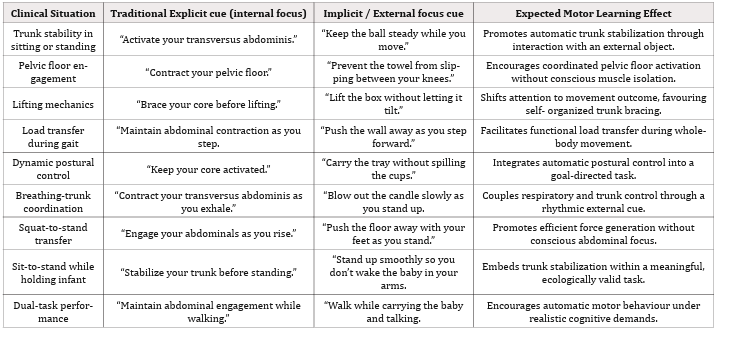
Table 1:Translating explicit internal-focus cues into implicit external-focus cues for diastasis recti abdominis rehabilitation.
Equally important is what clinicians may choose to avoid. Repeated verbal cues emphasizing precise muscle contractions, timing, or sequencing can increase self-monitoring and overcontrol, potentially disrupting fluid movement. In patients with reduced body awareness or high movement-related anxiety, internally focused instructions may increase effort and tension without improving functional performance. External focus strategies do not require abandoning clinical reasoning or safety considerations; rather, they offer an alternative way to guide movement that aligns with functional goals and real-life demands. By carefully selecting tasks, adjusting environmental constraints, and using clear, goaloriented language, clinicians can support core function while minimizing reliance on conscious motor control-an approach that, combined with implicit motor learning principles, may facilitate movement patterns that are efficient, resilient, and transferable beyond the clinical setting.
Implicit Motor Learning into Dra Rehabilitation
Integrating implicit motor learning and external focus strategies into DRA rehabilitation requires a shift in how therapeutic tasks are designed, instructed, and progressed. Rather than emphasizing isolated muscle activation, this framework prioritizes functional task performance, environmental interaction, and gradual exposure to complexity, with the goal of facilitating automatic and adaptable core function [16]. Figure 1 summarizes the proposed three-level conceptual framework, linking motor learning principles to clinical application and functional outcomes.

Figure 1:Conceptual framework for integrating implicit motor learning into rehabilitation of women with diastasis rectiabdominis. A theory-informed framework proposed by the authors.
Pedagogical Principles for Pelvic Health Physical Therapy
At the core of this framework is a reduction in explicit verbal instruction related to muscle activity. Clinicians are encouraged to limit detailed explanations of how a movement should be performed and instead emphasize the goal of the task, using instructions that are concise, goal-oriented, and focused on task success rather than internal sensations. Constraints-led approaches and thoughtful task setup play a central role: by structuring the task and environment appropriately and allowing the patient to explore movement solutions, learning is guided through experience rather than conscious rule acquisition. Feedback is provided sparingly and directed toward task outcome rather than movement mechanics [28].
Task Design and Use of Constraints
Tasks are designed to elicit abdominal wall engagement through interaction with external loads, objects, or environmental constraints, such as pressing, holding, resisting movement, or maintaining stability while an external force is applied. The direction, magnitude, and position of the load are adjusted to influence motor behavior without explicitly instructing muscle activation [6,10]. Constraints such as base of support, surface stability, and movement direction are used strategically to shape movement patterns; by modifying these constraints, clinicians can guide motor responses while preserving the implicit nature of the learning process [18]. Table 1 illustrates how these principles can be translated into specific clinical cues across common DRA rehabilitation scenarios.
Progression Strategies and Variability
Progression within this framework focuses on increasing task complexity rather than conscious control. Variability is intentionally introduced through changes in task demands, body position, speed, or environmental context 13,19,20, which may include asymmetrical loads, dynamic transitions, or dual-task elements that reflect real-life challenges [21]. This progression aims to enhance the adaptability and robustness of motor behavior, supporting the transfer of core function to daily activities. Progression is individualized and responsive to the patient’s confidence, movement quality, and tolerance [13,22].
Clinical Decision-Making Considerations
Because implicit motor learning may reduce cognitive load during acquisition of a functional movement, it may be particularly appropriate for women with DRA who demonstrate difficulty with voluntary muscle activation, reduced body awareness, or challenges integrating core control into functional tasks [6,23]. It may also be useful in later stages of rehabilitation, when the goal shifts from isolated control to functional performance [13]. Implicit learning strategies may not be appropriate as a stand-alone approach in all contexts. Situations requiring explicit instruction-such as symptom management or early-stage motor awareness training in some patients-may still benefit from more direct guidance. Clinical judgment remains essential, and this framework is intended to complement, not replace, existing rehabilitation strategies [6,9]. By integrating implicit motor learning principles with thoughtful task design and progression, pelvic health physical therapists can expand their clinical toolkit, offering a structured yet flexible approach to facilitating core function in women with DRA that aligns with the complex and dynamic demands of postpartum life [9,13].
Clinical Reflections and Preliminary Observations
The clinical framework proposed in this article is grounded in both motor learning theory and clinical experience in pelvic health physical therapy [7,13,23]. In practice, incorporating implicit learning and external focus strategies has been associated with observable changes in how women with DRA engage with movement tasks. When attention is directed toward task goals rather than internal muscle activation, many patients demonstrate a more fluid and confident movement strategy, with reduced verbal prompting required from the clinician [6,7,13]. In clinical settings, imaging tools such as ultrasound may be used as adjuncts to observe abdominal wall behavior during task performance [24-26]. These observations can support therapists in understanding how different task constraints influence abdominal wall engagement, without positioning imaging findings as outcome measures or indicators of treatment efficacy; rather, they may help inform clinical reasoning and task selection within the broader functional framework proposed here. Patients often report that externally focused, task-oriented activities feel more intuitive and easier to integrate into daily life than exercises requiring sustained conscious control of specific muscles [7,13,23]. This subjective experience aligns with the aim of promoting automatic and adaptable motor behavior in the context of postpartum life, where cognitive and physical demands are high. These reflections are intended to illustrate the clinical plausibility of the proposed framework, not to demonstrate treatment effectiveness. They highlight how implicit motor learning principles may be integrated into routine practice and how clinicians may observe meaningful changes in movement behavior [9].
Implications For Practice and Future Directions
Integrating implicit motor learning and external focus strategies into DRA rehabilitation may offer pelvic health physical therapists an additional lens through which to approach core dysfunction in postpartum women. By shifting emphasis from isolated muscle activation toward functional task performance, clinicians may support movement patterns that are more adaptable and transferable to everyday activities.
This framework encourages therapists to reflect not only on what exercises are prescribed, but also on how tasks are instructed and progressed-small changes in language, task design, and environmental constraints may meaningfully influence motor behavior and patient engagement. This shift in how DRA exercises are typically designed and explained is not intended to replace existing rehabilitation strategies, but to complement and expand the clinician’s therapeutic repertoire. Future research is needed to investigate the clinical outcomes associated with this framework, including its impact on functional performance, symptom perception, movement confidence, and long-term integration into daily activities. Studies employing mixed-methods designs, functional outcome measures, and patient-reported experiences may be particularly valuable in capturing the complexity of postpartum rehabilitation.
Conclusion
Diastasis recti abdominis presents a rehabilitation challenge that extends beyond the structural considerations of the abdominal wall. Traditional approaches emphasizing explicit motor control and voluntary muscle activation may be limited in their ability to support the functional integration of core control into daily life. This clinical perspective proposes an alternative framework informed by implicit motor learning and external focus principles. By prioritizing task-oriented exercises, reducing cognitive load, and supporting automatic motor behaviour, pelvic health physical therapists may better align rehabilitation strategies with the reallife demands faced by postpartum women. While further research is required to evaluate clinical outcomes, integrating these principles into practice offers a theoretically grounded approach to facilitating core function in women with DRA.
References
- Lee DG, Hodges PW (2016) Behaviour of the linea alba during a curl-up task in diastasis recti abdominis: A clinical ultrasound study. J Orthop Sports Phys Ther 46(7): 580-589.
- Parker MA, Millar LA, Dugan SA (2009) Diastasis rectus abdominis and lumbo-pelvic pain and dysfunction: A critical review. J Ortho Sports Phys Ther 39(4): 287-295.
- Spitznagle TM, Leong FC, Van Dillen LR (2007) Prevalence of diastasis recti abdominis in a urogynaecology patient population. Int Urogynaecol J Pelvic Floor Dysfunct 18(3): 321-328.
- Keshwani N, Mathur S, McLean L (2018) Relationship between inter-rectus distance and symptom severity in women with diastasis recti abdominis in the early postpartum period. Phys Therapy 98 (3): 182-190.
- Kal E, Prosee R, Winters M, Van der Kamp J (2018) Does implicit motor learning lead to greater automatization of motor skills compared to explicit motor learning? A systematic review. PLoS ONE 13(9): e0203591.
- Masters RSW, Poolton JM, Maxwell JP (2008) Stable implicit motor processes despite aerobic locomotor fatigue. Consciousness and Cognition 17(1): 335-338.
- Wulf G (2013) Attentional focus and motor learning: A review of 15 years. International Review of Sport and Exercise Psychology 6(1): 77-104.
- Lohse KR, Wulf G, Lewthwaite R (2012) Attentional focus affects movement efficiency. Human Movement Science 31(3): 735-744.
- Benjamin DR, Van de Water AT, Peiris CL (2014) Effects of exercise on diastasis of the rectus abdominis muscle in the antenatal and postnatal periods: A systematic review. Physiotherapy 100(1): 1-8.
- Wulf G, McNevin N, Shea CH (2001) The automaticity of complex motor skill learning as a function of attentional focus. Q J Exp Psychol 54(4): 1143-1154.
- Maresch J, Mudrik L, Donchin O (2021) Measures of explicit and implicit learning in motor skill acquisition: What we know and what we do not. Neuroscience & Biobehavioral Reviews 128: 558–568.
- Gluppe SL, Engh ME, Bø K (2020) Immediate effect of abdominal and pelvic floor muscle exercises on inter-rectus distance in postpartum women: a randomized controlled trial. Phys Ther 100(8): 1372–83.
- Wulf G, LewthwaiteR (2016) Optimizing performance through intrinsic motivation and attention for learning: The OPTIMAL theory of motor learning. Psychonomic Bulletin & Review 23(5): 1382-1414.
- Benjaminse A, Welling W, Otten B, Gokeler A (2018) Transfer of improved movement technique after receiving verbal external focus and video instruction. Knee Surgery Sports Traumatology Arthroscopy 26(3): 955–962.
- Smrcina Z, Woelfel S, Burcal C (2022) A systematic review of the effectiveness of core stability exercises in patients with non-specific low back pain. Journal of Back and Musculoskeletal Rehabilitation 35(5): 766-774.
- Mc Nevin NH, Shea CH, Wulf G (2003) Increasing the distance of an external focus of attention enhances learning. Psychological Research 67(1): 22-29
- Winter bottom L, Nilsen DM (2024) Motor learning following stroke: Mechanisms of learning and techniques to augment neuroplasticity. Physical Medicine and Rehabilitation Clinics of North America 35(2): 277-291.
- Davids K, Button C, Bennett S (2008) Dynamics of skill acquisition: a constraints-led approach. Champaign (IL): Human Kinetics.
- Kunavar T, Jamšek M, Avila Mireles E J, Rueckert E, Peternel L, et al. (2024) The effects of different motor teaching strategies on learning a complex motor task. Sensors 24(4): 1231.
- Schmidt RA, Lee TD (2011) Motor learning and performance: from principles to application. 5th ed. Champaign (IL): Human Kinetics.
- Davids K, Glazier P, Araújo D, Bartlett R (2003) Movement systems as dynamical systems: the functional role of variability and its implications for sports medicine. Sports Med 33(4): 245–260.
- Plummer P, Eskes G, Wallace S, Giuffrida C, et al. (2013) Cognitive-motor interference during functional mobility after stroke: state of the science and implications for future research. Arch Phys Med Rehabil 94: 2565–2574.
- Kleynen M, Braun SM, Van Vijven K (2014) Implicit motor learning in rehabilitation: a systematic review. Disabil Rehabil 36(9): 719–730.
- Whittaker JL, Teyhen DS, Elliott JM, Cook K, Helene M Langevin et al. (2007) Rehabilitative ultrasound imaging: understanding the technology and its applications. J Orthop Sports Phys Ther 37: 434–449.
- Teyhen DS, Childs JD, Dugan JL, Wright AC, Julie A Hides, et al. (2007) Ultrasound imaging of the abdominal muscles during rehabilitation exercises. J Orthop Sports Phys Ther 37: 450–466.
- Keeler J, Albrecht M, Eberhardt L, Horn L (2012) Diastasis recti abdominis: a survey of women's health specialists for current physical therapy clinical practice. J Women’s Health Phys Therap 36: 131–42.
- Maier M, Ballester BR, Verschure PFMJ (2019) Principles of neurorehabilitation after stroke based on motor learning and brain plasticity mechanisms. Frontiers in Systems Neuroscience 13: 74.
- Shea CH, Wulf G (1999) Enhancing motor learning through external-focus instructions and feedback. Human Movement Science 18: 553–571.




 We use cookies to ensure you get the best experience on our website.