
Review Article 
 Creative Commons, CC-BY
Ai Fueled Technology & US healthcare - Emulatable Lessons in Affordability, Accessibility and Accountability
*Corresponding author:Faisal M Rahman, The Graham School of Management, Saint Xavier University, Chicago, USA.
Received:August 13, 2026; Published:August 21, 2026
DOI: 10.34297/AJBSR.2026.32.004114
Abstract
Artificial Intelligence (AI) is creating an environment of excitement and fear in the healthcare sector. On one end, it holds out the promise of better diagnosis of a patient’s illness and a more comprehensive treatment plan, it also creates the fear of loss of jobs and further decline in the element of human empathy in patient care. Author draws upon his experience of operating ambulatory surgery centers and management of physician practices in the United States to discuss potential use of proven practices to the less developed countries. AI fueled technology could be THE powerful tool to bring affordable, accessible, and accountable healthcare throughout the world.
Artificial Intelligence (AI)- Definition
Artificial Intelligence, or AI, is a field of computer science that focuses on building machines and systems that can perform tasks that usually take human intelligence, like learning, reasoning and understanding, recognizing patterns, making decisions based on the data provided, and solving problems. An AI system, unlike previous computer systems, does not have to wait for the programmer to give it direct instructions for every single step, it learns using the data provided, recognizing patterns over time and making decisions based on them. There are two different types of Artificial Intelligence:
Narrow AI (what We Have Today)
Is a task specific system that outperforms humans in certain tasks, such as facial recognition tools, self-driving cars, voice assistants, fraud detection… Narrow AI has the potential to improve efficiency and cut costs by eliminating dull repetitive tasks. However, it has limitations as it needs massive amounts of highquality data and is not truly intelligent but rather just very good at recognizing patterns.
General AI
Is a theoretical system that can display real intelligence, thinking and learning like a human, but with the potential to acquire much more knowledge and apply it in different contexts. This system does not exist yet, and is something that might or might not be possible.
Outpatient Settings - Definition
Outpatient Settings are healthcare environments that provide patient care without admitting patients overnight. In other words, you go in, get treatment and go home all in the same day. These settings can include a Doctor’s Office, Physical Therapy Clinics, Diagnostic Imaging Centers and more. This is opposite of Inpatient Settings which admit patients overnight, including more serious surgeries, procedures or any care that takes at least one night stay. Outpatient care tends to be less expensive as inpatient care includes the cost of every day spent in the hospital, as well as every procedure done in that time period [1-3] (Table 1).
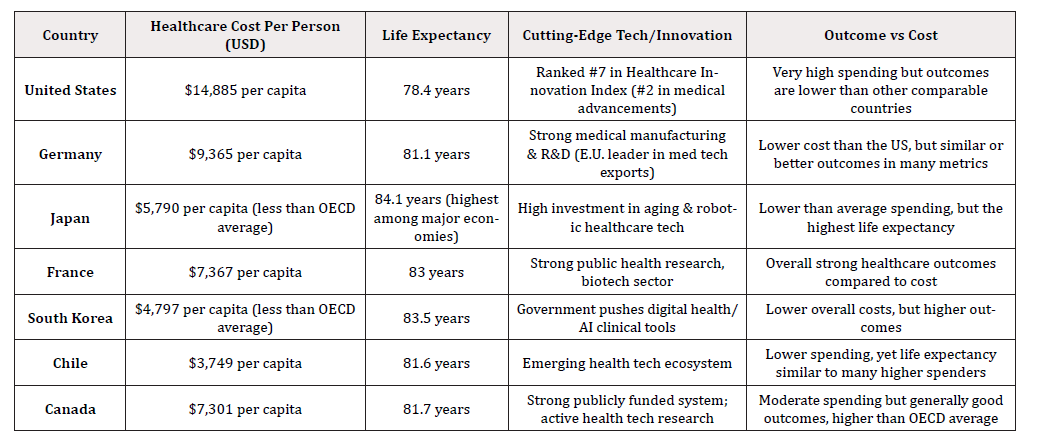
Table 1:US Healthcare Spending Compared to Other Countries.
Overview
As seen in the table above, the United States is the by far highest OECD, and the highest global spender on healthcare with $14,885 per capita. This equals roughly 17.2% of its GDP, again way above the OECD average of 9.3%. Despite this high spending the United States still performs lackluster in many important measures, like life expectancy where the USA ranks rather poorly, at 78.4 years, leagues behind other major economies like Japan, at 84.1, France at 83, or its closest neighbor Canada, at 81.7 years [4- 18]. Even South American countries, like Chile who spends much less overall on healthcare, $3,749 per capita, have their outcomes reflect broader social and economic factors alongside healthcare provision. However, this high spending can be somewhat reflected in technological innovation, where the United States ranks 2nd in media advancements, 4th in medical digitalization, and 2nd in R&D (research and development) expenditures.
There are many factors that explain why the United States spends so much on healthcare, but its results are mediocre. Most importantly, the prices are astronomically high compared to almost anywhere else. OECD data show Americans do not visit physicians more frequently than many Europeans or Japanese. The difference is largely due to higher prices for hospital stays, specialists’ visits, diagnostics imaging, and prescription drugs. United States obesity levels are also extremely high, which puts pressure on the healthcare system. According to OECD data, self-reported obesity was 35%, compared to the average of 19%, but that number is likely even higher as per Center for Disease Control and Prevention the adult obesity rate in the United States is 42%. Also 36% of adults reported that they do not perform sufficient physical activity, but this number is likely also higher. This puts the population at the higher risk of chronic disease, adding on to the burden. Countries like Japan, France, and Germany invest more heavily in universal primary care access, preventative screenings, and early intervention, while the US historically reimbursed specialty and procedural care at higher rates than preventive services. This leads to more late-stage treatment, meaning higher costs, and weaker outcomes [19].
Use of AI in the US Market
As the United States healthcare system continues to struggle with high cost and mediocre results, Artificial Intelligence has emerged as a new technology that has the potential for transformation. The U.S. The AI healthcare market is on a path to grow from approximately $10.26 billion in 2025 and is projected to reach $99.77 billion by 2033, reflecting an unprecedented wave of institutional investment in technology-driven care. This growth of 32.88% is mainly driven by the need for more affordable healthcare solutions, and highly specialized medicine. Artificial Intelligence uses large amounts of data, specialized algorithms and analytics to improve patient diagnosis, using patient records to catch patterns that may not be obvious at first or hard to spot even for a trained eye, drug development, medical imaging, while lowering cost by eliminating repetitive tasks. Three of the most consequential and rapidly evolving domains within this landscape are patient diagnosis, patient care follow-up, and revenue cycle management.
Patient Diagnosis
As of August 2024, FDA (Food and Drug Administration) has authorized approximately 950 medical devices incorporating AI or machine learning, the vast majority of which are designed to assist in the detection and diagnosis of disease, 723 were radiology devices (76%). In 2023 alone that number was 221, which is a massive increase from 33 approved devices between 1995 and 2015. This shows the rapid growth of Artificial Intelligence in patient diagnosis and US healthcare in general. A meta-analysis of 83 different studies found that AI algorithms now achieve similar diagnosis accuracy of 52.1%, comparable to non-expert physicians, but still fall far behind expert physicians, 15.8% difference in accuracy. This shows the massive potential of AI, as its accuracy can only get better as technology advances and data sets expand. However, it also displays its limitations and the need for experts. AI systems can also inherit biases from the datasets on which they were trained, potentially producing unjust outcomes for underrepresented patient populations. Leading health and patient safety organizations, including the Emergency Care Research Institute (ECRI) [20], emphasize that clinicians must treat AI as a supplementary tool designed to support, and not a replacement, clinical expertise. Transparent governance, informed patient consent, and continuous monitoring for algorithmic disparities are all prerequisites for responsible deployment.
Patient Care, Follow-Up and Remote Monitoring
Besides the initial clinical diagnosis and encounter with the professional, AI is altering the trajectory of the post-care followup through remote patient monitoring (RPM). As demand for healthcare rapidly increases due to the aging population the healthcare budget is on the rise. In 2024 Medicare spending exceeded approximately $1 trillion dollars, which is 20% of total national health expenditure and 13.5% of the total federal budget. With total spending projected to reach $1.9 trillion by 2032, a big portion of which is geared towards hospitalization, a need for devices that can increase efficiency and decrease costs grows. In the United States, 46.3% of hospitals now offer RPM services, and the U.S. RPM market reached $12.76 billion in 2024, with forecasts of $32.17 billion by 2032 Today, AI-powered RPM systems allow real-time collection and analysis of patient data from wearable devices, biosensors, and connected health platforms, enabling clinicians to monitor patients continuously from outside the clinical setting. Patients with chronic conditions, such as cardiovascular patients or the ones with diabetes, present a financial burden on the US healthcare system, and AI monitoring has high implications. For cardiovascular patients, AI systems can detect irregular heart rhythms, blood pressure fluctuations, and changes in activity levels that may signal a cardiac event, triggering alerts to care teams. For the 38.4 million people living with diabetes in America, AI-powered continuous glucose monitors provide real-time blood sugar tracking with predictive alerts for dangerous glycemic episodes.
Revenue Cycle Management
Per McKinsey and Company collectively, healthcare systems in the United States spend more than 140 billion dollars annually on revenue cycle management, with outdated technologies and manual processes contributing to delays and errors driving the cost up. This led many healthcare executives to focus on leveraging AI to automate many repetitive tasks with more than 30% percent of providers prioritizing implementation of AI into specific cases in revenue cycle management. With labor-intensive tasks like accounts receivable follow-up, underpayment management, denials management, and cash posting are time-consuming, making them perfect for using artificial intelligence to complete them, with only human oversight. The emergence of AI agents, systems that can autonomously execute complex, multi-step processes with minimal human intervention, is the reason for this transformation. Unlike generative AI, AI agents can function more like a coworker: scheduling, coding, submitting, appealing, and reconciling claims across interconnected systems. However, the adoption of these AI systems is uneven with many smaller Healthcare systems falling behind the larger ones, with only 20% of systems with revenues between $500 million and $1 billion shifting towards implementing AI into revenue cycle management, compared to 64% of the larger systems, per Fierce Healthcare. This poses the risk that, like in many aspects of the United States healthcare system, technological innovation only amplifies resource inequalities.
Lessons from the US Experience - What Can Be Emulated in Poorer and Less Developed Countries?
The United States, despite all of its flaws and inefficiencies in healthcare, has been on a path of an AI driven healthcare innovation. The critical question is not whether the innovation has been impressive, but whether it is transferable to poorer countries and lesser economies, does the financial aspect allow for these innovations to be implemented there. While many of the United States innovations in this field are perhaps too expensive and unrealistic for poorer countries to emulate, there are still ways they can be implemented. We organize these lessons around three pillars: affordability, accessibility, and accountability.
Affordability
The most immediate barrier to facilitating these innovations to poorer and less developed countries is the cost. A new robotically surgical platform can cost millions of dollars, with additional costs every time a surgery is performed, this is simply a price many healthcare systems cannot pay, or justify. But not all tools are inherently as expensive as that, and the example of the US shows that most efficiency and cost saving tools come in the form of software and not complex surgical equipment.
AI applications that use natural language processing, for example, require no specialized equipment, only internet and a mobile device or a computer. These tools can be used to take verbal patients notes in real time allowing clinical professionals to focus on the patient interaction while improving the accuracy of medical records. Similarly, AI-driven diagnostic algorithms for conditions such as tuberculosis, malaria, and cervical cancer have been developed for deployment on smartphones, at a fraction of the cost of conventional laboratory infrastructure. The World Economic Forum has explicitly called for the use of open-source software and scale-oriented designs so that developing economies can access emerging AI technologies on affordable terms. The lesson these emerging economies can take from the US is not to replicate the system and every investment, but to identify which software tools can give back the biggest return on investment while having low implementation costs.
Accessibility
Accessibility is the next key aspect of emulating the United States system in poorer countries. In the United States, AI-powered remote patient monitoring has proven the ability to extend care far beyond clinic walls tracking chronic disease patients, flagging deterioration early, and reducing costly hospitalizations. The World Economic Forum notes that these poorer and lesser developed countries face far fewer legacy systems (meaning old systems) constraints than rich economies. That puts them well positioned to leverage mobile AI platforms for example, given the fact that mobile use is highly widespread. This transformation is already happening in a handful of countries, point-of-care AI ultrasound platforms have been piloted in Kenya, telemedicine services using AI diagnostics have been deployed in rural Brazil and Angola, and smartphoneenabled anthropometry solutions have been used in rural India to detect low-birth-weight newborns according to Friedrich Naumann Foundation. One of AI’s greatest powers is in follow-up care, the ability to maintain contact with a patient even when not in the clinic physically. AI-driven chatbots capable of health education, medication adherence support, and early symptom screenings could be an immensely valuable tool that can help propel poorer countries towards better and more effective healthcare. Biggest obstacles, however, present the lack of inconsistent electricity and limited internet connectivity in remote regions. Therefore, AI tools that focus on low-income remote communities need to have offline functionality.
Accountability
Artificial intelligence is a fairly new technology and concept and it is not yet fully regulated, and these emerging economies are in a unique position where they can jump on an opportunity to regulate and build in accountability from the start, not retrofitted afterwards. In the United States, the rapid expansion of AI diagnostic and billing tools has drawn scrutiny and skepticism regarding data privacy, bias by the algorithms, and the lack of transparency in how AI systems work and make clinical decisions. As a result, the FDA has developed frameworks for AI device authorization, and ECRI has published detailed guidance on responsible AI implementation, including patient disclosure, consent, and staff training requirements, per American Hospital Association. For poorer countries where regulatory institutions may be less developed it is crucial to take that lesson from the United States. If data sets used by the AI are trained primarily on data from Western countries, that contain wealthier, mainly white populations, and are deployed into, for example African or South Asian countries, they risk producing biased and inaccurate outcomes.
Key Elements Include: ensuring that AI tools are validated on locally representative datasets, establishing clear lines of responsibility when AI-assisted decisions cause harm, requiring transparency in algorithmic logic, and including community voices, including health workers and patient advocates, into governance structures.
Acknowledgments
None
Conflicts of Interest
None.
References
- Leah Davidson (2019) Narrow vs. General AI: What’s Next for Artificial Intelligence.? Springboard.
- (2026) What is artificial intelligence (AI)? Michigan Technological University. Michigan Technological University.
- United Healthcare (2026) Inpatient vs. outpatient care. UnitedHealthcare.
- (2026) Health at a glance: OECD indicators 2025. Organization for Economic Co-operation and Development.
- Population Reference Bureau. Total health spending per capita- international indicator.
- (2024) United States #7 in the world index of healthcare innovation.
- Centers for Disease Control and Prevention (2024) New CDC data show adult obesity prevalence remains high.
- Gumas ED, Lewis C, Horstman C, Gunja MZ (2024) Finger on the pulse: The state of primary care in the U.S. and nine other countries. The Commonwealth Fund.
- American Hospital Association (2026) How to safely use AI for diagnosis: 14 recommendations.
- Health Arc (2025) Remote patient monitoring: 10 key applications for 2025.
- McKinsey Company (2026) Agentic AI: The race to a touchless revenue cycle.
- Fierce Healthcare (2025) Adoption of AI for hospital RCM surges, but cost, operational constraints slow progress.
- (2026) United States AI in healthcare market forecast report and company analysis 2025-2033 featuring AWS, General Vision, Google, Intel, Medtronic, Micron, Microsoft, Next IT, NVIDIA, Siemens Healthcare.
- Sivakumar R, Lue B, Kundu S (2025) FDA approval of artificial intelligence and machine learning devices in radiology: A systematic review. JAMA Network Open 8(11): e2542338.
- Takita H, Kabata D, Walston SL, Tatekawa H, Saito K, et al. (2025) A systematic review and meta-analysis of diagnostic performance comparison between generative AI and physicians. npj Digital Medicine 8: 175.
- Dubey A, Tiwari A (2023) Artificial intelligence and remote patient monitoring in the US healthcare market: A literature review. Journal of Market Access Health Policy, 11(1): 2205618.
- NHE fact sheet US Department of Health and Human Services.
- World Economic Forum (2024) Why AI has a greater healthcare impact in emerging markets.
- Friedrich Naumann Foundation (2025) Policy report: Examining AI in low and middle-income
- American Hospital Association (2026) How to safely use AI for diagnosis: 14 recommendations from




 We use cookies to ensure you get the best experience on our website.