
Research Article 
 Creative Commons, CC-BY
Amiodarone-Induce Hypokalaemia in a 70 Year Old Female Associate with Cardiac Patient: A Dose Related Adverse Drug Reaction
*Corresponding author:Subba Dil Prasad, Assistant Professor, Sharda School of Pharmacy, Sharda University, Greater Noida, Uttar Pradesh, India.
Received:November 03, 2026; Published:November 13, 2026
DOI: 10.34297/AJBSR.2026.32.004217
Abstract
Amiodarone is a widely used class III antiarrhythmic agent for the treatment of atrial and ventricular arrhythmias but, one among many adverse systemic effects, it produces electrolytic disturbances, the common ones being the clinically significant hypokalemias. Methods: A 70-year-old female, with ischemic heart disease (EF 40%), type 2 diabetes mellitus, and hypertension, developed electrolyte imbalance during hospital stay. The medicines given to the patient and biochemical parameters were reviewed. The occurrence of an ADR was assessed by the Naranjo Scale. Results: The patient received ecosprin (aspirin + para-aminosalicylic acid), gemer (glimepiride +metformin), losar (losartan), storvas (atorvastatin), flavedon (trimetazidine), lantus (insulin glargine), clexane (enoxaparin), and axcer (ticagrelor). The fifth day saw the commencement of amiodarone 200 mg BD (cardarone) and syrup potkar 15 mL. Serum potassium was down from 4.0 mmol/L to 3.3 mmol/L on day 7. After withdrawal of the two drugs, serum potassium normalized to 3.8 mmol/L within 24 hours. This reaction was rated as definite (Naranjo score = 10) and moderate in severity. Discussion: Hypokalemia was thus induced by amiodarone with altered renal potassium regulation. Insulin administration could have also caused an intracellular shift of potassium. Early withdrawal of these offending agents brought about full recovery in the case presented. Conclusion: Emphasizing the case reports, this case claims the importance of regular monitoring of serum electrolytes in senile diabetic cardiac cases receiving amiodarone. Recognition at an early stage and timely pharmacovigilance intervention can avert the catastrophic complication.
Keywords:
Amiodarone, Hypokalemia, Adverse Drug Reaction, Naranjo Scale. Abbreviation: ADRs: Adverse Drug Reactions, DDIs: Drug -Drug Interactions, K+: Potassium ion.
Introduction
Amiodarone, a class III antiarrhythmic drug, is an effective treatment for both atrial and ventricular arrhythmias, but it has a lot of the severe multisystem side effects of the kind that have electrolyte disruptions, such as hypokalemia, that are uncommon but, when present, can have very big clinical consequences. The substance’s long half-life and lipophilicity end up in storage and the toxicity, as the main target, is affecting the thyroid, lungs, and live [1,2]. It is highly recommended that the patients undergo regular monitoring and testing in order to have early detection of the adverse reactions. This statement is illustrated by the case studies which show that after the patient stops taking amiodarone, they start to get better and the associated organ functions return to normal once more [3]. Additionally, while amiodarone is less likely to produce torsades de pointes as compared to other class III drugs, its non-cardiac reactions require a close patient examination and pre-initiation monitoring schemes [4].
Case Presentation
A 70-year-old woman with coronary artery disease (EF 40%), type 2 diabetes, and high blood pressure reported chest pain and shortness of breath. Her prescribed medicines were ecosprin 75 mg (aspirin + para-aminosalicylic acid), gemer 1 mg (glimepiride + metformin), losar 50 mg (losartan), storvas 80 mg (atorvastatin), axcer 90 mg (ticagrelor), flavedon 35 mg (trimetazidine), lantus (insulin glargine), nephrosave (pyridoxamine + acetylcysteine), clexane 60 mg (enoxaparin), and pan-D (pantoprazole + domperidone). Throughout the first three days, her serum potassium measurements remained in the 4.0–4.2 mmol/L range. Starting from day 4, the patient started to take 200 mg BD of amiodarone (cardarone) and syrup potkar 15 mL daily. Consequently, the potassium levels decreased to 3.4 mmol/L on days 5 and 6, then to 3.3 mmol/L on day 7. The medications were stopped on day 7, and the levels of potassium started to rise, reaching 3.8 mmol/L on day 8. The patient did not add any new drugs or foods to her diet. (Table 1-3), (Figure 1).
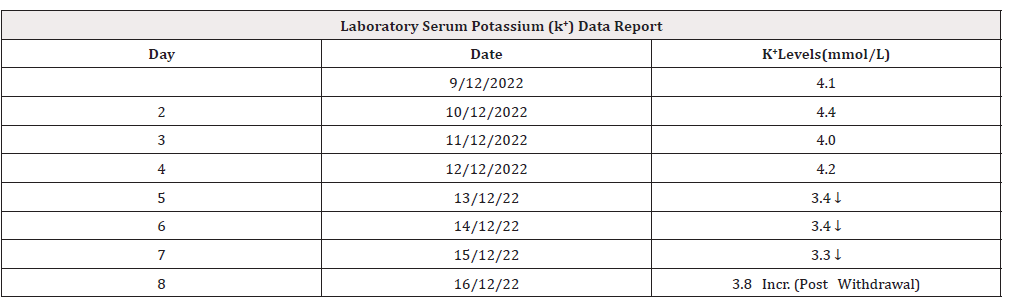
Table 1:Serum Potassium levels Days, Data Report.
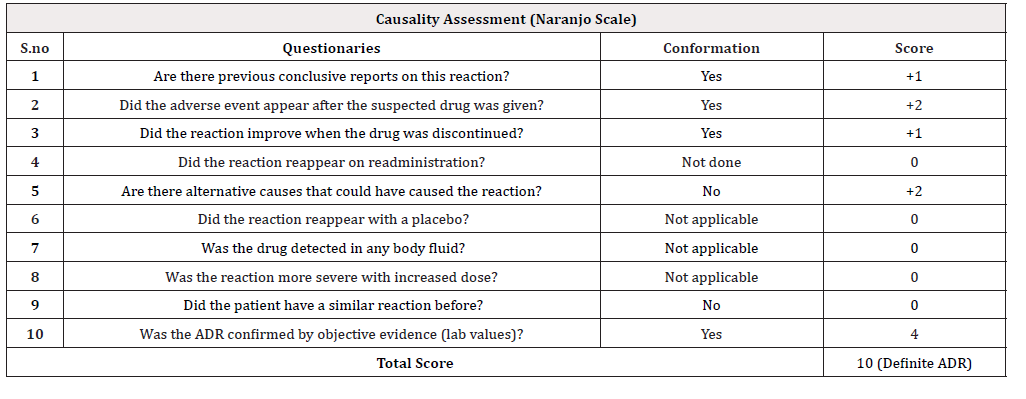
Table 2:Naranjo scale.

Table 3:Contributing factors to Hypokalaemia.
The temporal association, laboratory confirmation, and improvement after dechallenge all supported a causal relationship between amiodarone and hypokalemia. The total score of 10 on the Naranjo Adverse Drug Reaction Probability Scale indicated a definite ADR. The reaction was moderately severe and Type A (predictable, dose-related). The drug that is mostly responsible for the chemicals in the body that leads to hypokalemia is Amiodarone with a 60% share, making it the main drug in suspicion. Additionally, the combination of insulin and amiodarone had a more significant effect on the potassium decline by the pharmacodynamic than expected, and other treatment drugs were negligible.
Case Management
Following the detection of decreased blood potassium levels (3.4–3.3 mmol/L), the patient’s medication chart was reviewed immediately. Day 7 of the patient’s hospital stay involved the cessation of Amiodarone (cardarone 200 mg BD) and syrup potkar 15 mL, as well as the identification of drug-induced hypokalemia as a probable cause. Electrolyte surveillance and cardiac monitoring were still performed. Oral potassium supplements and the intake of potassium-rich foods (e.g., a banana, coconut water, and green vegetables) were introduced to the patient. Insulin was carefully controlled such that there would not be any further intracellular potassium shift, and blood glucose and ECG monitoring was done daily. Serum potassium came up to 3.8 mmol/L within the first day following the suspected drugs’ discontinuation and normalized after that. The patient had a stable condition, and there was no further arrhythmic event or hypokalemia relapse during the followup.
Discussion
Amiodarone-induced hypokalemia, although not very frequently seen, is of high clinical importance. The medication could affect the excretion of electrolytes in the renal tubules or even lead to thyroid problems, both resulting in a potassium upset [5]. Treatment with insulin (insulin glargine) at the same time might be a contributor to the increased intracellular potassium uptake and hypokalemia which show on table 1 [6]. The association of diabetes and heart damage, on the other hand, has a compounding effect on electrolyte disturbance in the person. The moment serums were detected, proactive measures that were taken led to the elimination of the situation of the arrhythmia that was brewing in the patient [7]. The patient should now go through a process of professional electrolyte and ECG monitoring; this is particularly important for most of the patients who are on amiodarone, and specifically for patients who are on insulin or other interacting medications [8,3].
Amiodarone-induced hypokalemia can be exacerbated by changes in renal tubular function and thyroid mediated electrolyte disorders. The use of insulin (Lantus) simultaneously may intensify intracellular potassium transfer and hence the serum K⁺ decline [9,1]. The Naranjo’s score conformation total score 10 indicate that definite ADRs with Type A (dose-related, predictable) and Severity: Moderate which show on Table 2. Amiodarone is of great importance as far as drug-induced hypokalemia is concerned. It operates primarily by renal mechanisms. Therefore, it is responsible for 60% of the cases shown on figure 1. On the other hand, insulin is a factor that promotes intracellular shift of potassium and is responsible for contributing to roughly 20% of hypokalaemia [10]. However, the interplay between amiodarone and insulin might produce a synergistic effect causing a further drop in serum potassium by approximately 10% [11]. Among other examples, supportive drugs, just like Potkar and Cardivas, could be a part of the whole affair of potassium redistribution, making up for about 10% of the hypokalemia cases, as well [11].
Conclusion
The current case strongly recommends regular monitoring of serum electrolytes in diabetic elderly patients with heart disease who are on amiodarone. Timely, required intervention and monitoring, diagnosis and drug surveillance can avert such severe life-threatening complications.
Ethical approval and informed consent
None.
Acknowledgements
None.
Conflicts of Interest
None.
References
- Savchuk H, Bridevaux PO, Fournier JM, Gobin N (2022) Amiodarone: some toxicity considerations. Rev Med Suisse 18(768): 247–251.
- Glover BM, Baranchuk A (2015) Amiodarone for atrial fibrillation: Friend or foe? Cardiology Journal 22(6): 603-604.
- Yan J, Xu Y, Zhu Q (2024) Case Report: Amiodarone-induced multi-organ toxicity. Frontiers in Cardiovascular Medicine 11: 1401049.
- Gelman I, Sharma N, Mckeeman O, Lee P, Campagna N, et al. (2024) The ion channel basis of pharmacological effects of amiodarone on myocardial electrophysiological properties, a comprehensive review. Biomed Pharmacother 174: 116513.
- Kjeldsen K (2010) Hypokalemia and sudden cardiac death. Experimental & Clinical Cardiology 15(4): e96-99.
- Najjar C (2022) Approach to Hyperkalemia. McGill Journal of Medicine 20(2).
- Shoeb AM, Ashar S, Ansari M (2024) Hypokalemia-induced arrhythmia: a case series. International Journal of Research in Medical Sciences.
- Morris D, Cameron N (2011) Did you know? Why amiodarone requires diligent monitoring? 21(4): 3-6.
- Hamilton D, Nandkeolyar S, Lan H, Desai P, Evans J, et al. (2020) Amiodarone: A Comprehensive Guide for Clinicians. American Journal of Cardiovascular Drugs 20(6): 549-558.
- Sung CC, Lin SH (2012) Drug-induced hypokalaemia: part II. Adverse Drug Reaction Bulletin 273(1): 1051–1054.
- Li T, Vijayan A (2014) Insulin for the treatment of hyperkalemia: a double-edged sword? Clin Kidney J 7(3): 239-241.
- Hamilton D, Nandkeolyar S, Lan H, Desai P, Evans J, et al. (2020) Amiodarone: A Comprehensive Guide for Clinicians. American Journal of Cardiovascular Drugs 20(6): 549-558.




 We use cookies to ensure you get the best experience on our website.