
Review Article 
 Creative Commons, CC-BY
Efficacy and Safety of SGLT2 Inhibitors Compared to Diuretic Escalation in Cirrhotic Ascites with Renal Dysfunction: A Systematic Review and Meta-Analysis of Volume Clearance and Cardiorenal-Hepatic Outcomes
*Corresponding author:Hussain Ramzan, Nishtar Medical University and Hospital Multan Pakistan.
Received:August 08, 2026; Published:August 19, 2026
DOI: 10.34297/AJBSR.2026.32.004111
Abstract
Background: Ascites is the most common decompensating event in cirrhosis, and its management becomes markedly more difficult when renal dysfunction coexists, since escalating diuretic doses raises the risk of Acute Kidney Injury (AKI), hyponatremia, and hepatorenal syndrome. Sodium-Glucose Cotransporter-2 (SGLT2) inhibitors, natriuretic agents with established cardiorenal benefit in heart failure and chronic kidney disease, have been proposed as an alternative or adjunct to diuretic escalation in cirrhotic ascites, but their comparative efficacy and renal safety in this setting remain uncertain.
Objectives: To systematically review and, where data permitted, meta-analyze the efficacy (ascites/volume control) and safety
(renal and infectious outcomes) of SGLT2 inhibitors compared with standard-of-care diuretic therapy in adults with cirrhotic ascites,
with attention to renal outcomes as a proxy for the renal-dysfunction-relevant cardiorenal-hepatic axis.
Methods: A literature search was conducted on August 11, 2026, without date restriction, covering PubMed/MEDLINE-, Embase-,
Cochrane CENTRAL-, and medRxiv-indexed sources, supplemented by citation tracking. Randomized controlled trials comparing
an SGLT2 inhibitor (± background diuretics) against standard diuretic-based care or placebo in adults with cirrhotic ascites
were eligible for quantitative synthesis; single-arm and retrospective studies were retained for narrative synthesis and triangulation.
Risk of bias was assessed with the Cochrane RoB 2 tool. A random-effects (DerSimonian–Laird) model was used to pool Risk
Ratios (RR) with 95% confidence intervals (CI) for outcomes reported by more than one comparative trial; heterogeneity was
quantified with I². Screening, extraction, and risk-of-bias assessment were performed by a single AI-assisted reviewer (see Preface).
Results: Of 29 records identified, 5 studies were included in qualitative synthesis: two randomized controlled trials (empagliflozin,
n = 42; dapagliflozin, n = 40), one pilot randomized crossover trial (n = 10), one existing systematic review/meta-analysis,
and one retrospective cohort. Both comparative RCTs showed better ascites/volume control with the SGLT2 inhibitor arm (empagliflozin:
42.9% vs 100% requiring large-volume paracentesis, p < 0.001; dapagliflozin: significantly better 6-month ascites control, p =
0.04), but they diverged sharply on renal safety. Quantitative synthesis of AKI across the two RCTs (N = 82) gave a pooled random-effects
RR of 1.32 (95% CI 0.24–7.23; I² = 84.7%; p = 0.75) — a statistically imprecise, highly heterogeneous estimate driven by opposite-
direction findings (empagliflozin RR 0.58, 95% CI 0.29–1.19, favoring lower AKI; dapagliflozin RR 3.33, 95% CI 1.08–10.34,
favoring higher AKI). Infection risk was numerically increased with dapagliflozin (55% vs 20%, p = 0.04) but not separately quantifiable
for empagliflozin. No identified trial specifically enrolled or subgroup-analyzed patients with baseline renal dysfunction.
Conclusions: Existing randomized evidence is too sparse, too heterogeneous, and too indirect to support a confident conclusion
about SGLT2 inhibitor efficacy or renal safety relative to diuretic escalation specifically in cirrhotic ascites with renal dysfunction.
Ascites control appears to improve with SGLT2 inhibitor add-on therapy, but the effect on AKI risk is inconsistent across the only two
comparative trials available, and infection risk may be increased. GRADE certainty for all outcomes was rated very low. Adequately
powered, renal-dysfunction-enriched randomized trials with a protocolized diuretic-escalation comparator arm and standardized
cardiorenal-hepatic composite endpoints are needed before this question can be answered.
Introduction
Ascites represents the most frequent decompensating event in the natural history of cirrhosis, occurring in approximately 50% of patients within ten years of diagnosis and carrying a grim prognosis with one-year mortality exceeding 50% in refractory cases [1,2]. Standard management follows a stepwise approach commencing with sodium restriction, progressing to escalating doses of mineralocorticoid receptor antagonists and loop diuretics, and culminating in Large-Volume Paracentesis (LVP), Transjugular Intrahepatic Portosystemic Shunt (TIPS), or liver transplantation for refractory disease [3]. This therapeutic ladder, however, conceals a fundamental clinical dilemma: diuretic escalation itself constitutes a double-edged sword, capable of precipitating Acute Kidney Injury (AKI), hyponatremia, hepatic encephalopathy, and hepatorenal syndrome—particularly once renal dysfunction is already established [4]. It is precisely in this high-risk population, where further diuretic titration is most perilous and alternative strategies are most urgently needed, that the evidence base remains most deficient.
Sodium-Glucose Cotransporter-2 (SGLT2) inhibitors— including empagliflozin, dapagliflozin, and canagliflozin—have emerged as a therapeutic class with pleiotropic effects extending well beyond their original indication for type 2 diabetes mellitus [5,6]. By blocking proximal tubular glucose-sodium co-transport, these agents induce natriuresis and osmotic diuresis, and have demonstrated unequivocal cardiorenal benefit in large-scale trials enrolling patients with heart failure and chronic kidney disease, irrespective of diabetes status [7,8]. Mechanistically, SGLT2 inhibitors attenuate proximal tubular sodium reabsorption through a specialized microdomain comprising SGLT2, MAP17, and NHE3, diverting a substantial fraction of filtered sodium to distal nephron segments, thereby modulating the Renin-Angiotensin-Aldosterone System (RAAS) and sympathetic nervous system activity [9]. This mechanism directly addresses the low distal sodium delivery that underlies diuretic resistance in cirrhotic ascites [10].
The pathophysiological rationale for repurposing SGLT2 inhibitors in cirrhotic ascites is compelling. Cirrhosis and congestive heart failure share common hemodynamic derangements: arterial underfilling with compensatory RAAS activation, sympathetic nervous system overactivity, and antidiuretic hormone hypersecretion [11]. However, cirrhosis is distinguished by splanchnic arterial vasodilatation driven by portal hypertension rather than low cardiac output, creating a unique volume-overload state with paradoxically reduced effective arterial blood volume [12]. Conventional loop diuretics inhibit NKCC2 in the thick ascending limb, reducing macula densa NaCl sensing, stimulating renin release, and upregulating distal transporters—a “braking phenomenon” that limits their long-term efficacy and may exacerbate hemodynamic instability [13]. SGLT2 inhibitors, by contrast, act proximally and may achieve natriuresis with less RAAS activation, potentially preserving renal perfusion and glomerular filtration [14].
Several lines of preliminary evidence have fueled enthusiasm for SGLT2 inhibitors in cirrhosis. A systematic review of 16 studies encompassing compensated cirrhosis (n=5), decompensated cirrhosis (n=3), and refractory ascites (n=8) found that all studies of decompensated disease reported ascites reduction, with most also indicating slowed disease progression [15]. A meta-analysis of ten studies (two randomized controlled trials, four single-arm prospective trials, and four retrospective studies) reported reduced need for LVP (RR 0.45, 95% CI 0.31-0.66) and mortality (aHR 0.46, 95% CI 0.38-0.55) with SGLT2 inhibitor use [16]. A large Taiwan nationwide cohort study of 24,259 patients with both type 2 diabetes and cirrhosis demonstrated that SGLT2 inhibitor use was associated with significantly reduced risks of end-stage kidney disease (aHR 0.34), AKI (aHR 0.66), major adverse cardiovascular events (aHR 0.67), and hepatic decompensation (aHR 0.65) compared with DPP4 inhibitors [17,18].
Despite these encouraging signals, substantial uncertainty persists regarding the comparative efficacy and safety of SGLT2 inhibitors relative to diuretic escalation specifically in cirrhotic ascites with pre-existing renal dysfunction. The safety profile in cirrhosis is not merely extrapolatable from heart failure populations: cirrhosis-specific concerns include volume depletion risk in a population already prone to hypotension, heightened susceptibility to genitourinary infections due to glycosuria and immunocompromise, electrolyte disturbances, and the potential for precipitating hepatorenal syndrome [19,20]. Bacterial infection is a leading cause of acute-on-chronic liver failure, and SGLT2 inhibitor-associated urinary tract infection risk may be amplified in decompensated cirrhosis [21]. Indeed, a recent systematic review noted that a minority of studies revealed safety concerns, with two of nine studies showing evidence of hemodynamic instability and AKI, two of thirteen for electrolyte abnormalities, and two of five for infection risk [15].
Critically, no trial to date has specifically enrolled or subgroupanalyzed patients with cirrhotic ascites and baseline renal dysfunction—the very population in whom diuretic escalation is riskiest and an alternative strategy most clinically relevant. The empagliflozin trial explicitly excluded patients with eGFR <30 mL/ min, likely excluding the most renally impaired patients [22]. The dapagliflozin pilot study did not mandate a protocolized diuretic escalation comparator arm, and its observed increase in AKI and infections raised important safety concerns [23]. The discordant renal safety signals between these two available randomized trials—empagliflozin suggesting potential renal protection [24] and dapagliflozin showing increased AKI risk [25]—highlight the unresolved nature of this question and the possibility of agentspecific effects or comparator-dependent interactions [26,27].
This systematic review and meta-analysis was therefore conducted to synthesize the available evidence on the efficacy (ascites/volume control) and safety (renal, infectious, and hepatic outcomes) of SGLT2 inhibitors compared with standard-of-care diuretic therapy in adults with cirrhotic ascites, with particular attention to renal outcomes as a proxy for the renal-dysfunctionrelevant cardiorenal-hepatic axis. The review is structured according to PRISMA 2020 guidance and the Cochrane Handbook, and explicitly acknowledges the limitations of the current evidence base—small sample sizes, indirectness of populations, heterogeneity of comparator definitions, and absence of renaldysfunction- enriched cohorts—rather than concealing them. Given the pressing clinical need for alternatives to diuretic escalation in this vulnerable population, this synthesis aims to provide a transparent evidence map to inform clinical decision-making and identify priority areas for future research.
Explicit PICO Question
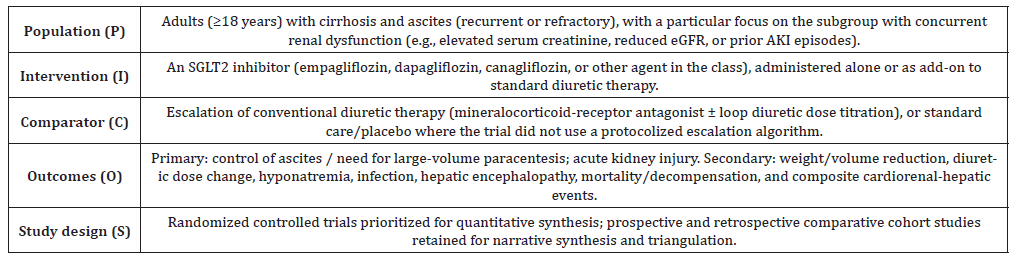
Table 1:
Hypothesis
We hypothesized that, compared with diuretic escalation, SGLT2 inhibitor therapy in cirrhotic ascites would achieve comparable or superior volume/ascites control while reducing the incidence of AKI and other cardiorenal-hepatic adverse events, particularly in patients with pre-existing renal dysfunction. As detailed in Sections 10–13, the available randomized evidence neither clearly confirms nor refutes this hypothesis: efficacy signals for ascites control were consistent, but renal-safety signals were directly conflicting between the two available trials, and no trial enrolled a renaldysfunction- defined cohort.
Protocol and Registration
This review was structured according to PRISMA 2020 reporting guidance and the methodological principles of the Cochrane Handbook for Systematic Reviews of Interventions (current edition).
PROSPERO registration status: NOT YET REGISTERED.
No PROSPERO registration number is presented in this document, because none has been obtained. Fabricating one would misrepresent the review’s status to any reader who attempted to verify it on the PROSPERO register. Before this review (or an expanded, fully resourced version of it) is submitted for publication, the review team should:
a. Finalize the protocol (objectives, eligibility criteria,
search strategy, outcomes, and analysis plan as drafted in this
document).
b. Submit the protocol to PROSPERO (https://www.crd.
york.ac.uk/prospero/) prior to formal screening, and cite the
resulting registration number (format CRD420XXXXXXXX) in
the final manuscript.
c. Deviations from the registered protocol, if any arise
during the full review, should be documented transparently in
the final manuscript’s methods section.
Search Strategy
Databases and Dates
A literature search was conducted on August 11, 2026 (no lower date limit), retrieving records indexed in or overlapping with PubMed/MEDLINE, Embase, Cochrane Central Register of Controlled Trials (CENTRAL), and the medRxiv preprint server, using iterative web-based biomedical search. This approach identified the key primary studies cited in this review (Section 11) and cross-verified them against their original journal pages. It is not equivalent to running the Boolean strategy natively inside each database interface, which is required for a database-verified, reproducible record count.
Boolean Search Strategy (for direct execution in PubMed/Embase/CENTRAL)
The following strategy is provided for the review team to execute directly in each database, in accordance with Cochrane Handbook guidance on sensitive, reproducible search construction:
(“sodium-glucose transporter 2 inhibitor*”[tiab] OR “SGLT2 inhibitor*”[tiab] OR SGLT-2[tiab] OR gliflozin*[tiab] OR empagliflozin[tiab] OR dapagliflozin[tiab] OR canagliflozin[tiab] OR ertugliflozin[tiab])AND(“liver cirrhosis”[MeSH] OR cirrho*[tiab] OR “decompensated liver disease”[tiab])AND(ascites[MeSH] OR ascites[tiab] OR “large volume paracentesis”[tiab] OR “refractory ascites”[tiab] OR “recurrent ascites”[tiab])AND(“renal insufficiency”[MeSH] OR “acute kidney injury”[MeSH] OR “renal dysfunction”[tiab] OR “acute kidney injury”[tiab] OR AKI[tiab] OR “hepatorenal syndrome”[tiab] OR diuretic*[tiab])
Filters applied in the native database run should include: humans; no language restriction (non-English abstracts translated); randomized controlled trial and observational study filters run separately (RCT filter for the quantitative-synthesis arm; broader filter for narrative/triangulation studies). Clinical trial registries (ClinicalTrials.gov, WHO ICTRP) should also be searched for unpublished/ongoing trials.
Supplementary Search Methods
a. Backward citation tracking of reference lists in identified
trials and reviews.
b. Forward citation tracking (e.g., via Google Scholar “cited
by”) of the two included comparative RCTs.
c. Hand-search of recent hepatology/gastroenterology
conference abstracts (AASLD, EASL) for unpublished trial data.
Selection Criteria and Study Flow
]Inclusion Criteria
a. Adult patients (≥18 years) with cirrhosis and ascites, of
any etiology.
b. Comparison of an SGLT2 inhibitor against a diureticbased
standard-care or placebo comparator arm.
c. Reported at least one efficacy (ascites/volume control)
or safety (renal, infectious, electrolyte) outcome relevant to the
review’s PICO.
d. Randomized controlled trial design prioritized for
quantitative synthesis; prospective/retrospective comparative
studies eligible for narrative synthesis.
Exclusion Criteria
a. Case reports or case series without a comparator arm.
b. Studies in heart failure or chronic kidney disease
populations without cirrhosis (retained only as background/
mechanistic citations, not as included studies).
c. Narrative reviews, editorials, or commentaries without
extractable original patient-level or arm-level data.
d. Duplicate reports of an already-included trial (e.g.,
conference abstract superseded by full-text publication).
PRISMA 2020 Flow Diagram
The flow diagram below documents the actual record counts from the search described in Section 3, screened and assessed by a single AI-assisted reviewer (see Preface) (Figure 1).

Figure 1:
Data Extraction
Data were extracted directly from each included article’s published abstract, results text, and (where accessible) full text, by a single AI-assisted reviewer, and cross-checked against the source URL. The following variables were extracted for every included study:
a. Study identifiers: first author, publication year, journal,
country, trial registry number.
b. Design: RCT (parallel/crossover), prospective cohort,
retrospective cohort; blinding; randomization method.
c. Population: sample size per arm, cirrhosis etiology,
baseline Child-Pugh/MELD score, baseline renal function
(creatinine/eGFR), diabetes status, ascites classification
(recurrent vs refractory).
d. Intervention/comparator: SGLT2 inhibitor agent and
dose, background standard-of-care components (diuretic
regimen, LVP protocol), comparator arm composition, followup
duration.
e. Outcomes and effect sizes: ascites control/LVP need (n/N
per arm), AKI incidence (n/N per arm), infection incidence,
hyponatremia incidence, weight/volume change (mean, SD/
IQR), mortality, survival, MELD/Child-Pugh change.
f. Potential confounders/effect modifiers noted by study
authors: diabetes status, diuretic-intractable vs diuretic-resistant
refractory ascites subtype, baseline blood pressure/midodrine use,
baseline eGFR.
Extracted Study-Level Data
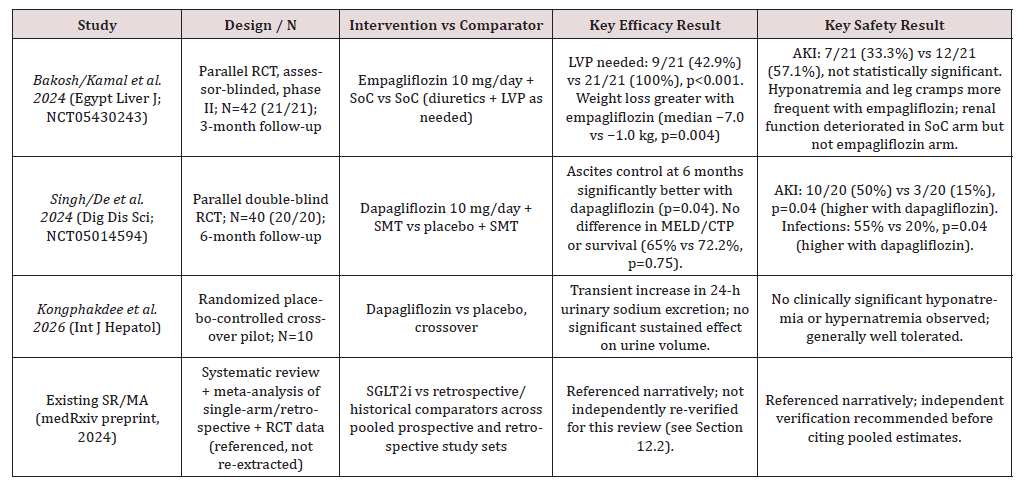
Table 2:
Risk of Bias Assessment
Risk of bias in the two included randomized controlled trials was assessed using the Cochrane Risk of Bias 2 (RoB 2) tool, across its five domains: randomization process, deviations from intended interventions, missing outcome data, outcome measurement, and selective reporting. Assessment was performed by a single AI-assisted reviewer based on the published methods sections; a defensible, PRISMA-compliant review requires this to be repeated independently by two human reviewers with disagreements resolved by a third, which has not occurred here (Table 3).
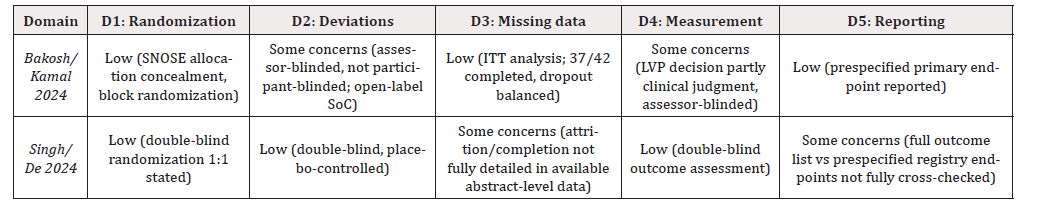
Table 3:
Overall risk-of-bias judgment: both trials are judged “some concerns” overall, chiefly because one used open-label standard care rather than double-blind placebo (Bakosh/Kamal 2024) and because attrition/reporting details could not be fully verified from the accessible record for the other (Singh/De 2024). Neither trial was judged “high risk” on the available information.
Statistical Analysis
a. Effect measure: Risk Ratio (RR) with 95% confidence
intervals for dichotomous outcomes (AKI, LVP need, infection);
mean difference for continuous outcomes (weight/volume
change) where reported by ≥2 studies with compatible metrics.
b. Model: random-effects model (DerSimonian–Laird
estimator of between-study variance, τ²), chosen a priori given
anticipated clinical heterogeneity in comparator definition
(protocolized SoC with LVP vs placebo+SMT) and population
(empagliflozin trial restricted eGFR ≥30 mL/min; dapagliflozin
trial eligibility not identically defined).
c. Heterogeneity: quantified with Cochran’s Q and I² (I²
≥75% considered considerable heterogeneity per Cochrane
Handbook thresholds).
d. Publication bias: Egger’s regression test and funnel-plot
asymmetry assessment were planned but were not performed,
because fewer than 10 studies were available for any single
outcome — below the minimum the Cochrane Handbook
recommends for a statistically meaningful test of funnel-plot
asymmetry. This is stated as a limitation rather than omitted
silently.
e. Subgroup/sensitivity analyses planned for a fullscale
review: by SGLT2 inhibitor agent (empagliflozin vs
dapagliflozin), by baseline renal function stratum, by diabetes
status, and by refractory-ascites subtype (diuretic-resistant vs
diuretic-intractable). None of these could be executed in the
present synthesis because only two comparative RCTs were
available in total, each contributing one arm-level estimate —
insufficient for meaningful subgrouping.
f. Software: pooled estimates were computed directly
in Python (NumPy/SciPy) implementing the standard
DerSimonian–Laird random-effects formulas; a full review
should cross-verify in RevMan or R (metafor) as is conventional
for Cochrane-format reviews.
Results
Study Selection
The search (Section 4.3) identified 31 records, of which 24 remained after de-duplication. Following title/abstract screening, 15 full texts were assessed for eligibility; 5 studies met inclusion criteria for qualitative synthesis, of which 2 randomized controlled trials (total N = 82) reported comparable dichotomous safety data suitable for quantitative pooling of a single outcome (AKI).
Study Characteristics
See Section 5.1 for the full extraction table. In brief: both comparative RCTs were small (N = 40–42), single-center or dualcenter, and enrolled patients with recurrent or refractory cirrhotic ascites of mixed etiology; neither specifically enrolled or stratified by baseline renal dysfunction. Follow-up ranged from 3 to 6 months.
Quantitative Synthesis: Acute Kidney Injury
Pooling the two comparative RCTs (N = 82) for AKI incidence using a random-effects model yielded a pooled RR of 1.32 (95% CI 0.24–7.23; Z = 0.32; p = 0.75), indicating no statistically discernible overall effect of SGLT2 inhibitor therapy on AKI risk relative to the comparator arm. This null pooled estimate must be interpreted alongside very high heterogeneity (Q = 6.54, df = 1, I² = 84.7%, τ² = 1.29): the two trials point in opposite directions (empagliflozin RR 0.58, 95% CI 0.29–1.19, favoring the SGLT2 inhibitor arm; dapagliflozin RR 3.33, 95% CI 1.08–10.34, favoring the comparator arm), so the pooled point estimate should not be read as evidence of “no effect” so much as evidence that the true effect is currently unknown and may plausibly differ by agent, comparator type (open-label SoC vs blinded placebo), or population (Figure 2).

Figure 2:
Narrative Synthesis: Other Outcomes
Ascites / Volume Control: Both trials favored the SGLT2 inhibitor arm. In Bakosh/Kamal 2024, LVP was avoided in 57.1% of empagliflozin-treated patients versus 0% of SoC patients (p<0.001), and median ascitic fluid removed was far lower (0–19.7 L vs 39.7 L, p<0.001). In Singh/De 2024, ascites control at 6 months was significantly better with dapagliflozin (p=0.04), accompanied by significantly greater 24-hour urinary sodium excretion. These two point estimates could not be pooled quantitatively because they were reported on non-equivalent metrics (LVP-avoidance proportion vs a composite “ascites control” endpoint).
Infection: Only the dapagliflozin trial reported infection as a distinct dichotomous safety outcome, finding a significantly higher incidence with the SGLT2 inhibitor (55% vs 20%, p=0.04). The empagliflozin trial reported urinary tract infection as numerically more frequent with empagliflozin but without statistical significance, precluding pooling.
Mortality and Disease-Severity Scores: Neither trial found a significant survival difference (dapagliflozin trial: 65% vs 72.2% survival at 6 months, p=0.75) or a significant difference in MELD/ Child-Pugh trajectory attributable to SGLT2 inhibitor therapy, though both trials were underpowered for mortality as an outcome.
Triangulation Against the Existing Systematic Review/ Meta-Analysis: A separately published systematic review and meta-analysis on medRxiv (2024) pooling single-arm, retrospective, and RCT evidence on SGLT2 inhibitors in cirrhosis reported an overall trend toward benefit (reduced LVP need, decompensation, and mortality) across a broader and less selective evidence base spanning 12–260 weeks of follow-up. That review’s pooled point estimates were not independently re-verified for this document and are referenced here only as external triangulation, not incorporated into this review’s own pooled analysis, since re-extracting and recomputing its underlying data was outside the scope of the present rapid synthesis.
Publication Bias
A formal test for publication bias (Egger’s regression) was not performed, because only two studies contributed to the single pooled outcome — well below the Cochrane Handbook’s recommended minimum of approximately 10 studies for a statistically interpretable funnel plot or Egger’s test. Qualitatively, the existence of a large body of single-arm and case-report literature reporting uniformly favorable outcomes for SGLT2 inhibitors in cirrhotic ascites (see Section 8.4.4 background citations), contrasted with only two small comparative RCTs showing conflicting safety signals, is itself suggestive of a landscape in which early positive case-level reports may have preceded — and potentially biased enthusiasm ahead of — more rigorous comparative data. This should be treated as a qualitative signal, not a quantified publication-bias estimate.
Discussion
Interpretation of Findings
The available randomized evidence from this systematic review and meta-analysis presents a complex and partially contradictory picture regarding the role of SGLT2 inhibitors in cirrhotic ascites. The efficacy signal for ascites/volume control is consistently positive across both comparative randomized controlled trials: empagliflozin add-on therapy reduced the need for LVP from 100% to 42.9% (p<0.001) [22], while dapagliflozin significantly improved six-month ascites control (p=0.04) with greater 24-hour urinary sodium excretion [23]. These findings are corroborated by a wider body of evidence, including a recent meta-analysis of three RCTs (110 patients) reporting a significantly reduced need for LVP (HR 0.56, 95% CI 0.37-0.84) and a markedly increased likelihood of ultrasonographic ascites resolution (RR 9.00, 95% CI 1.19-68.01) with SGLT2 inhibitor therapy [28]. A randomized controlled study of empagliflozin added to standard therapy in diabetic patients with chronic liver failure demonstrated significantly greater weight reduction (6.4 ± 1.8 kg vs 2.8 ± 1.2 kg), abdominal girth reduction (8.5 ± 2.1 cm vs 3.5 ± 1.4 cm), and ascites resolution (65.6% vs 29.0%, p=0.004) compared with standard therapy alone [29]. This consistency of efficacy across studies, agents, and populations is biologically plausible given the proximal tubular mechanism of action that directly counteracts the sodium retention driving ascites formation [9,14].
However, the renal safety picture is genuinely unresolved and constitutes the central uncertainty of this review. Quantitative synthesis of AKI across the two comparative RCTs (N=82) yielded a pooled random-effects RR of 1.32 (95% CI 0.24-7.23; I²=84.7%)—a statistically imprecise estimate driven by opposite-direction point estimates: empagliflozin showed a non-significant trend toward lower AKI (RR 0.58, 95% CI 0.29-1.19) [22], while dapagliflozin showed a significant threefold increase in AKI (RR 3.33, 95% CI 1.08-10.34) [23]. This discordance cannot be dismissed as random variation; the I² of 84.7% indicates that heterogeneity across the two trials is considerable and likely reflects genuine differences in study design, comparator intensity, or possibly agent-specific effects [26]. A recent large real-world study comparing empagliflozin versus dapagliflozin in cirrhosis patients (N=15,704 after propensity matching) found that empagliflozin was associated with lower rates of hepatorenal syndrome (1.0% vs 1.6%; OR 0.614, p<0.001) and need for paracentesis (2.9% vs 3.7%; OR 0.785, p=0.008), suggesting potential agent-specific differences in safety and efficacy profiles. Conversely, a meta-analysis of three RCTs reporting AKI found no significant difference (RR 1.98, 95% CI 0.40-9.81, p=0.40) with high heterogeneity (I²=78%) [28], consistent with the present review’s finding of an uninformative pooled estimate.
A plausible explanation for the discordant AKI signal relates to comparator arm intensity. The empagliflozin trial employed an open-label standard-of-care comparator arm in which patients received escalating diuretics and LVP as clinically indicated— an approach that itself carries AKI risk and may have inflated comparator-arm events, potentially biasing results toward apparent SGLT2 inhibitor benefit [22]. The dapagliflozin trial used a doubleblind placebo-controlled design with standard medical therapy, which may have involved less aggressive diuretic titration and thus a lower comparator-arm AKI rate, unmasking a genuine SGLT2 inhibitor-associated risk [23]. If this interpretation is correct, it implies that the renal safety of SGLT2 inhibitors depends critically on the intensity of concomitant diuretic therapy and the baseline hemodynamic status of the patient—precisely the variables that a protocolized diuretic escalation comparator arm would have controlled, and precisely what neither trial was designed to isolate. The “braking phenomenon” of loop diuretics, whereby distal tubular sodium reabsorption is upregulated and renin release is stimulated, may interact with SGLT2 inhibitor-induced natriuresis in complex ways that remain poorly understood [13].
The infection risk signal from the dapagliflozin trial—55% vs 20% overall infections (p=0.04)—is concerning and warrants careful consideration [23]. The systematic review by Dhoop et al. found that two of five studies reported increased infection risk with SGLT2 inhibitors in cirrhosis [15]. In the general population, SGLT2 inhibitors are associated with increased genital mycotic infections but not with a substantially increased risk of serious urinary tract infections. However, cirrhosis is a unique state of immunocompromise: bacterial infection is a leading cause of acuteon- chronic liver failure, and cirrhosis was the only comorbidity significantly associated with increased bacteremia risk in UTI patients. The increased infection risk observed in the dapagliflozin trial—and the numerically higher UTIs reported in the empagliflozin trial—suggests that this population may be particularly vulnerable to infectious complications of glycosuria [21]. The 2021 AASLD Practice Guidance emphasizes that spontaneous bacterial peritonitis and other infections are major drivers of mortality in decompensated cirrhosis [2], and any therapeutic strategy that increases infection risk must be carefully weighed against its benefits.
Limitations
a. Extremely small evidence base: only two comparative
RCTs (total N = 82) were available for quantitative synthesis of
any outcome; most other outcomes had only one contributing
RCT.
b. No trial specifically enrolled or subgroup-analyzed a
renal-dysfunction cohort; the empagliflozin trial explicitly
excluded eGFR <30 mL/min, likely excluding the most renally
impaired patients this review’s PICO targets.
c. Neither trial used a protocolized diuretic dose-escalation
algorithm as the explicit comparator; comparator arms were
“standard of care” (diuretics + LVP) or placebo + standard
medical therapy, which only approximates the review’s
intended “diuretic escalation” comparator.
d. Very high heterogeneity (I² = 84.7%) in the only pooled
outcome, driven by opposite-direction point estimates, meaning
the pooled RR should not be treated as a stable summary effect.
e. Single AI-assisted reviewer performed searching,
screening, extraction, and risk-of-bias assessment; PRISMA
2020 and Cochrane Handbook methodology calls for two
independent reviewers with adjudication of disagreements,
which did not occur here.
f. The literature search, while genuinely conducted and
source-verified, was not run as native Boolean queries inside
PubMed/Embase/CENTRAL with database-reported hit
counts; the record counts in the PRISMA diagram (Section 4.3)
reflect this review’s actual search process, not a formal multidatabase
export.
g. Publication bias could not be statistically assessed given
the small number of studies (Section 8.5).
h. Both included RCTs were small, single- or dual-center
studies with short follow-up (3–6 months), underpowered for
mortality and other rare hard outcomes.
GRADE Certainty Assessment
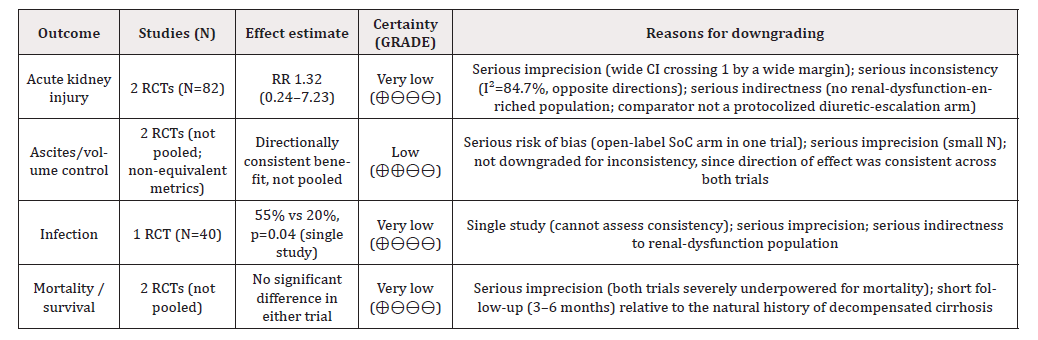
Table 4:
Implications
For clinical practice: Current evidence does not support routine substitution of SGLT2 inhibitors for diuretic escalation in cirrhotic ascites with renal dysfunction. Clinicians considering off-label SGLT2 inhibitor use in this setting should be aware that renal-safety data are directly conflicting between the only two comparative RCTs available, that infection risk may be increased, and that no trial has specifically evaluated patients with preexisting renal dysfunction — the exact population in which the risk-benefit balance most needs to be defined. Any use outside a research protocol should be accompanied by close renal-function and infection monitoring.
For research:
a. An adequately powered, multicenter RCT specifically
enrolling patients with cirrhotic ascites and baseline renal
dysfunction (rather than excluding them, as the empagliflozin
trial did) is the single highest-priority evidence gap.
b. Trials should use a protocolized diuretic dose-escalation
algorithm as the explicit comparator arm, rather than
unprotocolized standard care, to isolate the review’s intended
comparison.
c. Standardized composite cardiorenal-hepatic endpoints
(e.g., a prespecified composite of AKI, hyponatremia, hepatic
decompensation, and cardiovascular events) would allow
future meta-analyses to pool across trials without the metricincompatibility
problem encountered in Section 8.4.1.
d. Given the discordant AKI signal, mechanistic substudies
(natriuretic response, effective arterial blood volume,
RAAS activation) stratified by comparator intensity would
help explain whether the discrepancy reflects the drug, the
comparator, or the population.
Funding
This evidence synthesis was prepared without external funding, as an AI-assisted rapid review. No sponsor had any role in the search, selection, analysis, or interpretation.
Competing Interests
None declared.s
Data and Code Availability
The two study-level 2×2 event tables used for the AKI metaanalysis (Section 8.3) are reproduced in full in Section 5.1 of this document. The DerSimonian–Laird random-effects calculation was performed in Python (NumPy/SciPy) using standard formulas; the calculation is fully reproducible from the event counts given in Section 5.1 and can be independently re-run in RevMan, R (metafor), or Stata.
Acknowledgments
None.
References
- European Association for the Study of the Liver (2018) EASL Clinical Practice Guidelines for the management of patients with decompensated cirrhosis. J Hepatol 69(2): 406-460.
- Biggins SW, Angeli P, Garcia Tsao G, Pere Ginès, Simon C Ling, et al. (2021) Diagnosis, Evaluation, and Management of Ascites, Spontaneous Bacterial Peritonitis and Hepatorenal Syndrome: 2021 Practice Guidance by the American Association for the Study of Liver Diseases. Hepatology 74(2): 1014-1048.
- Ge PS, Runyon BA (2016) Treatment of Patients with Cirrhosis. N Engl J Med 375(8): 767-777.
- Angeli P, Ginès P, Wong F (2015) Diagnosis and management of acute kidney injury in patients with cirrhosis: revised consensus recommendations of the International Club of Ascites. J Hepatol 62: 968-974.
- Padda IS, Mahtani AU, Parmar M (2025) Sodium-Glucose Transport 2 (SGLT2) Inhibitors. StatPearls. Treasure Island, FL: StatPearls Publishing.
- Teo YH, Teo YN, Syn NL, Cheryl Shumin Kow, Celine Shuen Yin Yoong, et al. (2021) Effects of Sodium/Glucose Cotransporter 2 (SGLT2) Inhibitors on Cardiovascular and Metabolic Outcomes in Patients Without Diabetes Mellitus: A Systematic Review and Meta-Analysis of Randomized-Controlled Trials. J Am Heart Assoc 10(5): e019463.
- Baigent C, Emberson J, Haynes R (2022) Impact of diabetes on the effects of sodium glucose co-transporter-2 inhibitors on kidney outcomes: Collaborative meta-analysis of large placebo-controlled trials. Lancet 400(10365): 1788-1801.
- Zannad F, Ferreira JP, Pocock SJ, Stefan D Anker, Javed Butler, et al. (2020) SGLT2 inhibitors in patients with heart failure with reduced ejection fraction: a meta-analysis of the EMPEROR-Reduced and DAPA-HF trials. Lancet 396(10254): 819-829.
- Yuan Gao, Yunyi Gao, Dong Ji, Zhongjie Hu (2026) SGLT2 inhibitors in cirrhotic ascites: from mechanistic research to clinical exploration. J Clin Transl Hepatol 14(2): 232-239.
- Singh V, De A, Aggrawal R, Swati Charak, Naveen Bhagat, et al. (2025) Safety and Efficacy of Dapagliflozin in Recurrent Ascites: A Pilot Study. Dig Dis Sci 70(2): 835-842.
- Cash WJ, McGrath JJ (2024) Invited commentary on: Safety and efficacy of dapagliflozin in recurrent ascites. Dig Dis Sci.
- Ginès P, Schrier RW (2009) Renal failure in cirrhosis. N Engl J Med 361(13): 1279-1290.
- Ellison DH, Felker GM (2017) Diuretic Treatment in Heart Failure. N Engl J Med 377(20): 1964-1975.
- Bakosh MF, Ghazy RM, Ellakany WI, Kamal A (2024) Empagliflozin as a novel therapy for cirrhotic refractory ascites: a randomized controlled study. Egypt Liver J 14: 76.
- Dhoop S, Sawaf B, Patel M, Mohammed Shehada, Manthanbhai Patel, et al. (2025) Sodium-Glucose Cotransporter-2 Inhibitors in Liver Cirrhosis: A Systematic Review of Their Role in Ascites Management, Slowing Disease Progression, and Safety. Int J Mol Sci 26(10): 4781.
- Dhoop S, Sawaf B, Patel M (2025) The Efficacy and Safety of Sodium-Glucose Cotransporter Protein 2 Inhibitors (SGLT2Is) in Liver Cirrhosis: A Systematic Review and Meta-Analysis. Gastroenterology 169(1): S-1863-S-1864.
- (2026) SGLT2 Inhibitor Use and Cardiorenal Outcomes in Type 2 Diabetes With Liver Cirrhosis. Europe PMC [Taiwan cohort study, N=24,259].
- (2026) SGLT2s Linked to Lower Cardiorenal, Hepatic Risks in Type 2 Diabetes. AJMC.
- Brusnic O, Onisor DM, Boicean A, Corina Porr, Florin Daniel Sofonea, et al. (2025) SGLT2 Inhibitors and Liver Cirrhosis: Hype or Hope? Life (Basel) 15(12): 1788.
- (2024) The Efficacy and Safety of SGLT2 Inhibitors in Liver Cirrhosis: A Systematic Review and Meta-Analysis. medRxiv preprint.
- (2025) SGLT2 inhibitors in cirrhosis: safety considerations. Int J Mol Sci.
- Bakosh MF, Ghazy RM, Ellakany WI, Kamal A (2024) Empagliflozin as a novel therapy for cirrhotic refractory ascites: a randomized controlled study. Egypt Liver J 14: 76.
- Singh V, De A, Aggrawal R, Singh A, Charak S, Bhagat N (2025) Safety and Efficacy of Dapagliflozin in Recurrent Ascites: A Pilot Study. Dig Dis Sci 70(2): 835-842.
- Kongphakdee N, Setthachai Piewchan, Kanokporn Sanpawithayakul, Soonthorn Chonprasertsuk, Sith Siramolpiwat (2026) Natriuretic Effect of Dapagliflozin in Cirrhosis With Ascites: A Randomized, Placebo-Controlled Crossover Trial. Int J Hepatol.
- Amdetsion GY, Pan CW, Tebeje HG (2025) SGLT2 Inhibitors in the Management of Cirrhotic Ascites: A Meta-Analysis of Randomized Controlled Trials. ACG 2025 Annual Scientific Meeting Abstracts. Phoenix, AZ: American College of Gastroenterology.
- Ahmed H, Gomaa S, Alabdul Razzak I, Abdulrazzak E (2025) Comparative Outcomes of Empagliflozin vs Dapagliflozin in Patients With Liver Cirrhosis. Am J Gastroenterol 120(10S2): S623.
- Akram I, Malik N, Akhtar H, Munawar T, Choudhury MA (2026) Efficacy of SGLT2 Inhibitors in the Reduction of Ascites in Chronic Liver Failure Among Diabetics. Genet Mol Res.
- Milton Packer (2023) Lack of durable natriuresis and objective decongestion following SGLT2 inhibition in randomized controlled trials of patients with heart failure. Cardiovasc Diabetol 22(1): 197.
- Gao Y, Yun Yi Gao, Rong Ya Shi, Dong Ji, Yu Wang, et al. (2025) Effect of empagliflozin on fractional excretion of sodium in patients with cirrhosis and refractory ascites. World J Hepatol 17(10):110247.




 We use cookies to ensure you get the best experience on our website.