
Review Article 
 Creative Commons, CC-BY
Electronic Cigarette Battery Injuries Presenting to United States Emergency Departments, 2015 to 2024: Anatomic Location and Hospital Disposition
*Corresponding author:Jasmanet S. Chahal, jasmanet.chahal@gmail.com
Received:October 06, 2026; Published:October 15, 2026
DOI: 10.34297/AJBSR.2026.32.004174
Abstract
Objective: Electronic Nicotine Delivery Systems (ENDS) can cause thermal burns and blast injuries. Prior surveillance has described where these injuries occur. This study examines whether the anatomic site of injury predicts the need for inpatient-level care.
Methods: We analyzed 2015–2024 National Electronic Injury Surveillance System (NEISS) data from emergency departments across the United States to identify visits for ENDS battery-related burn and explosion injuries. Cases were identified through a manual review using keywords related to ENDS. Admission or observation rates were compared by coded injury-location entries and anatomic regions at the patient level using Fisher’s exact tests.
Results: Between 2015 and 2024, 93 patients with 116 coded injury locations met inclusion criteria. Most patients were male (83/93, 89.2%), with a mean age of 34.0 years. Thermal burns predominated (75/93, 80.6%). The most frequently injured sites were upper leg (55/116, 47.4%), hand and fingers (23/116, 19.8%), and the lower trunk (15/116, 12.9%). The disposition for the injured patients was as follows: treated and released (61/93, 65.6%), admitted (24/93, 25.8%), held for observation (1/93, 1.1%), and transferred (7/93, 7.5%). Admission or observation rates did not differ significantly by anatomic region (upper leg 16/50, 32.0% vs 9/43, 20.9%, p = .251; lower trunk 4/11, 36.4% vs 21/82, 25.6%, p = .479; hand and finger 4/20, 20.0% vs 21/73, 28.8%, p = .573).
Abstract
Conclusions: ENDS battery-related injury locations are consistent with previous literature; the upper leg and hand remain
the most common locations for injury. Anatomic injury does not predict disposition. Surveillance body-part codes identify general
regions rather than specific sites; this limits their value as triage discriminators. These findings support continued surveillance and
push for stronger battery safety regulations for ENDS devices.
Categories: Trauma, Emergency Medicine, Epidemiology/Public Health
Keywords:Anatomic injury location, Electronic cigarette, Electronic nicotine delivery systems (ends), Emergency department disposition, Injury surveillance, Lithium-Ion battery, Thermal burn, Vaping device injury
Introduction
Since their introduction to the U.S. market in 2007, Electronic Nicotine Delivery Systems (ENDS) have rapidly gained popularity as a perceived “healthier” alternative to traditional cigarette smoking. Much of this perception is based on the premise that combustion is what produces most carcinogens in cigarette smoke whereas e-cigarettes briefly heat liquid to vaporize [1]. This position has centered attention on the inhalational risks of vaping, forcing the mechanical safety of these devices to be under-researched. The lithium-ion batteries that power these devices contain flammable electrolyte solutions that are highly flammable and could lead to an outright combustion or explosion. Failure of these batteries can occur during active use, while the device is charging, or while it is sitting dormant in pockets or purses. There have been case narratives describing ignition of the battery after contacting loose metals such as keys or coins [2]. These injuries are distinct from contact burns. A failing lithium-ion cell delivers a thermal blast that causes simultaneous caustic electrolyte injury. error and colleagues proposed a classification of this type of injury, identifying distinct mechanisms with different implications for management [3]. Due to the mechanism of injury, the initial inspection of injuries is often underestimated because the electrolyte solution causes damage beyond what is visible at the skin [3]. The lithium electrolyte solution is alkaline and contact with tissue produces a chemical burn. These injuries drive liquefactive necrosis. Reported cases have required operative debridement of necrotic subdermal tissue [4]. This makes ENDS devices a serious public health concern. Injuries from ENDS in the oral and maxillofacial region are rare but sometimes can create emergent situations. Fractures in the lower facial third can compromise the airway leading to required intubation. More commonly, ENDS injuries manifest as fractured teeth, bones, and soft tissues. ENDS injuries to the oral and maxillofacial region rarely warrant emergency status as the rich, collateral blood supply of the head and neck often prevents necrosis of tissues because of injury. Often, debridement of wounds and suturing are curative. For more advanced bone or tooth fractures, these injuries can often be managed by outpatient [5]. Past research established a clear correlation between the growth of the ENDS market and a significant rise in related Emergency Department (ED) visits [6-8]. Their findings highlighted that injuries predominantly affect young adult males, with thermal burns most commonly occurring on the upper legs, lower trunk, and hands — a pattern our own review of NEISS cases through 2024 continues to reproduce. Existing research fails to examine whether the anatomic site of injury itself carries prognostic information relevant to ED decision-making. Existing research describes injury location and disposition as descriptive variables, but there is little insight into whether the two are related. From a triage standpoint, the more clinically useful question is not simply which body regions are commonly burned, but whether burns to specific regions are disproportionately likely to require admission or observation, information that could inform a treating physician’s disposition decision before burn depth and total body surface area have been assessed. This study provides a necessary and substantively expanded update to the clinical understanding of ENDS-related trauma. In addition to characterizing demographic patterns and injury mechanisms consistent with prior work, we stratify disposition outcomes by anatomic body part to evaluate whether injury location predicts the likelihood of hospitalization or observation. The result is intended as a practical reference not only for emergency physicians managing the initial presentation, but for surgeons, admitting internal medicine teams, and regulatory bodies responsible for consumer battery safety.
Materials and Methods
The National Electronic Injury Surveillance System (NEISS) is a system used to estimate how many people in the United States (U.S.) are seen in Emergency Departments (EDs) each year for injuries associated with consumer products [9]. The data is maintained by the Consumer Product Safety Commission (CPSC). The data collected by the NEISS is a stratified probability sample of more than one hundred hospitals and pediatric hospitals in the U.S. that are selected to represent all EDs in the United States [9]. Participating hospitals must have at least six inpatient beds and a dedicated ED. Consumer product related visits from the ED are recorded on a nightly basis and submitted to NEISS [4]. The recorded data is accessible through the CPSC website and has multiple coded variables such as age, sex, ethnicity, injury type, diagnosis, affected body part, product type, brief clinical narrative, and disposition [9]. Once variables are selected, the data is downloaded as a Microsoft Excel file and able to be viewed. Data from 2015-2024 was accessed and analyzed using Google Sheets. The primary product code utilized for data extraction was NEISS product code 884 (Batteries), which captures incidents involving battery-powered consumer devices. Age groups included in the query were 10-19, 20-29, 30-39, 40-49, 50-59, 60-69, 70-79, and ≥80 years. A broad range of body part codes and injury diagnosis codes were included to maximize capture of relevant incidents; these codes are illustrated in (Table 1) and (Table 2). All available disposition categories were included in the initial data pull and illustrated in (Table 3).
Table 1:NEISS Body Part Codes.
Note*: The National Electronic Injury Surveillance System (NEISS) uses standardized codes abstracted from emergency department records to record consumer product injuries. Body part counts (n) represent injury-location entries totaling 116. Codes queried but not present in the final sample are shown as n = 0.
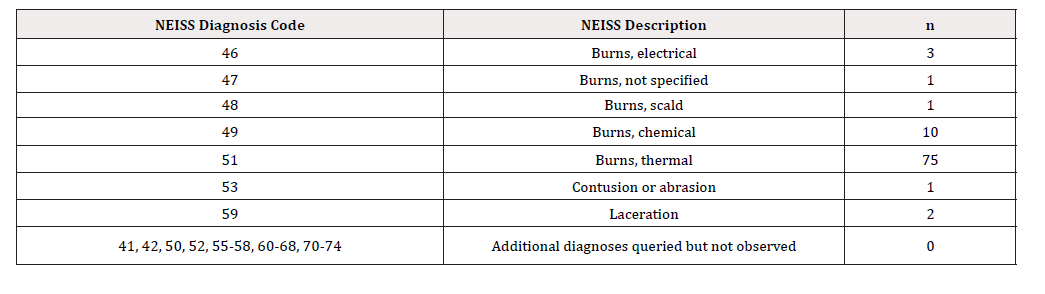
Table 2:NEISS Injury Diagnosis Codes.
Note*: Diagnosis counts representing patients totaling 93 (n). Codes queried but not present in the final sample are shown as n = 0.
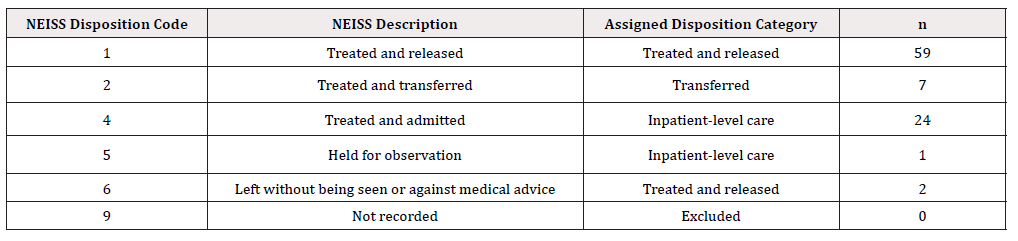
Table 3:NEISS Disposition Codes.
Note*: Disposition counts represent patients totaling 93 (n). Codes queried but not present in the final sample are shown as n = 0
This query yielded a total of 1,730 incidents across the 10-year study period. Each record was then manually reviewed by the study team using the Google Sheets “Find” function with search terms related to electronic cigarettes and vaping devices (e.g., “e-cig,” “vape,” “e-cigarette,” “ecig,” “vaping,” and “electronic cigarette”). Of the 1,730 incidents, 1,631 were excluded because the clinical narrative did not describe a direct ENDS device injury resulting from battery malfunction or explosion. An additional five incidents were excluded during manual review despite an initial battery-related mention, because the clinical narrative described the mechanism of injury to be outside the scope of the inclusion criteria. Further, one more incident was excluded because the case did not include a disposition. The final study comprised 93 incidents that met inclusion criteria, which corresponds to 116 individual coded injury locations. For demographic analysis, patients were grouped into the following age categories: <18, 18-29, 30-44, 45-60, and >60 years. Injury locations were grouped into the following categories: face and mouth (76, 77, 88, 89, 94, 85), upper trunk (30, 31, 85, 84, 85), lower trunk (79, 85), elbow and upper arm (32, 80, 85), hand and finger (82, 34, 92, 33, 85), pubic region (38, 85), upper leg (81, 85), knee and lower leg (35, 84, 36, 85), and ankle and foot (83, 93, 85, 37). Diagnoses included burns (thermal, chemical, electrical, and not otherwise specified), lacerations, fractures, contusions or abrasions, foreign body injuries, and others as coded by the treating ED clinician. Dispositions were categorized as: treated and released, treated and transferred, treated and admitted for hospitalization, and held for observation. These demographics and groupings are illustrated in Table 4. For the purposes of this analysis, patients who were admitted for hospitalization or held for observation were considered to have required inpatient-level care. As all datasets utilized fully anonymized, de-identified patient data, institutional review board approval was not required for this study (Table 4).
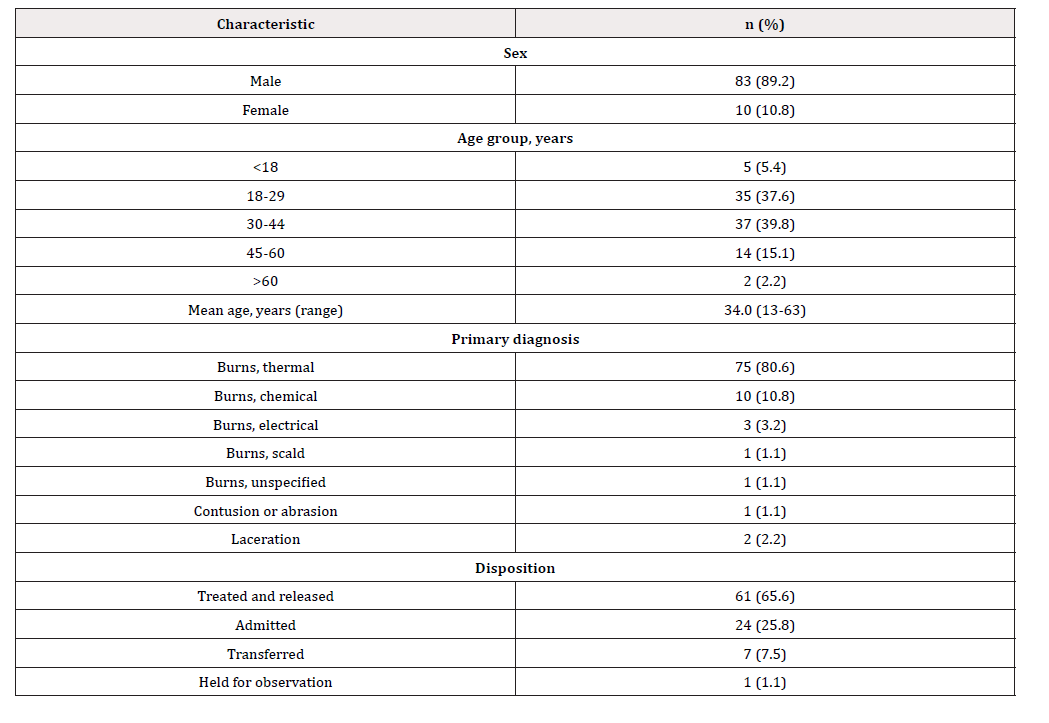
Table 4:Patient Demographics and Clinical Characteristics (N = 93).
Note*: Demographic and clinical characteristics for patients treated for electronic cigarette battery injuries from 2015 to 2024 in emergency departments across the United States. Percentages are unweighted. Diagnoses reflect the primary diagnosis established in the surveillance record from the visit.
Comparisons of disposition were performed using each patient’s primary injury site (n = 93). The threshold for comparison is anatomic groups containing at least 10 patients. The proportion of admitted or held for observation were compared amongst the remaining patients using a two-tailed Fisher’s exact test. The analyses were performed using Python. A p-value below 0.05 was considered statistically significant. Percentages in the study are unweighted.
Results
Of the 1,730 cases initially returned by the NEISS product-code query, 99 met the inclusion criteria for a direct ENDS battery malfunction or explosion injury. Six of these in total were excluded for failing to meet criteria and one of the six lacked a disposition. This left a total of 93 patients with 116 corresponding injury locations for analysis. Injury locations were calculated using recorded injury locations (n = 116), this means that patients with multiple injury sites contribute to more than one location. Analyses were performed at the patient level using each patient’s primary injury site (n = 93) to avoid duplicate observations. The patients were predominantly male (83/93, 89.2%), the mean age was 34.0 years (median 32, range 13-63). Stratifying the results by age illustrated that the sample was skewed toward younger adults: 30-44 years (37/93 patients, 39.8%), 18-29 years (35/93 patients, 37.6%), 45- 60 years (14/93 patients, 15.1%), under 18 (5/93, 5.4%), and over 60 (2/93, 2.2%). Applying NEISS statistical weights across the 93 cases estimates 3,420 ED visits nationally for ENDS battery malfunctions over the 2015-2024 period. This averages 342 visits per year. Most injuries were thermal burns (75/93, 80.6%), followed by chemical burns (10/93, 10.8%), electrical burns (3/93, 3.2%), lacerations (2/93, 2.2%), and a single case of contusion/abrasion (1/93, 1.1%). Across the 116 injury locations, the upper leg was the most frequently affected site (55/116, 47.4%), followed by hands or fingers (23/116, 19.8%), lower trunk (15/116, 12.9%), and knee/lower leg (12/116, 10.3%). The remaining anatomic groups (face and mouth, ankle and foot, elbow and upper arm, upper trunk, and pubic region) together accounted for less than 10% (11/116, 9.5%).
Figure 1: Anatomic Distribution of Injury Locations
a) Mouth and face: 1.7% (2/116)
b) Upper trunk: 1.7% (2/116)
c) Lower trunk: 12.9% (15/116)
d) Elbow and upper arm: 0.9% (1/116)
e) Hand and fingers: 19.8% (23/116)
f) Pubic region: 3.4% (4/116)
g) Upper leg: 47.4% (55/116)
h) Knee and lower leg: 10.3% (12/116)
i) Ankle and foot: 1.7% (2/116)
Note: Distribution of 116 coded body-part entries across 93 patients.
Patients with injuries or diagnoses coded for more than one
body part contribute more than one entry. Percentages are total entries
and unweighted.
Overall, of the 93 patients who suffered injuries, 61/93 (65.6%) of them were treated and released (including two who left against medical advice), 24/93 (25.8%) were admitted, 7/93 (7.5%) were transferred, and 1/93 (1.1%) were held for observation. Stratifying by anatomic region, the highest rates of admission were observed for lower trunk (5/15, 33.3%) and knee/lower leg (4/12, 33.3%). This was followed by injuries to the upper leg (17/55, 30.9%), hand/finger (6/23, 26.1%), and pubic region (1/4, 25.0%). The single elbow/upper-arm case resulted in an admission (1/1, 100%), however, given the small sample size this should be interpreted with caution. The full proportion of injury locations and hospitalization are shown in (Table 5).
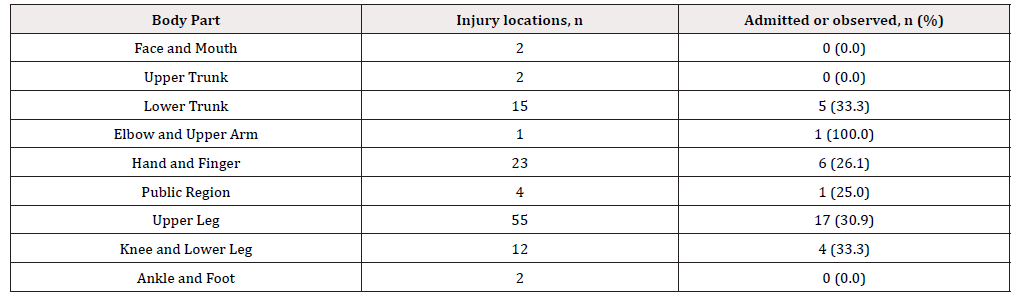
Table 5:Admission by Primary Injury Site.
Note*: Proportion of injury locations in each anatomic region for which patients were admitted for hospitalization or held for observation. Several regions rest on fewer than five entries, and those percentages are unstable and should not be read as population rates.
Stratifying disposition by anatomic region, based on each patient’s primary injury site (n = 93), admission or held for observation rates varied across body regions without statistical significance. Patients with a primary injury to the lower trunk were admitted or held for observation at a rate of 4/11 (36.4%), followed by upper leg (16/50, 32.0%), and hand/finger (4/20, 20.0%). To assess whether these differences reflected a true association between injury location and disposition rather than chance, a Fisher’s exact test was performed. Each group was compared against all patients whose injury was another site. The results of Fisher’s exact test are reported in Table 6. Given the smaller sample size of this study, these findings should be interpreted as descriptive. A larger sample would be needed to determine whether anatomic injury location carries independent prognostic value for disposition decisions (Table 6).

Table 6:Admission or Observation by Primary Injury Site.
Note*: Comparison of admission or observation rates between each of the three largest anatomic groups. Analysis is at the patient level using the patient’s primary injury site (n = 93). Odds ratios and P values are from a two-tailed Fisher’s exact test. No comparison reached statistical significance (p ≤ 0.05).
Discussion
This analysis of a decade of national emergency department surveillance describes 93 patients who were injured by ENDS battery malfunctions. Until now, studies in the past have characterized injury location without consideration of clinical outcomes. Three findings were present in this analysis: the anatomic distribution of injuries remained skewed toward the thigh and hand; roughly onein- four patients required inpatient care; and the anatomic site of injury did not predict whether patients would require inpatient care.
Anatomic Distribution and Mechanism of Injury
Nearly half of all injury locations were in the upper leg, this is consistent with the locations that were described in previous literature. Corey et al. found that most burns in their analysis were thermal and occurred in the upper leg or lower trunk [2]. Patterson et al. categorized the injury locations in which waist and groin were the largest category followed by facial and hand injuries [10]. Our data reproduces similar findings years later despite changes with the mechanics of ENDS devices like pods and disposable devices. The persistence of this pattern despite changes to device architecture suggests that operative risk is not a factor but rather a combination of an unprotected lithium-ion cell battery and pocket carriage. Hand and fingers accounted for the second largest portion of injury locations. This is mechanically distinct since thigh injuries arise from dormant devices igniting in a pocket, hand injuries typically occur during active handling of the device. Serror et al. argue that a classification organized around injury mechanism rather than topography could lead to improved medical management [3]. Our findings offer indirect support for this position.
Disposition and Anatomic Prediction
Approximately a quarter (25/93, 26.9%) of patients in this cohort were admitted or held for observation. This aligns with the most recent national surveillance done by Blakney et al. where they reported that 26.3% of patients required hospital admission and 3.9% were transferred to other facilities [8]. The hypothesis that injury location informs disposition at bedside was not supported by this study. Admission rates varied across anatomic regions and no statistical significance was found. The reason for this could be for three primary reasons. First, this study used disposition as a proxy for severity. It did not consider burn depth, total body surface area, airway involvement, and comorbidities all of which are considerations of an admission decision. A recent analysis done by Burn Care Quality Platform found that length of stay per percent of total body surface area was substantially longer for e-cigarette burns than other burns. Second, the NEISS generates national estimates from a probability sample of around a 100 hospitals across the country rather than being a census of every emergency department in the country [9]. The system is designed to represent all U.S. emergency departments. However, for an uncommon injury type like this, the details matter. The 93 cases in this study leave several body regions unexamined. A difference in admission rates could still exist. Third, the NEISS body-part codes describe a general anatomic region rather than a specific site of injury. For example, the upper leg code encompasses everything from the hip to the knee regardless of dimension and proximity to neurovascular structures. Two patients assigned the same code may have substantially different clinical outcomes.
Comparison with Alternative Surveillance Sources
Emergency department visits is one of the several partial views of injuries of this type. An analysis of poison control center data for 2010-2019 identified 69 burn cases, of which 5.8% were admitted while roughly 20% never went to a health care facility [11]. This reflects that there is a large population of individuals that never reach the ED at all. This suggests that there is a severity gradient across surveillance systems where poison control centers capture milder presentations, EDs capture intermediate ranges, and burn centers likely capture more severe injuries.
Limitations
This study and previous studies are limited by the fact that the NEISS does not maintain a product specific code for ENDS devices, so case identification depends on keyword review of free-text narratives [6-8]. As a result, cases that were found outside of our search terms were missing. Our case counts fall below reported overlapping periods by others suggesting that our search terms were more conservative. Additionally, the dataset contains no information on burn depth, total body surface area, operative management, or outcomes, so severity is observable only through disposition. Additionally, statistical comparisons were performed at the patient level and descriptive comparisons were computed based on body-part entries. No confidence intervals were computed.
Conclusions
Over a ten-year period of emergency department surveillance, ENDS battery malfunctions produced a small but clinically serious portion of injuries. These injuries maintained a consistent profile where patients were predominantly thermal burns, male, early to middle adulthood, and injured most frequently at the upper leg and hand, respectively. In this analysis, there was no relationship present between the anatomical location where a patient was burned and whether that patient was admitted. The variable, body-part code that is available in surveillance data is less informative than other clinical features such as burn depth, surface area, and involvement of underlying structures. As a result, anatomic location should not be treated as a triage discriminator in ENDS battery injuries. Until regulatory bodies create protection standards for battery-operated ENDS devices, emergency departments will continue to see these injuries and should approach them as thermal blast injuries rather than simple contact burns.
Additional Information
Author Contributions
All authors have reviewed the final version to be published and
agreed to be accountable for all aspects of the work.
a) Concept and design: Jasmanet S. Chahal, Shaufe Hassan,
Sameer Islam
b) Acquisition, analysis, or interpretation of data: Jasmanet
S. Chahal, Noor Chughtai, Carson Maris, Shaufe Hassan, Mark
Gamadia, Kody T. Park, Steven Keehn, Sameer Islam, Armand
Amadiar
c) Drafting of the manuscript: Jasmanet S. Chahal, Shaufe
Hassan, Sameer Islam
d) Critical review of the manuscript for important intellectual
content: Jasmanet S. Chahal, Noor Chughtai, Carson Maris,
Shaufe Hassan, Mark Gamadia, Kody T. Park, Steven Keehn, Sameer
Islam, Armand Amadiar
e) Supervision: Jasmanet S. Chahal, Shaufe Hassan, Steven
Keehn, Sameer Islam
Disclosures
a) Human subjects: All authors have confirmed that this
study did not involve human participants or tissue.
b) Animal subjects: All authors have confirmed that this
study did not involve animal subjects or tissue.
c) Conflicts of interest: In compliance with the ICMJE uniform
disclosure form, all authors declare the following:
d) Payment/services info: All authors have declared that no
financial support was received from any organization for the
submitted work.
e) Financial relationships: All authors have declared that
they have no financial relationships at present or within the
previous three years with any organizations that might have an
interest in the submitted work.
f) Other relationships: All authors have declared that there
are no other relationships or activities that could appear to
have influenced the submitted work.
Acknowledgments
Jasmanet Chahal, Shaufe Hassan, and Sameer Islam contributed equally to the work and should be considered co-first authors. The authors used Canva (Canva Party Ltd., Surry Hills, Australia) to produce all figures, Microsoft Word (Microsoft Corp., Redmond, WA) to produce all tables, and Claude (Anthropic PBC., San Francisco, CA) for language editing and formatting.
References
- Jackson SE, Brown J, Kimber C, East K, Brazier E, et al. (2026) Changes in harm perceptions of e-cigarettes compared with cigarettes following the announcement of the disposable vape ban in Great Britain. Nicotine Tob Res (28): 1443-1448.
- Corey CG, Chang JT, Rostron BL (2018) Electronic nicotine delivery system (ENDS) battery-related burns presenting to US emergency departments, 2016. Inj Epidemiol (5): 4.
- Serror K, Chaouat M, Legrand MM, F Depret, J Haddad, et al. (2018) Burns caused by electronic vaping devices (e-cigarettes): a new classification proposal based on mechanisms. Burns (44): 544-548.
- Brownson EG, Thompson CM, Goldsberry S (2016) Explosion injuries from e-cigarettes. N Engl J Med (375): 1400-1402.
- Tran V, Mian M, Sreedharan S, Ross Robertson , Anik Saha, et al. (2023) Oral and maxillofacial injuries associated with e-cigarette explosions: a systematic review and management guidelines proposal. J Oral Maxillofac Surg (81): 583-592.
- Michael R, Ebraheim N, Maier J, Tanios M, Kouri A, et al. (2019) Electronic cigarette burns: a case report and review of current literature. Case Rep Orthop (2019): 4231764.
- Rossheim ME, Livingston MD, Soule EK, Zeraye HA, Thombs DL, et al. (2019) Electronic cigarette explosion and burn injuries, US emergency departments 2015-2017. Tob Control (28): 472-474.
- Blakney AM, Griggs E, Farrell S, Lindsey K, Chang J, et al. (2026) Electronic nicotine delivery system (ENDS) battery-related explosions and burns presenting to United States emergency departments, 2020-2024. Prev Med (207): 108563.
- (2017) US Consumer Product Safety Commission: National Electronic Injury Surveillance System (NEISS). Accessed: February 18 2026.
- Patterson SB, Beckett AR, Lintner A, Carly Leahey, Ashley Greer, et al. (2017) A novel classification system for injuries after electronic cigarette explosions. J Burn Care Res (38): 95-100.
- Wang B, Liu ST, Rostron B, Hayslett C (2020) Burn injuries related to e-cigarettes reported to poison control centers in the United States, 2010-2019. Inj Epidemiol (7): 37.




 We use cookies to ensure you get the best experience on our website.