
Research Article 
 Creative Commons, CC-BY
Outright Rejection 1(p38) toward the First Genetic Code UUU 2(p3492), 3(ep1116), 4(p295), 5(p667), 6(p212), 7(p213), 8(p610) Discovered* by the Matthaei-Nirenberg Polyuridylic Acid Experiment 9 (p187), 10(p1598) in 1961 An effort to dismantle a biological nucleic bomb presented during the “Cold War”
*Corresponding author:Xing Yang (杨星阳), Molecular & Chemical Fastener Research Centre of Beijing Be Bolt Fastener Co. Ltd Beijing, China.
Received:September 26, 2026; Published:October 14, 2026
DOI: 10.34297/AJBSR.2026.32.004175
Abstract
The present study identifies many critical errors in the polyuridylic acid (poly-U) experiment conducted by Matthaei and Nirenberg in 1961. These are as follows:
a)
Poly-U cannot function as mRNA;
b)
Poly-U does not exhibit a triplet nature;
c)
UUU does not degenerate into UUC;
d)
The poly-U experiment cannot deduce the existence of the phe-tRNA molecular structure;
e)
The genetic function of poly-U does not conform to the mathematical model 41000;
f)
UUU does not possess an anti-codon; and
g)
UUU does not historically evolve into phenylalanine.
Thus, the “discovery of the genetic code UUU” cannot be established in chemical or genetic science. “Deciphering the first genetic code UUU” was most likely a piece of hyped science during the height of the “Cold War”.
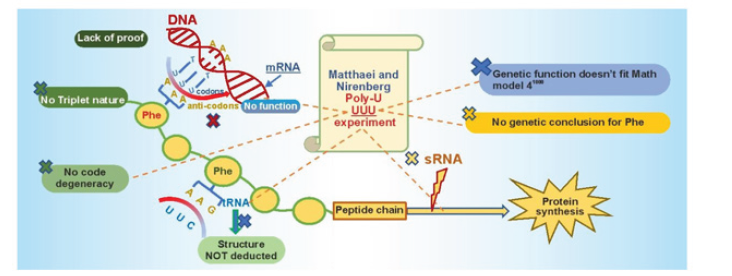
*Many sources use the term “discovery” to describe the findings of the Matthaei-Nirenberg poly-U protein-synthesis experiment. The most canonical of these sources is Crick’s 1962 Nobel Lecture, wherein he stated: “The breakthrough in the coding problem has come from the discovery, made by Nirenberg and Matthaei” 11 (Lecture). The term “discovery” is also commonly used in school test papers, for example: “The first codon discovered by Nirenberg and Matthaei was UUU”12(internet). Both the American Chemical Society (ACS) and the National Institute of Health (NIH) use “cracked”13(internet) or “deciphered”14(internet); some textbooks15 (p239) use both “discover” and “decipher.” (Table 1) Crick’s 4 × 4 × 4 Table16 (p1), 17(p368),18 (p548), 19(p462),20(p574)CSHL Quant Biol 31(1966): p1 Reprinted with permission from CSHL Quant Bio, Vol 31 © 1966 by CSHL Quant. Biol., www.cshl.edu.
Keywords:Matthaei and Nirenberg, UUU, Crick’s 4 × 4 × 4 Table.
Text Body
As shown in (Table 1), the letter triplet “UUU” is formed by setting the first, second (top row), and third (rightmost) columns to this letter. If Gamow and Crick were treated as professional cryptographers, then setting a three-letter code using such a table would be analogous to assigning a three-digit combination for a padlock, such as the one shown in (Figure 1). Statements such as “UUU encodes F” (Note: symbol F denotes phenylalanine in biochemistry) and “64 triplets encode 26 English alphabet letters (Gamow’s 25 alphabet letters in the names of 25 amino acids + 1 comma)” are merely chemical code-communication conventions. Therefore, “UUU encodes F” need not be specifically associated with the Matthaei and Nirenberg poly-U experiment, because the same communication protocol could be assumed by any specific code-communication users without conducting chemical experiments.
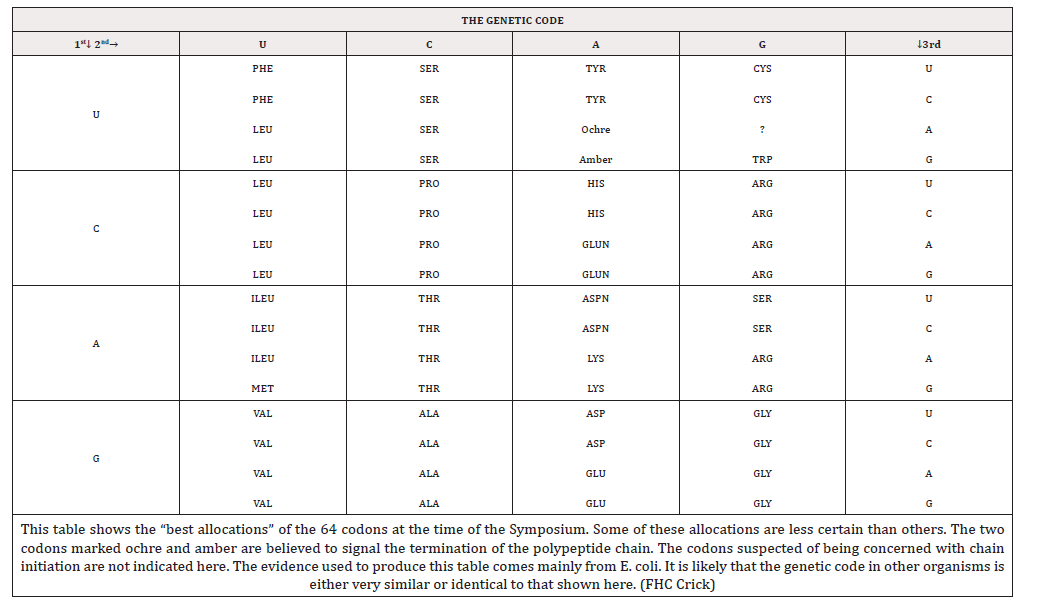
Table 1:Crick’s 4 × 4 × 4 Table16 (p1), 17(p368), 18 (p548), 19(p462), 20(p574) CSHL Quant Biol. 31(1966): p1. Reprinted with permission from CSHL Quant. Biol., Vol. 31. © 1966 by CSHL Quant. Biol., www.cshl.edu
(Source: CSHL Quant Biol. 31(1966): p1. Reprinted with permission from CSHL Quant. Biol., Vol. 31. © 1966 by CSHL Quant. Biol., HYPERLINK “http://www.cshl.edu)” www.cshl.edu)
Notes: a) “The arrangement of this table, whose significance for biology has been compared to that of the Periodic Table of Elements for Chemistry, was suggested by Crick” 18(p547–548); b) the byline “F. H. C. Crick” under the table’s caption in the screenshot was originally from the document CSHL Quant. Biol. 31 (1966) itself. C)This table was originally termed in Crick’s articles and lectures; Hereafter, it is referred to as “Crick’s 4 × 4 × 4 Table” in order to emphasize both Crick’s historical contribution to and its mathematical structure 4 × 4 × 4, although most current textbooks and papers refer to it as “the Standard Genetic Code (SGC)” , especially when distinguishing it from the derived versions of . Notes: the formula for calculating the total number of three-digit combinations is 10 × 10 × 10 = 1000, which is the same to the formula for calculating total number of genetic codons. However, if Gamow and Crick are regarded as the founders of contemporary molecular biology, as is commonly taught in modern university textbooks 21(p210)-50(p145) - - where more than 1000 bibliographic references published over the past 60 years have been omitted - - then the letter triplet “UUU” within Crick’s 4 × 4 × 4 Table refers specifically to 11(lecture), 21(p210)-50(p145), 51(newspaper), 52(newspapers), 53(p462) the Matthaei-Nirenberg poly-U experiment, namely, “stimulation of U-C14-L-phenylalanine incorporation by polyuridylic acid” 9(p187),10 (p1598) (Figure 2). Notes: the formula for calculating the total number of three-digit combinations is 10 × 10 × 10 = 1000, which is the same to the formula for calculating total number of genetic codons 4 × 4 × 4 = 64 2(p3490), 54(p416-7), 55(p1231), 56(p68), 57(p82), 58(p169), 59(p136), 60 (p529), 61 (p46), or in general form, a × b ×c 62 (p50-52),63(p1547).
Source: Nirenberg, M.W. and Matthaei, J.H. The dependence of cell-free protein synthesis in E. coli upon naturally occurring or synthetic polyribonucleotides. Proc Nat Acad Sci U.S (1961). 47(10), p1598. Notes: In scientific methodology, the chemical reaction “if Poly U↑, then poly Phen↑” could never have been used to deduce that “UUU codes for Phe”, nor to predict that the existence of 4 × 4 × 4 = 64 base triplets implies the presence of 20 amino acids species.
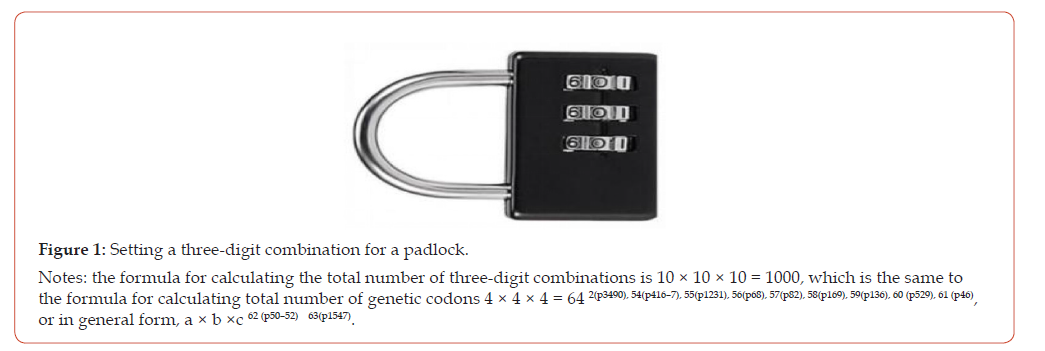
Figure 1:Setting a three-digit combination for a padlock.
Notes: the formula for calculating the total number of three-digit combinations is 10 × 10 × 10 = 1000, which is the same to
the formula for calculating total number of genetic codons 4 × 4 × 4 = 64 2(p3490), 54(p416–7), 55(p1231), 56(p68), 57(p82), 58(p169), 59(p136), 60 (p529), 61 (p46),
or in general form, a × b ×c 62 (p50–52) 63(p1547).
(Source: Nirenberg, M.W. and Matthaei, J.H. The dependence of cell-free protein synthesis in E. coli upon naturally occurring or synthetic polyribonucleotides. Proc Nat Acad Sci U.S (1961). 47(10), p1598. )
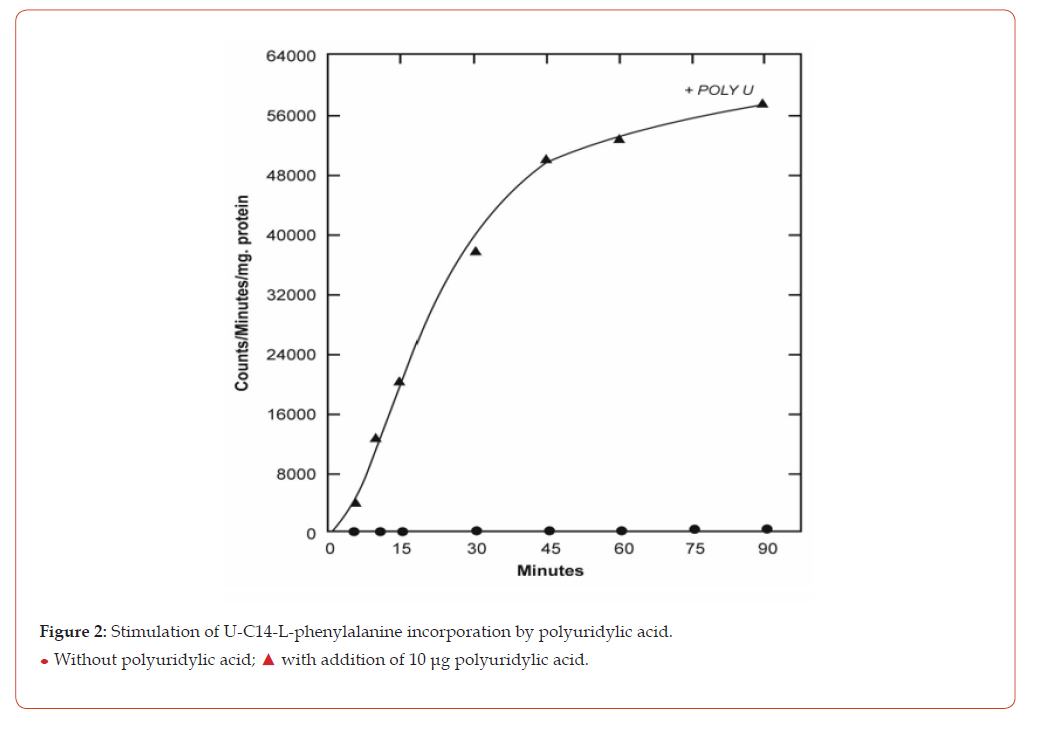
Figure 2:Stimulation of U-C14-L-phenylalanine incorporation by polyuridylic acid. ● Without polyuridylic acid; ▲ with addition of 10 μg polyuridylic acid.
Notes: In scientific methodology, the chemical reaction “if Poly U↑, then poly Phen↑” could never have been used to deduce that “UUU codes for Phe”, nor to predict that the existence of 4 × 4 × 4 = 64 base triplets implies the presence of 20 amino acids species. If there is no Crick’s frequent citation and ridiculous interpretation on this figure, then no one would have been able to conclude that “UUU codes for Phe” from this chemical reaction data conducted by Matthaei and Nirenberg.
There is a long history behind the story of UUU defined by sites 1-2-3, involving a loose genetic (sometimes not genetic) or chemical (sometimes not chemical) relationship among Gamow’s diamond code64 (p318), 65(p11) concept (and his RNA Tie Club), Crick’s adaptor66(p8) concept (and the Watson-Crick DNA model), and Nirenberg’s cell-free protein synthesis system (and NIH researchers), also there are many publications saying that UUU was famous for the 5th International Biochemistry Congress55(p1232) in Moscow in August 1961. Before the Moscow conference, the triplet codes defined by sites 1-2-3 were primarily based on Gamow’s 4 × 4 × 4 = 64 calculation (without any direct connection to UUU) and Crick’s various new explanations surrounding 4 × 4 × 4 = 64. After the Moscow conference, however, the triplet codes indicated by sites 1-2-3 were reportedly reinterpreted in terms of poly-U in the Matthaei-Nirenberg cell-free protein synthesis experiments, and UUU was immediately identified with poly-U. As a result, this UUU, marked by sites 1-2-3 on poly-U, came to be regarded as the first confirmed genetic code and was placed in the first row and first column position of Crick’s 4 × 4 × 4 Table see (Table 1). Subsequently, the Matthaei-Nirenberg poly-U experiment became the defining chemical reaction experiment in the development of modern molecular biology. Furthermore, the Watson-Crick model of DNA was awarded the Nobel Prize in 1962, one year after the great hype of UUU as the first genetic code. The reputation of Nobel Laureates led Crick et al. to put forward numerous additional theories and hypotheses concerning UUU, such as UUU’s mother code TTT, UUU’s brother code UUC, UUU’s non-overlapping reading technology, UUU’s universality, UUU’s specificity, UUU’s anticodon, UUU’s tRNA molecular structure, UUU’s evolutionary hypotheses, the 3rd U’s Wobble Theory, UUU’s unidirectional information flow, and UUU’s collinearity with peptides etc. One striking feature of the additional theories and hypotheses was the widespread use of military-like terminologies, such as “translation,” “transcription,” “mRNA tape”62(p11, p107), “translation modulation”62(p105, p106), “translation frequency”62(p9), “simultaneous cessation of transcription”62(p106), “punctuation”62(p103) etc.
Finally, following the dissemination of popular press, “UUU” was fully portrayed as a revolution in the field of biology: “far greater in its potential significance than the atomic or hydrogen bomb” 13(internet). See (Figure 3) below: Herein, I attempt to dismantle this “atomic or hydrogen bomb”, UUU, in light of the current threat of the nuclear war brought about by the Russia-Ukraine conflict and the current dilemma of the biological sciences - - namely, whether biological theory should be confined to the notion of “code or not code”. I hope that biological educators worldwide can return biological science to biology and that the young generation of this world can benefit from today’s biological education.
Herein, I present numerous findings and evidence to demonstrate that Matthaei and Nirenberg’s 1961 poly-U experiment could never have discovered the genetic code UUU. Let us be clear: we do not need “atomic or hydrogen bomb” biology! We need peaceful biology! The biological experiments of today and tomorrow should rise above the quagmire of “code or not code”!
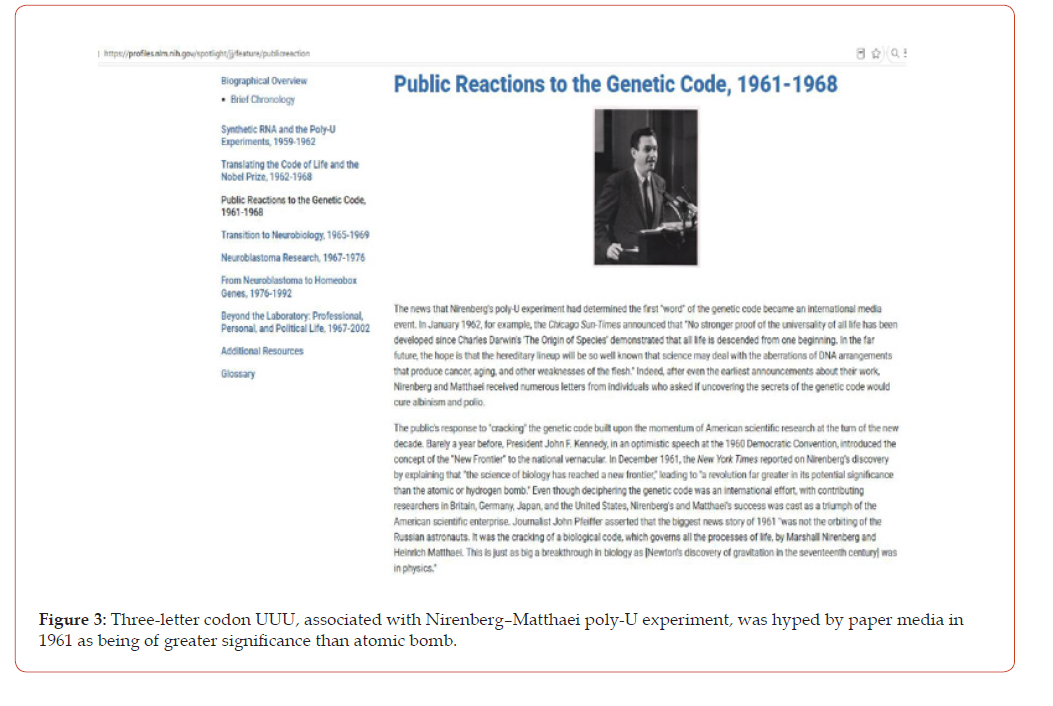
Figure 3:Three-letter codon UUU, associated with Nirenberg–Matthaei poly-U experiment, was hyped by paper media in 1961 as being of greater significance than atomic bomb.
True Story: Matthaei and Nirenberg did not Announce that they had Discovered the Triplet Nature of Poly-U
I have double-checked Matthaei and Nirenberg’s presentation at the 5th International Congress of Biochemistry in Moscow. Surprisingly, I did not find phrase “UUU” in their presentations. I also carefully examined their PNAS paper: The dependence of cellfree protein synthesis in E. coli upon naturally occurring or synthetic polyribonucleotides published on October 15.1961, strangely, the phrase UUU still does not appear in this paper. What happened? Let us return to the field of chemical science. Similar to the fact that CH3-CH2-CH3 (propane) has three carbon atoms and CH2- CH2-CH2-CH3 (butane) has four carbon atoms, “pU-pU-pU” 67(p1167) (triplet) represents three uracil residues while “pU-pU-pU-pU” (quadruplet) represents four uracil residues. No qualified chemists would intentionally use an overlapping reading method to read CH3-CH2-CH2-CH3 (butane) as two “CH3-CH2-CH3” (propane) or use a nonoverlapping reading method to read CH3-CH2-CH2-CH2-CH2- CH3 (hexane) as two “CH3-CH2-CH3”(propane); thus, no qualified biochemists will consider an Overlapping Reading Method as a biological discovery to read UUUU as two triplets UUU, nor to consider a Non-overlapping Reading Method as a biological discovery to read UUUUUU as two triplets UUU! Thus, it is not possible for Dr. Matthaei (NIH researcher) and Dr. Nirenberg (NIH researcher) to announce the silly discovery of the triplet UUU residing in poly-U (or U U U U U U ...U U U U U)!
As shown in (Figure 2), the highlight chemistry of Matthaei and Nirenberg’s poly-U experiment merely reflected a linear correlation between poly-U and poly-Phe (“if Poly U↑, then poly Phen↑” reaction); Correspondingly, it is not possible for chemists or biochemists to deduce the triplet nature of poly-U from the “if Poly U↑, then poly Phen↑” linear correlation. This explains why Matthaei and Nirenberg did not collect experimental data to demonstrate that poly-U comprised numerous triplets of UUU and answered why they did not attempt to add the following massive concepts to their poly-U molecule: nonoverlapping or overlapping reading, comma or comma-less, start codon, and stop codon (notably, all these concepts were the major research subjects in Crick’s lectures and papers before 1961). Thus, the popularized textbook knowledge that “Nirenberg and Matthaei therefore concluded that the triplet codon UUU encodes phenylalanine” 2(p3492-3) or “Nirenberg and Matthaei had thus shown that the codon UUU specifies phenylalanine” 3(ep1116) is certainly a misleading statement! The textbook writers roughly follow Watson’s 1965 textbook, misleading students into believing that the Matthaei and Nirenberg experiment deduced the triplet codon UUU, this constitutes the key problem of present-day university education regarding the first genetic code UUU!
How did the story of “the triplet nature of polyU” disseminate from 1961 through 1968? This is the story of F.H.C. Crick’s credit. On one hand, Crick announced his own discovery of the triplet nature of polyU in the Crick-Brenner phage T4 experiments 55(p1232); On the other hand, Crick wrote to Nirenberg, encouraging him to “show that the coding ratio is 3” (say, triplet nature), see (Figure 4): On November 16, 1961, Crick wrote to Nirenberg and encouraged him to “show that the coding ratio is 3.” On January 4, 1962, in another letter See (Figure 5) to Nirenberg, Crick admitted that “the English papers have made rather a fuss about our Nature paper, which was published on Saturday, but as far as I have been able, I have stressed that it is your discovery which was the real breakthrough”. Here, clearly, “I have been able I have stressed that it is your discovery” tells us that it was Crick that said “Nirenberg and Matthaei discovered the triplet nature of poly-U”.
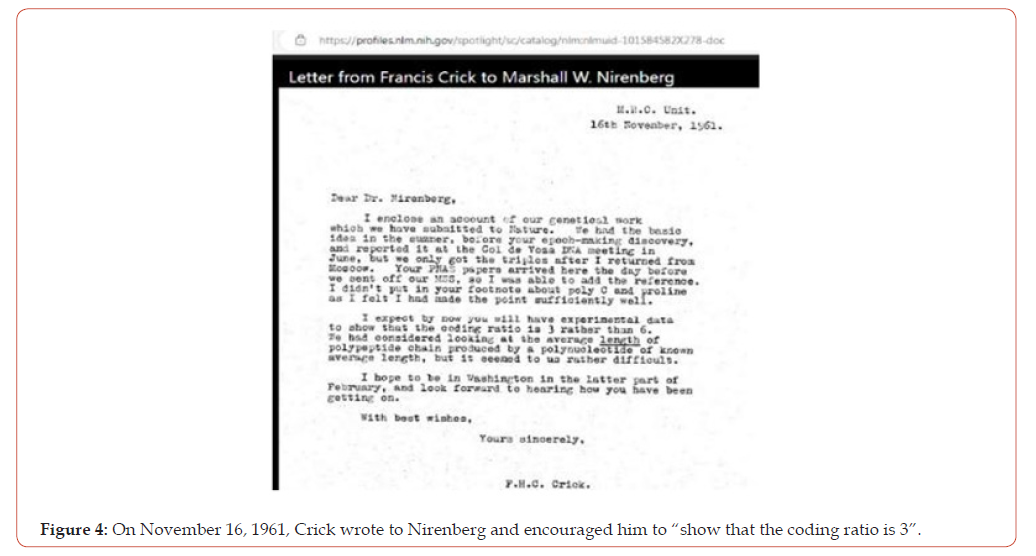
Figure 4:On November 16, 1961, Crick wrote to Nirenberg and encouraged him to “show that the coding ratio is 3”.
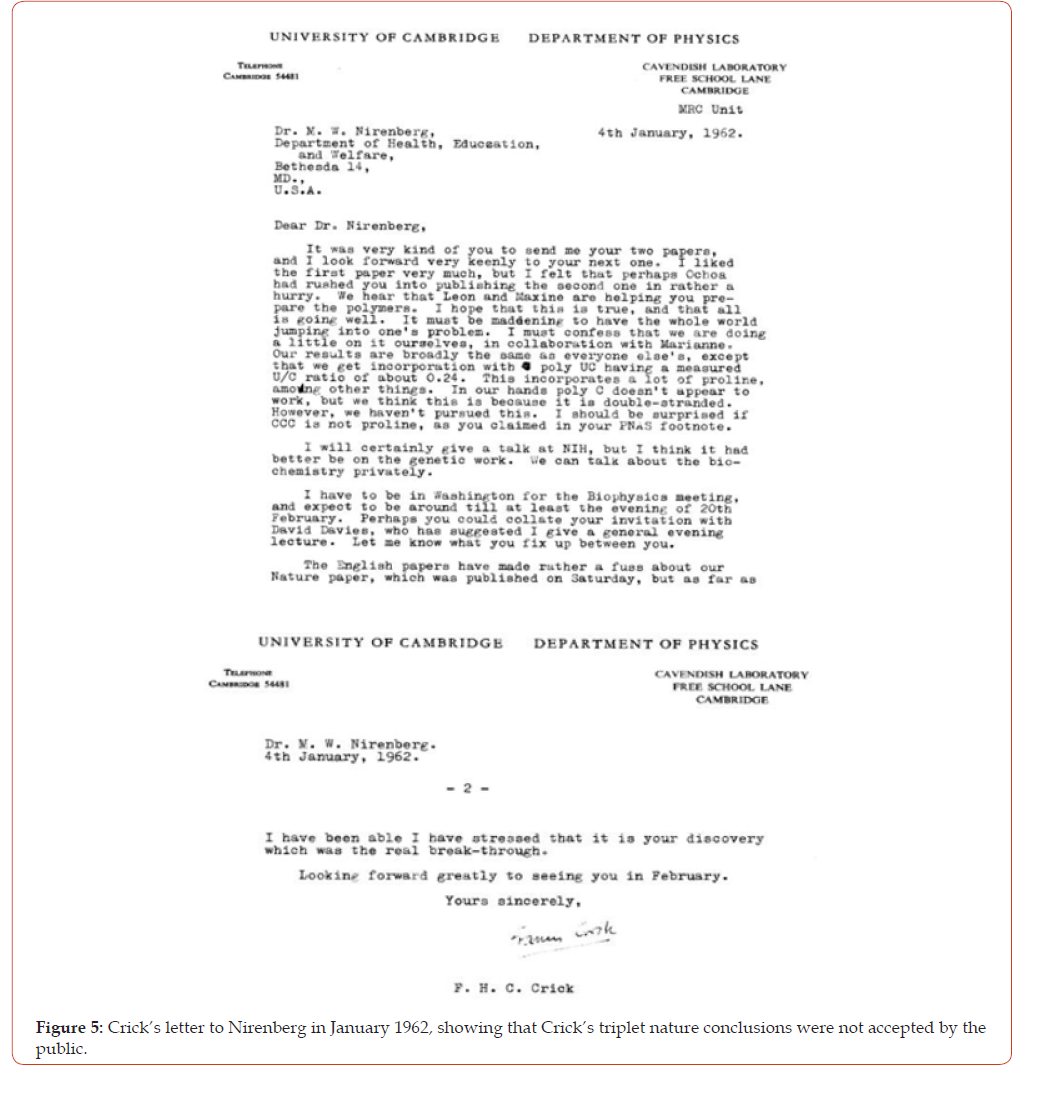
Figure 5:Crick’s letter to Nirenberg in January 1962, showing that Crick’s triplet nature conclusions were not accepted by the public.
On January 4, 1962, in another letter See (Figure 5) to Nirenberg, Crick admitted that “the English papers have made rather a fuss about our Nature paper, which was published on Saturday, but as
far as I have been able, I have stressed that it is your discovery which was the real break-through”. Here, clearly, “I have been able I have stressed that it is your discovery” tells us that it was Crick that said “Nirenberg and Matthaei discovered the triplet nature of poly-U”.
True Story: Matthaei and Nirenberg Experiment did not Mention the Term “Degeneracy” of UUU
Clearly, I and you and everyone cannot find term “degeneracy” in both Matthaei and Nirenberg’s Moscow conference presentation and their PNAS paper in 1961. Furthermore, I and you and everyone cannot reach to “UUU degenerated into UUC” by analyzing Matthaei and Nirenberg’s experimental data and methodologies. On the side of 64 triplets, “degeneracy” means reducing the number of base triplets to 20; on the side of 20 amino acids, “degeneracy” means expanding the number of amino acids from 20 to 64 68(p4-9), which means the repetitive nature of amino acids. However, Matthaei and Nirenberg’s experiments did not provide any entry point for the theme of “repetition of amino acids”.
True Story: Matthaei and Nirenberg Never Suggested or Concluded That Knowing the Base Sequence of “Soluble RNA (Srna)” Was Necessary to Carry Out “if Poly-U↑, Then Poly-Phe↑” Reaction
Matthaei-Nirenberg experimental report: “Soluble RNA has been shown to act in a catalytic fashion” 10 (p1601), 69(p1554); “Hoagland and Comly have recently shown S-RNA to act in a catalytic fashion” 9 (p186). My Outright Rejection: Matthaei and Nirenberg never assumed, proved, stated, or clarified that the sRNAs in their reaction system were countless phe-tRNA molecules with features of:
i. Uploading each phenylalanine of poly-phe from one locus
and downloading each of them to another locus where poly-phe
was accumulating;
ii. Inputting each sequential information of UUU from poly-U
and outputting the information of UUU to specific single phe to be
caught by the CCA arm of phe-tRNA;
iii. Being equipped with the universal order of tRNA
nucleotides, which is also a 90% copy of Holley’s ala-tRNA
nucleotide sequence (or vice versa: ala-tRNA nucleotide sequence
is a 90% copy of the Matthaei-Nirenberg sRNA); and
iv. Having “1/64 - transfer - 1/20” numerical structure to
accommodate other 63 triplets and 19 amino acids. Furthermore,
Matthaei- Nirenberg never determined whether the 100%
occurrence of the “if poly-U↑, then poly-phe↑” reaction required a
100% correct nucleotide sequence of phe-sRNA.
Apparently, the Matthaei-Nirenberg poly-U experiment was not designed to prove whether phenylalanine inserts into nucleotide triangle ΔUUU or ΔTTT (Gamow’s code scheme), how one phenylalanine can effectively link to the triplet UUU or TTT (Crick’s adaptor scheme), or how the nucleotide sequence order of sRNA controls the chemical compatibility between UUU and phenylalanine. Any schemes relating the 20 (aa)-RNA-64 (trinucleotide) solution to poly-U or poly-phe, sRNA, or the ribosome in the experiment procedure should first consider the protein synthesis experimental events conducted before and after the 1961 Moscow Conference. In 1954 (7 years before the Matthaei-Nirenberg poly-U experiment), Keller and Zamecnik 70(p337) reported the “incorporation of leucine into protein” 70(p339-340) depending upon the “glycolysis of hexose diphosphate” 70(p339-340), wherein they did not assume the necessity of “1/64-transfer-1/20” featured sRNA (tRNA) for incorporating leucine into proteins (nor announced that they discovered that the genetic code of leucine is hexose diphosphate); Littlefield and Keller 71(p14) confirmed Zamecnik’s cell-free system as that “which catalyzes the incorporation of C14-amino acids into protein in the presence of Adenosine Triphosphate (ATP), an ATP-generating system, and either Guanosine Triphosphate (GTP) or guanosine diphosphate (GDP)” 71(p14); Additionally, Keller and Zamecnick did not mention Keller’s and Zamecnik’s sRNA featuring “1/64 - transfer - 1/20.” In 1965 (4 years after the Matthaei-Nirenberg poly-U experiment), Robert W. Holley determined the nucleotide order of ala-tRNA and confirmed that ala-tRNA was “the first known nucleic acid” 72(p1462) and announced that “transfer RNA (’s) are the smallest biologically active nucleic acids known. Their function is to carry activated amino acids to the site of protein synthesis” 72(p1462). However, Holley did not succeed in producing poly-ala (so-called the “Protein Synthesis”) using the determined nucleotide sequential order of ala-tRNA molecules! Furthermore, he failed to clarify whether the nucleotide sequential order of ala-tRNA was identical to that of Matthaei-Nirenberg’s sRNA. Apparently, knowing or not knowing the nucleotide sequence order of sRNA does not really affect the perfect accomplishment of Matthaei-Nirenberg “if poly-U↑, then poly-phe↑” reaction.
In linguistics, phenylalanine is a word originating from a 20-letter language, whereas GAA (on behalf of UUU) is a word originating from a 4-letter language; there is no third-party entity where both phe and GAA collectively belong to. Thus, the phe (original 20-letter language)-GAA (translated 4-letter language)- tRNA (non-4-non-20-letter language) structure is clearly a paradox. In other words, there is no reason why a word originating from a 4-letter language would signify a word originating from a 20-letter language. Taking a simple example, the language meaning of the English word “star sun” (from a 26-letter language) is equivalent to the language meaning of the Chinese word “星 阳” (from a language of 214 character language with radicals 73(internet)) because both the English term “star sun” and Chinese term “星阳” signify a thirdparty entity -- me, the Author of this article. Therefore, it lacks a “common target” for both “phe & UUU” and their “tRNA”, the general structure of aa-anticodon-tRNA constitutes a ridiculous linguistics paradox: Without any “common target”, it announces that 4-letter language can be translated into 20-letter language! This is not a natural science discovery. Remarkably, some experts concur that “the function of a ribosome is to translate the genetic information encoded in the nucleotide sequence of mRNA into the amino acid sequence of a protein” 74(p158), which questions the translation function of tRNA molecules.
True Story: Matthaei and Nirenberg Never Announced the Discovery of UUU’s “Anticodon”
Matthaei-Nirenberg’s poly-U experimental paper never
mentioned the term “anticodon”, nor to hint that GAA or AAA can
serve as a substitute for UUU in their “if poly-U↑, then poly-phe↑”
reaction. On January 5, 1962, months after UUU became the biggest
news story of 1961, Nirenberg 51(newspaper) began to informally
consider AAA (not GAA) as UUU’s anticodon, see (Figure 6). (note:
this reference document
Note: In this image of Nirenberg on January 1962, we can clearly observe that on the blackboard, Nirenberg has paired “UUU” with “AAA” using virtual dots and has used the phrase “AAA-sRNA” to hint that AAA, via the sRNA structure, might be UUU’s anticodon.
In March 1963, after the Matthaei-Nirenberg poly-U experiment was cited extensively in Crick’s 1962 Nobel Lecture, Nirenberg formally inserted a large number of “XXX (anticodons of triplet UUU)” 57(p86) into their 1961 “if poly-U↑, then poly-phe↑” reaction (Figure 7).
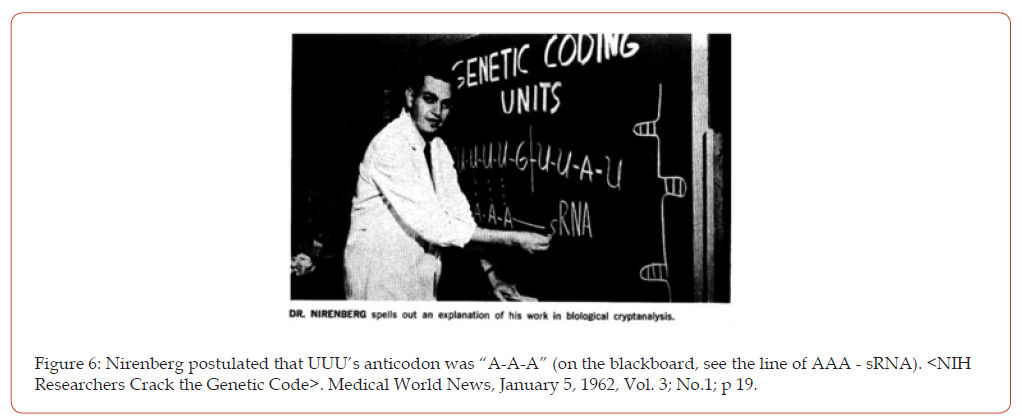
Figure 6:Nirenberg postulated that UUU’s anticodon was “A-A-A” (on the blackboard, see the line of AAA - sRNA).
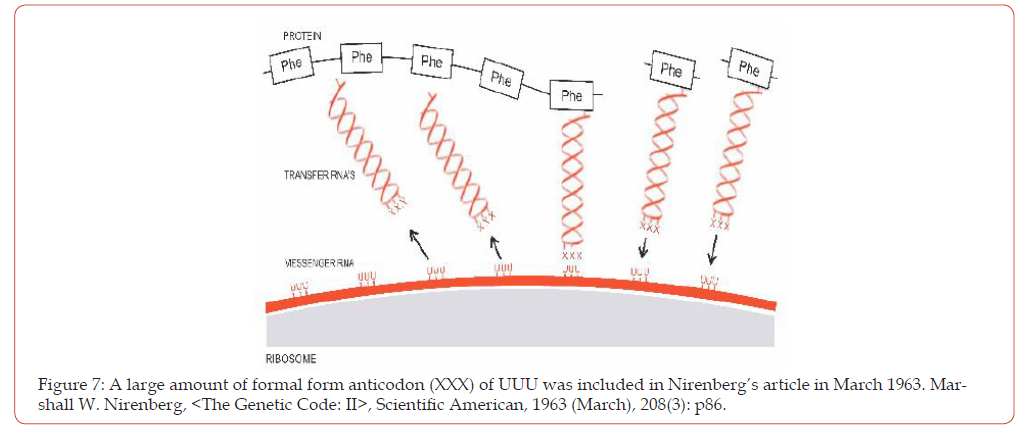
Figure 7:A large amount of formal form anticodon (XXX) of UUU was included in Nirenberg’s article in March 1963. Marshall
W. Nirenberg,
Note: In this image of Nirenberg on January 1962, we can clearly observe that on the blackboard, Nirenberg has paired “UUU” with “AAA” using virtual dots and has used the phrase “AAA-sRNA” to hint that AAA, via the sRNA structure, might be UUU’s anticodon.
In March 1963, after the Matthaei-Nirenberg poly-U experiment was cited extensively in Crick’s 1962 Nobel Lecture, Nirenberg formally 57(p86) inserted a large number of “XXX (anticodons of triplet UUU)” 57(p86) into their 1961 “if poly-U↑, then poly-phe↑” reaction (Figure 7).
a) In this 1963 article by Nirenberg, the anticodons of poly-U
were massively assumed to be XXX, this signifies that in 1963, a
large number of poly-U anticodons were added to the Matthaei-
Nirenberg “if poly-U↑, then poly-phe↑” reaction of 1961. Moreover,
if the anticodon of UUU is truly AAA, as explained by Nirenberg at
that time, then the anticodon chain of poly-U must be poly-A, and
their “if poly-U↑, then poly-phe↑” reaction should be corrected to “if
poly-U↑, then poly-A↑, then poly-Phe↑.”
b) Importantly, in this figure, Nirenberg drew a big gap
between every two triplets of UUU so that the numerous obviously
small-sized UUU can fit well with the numerous obviously hugesized
tRNA. Furthermore, the presence of gaps indicates that every
UUU on the poly-U is separated from other UUUs and clearly visible
(not invisible). Poly-U then changes to a three-gap-three-gap-three
pattern. However, “gaps” demand the chemical structure of poly-U
to be evenly separated by every three digits to ensure the triplet
nature of poly-U is obtained when testing the chemical structure
(rather than Crick-Brenner’s triplet nature genetic experiments).
c) Notably, if poly-U can be visualized with numerous gaps,
then poly-C, poly-A, poly-G, poly-T, and all other nucleotide chains
must also be visualized similarly, signifying that the single-stranded
nucleotide sequences must be chemically separated by every three
digits. (This is chemically impossible!)
My Outright Rejection
Whether or not sRNA had an anticodon region was never a necessary chemical requirement for the success of the Matthaei- Nirenberg “if poly-U↑, then poly-phe↑” chemical reaction. However, in order to use “if poly-U↑, then poly-phe↑” reaction to open a new era of “Central Dogma” theory, Matthaei-Nirenberg’s sRNA must have an anticodon region and Matthaei-Nirenberg’s UUU on poly-U must pass its information to UUU’s anticodon assumed on sRNA (then this information will flow into phenylalanine). Otherwise, the genetic information center proposed by the “Central Dogma” cannot be guaranteed (say, poly-U must receive genetic information from this genetic center and passes this external information onto protein), and the genetic information passing system of nucleic acids cannot be established! That is: the concept of “UUU’s anticodon” appearing in Matthaei-Nirenberg’s poly-U experiment is first, the theoretical requirement of the “Central Dogma” theory; and second, the technical requirement of many basic definitions relating to the “Central Dogma,” such as “mRNA” (the first theoretical molecule within the “central dogma”), “protein synthesis (the final step within the “central dogma” hypothesis), “ tRNA” (the second theoretical molecule within the “central dogma”), “ribosome” (the only wild-type organelle the “central dogma” theory relies on), “genetic translation”(the first molecule-molecule communication theory derived from the “central dogma”), and “signal RNA” (the derivative molecule-molecule communication molecules from theoretical mRNA). (Note: all of the above molecules and theories require an anticodon or secondary anticodon).
Here, we see massive contradictory explanations in comprehending the anticodon of UUU.
i. Anticodon (GAA, AAA) -codon (UUU)’s U/A U/G pairing
75(p552) has challenged the Watson-Crick DNA model; hence, U/A
U/G pairing of (UUU: GAA) signifies that “UUU: GAA” triplet-pair
can act as the information center assumed by “Central Dogma.”
Based on current knowledge, the sole chemical law of the anticodon
concept for UUU is the U/A and U/G parings discussed in “UUU:
GAA” and “UUU: AAA,” this supports the existence of U/A pairing
in biochemical theories. At the same time, the linear structure
of mRNA is composed of (U, A, G, C)-this supports that uracil
chemically connects to adenine, guanine, and cytosine as well.
Now, every chemist will see “U/A” pair and “U• T; U• A; U• G; U•
C” doublet nucleotide chains can theoretically occur in the Watson-
Crick DNA model. Once the “U/A” pair and “U• T; U• A; U• G; U•
C” chains participate in the Watson-Crick DNA model, the genetic
information carried by “UUU (codon): GAA (anticodon)” and “UUU
(codon): AAA (anticodon)” triplet pairs must belong to DNA, i.e.:
their genetic information becomes the right information center
assumed by “Central Dogma.” Thus, the biochemical social status of
“GAA” and “AAA” has naturally lifted to the DNA position from tRNA
position, the base-pairing genetic information carried by (UUU:
GAA) triplet pairs must be lifted to “information commander”
(never be an information soldier).
ii. Because the U/A U/G pairs have a perfect two-pole
property, “UUU: GAA” triplet pairing can never function as
unidirectional flow diodes. The genetic information flow from
UUU to UUU’s anticodon is not theoretically ensured. Conversely,
most likely, the genetic information from the center of the “Central
Dogma” will be bounced back to the information center via the
pairing of codon-anticodon U/A U/G.
iii. The triplet nature of UUU’s anticodon had not been
genetically tested by 2-9 June 1966 (CSH Symposium on The Genetic
Code). Therefore, I doubt-till June 1966-the genetic information
center assumed by the “Central Dogma” did not gain support from
the concept of UUU’s genetic information flow (via its anticodon).
It was believed that Crick and Brenner’s nucleotide insertion and
deletion experiments proved the triplet nature of UUU; however, the
nature of anticodon GAA (or AAA triplet) had never been assessed
by Crick and Brenner’s genetic experiments and had never been
discussed before June 1966 as UUU’s anticodon GAA or AAA had
not been identified yet. This begs the question of why the anticodon
GAA or AAA appears to be three nucleotides (rather than four or
five)? It is self-evident that the insertion or deletion of one or two
nucleotides on the anticodon region of phe-tRNA will not affect the
chemical property of the CCA arm, which binds to any amino acid
species. From the mathematical perspective, the triplet nature of
the anticodons appears similar to choosing 3 from 5 of (U, C, A, G,
I), i.e., 5 × 5 × 5 = 125; the genetic codon’s triplet nature can be
obtained from 4 × 4 × 4 = 64 calculation about choosing 3 from 4 of
(U, C, A, G). Clearly, we see that the genetic information flow from 64
triplet codons of (U, C, A, G) to 125 triplet anticodons of (U, C, A, G, I)
is the exact information interconversion between two sets of code
book, whereas “codon-anticodon pairing” and “3rd base Wobble”
cannot reach the mathematically reasonable interconversion
between 64 (codon) and 125 (anticodon) triplets.
iv. Comparing with A/T G/C pairing (standard 75(p548) Watson-
Crick pairing), the codon--anticodon pairings based on unusual
nucleoside “I” (inosine), such as “IGC: GCC,”76(p62) “IGA: UCC,” 76(p62)
and “IAC: GUC” 76(p62) , see (Figures 8a) 76(p62) (October 1966, Scientific
American) and (Figure 8b) 77(p342) (May 1966, Croonian Lecture), are
obviously rare or unusual. There is no general consensus among
communication experts that the formal information flow from
the information center (DNA) to an intermediary (mRNA) to the
translator (tRNA) is perfectly realized by rare and wrong base
pairings. If Ochoa or Nirenberg in 1961 had designed studies such
as “If poly-I↑, then poly-ala↑” or “If poly-I- G- C (1:5: 25), then IGC
code for ala” to decipher genetic codons such as “I3: ala” or “IGC:
ala”, the concept of anticodon based on inosine would never have
happened in 1966.
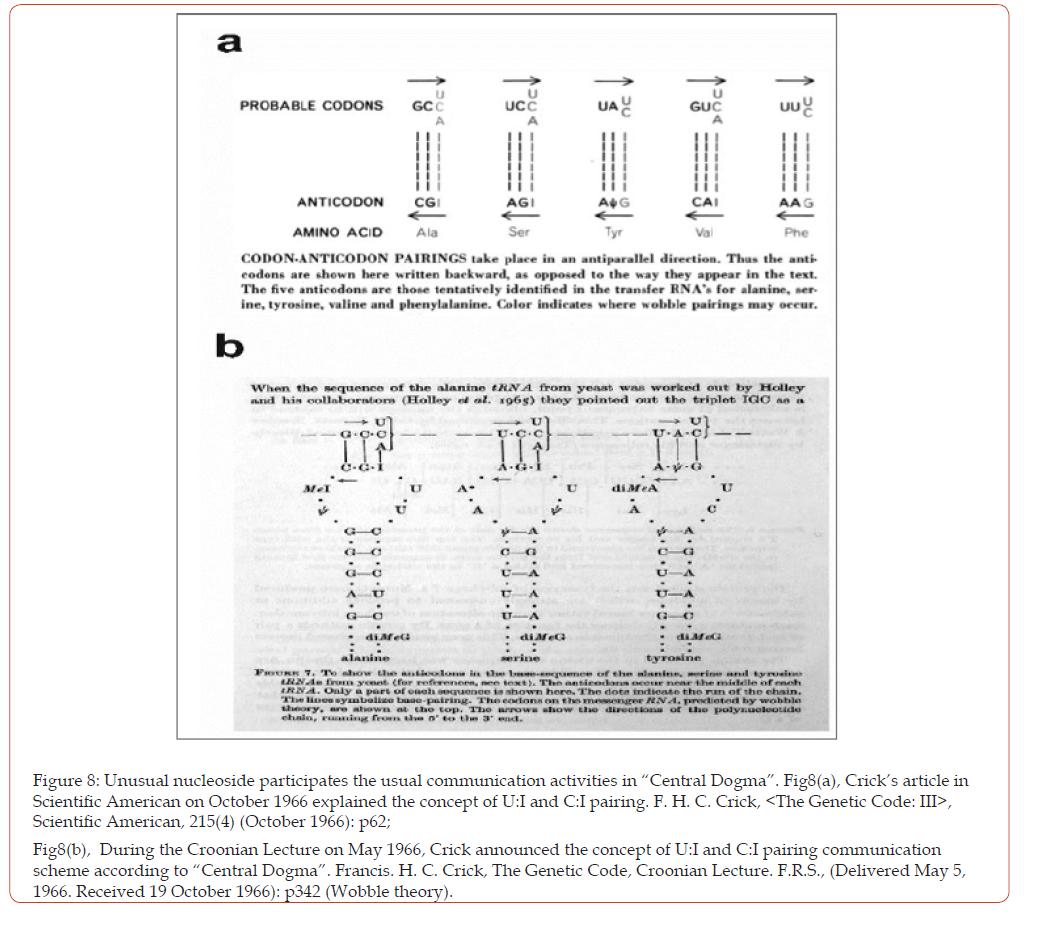
Figure 8:Unusual nucleoside participates the usual communication activities in “Central Dogma”. Fig8(a), Crick’s article in
Scientific American on October 1966 explained the concept of U:I and C:I pairing. F. H. C. Crick,
Fig8(b), During the Croonian Lecture on May 1966, Crick announced the concept of U:I and C:I pairing communication
scheme according to “Central Dogma”. Francis. H. C. Crick, The Genetic Code, Croonian Lecture. F.R.S., (Delivered May 5,
1966. Received 19 October 1966): p342 (Wobble theory).
a) Crick’s article in Scientific American on October 1966 explained
the concept of U:I and C:I pairing. F. H. C. Crick,
b) During the Croonian Lecture on May 1966, Crick announced
the concept of U:I and C:I pairing communication scheme
according to “Central Dogma”. Francis. H. C. Crick, The Genetic
Code, Croonian Lecture. F.R.S., (Delivered May 5, 1966.Received
19 October 1966): p342 (Wobble theory).
v. There is no chemical difference between “codonanticodon pairing (communication)” and “codon-codon pairing (communication).” Chemically, the UUU’s anticodons GAA and AAA are identical to the standard codons GAA and AAA in Crick’s 4 × 4 × 4 Table. Therefore, the information flow from UUU (anticodon) to GAA (codon) and AAA (codon) can represent the information flow from a given standard genetic codon (UUU) to another standard genetic codon (GAA or AAA). Additionally, the “genetic information” for protein synthesis via tRNA refers to whether the tRNA carries an amino acid. If it does, it contains genetic information; if not, there is no genetic information. Holley’s discovery of the ala-tRNA molecule indicated that tRNAs bind an alanine without anticodon-codon base pairing.
In fact, by April 1966 75(p548), the total number of anticodons that
Crick 75(p553) had identified was only three (see below list), they are:
a) IGC-for alanine, Crick cited Holley (1965, Holley) to
support this anticodon idea. i.e., Holley says, “another possibility
for the coding triplet is the I-G-C sequence, which is in the middle
of the chain and is particularly sensitive to ribonuclease Ti.” 72(p1465);
Crick says “Holley et al (1965) have already pointed out that IGC is
a possible anticodon for alanine”75(p553).
b) IGA-for serine, Crick cited Dutting (1965, Dutting, Karan,
Melchers, & Zachau) to support this anticodon idea; why did Dutting
conclude this anticodon? Nobody knows.
c) IAC-for valine, Crick cited Ingram (1963, Ingram &
Sjoquist) to support this anticodon. How did Ingram conclude this
anticodon IAC? It remains unclear.
This list shows that UUU’s anticodon GAA or AAA had not been established by Crick until April 1966. In October 76(p60) 1966, Crick wrote “an anticodon for phenylalanine is GAA” (Note: this was not “an anticodon for UUU is GAA”) and not AAA. Further (i) when collecting and listing the anticodons (for alanine, serine, and valine), Crick did not clearly list the entire standard codons for each anticodon. This signifies that the “anticodon” of most genetic codons was not established in 1966 when Crick’s 4 × 4 × 4 table was contemporarily finalized; and (ii) in Crick’s original descriptions, the goal of defining the anticodon concept is associated with amino acids and not the 64 standard codons. This signifies that the academic research regarding the anticodon of UUU, i.e., GAA should be focused on “GAA - phe or AAAphe biochemistry (phe-trinucleotide chemical linking technique)” but not on the “GAA-UUU biochemistry (G/U A/U base pairing)”. To this view, it is illegal to conclude Matthaei-Nirenberg’s “if poly-U↑, then poly-phe↑” reaction as “UUU codes for Phe” before finding that “GAA (or AAA) codes for phe.”
True Story: U U U U ...U U U U U U form of Poly-U has No Mathematical Model 41000
Gamow and Watson’s 78 (explanation) Assertions Regarding the Poly-U Chain: Gamow wrote, “for a chain which is, for example, 10,000 steps long, the number of possible arrangements is 410,000, which is much (much!) larger than the number 1076 representing the number of all atoms in the universe within range of the 200’’ telescope at Palomar Mountain Observatory” 79(p1). Watson states in his textbook, “a typical bacterial gene is made up of approximately 1000 base pairs. The number of potential genes of this size is 41000” 19(p28), 20(p31), and “the possible number of different genes of MW = 106 is 41500” 80(p285).
My Outright Rejection: On one hand, poly-U was described in 1961 as a long polynucleotide chain of uridylic acid, although it does not contain the letters C, A, G. Assuming poly-U is the sole gene of poly-phe, the number of the gene on poly-U should not be calculated as 41000 but rather as 11000. On the other hand, the amount of uracil residues in the Matthaei-Nirenberg “if poly-U↑, then poly-phe↑” reaction is substantially greater than 1000, as indicated by “+10 μg Polyuridylic acid”10(p1595,1599) and “10 μg Polyuridylic acid added” see (Figure 2). Furthermore, the biological function of phenylalanine in Matthaei-Nirenberg’s poly-phe cannot be consistent with Gamow’s model 41000 for the amount of information as large as 201000 or 20∞. (Note: each digit of the 20-letter language of proteins has 20 options, resulting in 1000 digits containing the information of 201000 units). In terms of this perspective of “the number of possible arrangements” (41000) replacing “the number of potential genes” (41000), I suppose Watson was fooled by Gamow as they were members of the RNA Tie Club of 1955. For instance, if Gamow gives Yčas a cup of water containing 10,000,000,000,000 H2 O molecules in front of Watson and the other members of the RNA Tie Club, the confidential information in Gamow’s cup of water cannot be 4^10,000,000,000,000(say, Gamow’s “message” in this cup of water, larger than the number 1076 representing the number of all atoms in the universe); rather, it should be 1^10,000,000,000,000 = 1 (the message in this cup of water is just like a signal of “do” or “not to do”). I believe that, as time passes, Dr. Watson will be interested in relating the actual events of the RNA Tie Club of 1955.
True Story: “Specificity” Of UUU Toward Singlet Phenylalanine is a Logical Fallacy
The Matthaei-Nirenberg description: “No other polynucleotide tested could replace polyuridylic acid” 10(p1595); “Omitting a mixture of 19 L-amino acids did not inhibit phenylalanine incorporation, suggesting that polyuridylic acid stimulated the incorporation of L-phenylalanine alone” 10(p1595); “...suggesting the synthesis of a polypeptide or protein containing phenylalanine alone. This conclusion was substantiated by demonstrating that poly-U did not appreciably stimulate the incorporation of any other 14 C-amino acids” 9(p188);
My Outright Rejection: In 1963, numerous scientists had
already reported contradictory experimental findings, such as “the
addition of polyuridylic acid to this (cell-free) system stimulates
the incorporation both of phenylalanine and of leucine” 81(p304),
“a stimulation of leucine incorporation by polyU has also been
reported in studies with extracts of E. coli” 81(p305), “Poly-U also
stimulated the incorporation of small amounts of C14-leucine and
C14-valine into protein” 82(p670), “We find that in a similar cell-free
system the stimulation of amino-acid incorporation by poly-U is
not limited to phenylalanine, but that variable amounts of leucine
(5-25 percent in different experiments) are always incorporated.”
83(p283), the authors of the same study “… conclude that poly-U, when
placed in this cell-free system, leads to the incorporation of more
than one amino-acid” 83(p284). “Leucine as well as phenylalanine
is coded by UUU” 84(p480) and “evidence which seems contrary to
this conjecture is that the same transfer RNA of leucine responds
to UGU and to UUU” 84(p480). Weinstein from Columbia University
College of Physicians and the Medical Service of Francis Delafield
Hospital (New York City) said, “we have observed repeatedly a
poly U stimulation of leucine which varies from 3 to 25% of that
obtained with phenylalanine” 85(p579). Woese particularly pointed
out that UUU corresponding to phe and leu was derived from
many organisms, i.e.: “It should also be noted that the UUU codon
might well represent an ambiguous assignment, as it directs the
incorporation of both phenylalanine and leucine into polypeptides
in cell-free extracts derived from many organisms” 86(p1031). These
experimental facts strongly suggest that in Crick’s 4 × 4 × 4
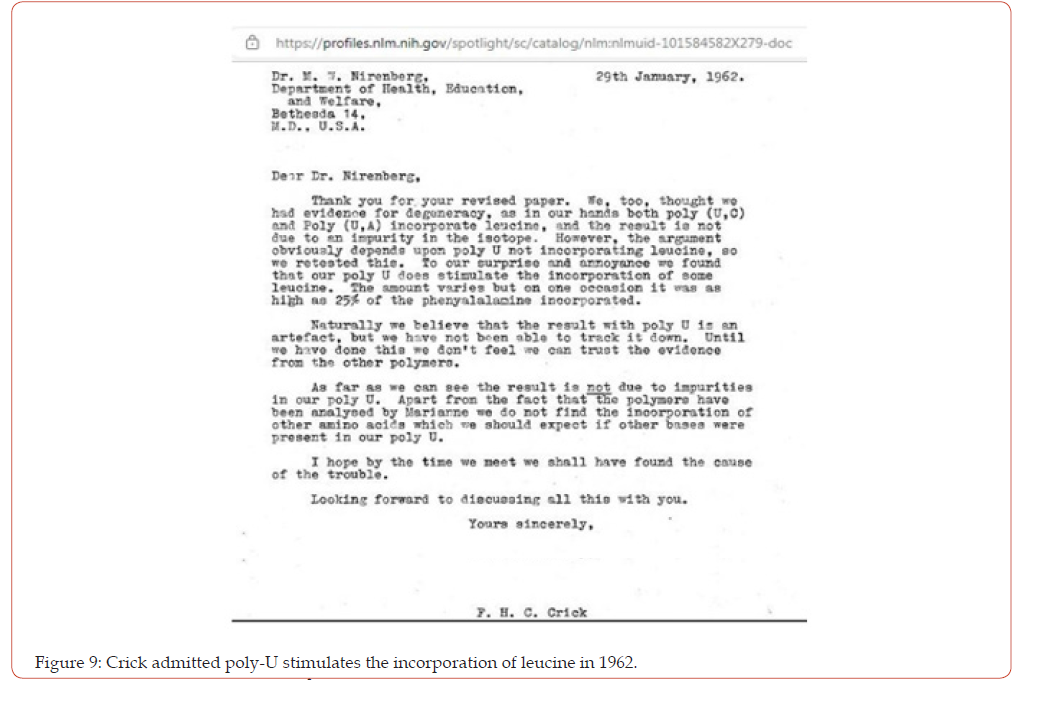
Figure 9:Crick admitted poly-U stimulates the incorporation of leucine in 1962.
Notes: this letter contains several important historical facts, such as
a) The experimental result that poly-U stimulates the
incorporation of leucine was not due to impurities in poly-U;
b) Crick himself found this experimental fact as early as January
29, 1962 when the notion at the time was “UUU encoding
phenylalanine alone”;
c) “I hope by the time we meet we shall have found the cause
of the trouble” indicates that Crick himself also took “UUU
encoding leucine” or “poly-U stimulates leucine” as an obstacle
for establishing “UUU encodes phenylalanine alone”.
d) Leucine was a rock-star level amino acid in “amino acid
incorporation into protein experiments” before 1961
Moscow congress, many labs should have grasped the mature
techniques to stimulate leucine into protein, this might be the
reason why many labs found that “UUU stimulates leucine”,
and why leucine in Crick’s ’s 4 × 4 × 4
However, most surprisingly, some experts are unsure of the “specificity” and the “degeneracy” of UUU. In this regard, they used “UUU: phe; UUU: leu” (expansion property of UUU) to explain the “degeneracy property” of UUU! For instance, “the existence of degeneracy of the second kind, where two different amino acids correspond to the same coding unit, is suggested by the observations that both leucine and phenylalanine respond to poly U” 87(p1453).
The most significant difficulty is that the concept of the specificity of poly-U (toward phenylalanine) has demolished the “deciphering theories” that employ “UUU codes for phenylalanine” to conjecture the other 63 trinucleotide-specify-amino acid patterns or the other 19 amino acid-specify-trinucleotide patterns. For instance, the idea that poly-U only specifies poly-phe wrongly guided pure chemists to believe that poly-C only specifies poly-pro and that poly-G only specifies poly-gly. Why is it misguided? Clearly, if transferring “4-letter language vs. 20-letter language” into the chemical reactions of “(polyU, polyC, polyA, polyG) vs. (poly-phe, poly-pro, poly-lys, poly-gly, poly-leu, poly-ileu, poly-ser, poly-val, poly-cys, poly-tyr, poly-trp, poly-thr, poly-ala, poly-arg, poly-asp, poly-aspn, poly-glu, poly-glun, poly-met, poly-his),” we observe that Matthaei-Nirenberg’s “if poly-U↑, then poly-phe↑” reaction is exactly another form of Gamow’s coding scheme ---- the discarded “1 amino acid vs. 1 nucleotide base”. The more specific poly-U was for producing poly-phe, the more difficult it was for Matthaei and Nirenberg to account for Gamow’s 4 × 4 × 4 coding problem.
True story UUU’s “Universality” Ranging from Bacteria to Higher Mammals is Bull Shit
On page 386 of Watson’s classic college textbook
Nature (no one Would Consider Nature Journal an Academic Joke) Published Crick’s Speech
“Why should it be universal? There were two possible explanations, he said. One was that it was the only possible code for stereochemical reasons, because the amino-acids fit uniquely either to the codons or to the anti-codons (The first possibility was suggested by Pelc and Welton earlier this year in Nature, 209, 869; 1966; but Dr. Crick found it quite unacceptable; the second was more likely, and evidence for it seemed to be accumulating.)” 88(p1397). According to Crick, “Another type of explanation for the constancy of the code was that it had become so complicated that any change would be lethal-that the genetic code had got into a rut. The fact that there is only one version of the code and not several co-existing versions still needed to be explained” 88(p1397). (Note: Nature here says that Dr. Crick explained “universality” as being “only one version of the code”.)
Crick’s Letter to Nature Journal
“Sir, --- I should like to make two points about the account of my talk to the British Biophysical Society which you published recently. I do not in fact believe that the idea of a stereochemical relationship between all amino-acids and their anticodons, as suggested by Dunnill, is likely. There is, in my opinion, suggestive evidence against it, but at the moment it is not enough to disprove the idea. My second point concerns the main substance of my talk, which was an attempt to show that a plausible theory could be constructed without necessarily assuming any stereochemical interaction of amino-acids with either codons or anti-codons.” 89(p119).
My Outright Rejection
“Universality,” such as “from bacteria to higher mammals,” is a process of genetic statistics. However, “stereochemical relationship (or interaction) ------the amino-acids fit uniquely either to the codons or to the anticodons” belongs to chemical sciences. Dr. Crick’s quarrel with the journal Nature reflects the scientific truth that by 1966 most of the “amino acids vs. genetic codons” corresponding relations made by Nirenberg and Ochoa experiments were not supported by genetic taxonomical data collections. Therefore, “poly U stimulates polyphenylalanine incorporation in cell-free extracts from a variety of different organisms ranging from bacteria to higher mammals” 80(p386) is most likely false! “Poly-U” could not have been extracted from a variety of different organisms; how dare you announce it occurs from a variety of different organisms! The “if poly-U↑, then poly-phe↑” reaction could not occur in a variety of different organisms! Furthermore, “Universality” was explained as “only one version of the code (book),” which was also a very strange proposition! Clearly, “only one version of the codebook in one organism” is different from “some different versions of the codebook in one organism” or “one or some different versions of the codebook in some or many organisms.” The multiple versions of the genetic codebook today provide good evidence for this stance. To this extent, the concept of universality is possibly a just slogan or dissemination strategy to make “4-letter language translating into 20-letter language” story the universal law regarding “protein biosynthesis”.
Attention Please: The “if Poly-U↑, Then Poly-Phe↑” Reaction Belongs to Chemical Reaction Experiment, but Not Information Flow Test
On page 388 of the first edition of
My Outright Rejection toward “Information Flow Test (Central Dogma)”
(Figure 2) shows clearly that “if poly-U↑, then poly-phe↑” is a chemical reaction and not an information flow experiment. “The reaction mixture components in μmoles per ml were as follows 10(p1589):
80 Tris, pH 7.8;
8 magnesium acetate;
50 KCl;
9 mercaptoethanol;
0.075 each of 20 amino acids;
2.5 ATP, K salt;
2.5 PEP, K salt;
15 μg PEP kinase (Boehringen & Sons, Mannheim, Germany).
The energy source for the phenylalanine aggregation reaction
in this reaction system is adenosine triphosphate and not uridylic
acid, uridine triphosphate, or polyuridylic acid. The article
In fact, the academic background of Matthaei-Nirenberg’s poly-U experiment the 1957 article Codes Without Commas by Crick used “code” 41 times and “genetic” and “heredity” zero times. In the subsequent development of Matthaei-Nirenberg’s poly-U experiment, the 1963 article On the Coding of Genetic Information 90(pp549-557) by Nirenberg, the words “code” and “codeword” were used 49 and 20 times respectively, while “genetic” was only mentioned twice. Another famous promoter of “the genetic code” table, Carl R. Woese, in his famous article Order in the Genetic Code published in 1965, used “codon” 41 times, “code” 11 times and “genetics” only 5 times while “wild-type” and “mutant” were used zero times. These findings significantly support my position that the Matthaei-Nirenberg poly-U experiment was the start of a chemical encryption approach unrelated to genetics.
Another piece of strong evidence for denying the genetic nature of this experiment: On April 22, 1955, three weeks prior to the establishment of the Warsaw Treaty Organization, George Gamow and renowned cryptologists William Frederick Friedman had a private correspondence see (Figure 10). At the time, William Frederick used the phrase “the cryptology of the protein molecule” 90-2(ID) in response to Gamow’s combination code scheme. No one would agree, after reading William Frederick’s letter, that Gamow wanted Friedman to provide genetic testimony. However, as we all know today, this experiment by Matthaei and Nirenberg is regarded as the initial breakthrough for Gamow’s total 4 × 4 × 4 code scheme.
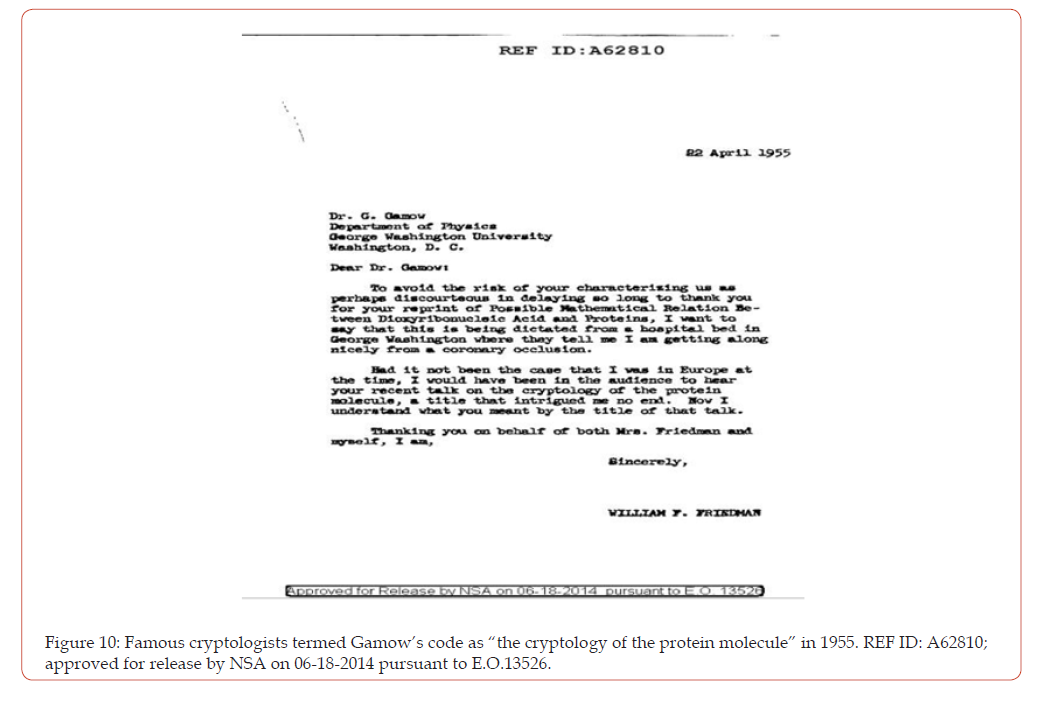
Figure 10:Famous cryptologists termed Gamow’s code as “the cryptology of the protein molecule” in 1955. REF ID: A62810; approved for release by NSA on 06-18-2014 pursuant to E.O.13526.
My Outright Rejection toward Terminology “Code”
This is an incredibly vital aspect. On one hand, the coding system was initially proposed by physicist George Gamow 56(p68), 62(p1) 91(lecture), and promoted primarily by Francis Crick and his colleagues. If Nirenberg and Matthaei wanted to establish an association between the “if poly-U↑, then poly-phe↑” reaction and a 4 × 4 × 4 = 64 (triplet), 4 × 4 = 16 (doublet), or 4 = 4 (singlet) code scheme, they would need to boldly and clearly introduce the Gamow’s diamond code theory 64(p318), 65(p11) into the poly-U experiment. Unfortunately, as evidenced by their 1961 publications, Nirenberg and Matthaei did not do it. Nirenberg and Matthaei further did not include discussions regarding Gamow’s “key-and-lock” 64(p318) (or “hands-in-glove” 62(p162)) concept, Crick’s adaptor hypothesis 66(p1-17) (“key-outside-lock” or “hands-outside-glove”), and Crick’s theories regarding nonoverlapping reading, codes without commas, and 4-letter language translating into 20-letter language because, from a chemistry perspective, it would be too difficult to discuss the poly-U comma and overlapping or nonoverlapping reading during (the structural and enzymatic 71 (p13)) protein synthesis. In this regard, George Gamow also conceded “Nirenberg didn’t even quote me in his paper,” 59(p255). On the other hand, if Matthaei and Nirenberg had boldly connected their experiments with Gamow’s diamond code or Crick’s adaptor theories, their “if poly-U↑, then poly-phe↑” reaction would soon become 100% unable to support Gamow’s theory of phe (key)-in-UUU (lock) and 100% unable to support Crick’s “triplet adaptor” theory of phe (nongenetic material) adapting to UUU (genetic material) via a linker. These two “100% impossible” statements could answer why Matthaei and Nirenberg’s research publication avoided referencing Gamow’s or Crick’s code schemes. Furthermore, Nirenberg and Matthaei did not cite any classical articles relating to the so-called “coding problem92-1 (p158), 92-2(p35-38), 92-3 (p181), 1(p1) in their 1961 publications.
In contrast to chemical reaction equations and genetic mapping methods, “code” is merely a spoken language that imparts neither chemical theory nor genetic laws. As a metaphor term“code” is a metaphor for chemical concept of base -triplet), code or codewords do not constitute a formal statement for scientific discovery in nature. Consequently, the greatest challenge in the Matthaei- Nirenberg poly-U experiment was not “whether the code is singlet or triplet” but rather if their poly-U is a discovery of the natural genetic material present in certain living species. Considering the significance of the background of “Cold War” during the Matthaei- Nirenberg experiment, the term “warfare” was closely associated with “code” or “codewords”; therefore, as with Gamow’s and Crick’s wording “code, decipher the code” highly coinciding with the establishment of the Warsaw Pact state group, the fact that Nirenberg et al. frequently used the term “codeword” to describe their subsequent chemical reactions is strong evidence to suggest that Nirenberg’s series of experiments belong to chemical encryption technology, which has no relationship with genetics! Thus, we find that the format “UUU codes for Phe” does not only appear as “codewords vs. plain words,” but also is “exactly a new type of ‘codewords vs. plain words.’”
My Outright Rejection toward Matthei and Nirenberg’s Announcement on poly(A,U)
“Polymers of adenylic acid and uridylic acid that were randomly combined were inactive in this system. Thus, the solution of poly-U and poly-A (which forms triple-stranded helices) had no activity” 10(p1595).
Attention Please: If categorizing amino acids into 20 sets and randomly setting mixed polymers of nucleotides at “poly X, poly X-Y, poly X-Y-Z, and poly X-Y-Z-Q” categories, there would be “20:69” (69 = 4 +10 + 20 + 35) types of 1 (aa polymer)-on-1 (nucleotide polymer) correspondence; therefore, Matthaei and Nirenberg used “the inactivity of polyA-polyU (to phenylalanine)” to deduce that phenylalanine was solely occupied by poly-U --this is clearly insufficient deduction! Worse yet, according to Crick’s 4 × 4 × 4 Table, Ochoa’s and Khorana’s experiments involving the numerous combinations of poly-U with poly-A, poly-C, and poly-G corresponding to different amino acids provided the primary experimental data sources for determining 1/20 (amino acids)-to-1/64 (triplet codons). The randomly combined adenylic and uridylic acid polymers were inert in this system (to any of the 20 amino acids) and demolished the theoretical foundation of Crick’s 4 × 4 × 4 Table “AAU (aspn), AUA (ileu), UAA (ochre), UUA (leu), UAU (tyr), and AUU (ileu),” denied the experimental results of the randomly mixed polymers obtained by Ochoa, and discarded the “combination property” of the holistic 64 triplets!
In addition, the conclusion method that uses “the specificity of poly-U (to poly Phe)” to replace the “specificity of UUU (to single phenylalanine)” is a play on words because the subsequent experimental stories tell us that this method requires numerous consecutive supporting theories to explain the jumps of poly-U to UUU. These include the triplet nature, degeneracy property, reading frame hypothesis, adaptor molecule, and the discovery of start codon and stop codon, etc.
My outright Rejection toward Matthaei-Nirenberg Conclusion
“Single-strandedness is a necessary requisite for activity” 10(p1595) (to stimulate the incorporation of amino acids) and “double and triple-stranded helices had no activity” 9(p187) (to stimulate the amino acids incorporated into protein).
Attention Please: At the Moscow conference, this point was stated as follows: “A solution of poly-U and poly-A, whose base pairs form double and triple-stranded helices, exhibited no activity whatsoever, indicating that single-strandedness is a prerequisite for activity.” 9(p186) It demonstrates that “double and triple-stranded helices” in Matthaei and Nirenberg’s context refers to “double or triple-stranded helices of polyA-U” rather than “double or triple strandedness of poly-U.” Their experiment cannot prove that double- or triple-stranded helices of poly-U are inactive, i.e., poly-U cannot be written as an UUUUUUUUUUU chain; despite the fact that we hypothesized that the stimulation function of poly-U for poly-phe synthesis in their experiments is a result of poly-single-stranded U’s morphology, according to Matthaei-Nirenberg experiment data, “39,800 mg/min/pulse count” 10(p1595) 9(p186) phenylalanine was incorporated into poly-phe, which begs the question how does a single-stranded poly-U (resembling a long rope) stimulate the incorporation of one or more phenylalanine molecules into a single-stranded poly-phe? Furthermore, 39.8 grams is a substantial amount of incorporation. What is the length of this 39.8g of polyphe at the molecular level rearrangement phe-phe-… … -phe-phe? In pure chemistry, the single-stranded arrangement of carbon, hydrogen, oxygen, sulfur, and phosphorus is incomprehensible; thus, the concept of single-stranded poly-U would be extremely difficult to comprehend! Therefore, it is incomprehensible that a single-stranded poly-U solely stimulates the incorporation of phenylalanine molecules into a single-stranded poly-phe.
This is analogous to a mathematical rope producing another type of extremely long rope! In experimental chemistry, Matthaei- Nirenberg’s rejection of double- and triple-stranded helices of poly-U was not only a rejection of the biochemistry of double-helix DNA toward protein but also a rejection of the stereochemistry as a whole toward the protein synthesis chemistry. Clearly, the tertiary structure of poly-U converts to the linear arrangement of uracil; this is first a complicated math problem similar to the transformation of a sphere or ellipse into a straight line or vice versa. Moreover, the linear arrangement of phe dominates the tertiary structure of poly-phe, which is mathematically impossible as well! Therefore, the single-strandedness of poly-U cannot assure that the reaction product of this experiment is single-stranded! In fact, the singlestrandedness of poly-U is merely “a necessary requisite” of supporting “Sequence Hypothesis” and not “a necessary requisite” for setting up the Matthaei-Nirenberg “If Poly U↑, then poly Phen↑” reaction experiment as standard “cipher text (poly-U) vs. plain text (poly-phe) correspondence” pattern. Worst of all, before the Matthaei-Nirenberg experiment, chemists had known that if two phenylalanines lose one molecule of H2O, a diphenylalanine peptide is produced. Then, the chemical process of sufficiently lengthening the single-stranded phenylalanine chain to 39.8 grams cannot be possibly caused by the addition of 10 μg polyuridylic acid to that one-stranded poly-U.
Why did not Crick Announce that Matthaei and Nirenberg Cracked the Genetic Code of Valine?
Attention Please: In Matthaei and Nirenberg’s publication of 1961, one can find lots of description about valine incorporating into protein, such as: “We have obtained a stable, cell-free E. coli system which incorporates 14 C -valine into protein at a rapid rate” 9(p184); “A stable cell-free system has been obtained from E. coli which incorporates C14-valine into protein at a rapid rate” 93(p404); “addition of ribosomal RNA to the reaction mixtures increased the amount of valine incorporated” 9(p185); “amino acid incorporation then was almost completely dependent upon the addition of ribosomal RNA” 9(p185); “dependence of 14C -L-valine incorporation into protein upon ribosomal RNA” 10(p1591).
Extremely evidently, regardless of whether a genetic code is a singlet or triplet if it exists, Matthaei and Nirenberg’s publications of 1961 has strongly suggested that valine’s code must be on rRNA but not on sRNA (or tRNA) nor on mRNA (or informational RNA). However, apparently, it appears in the 1960s that the major developers of 4 × 4 × 4 notions were not really interested in deciphering the genetic code of rRNA (or other natural organelles), also, they do not want to collect experimental evidence happened before the Moscow conference.
Why was that? Perhaps for these reasons:
i. starting from the different combinations of U, G, C, and A
to create 4 × 4 × 4 = 64 trinucleotides to speculate 20 amino acids
might be easier than starting from 20 amino acids to speculate 64
trinucleotides; most experiments before the Moscow conference
focused on using amino acid incorporation to speculate the 4 × 4 ×
4 = 64 genetic codons and were unsuccessful.
ii. ii) There are always unusual nucleotides appearing on
organelle or species RNA (such as rRNA). The goal of 4 × 4 × 4 = 64
codons is more difficult to realize when building on rRNA than with
theoretical mRNA.
iii. iii) Naming poly-U as a code is more easily accepted than
naming rRNA as a code since “poly-U” is a more accurate chemical
concept than “rRNA.”
Who and Who are Guiding Public People to Believe that Matthaei and Nirenberg Discovered the First Genetic Code?
From the 5th International Congress of Biochemistry to the present-day college biochemistry education, the public medias have consistently informed audiences that Matthaei and Nirenberg’s “if poly-U↑, then poly-phe↑” reaction discovered the “UUU codes for Phe” and that this was the first experimental evidence to establish Crick’s 4 × 4 × 4 Table.
Attention Please: Before the 1961 Moscow conference, “whose genetic material dominates the phenylalanine specifically, is it UUU ? ” and “which amino acid does the triplet letter UUU uniquely correspond to, is phenylalanine?” were not particularly popular in science; however, just experiencing several days of Moscow conference, “by January 1962, interviews and photographs featuring Nirenberg and Matthaei appeared in scientific journals, newspapers, and weekly magazines around the world” 94 (internet), and “ as early as 1961, when Dr. Nirenberg first announced the results of the poly-U experiments, scientists, politicians, journalists, religious leaders, and members of the public at large began weighing in on the implications of his discovery” 95(internet).
This, ---no academic basis of instant famous---, was too strange! It is impossible that “politicians, journalists, religious leaders, and members of the public at large” suddenly became genetic researchers within four months from August to December 1961! If “Cold War” had not occurred during the 1960s, Matthaei and Nirenberg’s account of the “first genetic code” would not have been written. Evidently, “UUU codes for Phe” event was not a standalone experiment, rather, it was one of many 1/20(aa)-on- 1/64(trinucleotide) coding units in a complex system of Gamow’s 4 × 4 × 4 coding problem. Alongside the “UUU codes for Phe” story, numerous rules were accompanied as well, such as “3, -the so-called discovery of triplet nature,” “4,-the so-called discovery of four basic nucleotides,” “4 × 4 × 4=64, -the discovery of total genetic codons,” “20,-the discovery of twenty amino acid species and the twenty types of relations,” “64⇔20, -the discovery of codon’s degeneracy, Gamow’s diamond code, and Crick’s adaptor hypothesis,” “3⇔20, -triplet nature applying to amino acids,” “3⇔64, -triplet nature applying to every genetic codon,” “4⇔20, -the discovery of fourletter language genetically controlling twenty-letter language in the imagination of ‘sequence hypothesis’ and ‘central dogma,’” and “3⇔1, - the discovery of three nucleotides genetically governing one amino acid.” Reviewing these accompanying rules reveals that all these so-called “discoveries” by cell-free protein synthesis experiments are exactly the application of different aspects of the polynomial expansions of (U + C + A + G)3, i.e., (U3 + C3 + A3 + G3 + 3U2 C + 3U2A + 3U2G + 3C2A + 3C2U + 3C2G + 3A2C + 3A2G + 3A2U + 3G2C + 3G2A + 3G2U + 6UCA + 6UCG + 6UAG + 6CAG).
If any chemist in 1961 reported to after both the NIH and the general public that Gamow’s 4 × 4 × 4 coding problem was merely a chemical technique agreement based on the different aspects of (U + C + A + G)3 polynomial expansions, no one would have believed the NIH and the public would have continued to invest attention and funds in the Matthaei and Nirenberg team to promote Gamow’s 4 × 4 × 4 coding problem! For example, on November 27, 1961, Fritz Lipmann from the Rockefeller Institute (New York) wrote back to Crick: “things are moving very fast suddenly and this fellow Nirenberg has given us a good push. We haven’t anything really new to tell. We are hoping that by using the poly-U-polyphenylalanine system, the mechanism of most peptide synthesis may be more easily approached” 96(letters), wherein Lipman never considered Nirenberg and Matthaei’s poly-U experiment when deciphering Gamow’s 4 × 4 × 4 coding problem.
“Code Words” and “Code War” in History of August 13, 1961
Matthaei and Nirenberg’s “immediate influence” came not from their study report but from the 5th Moscow conference (August 10-16, 1961, with 7,000 attendees). Here is how the Moscow conference played out:
Nirenberg relates, “I gave my talk in Moscow to an audience of ~ 35 people. However, Francis Crick invited me talk again in a large symposium that he was chairing on nucleic acids, which I did to an extraordinarily enthusiastic audience.”97(p49) Crick states, “I asked Marshall to take part in a much larger meeting, of which I was the chairman This suggested that UUU (assuming a triplet code) was a codon for phenylalanine (one of the “magic twenty” amino acids), as indeed it is.” 58(p130) (Note: the words between the brackets are taken from the original source.) This alongside the Crick triplet nature experiment that was conducted 2 months later proved that Crick and not Nirenberg, Matthaei, or the 35 expert audiences of the Moscow Congress considered the Matthaei-Nirenberg poly-U experiment as “breaking the first code UUU.” The personal communication presented as (Figure 11) also demonstrates that Nirenberg’s social status abruptly altered in September 1961, shortly after the conclusion of the 5th Moscow conference but not till the 15th day of October 1961 when Nirenberg and Matthaei’s PNAS paper was formally published.
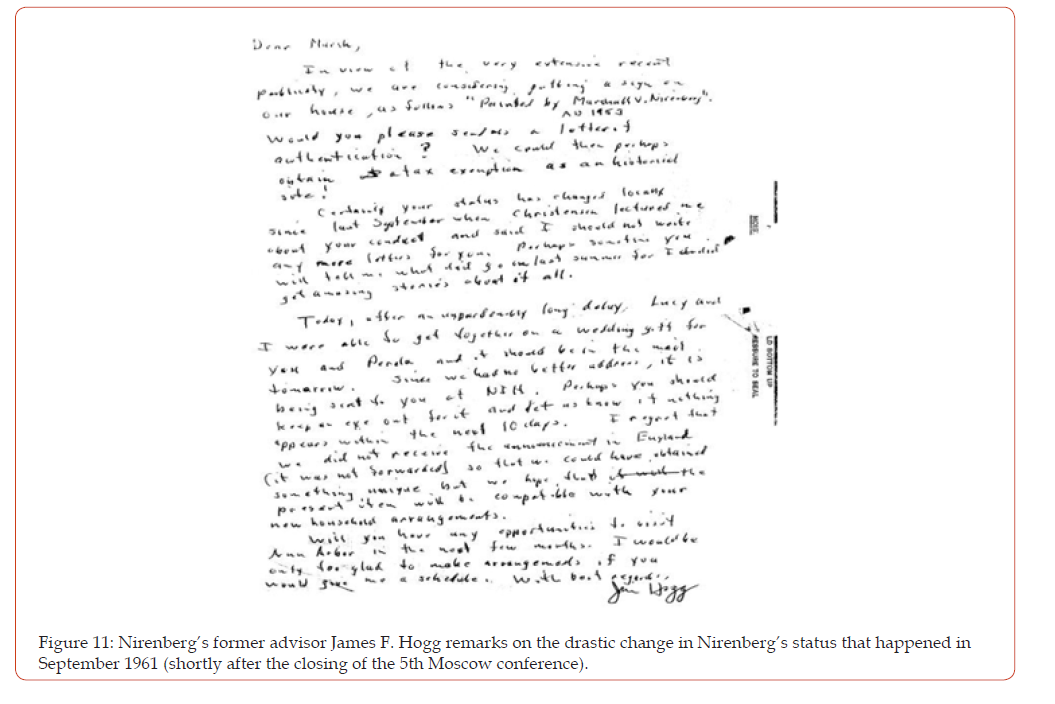
Figure 11:Nirenberg’s former advisor James F. Hogg remarks on the drastic change in Nirenberg’s status that happened in September 1961 (shortly after the closing of the 5th Moscow conference).
Note: Letter from James F. Hogg to Marshall W. Nirenberg;
January 29, 1962; Profiles Collection:
Just during the Moscow conference days, the most famous image of the “Cold War” in Europe, The Berlin Wall’s barbed wire fence form, was erected on August 13, 1961 98(internet). It was 3 days after the opening ceremony of the Moscow conference and a year before the Cuba Missile Crisis. A historian from the United States remarked “By 1960, mankind could destroy itself at any moment-a sobering and harsh fact that all generations had to acknowledge” 99(p10), and “the first relaxation of tensions between the two nations (the Soviet Union and the United States)” 99(p3) was when the first Limited Test Ban Treaty 100 (p562) was made in 1963. This alongside Kennedy’s inaugural address reveals that Moscow and Washington were not in a state of friendliness in 1961; rather, they were in a state of total confrontation. In this situation, we see such a multi- overlapped scenario: the experiment of the Russian descendant scientist (“deciphered the code UUU” by Nirenberg) overlapped the large-scale academic activity of the former Soviet Union (the Moscow conference) and overlapped the theory of Russian physician (diamond code proposed by Gamow), the political event of former Soviet Union (to build the Berlin Wall), Crick’s overlapping and nonoverlapping reading research on the triplet code, and “code” of genetics overlapped the “war” of the “Cold War”!
Other Points Related Established “Textbook Knowledge” in Brief
Why Phenylalanine must be Coded by UUU and UUC and by no other Triplets? This is the Typical Crick Style of Misleading Statements
Crick queried grotesquely in 1966, “Are there profound structural reasons why phenylalanine must be coded by UUU and UUC and by no other triplets”? 76(p62). Before answering this concern, we should first inquire about Dr. Crick, who says phenylalanine must be coded by UUU and UUC? Conversely, to the strictness of science, why did Dr. Crick not ask “why must both phe and leu be coded by unique UUU?” as many researchers, including Dr. Crick, had pointed out that poly-U stimulated both Phe and Leu incorporation during protein synthesis. Moreover, in 1954, Gamow had already described the optimal way to prove the structural relationship between 4 nucleoside bases and 20 amino acids as follows: “the answer can be given only by actually constructing a model of a DNA molecule from an atomic-model-kit, and comparing it with the models of various amino acids” 79(p11). There are no “profound structural reasons” when comparing the model of a DNA molecule with those of amino acids. “Phenylalanine must be coded by UUU and UUC” was certainly not the experimental conclusion from Matthaei and Nirenberg’s “if poly-U↑, then poly-phe↑” reaction, however, at the time it was most likely an optimal solution for an early finalization of the first version of Crick’s 4 × 4 × 4 Table.
“UUU or Poly-U” 20(p 588), 101 (internet) is a Wrong Phrase
Page 588 of
“Sense vs. Nonsense,” “Overlapping vs. Nonoverlapping,” and “Noninterlacing vs. Interlacing” do not Fit to Poly-U’s Linear form UUUUU…UUUUUU
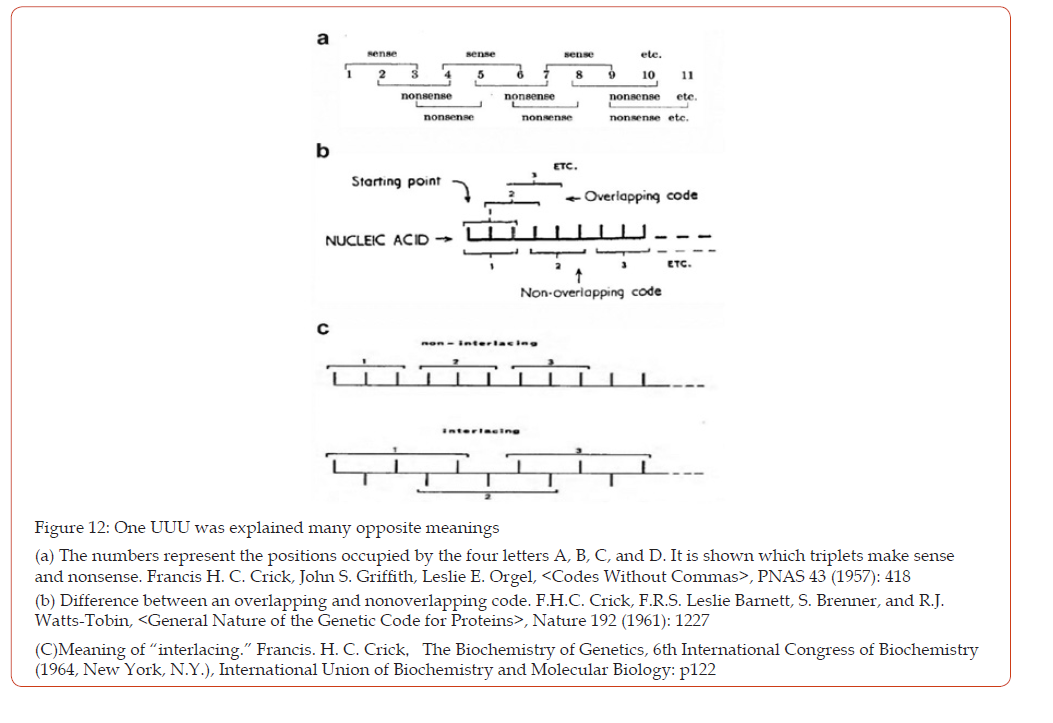
Figure 12:One UUU was explained many opposite meanings
(a) The numbers represent the positions occupied by the four letters A, B, C, and D. It is shown which triplets make sense
and nonsense. Francis H. C. Crick, John S. Griffith, Leslie E. Orgel,
(b) Difference between an overlapping and nonoverlapping code. F.H.C. Crick, F.R.S. Leslie Barnett, S. Brenner, and R.J.
Watts-Tobin,
(C)Meaning of “interlacing.” Francis. H. C. Crick,The Biochemistry of Genetics, 6th International Congress of Biochemistry
(1964, New York, N.Y.), International Union of Biochemistry and Molecular Biology: p122
(Figure 12(a,b,c)) demonstrates that “sense UUUs” are chemically identical to “nonsense UUUs,” “nonoverlapping UUUs” are chemically identical to “overlapping UUUs,” and “noninterlacing UUUs” does not differ from “interlacing UUU” 103 (p122) from a chemical standpoint. Therefore, Matthaei and Nirenberg’s “if poly-U↑, then poly-phe↑” reaction experiment could not distinguish between “sense, nonoverlapping, noninterlacing, or intelligent” UUUs and “nonsense, overlapping, interlacing, or stupid” UUUs. The most common explanation for “sense” and “nonsense” is “to punctuate message by establishing twenty ‘sense’ triplets, the remaining forty-four combinations making ‘nonsense’” 104 (p971). Thus, 20 triplet codons should correspond to 20 amino acids, while the remaining 44 triplet codons should not correspond to amino acids.
a) The numbers represent the positions occupied by the four
letters A, B, C, and D. It is shown which triplets make sense and
nonsense. Francis H. C. Crick, John S. Griffith, Leslie E. Orgel,
b) Difference between an overlapping and nonoverlapping
code. F.H.C. Crick, F.R.S. Leslie Barnett, S. Brenner, and R.J. Watts-
Tobin,
c) Meaning of “interlacing.” Francis. H.C. Crick the
Biochemistry of Genetics, 6th International Congress of
Biochemistry (1964, New York, N.Y.), International Union of
Biochemistry and Molecular Biology: p122.
About the Relationship between UUU and phe-tRNA in Protein Biosynthesis 76(p55)
The current knowledge includes the following: UUU coming from one portion of mRNA kisses the phe-tRNA’s “hip” (the anticodon site) and informs the molecule, “You let your phe go!” (Figure 13). However, there have been no experimental indications that UUU is male and tRNA is female or that UUU kissing tRNA causes tRNA to become pregnant as phe-tRNA. Conversely, in 1963, the Oak Ridge National Laboratory (Tennessee) team led by Akira Kaji found that “the crude RNA-polymerase fraction by itself catalyzes this incorporation without the addition of the usual ribosomal and soluble components”105(p406), and, this incorporation particularly refers to the phenylalanine (or leucine) incorporation into protein 105 (p408).
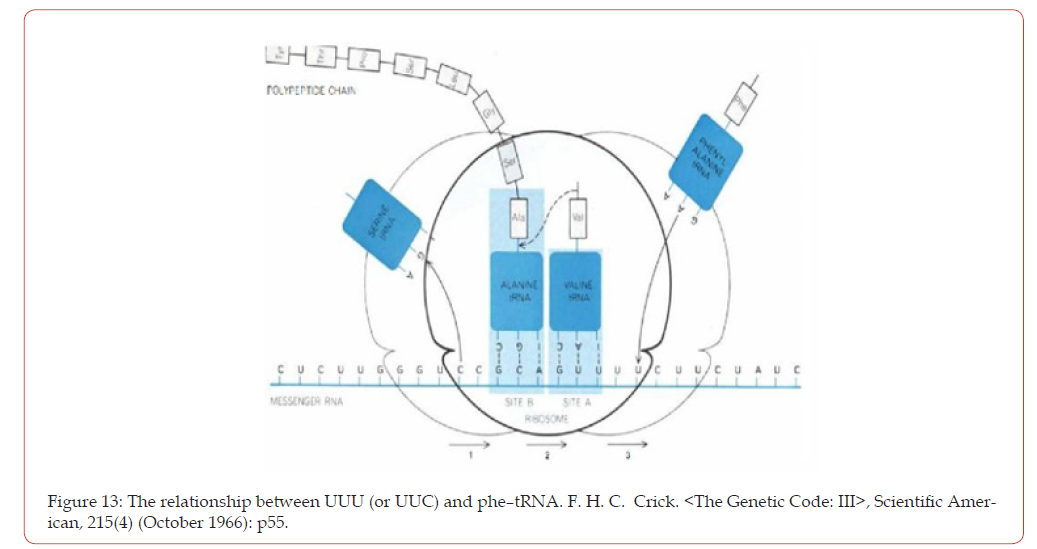
Figure 13:The relationship between UUU (or UUC) and phe–tRNA. F. H. C. Crick.
About the Initiator Codon and Terminator Codes
In Matthaei and Nirenberg’s poly-U experiment, nobody
can distinguish between the beginning and finishing triplets
UUU (Figure 14) 103 (p110) below. It is exceedingly unlikely that the
occurrence of the “if poly-U↑, then poly-phe↑” reaction requires an
AUG as a starting codon and a UGA as an ending codon. Note that
nothing special in the structure (other than the base sequence)
marks the beginning or end of the gene. Francis. HC Crick ,
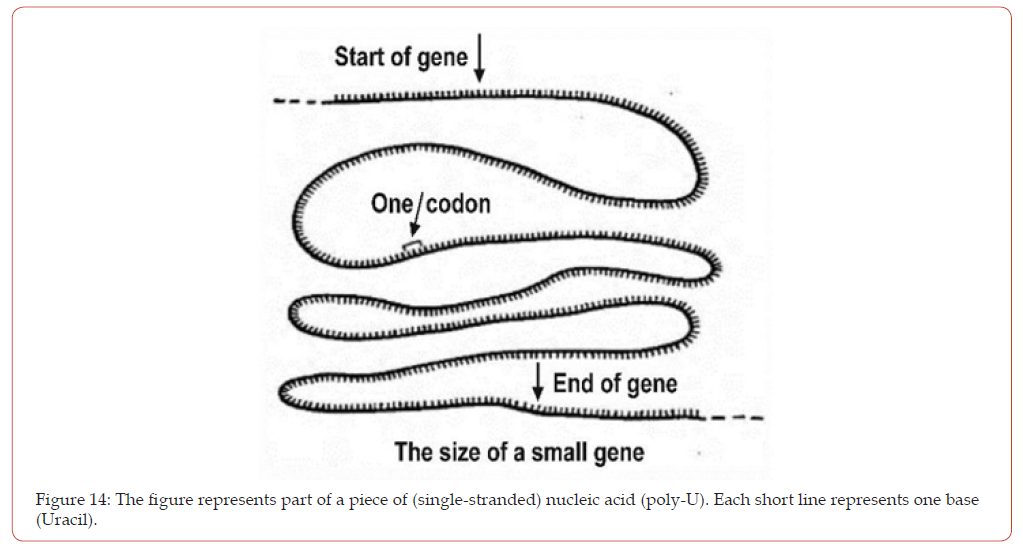
Figure 14:The figure represents part of a piece of (single-stranded) nucleic acid (poly-U). Each short line represents one base (Uracil).
4 × 4 × 4 Table has not been Completed Until Today. As a Rough Conclusion of Cell-Free Protein Synthesis Experiments in 1960s, Crick’s version of 4 × 4 × 4 Table is Neither Stereochemically nor Computational Valid
In 1962, a newspaper reported that: “The genetic code for proteins may be deciphered before the end of 1962. This is a prediction of four scientists , The scientists are Dr. F.H.C. Crick, Leslie Barnett, Dr. S. Brenner, and Dr. R.J. Watts-Tobin.” 61(p44-46) However, to date, “something about the shape or chemistry of phenylalanine which necessarily makes it be coded by the triplet UUU” 103 (p126) or “stereochemical fit between each amino acid and a group of nucleotides on its corresponding S-RNA” 85(p580) remain unknown. Thus, the reason why “stereo-chemically related amino acids correspond to closely related nucleotide triplets” 106(p93) has not yet been resolved. Worst of all, the “stereochemical relations between coding triplets and amino acids”107(p868) research and their zero-space style “amino-acids fitted into triplets”107 (p869) models, such as fitting model of “asparagine-AAC, tyrosine-UAU, and leucine-UUG” 107 (p869), directly violate the codon-anticodon pairing theories between mRNA and tRNA.
About George Gamow (1904-1968) and his Combination code and Career
Gamow was recognized as a Russian-born American physicist
and cosmologist. Since the finalization of Crick’s 4 × 4 × 4
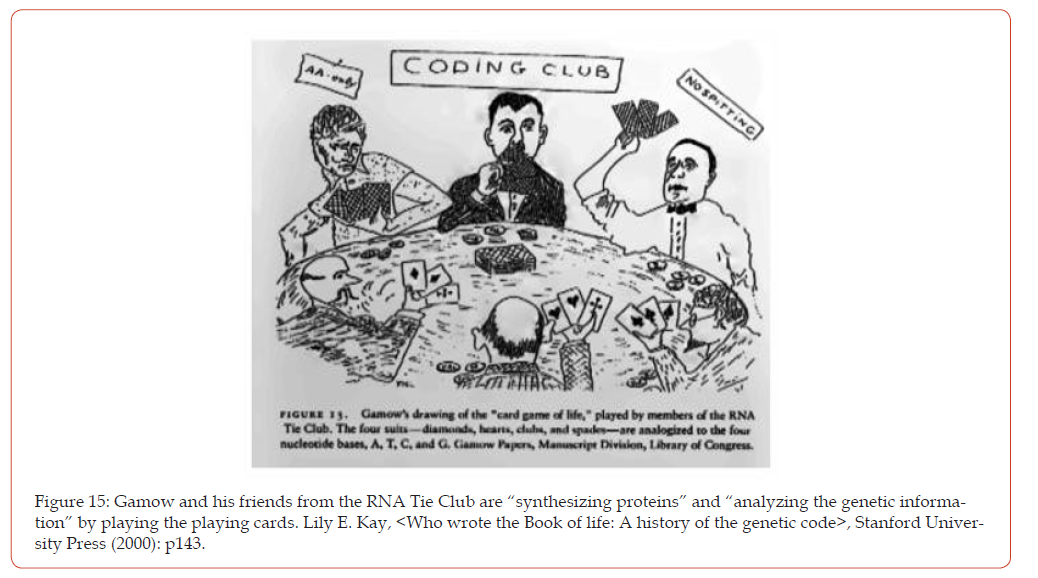
Figure 15:Gamow and his friends from the RNA Tie Club are “synthesizing proteins” and “analyzing the genetic information”
by playing the playing cards. Lily E. Kay,
Systematic Discussion
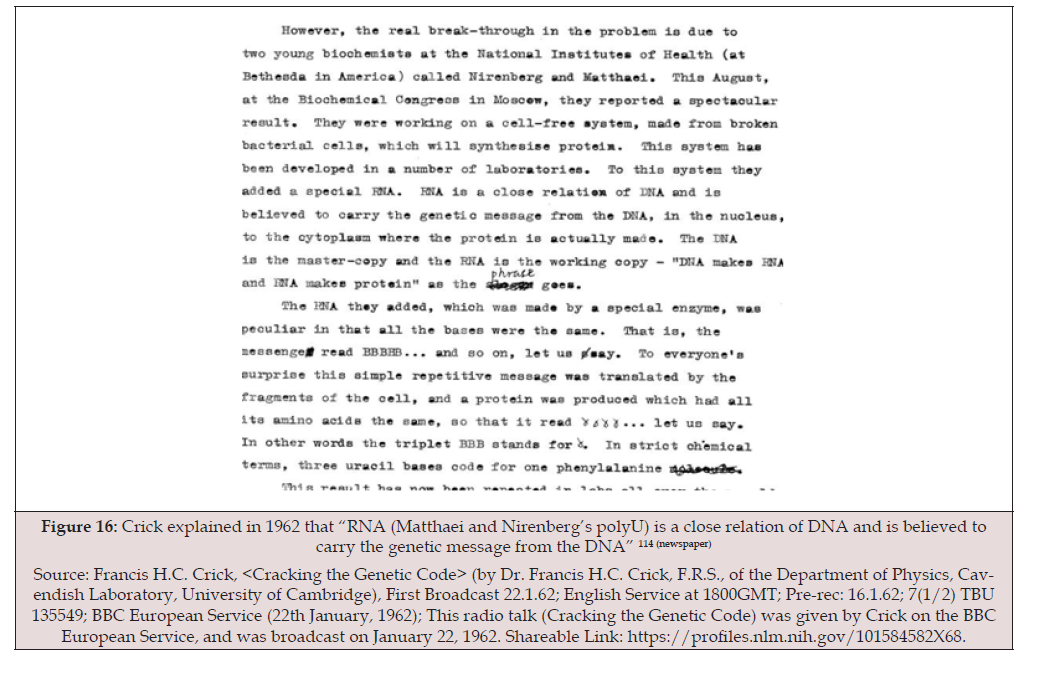
Figure 16:Crick explained in 1962 that “RNA (Matthaei and Nirenberg’s polyU) is a close relation of DNA and is believed to
carry the genetic message from the DNA” 114 (newspaper)
Source: Francis H.C. Crick,
In the historical story of the 4-letter language of nucleic acids translating to the 20-letter language of proteins, the 3-digit reading of the 4-letter language (triplet nature of the genetic code) is the first key step and plays a systematic role in all the experimental events, “20 groups of triplet codons corresponding to 20 species of amino acids” (Gamow’s diamond code hypothesis, Crick’s adaptor idea for an aa-tRNA structure, and Nirenberg and Ochoa’s cell-free protein synthesis experiments) is the major content throughout all forms of experimental events known as “deciphering the genetic code (experimental campaign),” and the presentation of 4 × 4 × 4 Table is the final goal. Before relating the Matthaei and Nirenberg poly-U experiment to the Gamow 4 × 4 × 4 coding problem, chemists must determine the chemical difference between the occurrence of “if poly-U↑, then poly-phe↑” reaction and the stereochemical fitting of “triplet uridylic acid (UUU) code for amino acid (phe)”. In 1961, at the Moscow Congress of Biochemistry, Dr. Crick considered “poly U” the standard four-letter language of nucleic acids and “poly phe” the standard 20-letter language of proteins, therefore, as shown in (Figure 16), he instantly considered Matthaei and Nirenberg’s “if poly-U↑, then poly-phe↑” reaction to be Gamow’s “UUU codes for Phe” coding scheme. To this extent, the so-called “breakthrough” in resolving the 4 × 4 × 4 coding problem was actually a “sudden” change in the chemical understanding of DNA and proteins from stereochemical atomic and molecular structure to linear chemical four-letter language and 20-letter languages. This explains why the linguistic terms “sense and nonsense,” “overlapping reading and non-overlapping reading,” “comma and comma-less,” and “central dogma” began to appear in chemical analyses related to cell-free protein synthesis.
Francis H.C. Crick,
Thus, the majority of error hints in Matthaei-Nirenberg’s poly-U experiment can be gleaned from the relationships between the following events: the genetic explanations of “UUU (word) codes for Phe (word),” the chemical reaction mechanisms of the “if poly-U (text), then poly-phe (text),” the analysis of the molecular structure of “phe-GAA(deputy UUU)-tRNA,” and the sequence alignment of UUUUUUUUUUUU into phe-phe-phe-phe-phe-phephe as following:
a) Error clue No1: They failed to present the “three-digit reading”
rationale for poly-U prior to drawing the conclusion “UUU
codes for phenylalanine” (note: We assume that “UUU codes
for phenylalanine” could build upon Matthaei-Nirenberg’s
poly-U experiment of 1961).
b) Error clue No2: They did not provide the experimental results
for “UUU vs. phe” and “UUC vs. phe” at the time when “UUU
codes for phenylalanine” became the biggest news story of
1961 (note: we assume that “UUU vs. phe” and “UUC vs. phe”
are the only optimal decreasing solution for reducing the 64
types of three-digital readings to 20 types).
c) Error clue No3: They failed to clarify whether their poly-U
experiment corresponded to Gamow’s diamond code theory,
implying that Nirenberg did not care about the way others
explained how the 20 groups of triplets corresponded to 20
singlet amino acids after the 5th Moscow conference. This
signifies that Nirenberg’s modest demeanor will be disastrous
for the field of biology in the 1960s.
d) Error clue No4: In 1961, They never sought to search for
the natural form UUUUUUUU (but not poly-U) in wild-type
organisms. Likewise, they never attempted to look for the
natural form phe-phe- phe- phe- phe- phe- phe- phe- phe
(but not poly-Phe) in wild-type organisms. According to the
sequence hypothesis, this is an essential stage for determining
whether their investigations correspond to genetic discoveries.
e) Error clue No5: At the Moscow conference, they never sought
to judge whether “if poly-U↑, then poly-phe↑” reaction needs
to interact with the nucleotide sequence of phe-tRNA. In terms
of the reaction phenomena “poly-phe↑,” was it because of the
unique correct RNA nucleotide sequence between the phe and
anticodon of phe-tRNA? Alternatively, was it because of the
addition of uridylic acid? The answer would help chemists
judge whether it is necessary to know the nucleotide orders
of phe-tRNA molecules when analyzing Matthaei-Nirenberg’s
poly-U experiment.
f) Error clue No6: They confused 4 × 4 × 4 and (U + C+ A + G)3.
If writing 4 × 4 × 4 = 64 as (1 + 1 + 1 + 1)3 = 64, one finds that
(1 + 1 + 1 + 1)3 = 64 is completely different from (U + C + A + G)3
= (U3 + C3 + A3 + G3 + 3U2 C + 3U2A + 3U2G + 3C2A + 3C2U + 3C2G +
3A2C + 3A2G + 3A2U + 3G2C + 3G2A + 3G2U + 6UCA + 6 UCG + 6UAG
+ 6CAG). The polynomial expansion of (U + C + A + G)3 exhibits
obvious number properties, such as “3,” “4,” “20,” “64,” “4 ⇄ 20,” “4
⇄ 64,” “3 ⇄ 20,” “3 ⇄ 64,” and “20 ⇄ 64,” but (1 + 1 + 1 + 1)3 = 64 has
none of those number properties. Furthermore, there is the Rosetta
Stone paradox: only when U = C = A = G = 1, (U + C + A + G)3 = (1
+ se1 + 1 + 1)3 = 64; therefore, I find such a story about “chemical
reaction experimental reasoning” as all the chemical experimental
stories about “deciphering the 64 genetic codes” are in fact a story
about making “C4 H4N2 O2 (uracil) = C4H5 N3 O (cytosine) = C5H5N5
(adenine) = C5H5N5O (guanine) = 1”. Otherwise, Crick’s 4 × 4 × 4
Conclusions
Matthaei and Nirenberg’s 1961poly-U experiment did not conclude that UUU (C4H4N2O2-C4H4N2O2-C4H4N2O2) was the genetic material of nongenetic material phe (C9 H11 NO2). Clearly, per the expression formula “UUU codes for phenylalanine,” UUU cannot deduce the other 63 triplets XYZ, phenylalanine cannot deduce the other 19 amino acids, and “UUU represents phenylalanine” in chemistry is not possible to deduce other 63 types of “63 XYZ (triplet) represent 19 amino acids (singlet),” nor possible to reach other 19 types of “19 (amino acids) being represented by 63 XYZ (trinucleotides).” “By the end of 1961, Matthaei & Nirenberg had tentatively arrived at a large number of codewords”110 (p393) -this even did not actually occur. The claims that “it was Matthaei who performed the experiment in May 1961 that showed that poly-U coded for the amino acid phenylalanine” 111(internet) was likely exaggerated news112(internet),109(internet),94(internet) presented in the 1960s “Cold War” era. Nirenberg’s codons in biology were claimed to be equivalent to Mendeleev’s periodic table in chemistry 58(p101) and Einstein’s E = mc2 in physics 95(internet). This is inadmissible. Dr. Crick’s wording on March 1962 “the discovery of Nirenberg and Matthaei is the beginning of the end (of an era in molecular biology)” 113(p16) meant that, starting from “UUU (code word): phe (plain word)” the linear diode biology began to fully replace stereochemical biology.
Acknowledgments
I wish to express my thanks to Jon Robert Havens from U.S.A
who provided me with Woese’s book
Statements and Declarations Funding
The author declares that no funds, grants, or other support were received during the preparation of this manuscript.
Competing Interests
The author has no relevant financial or non-financial interests to disclose (September 23, 2026).
References
- Lanni F (1964) The biological coding problem. Advances in genetics. 12: p1-38.
- Nelson David L, Cox Michael M, Hoskins Aaron A, (2021) Lehninger Principles of Biochemistry (8th Edit), New York: MacMillan Learning p3492-3458.
- Karp G (2020) Karp’s Cell and Molecular Biology (9th Edit), Hoboken (NJ): John Wiley & Sons p1116.
- Peter R, George J, Kenneth M, Jonathan L, Tod D et al. (2020) Biology (12th Edit), New York: McGraw Hill Education p295.
- Lodish H, Berk A, Kaiser Chris A, Krieger M, Bretscher A, et al. (2021) Molecular Cell Biology (9th Edition). New York: MacMillan International Higher Education p667.
- Simon Eric J, Dickey Jean L, Reece Jane B, Hogan Kelly A (2016) Campbell Essential Biology (6th Edit), ESSEX (England): Pearson Education p212.
- Princeton Review (2021) Princeton Review AP Biology Premium Prep 2022 (for High School Student). New York: Penguin Random House Publishing Team p213.
- Jones M, Fosbery R, Taylor D, Gregory J (2020) Cambridge International AS & A Level Biology Coursebook. Cambridge University Press p610.
- Nirenberg MW, Matthaei JH (1961) The dependence of cell-free protein synthesis in E. coli upon naturally occurring or synthetic template RNA. In Biological Structure and Function at the Molecular Level (Engelhardt, V.A., ed.) MacMillan: p 184-195.
- Nirenberg MW, Matthaei JH (1961) The dependence of cell-free protein synthesis in E. coli upon naturally occurring or synthetic polyribonucleotides. PNAS, 47(10): p1589-1602.
- (1962) (Nobel Lecture) Crick, F. On the genetic code.
- (internet) The use of “discover”.
- (internet) The use of “crack”.
- (internet) The use of “decipher”.
- BSCS Administrative Staff. BSCS Biology (2006) A Molecular Approach, 9th. Columbus (Ohio): Glencoe: McGraw-Hill p237-239.
- (1966) Cold Spring Harbor Laboratory Press. The Genetic Code, Cold Spring Harb Symp Quant Biol 31: p1.
- Crick FH (1968) The origin of the genetic code. Journal of molecular biology 38(3): p367-369.
- Stent GS, Calendar R (1978) Molecular Genetics: An Introductory Narrative (2nd Edit), San Francisco: WH Freeman and Company: p547-548.
- Watson JD (2003) Molecular Biology of the Gene (5th Edit), New York: Benjamin Cummings: p462-466, p28.
- Watson JD (2013) Molecular Biology of the Gene (7th Edit), New York: Benjamin Cummings p574-588, p31.
- Ronner P, Netter FH (2018) Netter’s Essential Biochemistry. Philadelphia Elsevier p 54.
- Mader Sylvia S, Windelspecht Michael (2018) Essentials of Biology (5th Edit), New York: McGraw-Hill Publishing Company: p193.
- Solomons TWG, Fryhle Craig B, Snyder Scott A (2013) Organic Chemistry (International Student Version) (11th Edit.), Singapore: John Wiley & Sons p1124.
- Fletcher Hugh, Hickey Ivor (2013) Genetics (4th Edit), New York: Garland Science (Taylor & Francis Group) p14.
- Hartl Daniel L (2014) Essential Genetics: A Genomics Perspective (6th Edit), Burlington (MA): Jones & Bartlett Learning p23.
- Voet Donald, Voet Judith G, Pratt Charlotte W (2013) Principles of Biochemistry (4th Edit) (International Student Version). Hoboken (NJ): John Wiley & Sons p967-970.
- Clark Mary Ann, Douglas Matthew, Choi Jung (2020) Biology (2 e), Houston (Rice University), OpenStax: p372.
- Vollhardt Peter, Schore Neil (2014) Organic Chemistry: Structure and Function, New Yok: W. H. Freeman and Company p1202.
- Klug William S, Cummings Michael R, Spencer Charlotte A, Palladino Michael A (2011) Concepts of Genetics (10th Edit), Boston: Pearson p323.
- Klug William S, Cummings Michael R, Spencer Charlotte A, Palladino Michael A (2017) Essentials of Genetics (9th Edit). New York: Pearson p238.
- Jeff Hardin, Gregory Bertoni, Lewis J Kleinsmith (2016) Becker’s World of the Cell Technology Update (8th Edit), Essex (England): Pearson Education Limited p683.
- Bauman RW (2014) Microbiology with Diseases by Taxonomy, Essex (England): Pearson Education Limited: p222.
- Pierce, Benjiamin A (2012) Genetics: A Conceptual Approach (3rd Edit.), New York: W. H. Freeman and Company: p404.
- Timberlake, Karen C (2013) General, Organic, and Biological Chemistry: Structure of Life (4th Edit), Boston. Pearson: p760.
- Guinn, Denise (2014) Essentials of General, Organic, and Biochemistry. New York: W. H. Freeman: p628.
- Brown, Terence A (2002) Genomes (3rd Edit), New York: Wiley-Liss: p392.
- Brown WH, Poon T (2011) Introduction to Organic Chemistry (4th Edit) (International Student Version). Singapore: John Wiley & Sons (Asia): p736.
- Clegg, Chris J (2009) Edexcel Biology for A2, London: Hodder Education: p56.
- Fowler Samantha, Roush Rebecca, Wise James (2017) Concepts of Biology, Houston (Rice University), OpenStax: p214.
- Bartee L, Shriner W, Creech C (2017) Principles of Biology: Biology 211, 212, and 213. Open Oregon Educational Resources: p 587.
- Knorre Dmitri G, Mysina SD (1998) Biochemistry: A Manual for Universities. New York: Nova Science Publishers: p143.
- Sanders, Mark F, Bowman John L (2012) Genetic Analysis: An Integrated Approach. Glenview (IL). Pearson p13.
- Pollard T, Earnshaw W, Lippincott-Schwartz J, Johnson G (2017) Cell Biology (3rd Edit), Philadelphia. Elsevier p210.
- Alberts Bruce (2014) Molecular Biology of the Cell (6th Edit), New York. Garland Science p334.
- Thieman, William J, Palladino Michael A (2013) Introduction to Biotechnology. Glenview (IL). Pearson p44.
- Bergtrom G (2015) Cell and Molecular Biology: What We Know & How We Found Out (Basic iText). University of Wisconsin Milwauke p166.
- Bauer Richard C, Birk James P, Marks Pamela S (2007) Introduction to Chemistry: A Conceptual Approach (2nd Edit), New York: McGraw-Hill p686.
- Reece Jane B, Urry Lisa A, Cain Michael L, Wasserman Steven A, Minorsky Peter V, et al. (2010) Campbell Biology (9th Edit), Boston: Benjamin Cummings p330.
- Snustad Peter, Simmons Michael J (2010) Principles of Genetics (5th Edit), (International Student Version). Singapore: John Wiley and Sons (Asia) p332.
- Kratz RF, Siegfried DR (2010) Genetics for Dummies (2nd Edit), Hoboken (NJ). Wiley p145.
- (1962) (newspaper) NIH Researchers Crack the Genetic Code. Medical World News 3: p19.
- Ubell E (1961) The code of life finally cracked. New York Herald Tribune.
- Crick FHC (1963) On the Genetic Code. Science. 139: p462
- Crick FH, Griffith JS, Orgel LE (1957) Codes Without Commas. PNAS 43(5): p416-421.
- Crick F, Barnett L, Brenner S, Watts-Tobin RJ (1961) General nature of the genetic code for proteins. Nature 192: p1227-1232.
- Crick FHC (1962) The Genetic Code. Sci. America 207(4): p68.
- Nirenberg MW (1963) The Genetic Code: II. Scientific American (Periodical) 208: p82-90.
- Crick FHC (1988) What Mad Pursuit: A personal view of scientific discovery, London: Weidenfeld and Nicolson p169-p130, p90-101.
- Kay Lily E (2000) Who Wrote the Book of Life? A History of the Genetic Code, Stanford (California): Stanford University Press p128-284.
- McMurry J (2002) Fundamentals of Organic Chemistry (4th Edit), Beijing: China Machine Press p529.
- (1962) (Newspaper) Findings may speed solution to genetic code: RNA stimulates amino acid incorporation into protein; sequence of bases in nucleic acid appears to be key to code. Chemical and Engineering News. 40: p44-46.
- Woese C (1967) The Genetic Code: The Molecular basis for Genetic Expression. New York: Harper & Row p17-19 p50-52 p21-22 p31(Tyr-UUU) p111-145 p162.
- Woese CR (1965) On the evolution of the genetic code. PNAS 54(6): p1547-1548.
- Gamow G (1954) Possible relation between deoxyribonucleic acid and protein structures. Nature 173: p318.
- Crick FH (1966) The genetic code-yesterday, today, and tomorrow. In Cold Spring Harbor symposia on quantitative biology 31: p1-9
- Crick FH (1955) On Degenerate Template and the Adaptor Hypothesis: A note for the RNA Tie Club. p8-15.
- Nirenberg MW, Leder P, Bernfield M, Brimacombe R (1965) RNA Codewords and Protein Synthesis, VII. On the general nature of the RNA Code. PNAS 53(5): p1167.
- Xingyang YANG, Tzu-Ching Shih (2024) Gentle Skepticism to the Degeneracy Nature of "First Genetic Code UUU". Journal of Pharmaceutical Research and Reports pp4-8.
- Hoagland MP, LT Comly (1960) Interaction of Soluble Ribonucleic Acid and Microsomes. PNAS 46(12): 1554-63.
- Zamecnik PC, Keller EB (1954) Relation between phosphate energy donors and incorporation of labelled amino acids into proteins. Journal of Biological Chemistry 209(1): p337-354.
- Littlefield JW, Keller EB (1957) Incorporation of C14-amino acids into ribonucleoprotein particles from the Ehrlich mouse ascites tumor, Journal of Biological Chemistry. 224(1):13-30.
- Holley RW, Apgar J, Everett GA, Madison JT, Marquisee M, et al. (1965) Structure of a Ribonucleic Acid. Science 47(3664):1462-5
- (2019) Chinese Radicals-The Full List. Chinese Radicals/Unlock Their Potential and Crack the Code (FREE PDF, Poster AND Quiz Included); LEARN CHINESE By LTL Team HQ.
- Alexander SS, Alexei VF (2012) “Chapter 9: The Ribosome as a Brownian Ratchet Machine” in Molecular Machines in Biology (Joachim F. ed.); Cambridge University Press p158.
- Crick FHC (1966) Codon Anticodon Pairing: The Wobble Hypothesis. Journal of Molecular Biology 19(2): 548-55.
- Crick FH (1966) The Genetic Code: III. Scientific American 215(4): 55-60.
- Crick FHC (1966) The Croonian Lecture, 1966: The genetic code. p332-342.
- (explanation) RNA Tie Club organized by G. Gamow was the earliest organization to promote the idea of diamond code. Some literatures say Watson was also the founder of RNA Tie Club.
- Gamow G (1954) Possible mathematical relation between deoxyribonucleic acid and proteins. Kgl Danske Videnskab Selskab Biologiske Meddelelser. 22: p1-11.
- Watson JD (1965) Molecular Biology of the Gene (1st edit), New York: W.A. Benjamin p332, p367-388.
- Sager R, Weinstein IB, Ashkenazi Y (1963) Coding ambiguity in cell-free extracts of chlamydomonas. Science. 140(3564):304-6.
- Matthaei JH, Jones OW, Martin RG, Nirenberg MW (1962) Characteristics and composition of RNA coding units. PNAS 48(4):666–677.
- Bretscher M, Grunberg-Manago M (1962) Polyribonucleotide-directed protein synthesis using an E. coli cell-free system. Nature 195: p283-284.
- Eck RV (1963) Genetic Code: Emergence of a Symmetrical Pattern. Science. 140(3566):477-81.
- Weinstein I Bernard (1963) Comparative Studies on the Genetic Code. Cold Spring Harbor Symposia on Quantitative Biology. 28: p579-580.
- Woese CR (1964) Universality in the genetic code. Science 144: p1030-1031.
- Weisblum B, Benzer S, Holley RW (1962) A physical basis for degeneracy in the amino acid code. PNAS 48(8):1449-1454.
- (lecture) ((1966)) Origin of Genetic Code. Nature 212(5069): p1397.
- (163) Crick FHC (1967) Origin of the Genetic Code. Nature 213: p119.
- Nirenberg MW, Jones W, Leder P, Clark BFC, Sly WS Pestka S (1963) On the coding of genetic information. Cold Spring Harbor Symposia on Quantitative Biology 28: p549-557.
- (lecture) Nirenberg, MW (1968) The Genetic Code, Nobel Lecture.
- (92-1) Crick FHC (1959) On Protein Synthesis, Symposium of the Society for Experimental Biology 12: 152-158.
- Crick FH C (1959) Biochemical activities of nucleic acids. The present position of the coding problem. Brookhaven Symposia in Biology 12: 35-38.
- Crick FHC (1963) The Recent Excitement in the Coding Problem. In “Progress in Nucleic Acid Research and Molecular Biology” (J. N. Davidson and W. E. Cohn, eds.). Academic Press 1: 180-210.
- Matthaei JH, Nirenberg MW (1961) The dependence of cell-free protein synthesis in coli upon RNA prepared from Ribosome. Biochemical and Biophysical Research Communications 4:404-8.
- (Internet) (2022) Synthetic RNA and the Poly-U Experiments, 1959-1962.
- (Internet) (2015) A Tribute to Marshall Nirenberg David Serlin.
- (letters) (1961) Letter from Fritz Lipmann to Francis Crick.
- (97-1) Xingyang YANG (2024) A Novel Discovery: Poly-U in 1961 Matthaei -Nirenberg Poly-U Experiment Cannot Act as mRNA. International Journal of Pharma Medicine and Biological Sciences 13(2): 48-52.
(97-2) Nirenberg MW (2004) Historical review: Deciphering the genetic code–a personal account. Trends Biochemical Science 29(1):46-54. - Major P ((2006)) The Berlin Wall crisis: The view from below.
- Silvestru VN (1991) Background perspectives on John F. Kennedy’s inaugural address. Political Communication 8: p3-10.
- Allan N, Henry SC, Jeffrey M (1986) A Pocket History of the United States (8th Edit). New York Washington Square Press p562.
- (Internet) Ginsberg J (2011) Breaking the code.
- (lecture) S Ochoa (1959) Enzymatic Synthesis of Ribonucleic Acid, Nobel Lecture p 653 (polyU).
- Crick Francis (1959) The Biochemistry of Genetics. The 6th International Congress of Biochemistry. New York, the International Union of Biochemistry and Molecular 32: p110-126.
- Robert Olby, Francis Crick, DNA, and the Central Dogma, Daedalus (1970) The Making of Modern Science: Biographical Studies MIT Press on behalf of American Academy of Arts & Sciences (Publisher) 99(4): pp938-987
- Kaji A, Kaji H, Novelli G David (1963) A soluble amino acid incorporating system. Biochemical and Biophysical Research Communications 10:406-9.
- Woese CR (1961) A nucleotide triplet code for amino acids. Biochemical and Biophysical Research Communications 5: p89-93.
- SR Pele, MGE Welton (1966) Stereochemical Relationship Between Coding Triplets and Amino-Acids. Nature 209(5026):868-70.
- Delbrück (1968) Max Resume of Gamow’s career, January p2 Max Delbrück Papers Box 8. Folder 21. California Institute of Technology.
- (Newspaper) (1961) Gain is reported in heredity study: “Genetic code” partly broken by US Researchers. New York Times.
- Singer MF, Jones OW, Nirenberg MW (1963) The effect of secondary structure of the template activity of polyribonucleotide’s. PNAS 49(3):392-9.
- (Internet) (2004) Marshall Nirenberg Deciphering the Genetic Code: Biographies/Matthaei, Heinrich. Sarah A. Leavitt; Deciphering the genetic code: Marshall Nirenberg; by the Museum, Office of NIH History, in collaboration with the National Heart, Lung, and Blood Institute. viewed June 9; Mode of access: Internet. Publication Type(s): Exhibition.
- (Internet) (2022) Nirenberg and Matthaei experiment.
- Periodical Crick Francis (1962) Towards the Genetic Code. Discovery 22: 8-16.




 We use cookies to ensure you get the best experience on our website.