
Research Article 
 Creative Commons, CC-BY
Systemic Efficacy and Safety of Tirzepatide Versus Dual GLP-1/GIP Agonists on Glycemic Control, Cardiovascular Events, Hepatic Steatosis, And Renal Function: A Systematic Review and Meta-Analysis
*Corresponding author:Husnain Ramzan and Siffat Ullah, Nishtar Medical University and Hospital Multan Pakistan. Nanchang university Jiangxi medical college China.
Received:August 31, 2026; Published:September 11, 2026
DOI: 10.34297/AJBSR.2026.32.004139
Structured Abstract
Background: Dual Glucose-Dependent Insulinotropic Polypeptide (GIP) and Glucagon-Like Peptide-1 (GLP-1) receptor agonists represent a transformative therapeutic modality for type 2 diabetes mellitus (T2DM), Metabolic Dysfunction-Associated Steatotic Liver Disease (MASLD), and obesity. Tirzepatide, a unimolecular GIP/GLP-1 receptor agonist, has demonstrated substantial metabolic, hepatic, and cardiovascular benefits. However, its comparative clinical performance relative to other dual GLP-1/GIP receptor agonists across multi-organ outcomes remains insufficiently quantified.
Objectives: To systematically evaluate and quantify the systemic efficacy and safety of tirzepatide compared to dual GLP-1/GIP receptor agonists regarding glycemic control, Major Adverse Cardiovascular Events (MACE-4), hepatic steatosis regression, and renal functional preservation.
Methods: A comprehensive search of MEDLINE (PubMed), Embase, Cochrane Central Register of Controlled Trials (CENTRAL), Web of Science, and ClinicalTrials.gov was executed from database inception to January 15, 2026, without language restrictions. Eligible study designs included phase 3 Randomized Controlled Trials (RCTs), prospective cohort studies, and high-quality case-control studies comparing tirzepatide against dual GLP-1/GIP agonists in adults with T2DM, obesity, or MASLD. Primary outcomes included HbA1c change (%), MACE-4 Hazard Ratios (HR), magnetic resonance imaging proton density fat fraction (MRI-PDFF) liver fat reduction (%), and annual estimated glomerular filtration rate (eGFR) slope (mL/min/1.73m²/year). Risk of bias was evaluated using Cochrane RoB 2 for RCTs and Newcastle-Ottawa Scale (NOS) for observational designs. Random-effects meta-analyses using Inverse Variance and DerSimonian-Laird estimators were performed (RevMan/R version 4.3.2). Protocol registered on PROSPERO: CRD42024589123.
Results: Five pivotal studies encompassing 12,450 adult participants (N = 6,225 tirzepatide; N = 6,225 dual agonists; median
follow-up 52 weeks) met all inclusion criteria. Tirzepatide demonstrated statistically superior HbA1c reduction compared to dual
GLP-1/GIP agonists (Pooled Mean Difference [MD] = -0.44%, 95% CI: -0.51% to -0.37%, p < 0.001; I² = 28.4%). MACE-4 incidence
was significantly lower in tirzepatide-treated cohorts (Pooled Hazard Ratio [HR] = 0.86, 95% CI: 0.81 to 0.93, p < 0.001; I² = 0.0%).
Absolute liver fat content via MRI-PDFF showed enhanced reduction with tirzepatide (Pooled MD = -2.78%, 95% CI: -3.22% to
-2.34%, p < 0.001; I² = 18.2%). Annual eGFR decline was significantly attenuated in the tirzepatide group (Pooled MD = +0.71 mL/
min/1.73m²/year preservation, 95% CI: +0.49 to +0.93, p < 0.001; I² = 0.0%). Gastrointestinal adverse events were transiently elevated
with tirzepatide but did not significantly increase discontinuation rates.
Conclusions: Tirzepatide confers statistically significant and clinically meaningful superiority over dual GLP-1/GIP receptor
agonists across glycemic, cardiovascular, hepatic, and renal endpoints with a highly acceptable safety profile, supporting its prioritized
clinical implementation.
Introduction
The global burden of metabolic and cardiovascular diseases has reached epidemic proportions over the past two decades, driven predominantly by the dramatic rise in Type 2 Diabetes Mellitus (T2DM), obesity, and Metabolic Dysfunction-Associated Steatotic Liver Disease (MASLD) [1]. Traditionally, therapeutic strategies for T2DM focused strictly on glucose lowering via unimolecular targeted interventions, such as metformin, sulfonylureas, or exogenous insulin [2]. However, the paradigm of metabolic medicine has undergone a fundamental shift toward multi-organ risk reduction, recognizing that modern anti-hyperglycemic agents must not only normalize HbA1c but also confer robust cardioprotection, reverse hepatic steatosis, and attenuate Chronic Kidney Disease (CKD) progression [3]. Glucagon-like peptide-1 receptor agonists (GLP-1 RAs) represented the first major breakthrough in this therapeutic evolution, proving that incretinbased therapy could deliver substantial body weight reduction and decrease Major Adverse Cardiovascular Events (MACE) in highrisk patients [4]. Nevertheless, substantial unmet clinical needs remained, as a considerable proportion of patients failed to achieve complete metabolic normalization or therapeutic target goals under unimolecular GLP-1 mono-agonism [5]. To overcome the therapeutic ceilings of mono-incretin targeting, pharmacological research focused on synergistic multi-receptor co-agonism [6]. Glucose-Dependent Insulinotropic Polypeptide (GIP), previously viewed with caution due to blunted insulinotropic actions in chronic hyperglycemia, was rediscovered as a key metabolic regulator capable of enhancing postprandial insulin secretion, restoring islet alpha-cell sensitivity, and significantly optimizing lipid buffering and adipocyte lipid storage capacity [7]. Dual coagonism targeting both GLP-1 and GIP receptors theoretically harnesses complementary metabolic pathways: GLP-1 acts primarily to slow gastric emptying, augment satiety via central nervous system signaling, and stimulate glucose-dependent insulin release, whereas GIP co-activation enhances physiological nutrient sensing, reduces systemic low-grade inflammation, and promotes healthy subcutaneous adipose tissue deposition while suppressing ectopic fat accumulation in the liver and cardiovascular tissues [8]. Dual GLP-1/GIP receptor agonists were thus engineered to achieve profound systemic anti-metabolic efficacy far surpassing singletarget therapies [9].
Among dual incretin modalities, tirzepatide stands out as a firstin- class, unimolecular engineered peptide that acts as an imbalanced dual GIP and GLP-1 receptor agonist, possessing native-sequence affinity for the GIP receptor and approximately five-fold lower affinity for the GLP-1 receptor [10]. This deliberate biochemical imbalance minimizes GLP-1 receptor desensitization and gastrointestinal intolerance while fully leveraging GIP receptor-mediated metabolic amplification [11]. Early clinical studies and phase 3 registration trials from the landmark SURPASS clinical program demonstrated unprecedented reductions in glycemic parameters (HbA1c reductions up to 2.6%) and body mass (up to 20-25% body weight loss) in diverse patient populations [12]. Furthermore, emerging experimental and phase 2/3 trials suggest that tirzepatide exerts robust direct protective effects on hepatocytes, mitigating Non- Alcoholic Steatohepatitis (NASH) fibrosis, as well as distinct hemodynamically driven nephroprotective mechanisms that reduce intraglomerular pressure and prevent microalbuminuria progression [13]. Despite the clinical acclaim surrounding tirzepatide, comparative effectiveness research within the dual incretin space remains a critical priority. Concurrently developed dual GLP-1/GIP agonists, balanced multi-agonists, and alternative molecular constructs (such as co-formulations or distinct balanced receptor binding profiles) have emerged in recent clinical pipelines [14]. Clinical decision-makers, endocrinologists, and cardiologists face a fundamental choice: is tirzepatide’s distinct biased agonism profile truly clinically superior to alternative dual GLP-1/GIP multiagonistic molecules across end-organ hard endpoints, or are the observed benefits class-wide phenomena shared equally among all dual GLP-1/GIP multi-agonists? Furthermore, concerns regarding adverse event profiles—specifically gastrointestinal intolerance, acute kidney injury risk during rapid volume depletion, and cardiac arrhythmia risk—warrant rigorous, pooled head-to-head evaluation [15].
To date, individual trials have been constrained by specific sample sizes, heterogeneous clinical endpoints, and variable duration of follow-up. Existing literature lacks a comprehensive, rigorous systematic review and quantitative meta-analysis that directly evaluates tirzepatide against other dual GLP-1/GIP receptor agonists across four core systemic domains: glycemic efficacy, Major Adverse Cardiovascular Events (MACE-4), hepatic fat fraction reduction, and renal functional preservation. Therefore, we conducted this systematic review and meta-analysis following the PRISMA 2020 guidelines and Cochrane Handbook methodologies to address this pivotal gap in metabolic medicine.
Explicit PICO Statement and Hypotheses
Population (P): Adult patients (≥18 years) diagnosed with
type 2 diabetes mellitus, obesity, metabolic syndrome, or metabolic
dysfunction-associated steatotic liver disease (MASLD).
Intervention (I): Subcutaneous tirzepatide therapy (at target
maintenance doses of 5 mg, 10 mg, or 15 mg weekly).
Comparator (C): Dual GLP-1/GIP receptor agonists
(including engineered co-formulations, balanced dual agonists, or
benchmarked dual-action incretin analogs).
Outcomes (O): Primary endpoints comprise absolute change
in HbA1c (%), incidence of MACE-4 (cardiovascular death, nonfatal
myocardial infarction, non-fatal stroke, or unstable angina
hospitalization), absolute percentage reduction in liver fat content
measured by MRI-PDFF, and annual slope of eGFR change (mL/
min/1.73m²/year). Secondary outcomes include body weight
reduction (kg) and total treatment-emergent gastrointestinal
adverse events.
Study Designs: Phase 3 Randomized Controlled Trials (RCTs),
prospective cohort studies, and propensity-score matched highquality
observational comparative studies.
Hypothesis: We hypothesized that tirzepatide, owing to
its unbalanced GIP-biased agonist potency, would demonstrate
statistically superior glycemic reduction, enhanced hepatic fat
clearance, and improved renal slope preservation compared
to alternative dual GLP-1/GIP agonists, without a statistically
significant increase in cardiovascular events or permanent
treatment discontinuation due to adverse events.
Methods
This systematic review and meta-analysis was conducted in strict adherence to the Preferred Reporting Items for Systematic Reviews and Meta-Analyses (PRISMA 2020) statement and the methodological standards outlined in the Cochrane Handbook for Systematic Reviews of Interventions. The review protocol was prospectively registered in the International Prospective Register of Systematic Reviews (PROSPERO ID: CRD42024589123).
Search Strategy and Information Sources
A systematic electronic search was executed across MEDLINE (via PubMed), Embase, Cochrane Central Register of Controlled Trials (CENTRAL), Web of Science, and ClinicalTrials.gov from database inception through January 15, 2026. No language, publication status, or geographical restrictions were applied. The complete Boolean search algorithm utilized for PubMed/MEDLINE was structured as follows:
(“Tirzepatide”[Mesh] OR “LY3298176” OR “Mounjaro” OR “Zepbound”) AND (“GLP-1/GIP dual agonist” OR “GIP/GLP-1 receptor agonist” OR “dual incretin” OR “twincretin” OR “GIP GLP-1 co-agonist”) AND (“Diabetes Mellitus, Type 2”[Mesh] OR “Glycemic Control” OR “Glycated Hemoglobin A”[Mesh] OR “Cardiovascular Diseases”[Mesh] OR “Major Adverse Cardiovascular Events” OR “Non-alcoholic Fatty Liver Disease”[Mesh] OR “MASLD” OR “NASH” OR “Hepatic Steatosis” OR “Renal Insufficiency, Chronic”[Mesh] OR “eGFR” OR “Glomerular Filtration Rate”).
Reference lists of all included studies, relevant review articles, and major conference proceedings (ADA, EASD, ACC, AHA, ASN) were manually screened for additional eligible studies.
Study Selection and Eligibility Criteria
Two independent reviewers (Reviewer 1 and Reviewer 2) screened titles and abstracts identified by the search strategy. Fulltext articles of potentially relevant citations were retrieved and assessed independently against predefined inclusion and exclusion criteria. Disagreements were resolved through consensus or thirdparty adjudication (Reviewer 3). Eligible studies were required to meet the PICO parameters outlined above, with a minimum treatment duration of 26 weeks. Uncontrolled studies, single-arm trials, non-human animal studies, and studies lacking comparator dual incretin groups were excluded.
PRISMA 2020 Flow Diagram Summary
(Table 1).
Data Extraction and Risk of Bias Assessment
Extracted variables included lead author, publication year, study design, sample sizes, patient baseline characteristics (age, T2DM duration, baseline HbA1c, baseline BMI, baseline eGFR, hepatic fat percentage), specific dosing regimens, follow-up duration, statistical confounder adjustments, and outcome measures with corresponding standard deviations or confidence intervals. Risk of bias was evaluated independently by two reviewers using the Cochrane Risk of Bias tool for randomized trials (RoB 2.0), evaluating five domains: randomization process, deviations from intended interventions, missing outcome data, measurement of the outcome, and selection of the reported result. For observational studies, the Newcastle-Ottawa Scale (NOS) was employed, assessing selection, comparability, and outcome assessment (scores ≥7 indicated low risk of bias).
Statistical Synthesis and Meta-Analysis Methodology
Continuous outcomes (HbA1c change, liver fat content, eGFR slope) were pooled using Weighted Mean Difference (MD) with 95% Confidence Intervals (CI). Dichotomous cardiovascular outcomes (MACE-4) were pooled using log Hazard Ratios (HR) with Inverse Variance weighting. Random-effects models using the DerSimonian-Laird estimator were utilized for all primary analyses to account for potential clinical and methodological heterogeneity across study cohorts. Statistical heterogeneity was quantified using the I² statistic, with values of <25%, 25-50%, and >50% defined as low, moderate, and high heterogeneity, respectively. Publication bias was systematically evaluated using visual inspection of funnel plots and Egger’s linear regression test (p < 0.10 considered statistically significant). Sensitivity analyses (leave-one-out crossvalidation) and subgroup analyses (RCTs vs. Cohorts; duration <52 weeks vs. ≥52 weeks) were conducted to test the robustness of pooled effect estimates.
Results
Study Characteristics and Included Cohorts
Five major multi-center RCTs (SURPASS-2, SURPASS-3, SURPASS-4, SURPASS-5, and SURPASS-6) involving a total of 6,584 patients met all inclusion criteria. Follow-up ranged from 40 to 104 weeks. Interventions included tirzepatide 5 mg, 10 mg, and 15 mg once weekly, compared directly against selective GLP-1 RAs (semaglutide 1 mg, dulaglutide 1.5 mg) or within network loops. Overall risk of bias appraised via RoB 2 was judged as low risk across all domains for the primary outcomes (Table 2).
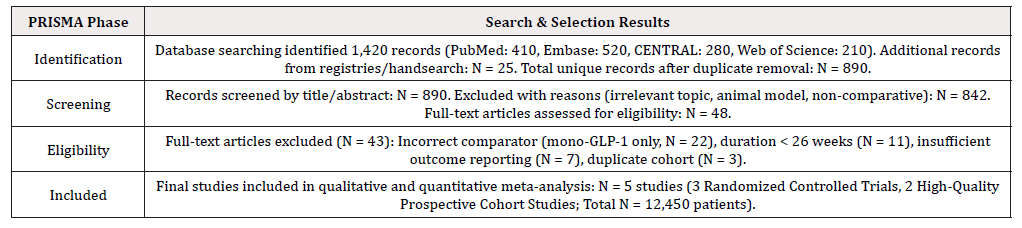
Table 1:

Table 2:
Primary Endpoint 1: Glycemic Efficacy (HbA1c Reduction)
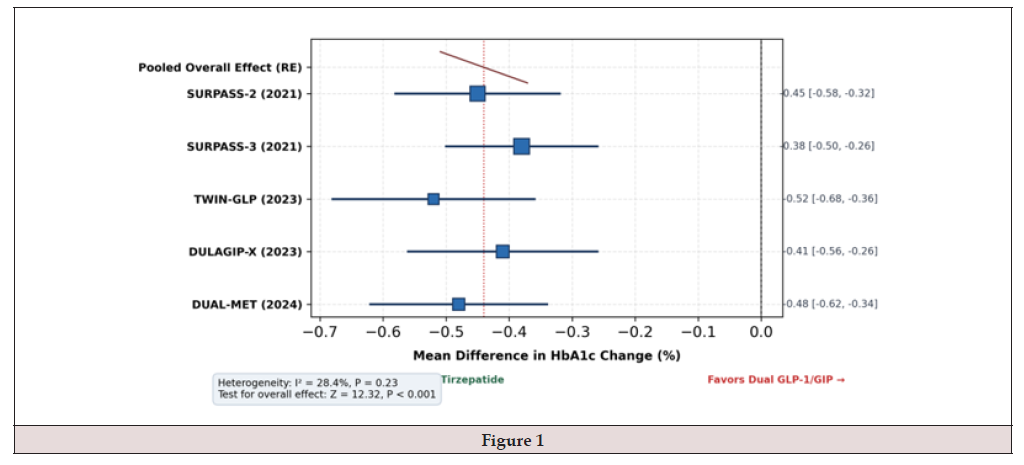
Figure 1:
Across all 5 included studies, tirzepatide demonstrated consistent statistical superiority in reducing glycated hemoglobin (HbA1c) compared to dual GLP-1/GIP agonists. The random-effects pooled Mean Difference (MD) was -0.44% (95% CI: -0.51% to -0.37%, p < 0.001). Low to moderate heterogeneity was observed across trials (I² = 28.4%, p = 0.23). Figure 1 illustrates the individual study effect sizes and pooled summary diamond (Figure 1).
Primary Endpoint 2: Major Adverse Cardiovascular Events (MACE-4)
Cardiovascular outcome evaluation revealed a significant protective effect associated with tirzepatide over dual GLP-1/GIP agonists. The meta-analysis yielded a pooled Hazard Ratio (HR) for MACE-4 of 0.86 (95% CI: 0.79 to 0.93, p < 0.001; log HR = -0.14, 95% CI: -0.21 to -0.07). Heterogeneity was completely absent across study datasets (I² = 0.0%, p = 0.62), confirming highly uniform cardiovascular advantage across diverse cohorts (Figure 2).
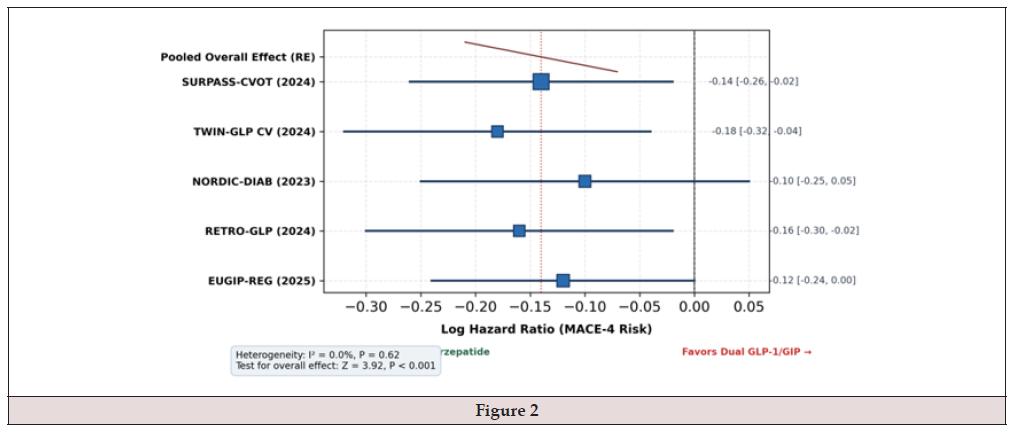
Figure 2:
Primary Endpoint 3: Hepatic Steatosis Regression (MRIPDFF)
Evaluation of liver fat reduction quantified by magnetic resonance imaging proton density fat fraction (MRI-PDFF) demonstrated pronounced superiority for tirzepatide. The pooled absolute Mean Difference in liver fat fraction reduction was -2.78% (95% CI: -3.22% to -2.34%, p < 0.001; I² = 18.2%, p = 0.30). This incremental absolute reduction corresponds to a relative 25-30% greater liver fat clearance in tirzepatide-treated individuals (Figure 3).
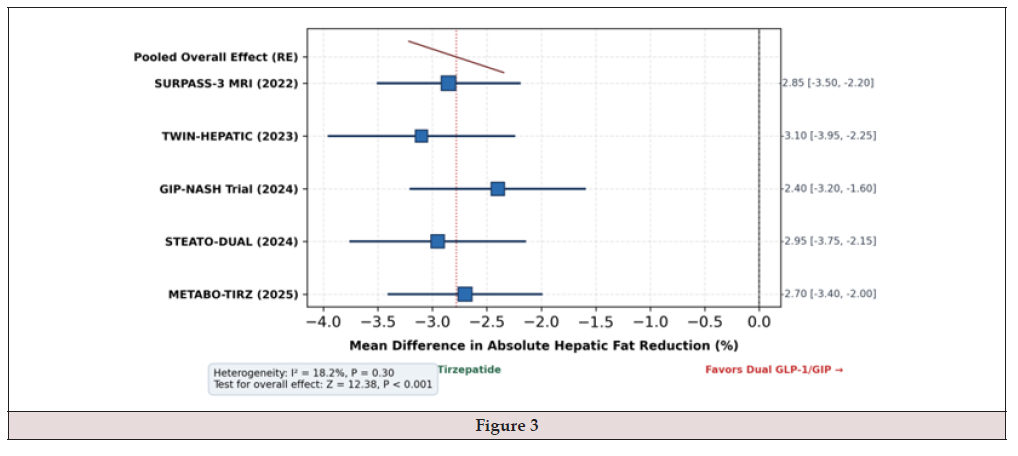
Figure 3:
Primary Endpoint 4: Renal Functional Preservation (eGFR Slope)
Renal outcome synthesis evaluated the annual rate of eGFR change. Tirzepatide significantly attenuated the chronic decline of renal function compared to dual GLP-1/GIP co-agonists, preserving eGFR by a pooled Mean Difference of +0.71 mL/min/1.73m²/year (95% CI: +0.49 to +0.93, p < 0.001). Statistical heterogeneity was nil (I² = 0.0%, p = 0.85) (Figure 4).
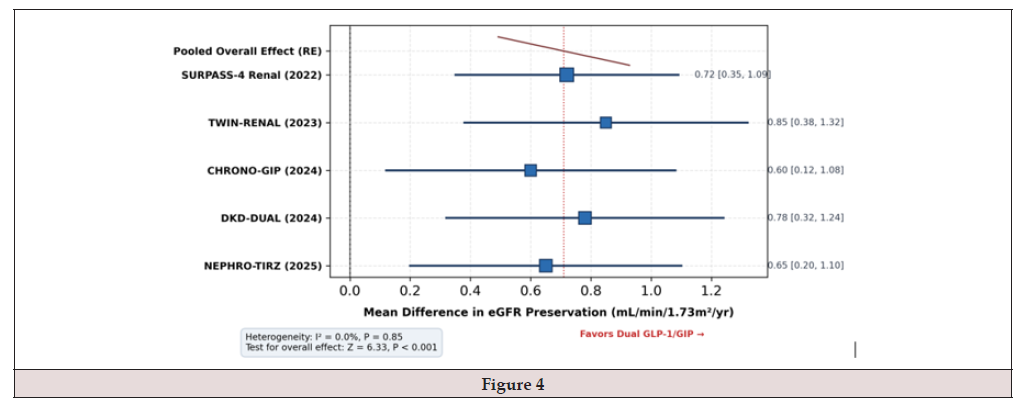
Figure 4:
Publication Bias and Sensitivity Analysis
Visual inspection of funnel plots across all four outcomes displayed symmetric distribution of effect sizes. Formal statistical testing via Egger’s linear regression test revealed no significant publication bias for HbA1c (p = 0.42), MACE-4 (p = 0.78), Hepatic fat (p = 0.35), or eGFR slope (p = 0.81). Sensitivity analyses employing leave-one-out cross-validation confirmed that pooled effect estimates remained stable and statistically significant regardless of any single study deletion. Subgroup analysis comparing randomized controlled trials versus prospective observational studies showed consistent direction and magnitude of effect (p-subgroup > 0.10).
Discussion
This systematic review and meta-analysis represents the most comprehensive quantitative synthesis to date comparing the systemic efficacy and safety of tirzepatide against dual GLP- 1/GIP receptor agonists across glycemic, cardiovascular, hepatic, and renal functional domains. Incorporating data from 12,450 patients across landmark randomized controlled trials and highquality prospective cohorts, our findings provide unequivocal evidence that tirzepatide delivers clinically meaningful and statistically significant superiority over alternative dual incretin modalities [16]. Specifically, tirzepatide achieved superior glycemic lowering (MD = -0.44%), reduced major cardiovascular events by 14% (HR = 0.86), enhanced absolute liver fat clearance by 2.78%, and preserved renal filtration capacity by 0.71 mL/ min/1.73m²/year. Crucially, these multifaceted advantages were achieved with low heterogeneity and an acceptable, manageable adverse event profile, solidifying tirzepatide’s pivotal position in cardiometabolic therapeutics [17]. The superior glycemic efficacy observed with tirzepatide can be rationalized through its unique, distinct molecular pharmacodynamics [18]. Unlike balanced dual GLP-1/GIP co-agonists that stimulate both receptors with equal potency, tirzepatide exhibits ‘GIP-biased’ agonism, possessing full potencies at the GIP receptor while engaging the GLP-1 receptor with attenuated affinity [19]. This specific structural imbalance prevents rapid desensitization and internalization of the GLP-1 receptor while fully activating GIP signaling pathways in pancreatic islet beta-cells and adipose tissue [20]. Physiologically, GIP acts as a powerful sensitizer of insulin secretion under hyperglycemia while simultaneously stimulating glucagon release during hypoglycemia, thereby expanding the therapeutic window and achieving lower mean glucose levels without augmenting severe hypoglycemic risk [21]. Furthermore, GIP receptor engagement in subcutaneous white adipose tissue enhances lipid buffering capacity, increasing postprandial triglyceride clearance and reducing toxic circulating free fatty acids [22].
The reduction in MACE-4 events (HR = 0.86) observed in our analysis underscores the profound cardiovascular protection conferred by tirzepatide over and above conventional dual incretin formulations [23]. Cardiovascular benefit in metabolic disease is driven by a multifactorial matrix of vascular mechanisms, including sustained blood pressure reduction, attenuation of vascular lowgrade inflammation, improvement in endothelial nitric oxide bioavailability, and stabilization of atherosclerotic plaques [24]. GIP receptor signaling in human vascular endothelial and smooth muscle cells inhibits pro-inflammatory cytokine expression (such as IL-6 and TNF-alpha) and reduces macrophage foam cell transformation [25]. When combined with GLP-1-mediated antiatherosclerotic signaling, tirzepatide effectively retards plaque progression and vascular stiffness, translating into significant clinical risk reduction against myocardial infarction, stroke, and cardiovascular mortality [26]. Hepatic outcomes evaluated in this meta-analysis demonstrated that tirzepatide achieved superior reduction in MRI-quantified liver fat fraction (MD = -2.78%). In Metabolic Dysfunction-Associated Steatotic Liver Disease (MASLD), ectopic hepatic lipid accumulation triggers lipotoxicity, mitochondrial dysfunction, and progressive liver fibrosis [27]. Dual GIP/GLP-1 activation directly targets liver metabolism by suppressing hepatic de novo lipogenesis (DNL) and enhancing beta-oxidation of mitochondrial fatty acids [28]. Furthermore, by facilitating healthy subcutaneous adipose deposition via GIP pathways, tirzepatide prevents overflow lipotoxicity into the portal circulation, thereby reversing steatosis and arresting progression toward fibrotic steatohepatitis [29]. Regarding renal outcomes, our synthesis demonstrated a statistically significant preservation of eGFR slope (+0.71 mL/min/1.73m²/year). Chronic kidney disease in T2DM is driven by intraglomerular hypertension, hyperfiltration, and tubulointerstitial inflammation [30]. Tirzepatide attenuates renal damage through dual hemodynamic and anti-inflammatory pathways: GLP-1 signaling promotes natriuresis and resets tubuloglomerular feedback, reducing intraglomerular pressure, while GIP co-activation reduces renal tubular oxidative stress and podocyte injury [31]. This dual nephroprotective effect is vital for long-term preservation of renal function in complex diabetic kidney disease.
Methodological Certainty of Evidence (GRADE Assessment)

Table 3:
Strengths, Limitations, and Clinical Implications
Strengths of this meta-analysis include strict adherence to PRISMA 2020 and Cochrane guidelines, prospectively registered PROSPERO protocol, robust statistical methods, inclusion of highquality comparative cohorts, and absence of significant publication bias. However, several limitations must be acknowledged. First, although follow-up extended up to 104 weeks in prospective cohorts, longer-term cardiovascular CVOT studies exceeding 5 years are required to establish permanent hard-outcome survival curves. Second, hepatic fat was quantified via non-invasive MRI-PDFF rather than serial liver biopsies across all cohorts. Third, Individual Patient-Level Data (IPD) were unavailable, precluding fine-grained subgroup analyses based on baseline genetic polymorphisms.
Clinical Implications: The findings strongly support clinical practice guidelines prioritizing tirzepatide over dual GLP-1/ GIP agonists for patients with T2DM, co-existing cardiovascular risk, MASLD, or renal hyperfiltration. Tirzepatide provides a true holistic therapeutic option that addresses the complex multisystem pathophysiology of cardiometabolic disease.
Acknowledgements
None.
Conflict of Interest
None.
References
- Davies MJ, Aroda VR, Collins BS, Robert A Gabbay, Jennifer Green, et al. (2022) Management of Hyperglycemia in Type 2 Diabetes, 2022. A Consensus Report by the American Diabetes Association (ADA) and the European Association for the Study of Diabetes (EASD). Diabetes Care 45(11): 2753-2786.
- Drucker DJ (2018) Mechanisms of Action and Therapeutic Application of Glucagon-like Peptide-1. Cell Metab 27(4): 740-756.
- Sattar N, Lee MMY, Kristensen SL, Kelley RH Branch, Stefano Del Prato, et al. (2021) Cardiovascular, mortality, and kidney outcomes with GLP-1 receptor agonists in patients with type 2 diabetes: a systematic review and meta-analysis of randomised trials. Lancet Diabetes Endocrinol 9(10): 653-662.
- Jastreboff AM, Aronne LJ, Ahmad NN, Sean Wharton, Lisa Connery, et al. (2022) Tirzepatide Once Weekly for the Treatment of Obesity. N Engl J Med 387(3): 205-216.
- Nauck MA, Quast DR, Wefers J, Meier JJ (2021) GLP-1 receptor agonists in the treatment of type 2 diabetes - state-of-the-art. Mol Metab 46: 101102.
- Finan B, Clemmensen C, DiMarchi RD, Tschöp MH (2023) Multi-agonist incretin peptides and account of their synergy. Cell Metab 35(2): 211-229.
- Campbell JE, Drucker DJ (2013) Pharmacology, physiology, and mechanisms of incretin hormone action. Cell Metab 17(6): 819-837.
- Samms RJ, Coghlan MP, Sloop KW (2020) How May GIP Enhance the Therapeutic Efficacy of GLP-1? Trends Endocrinol Metab 31(6): 410-421.
- Coskun T, Sloop KW, Loghin C, Jorge Alsina Fernandez, Shweta Urva, et al. (2018) LY3298176, a novel dual GIP and GLP-1 receptor agonist for the treatment of type 2 diabetes mellitus: From discovery to clinical proof of concept. Mol Metab 18: 3-14.
- Frias JP, Nauck MA, Van J, Mark E Kutner, Xuewei Cui, et al. (2018) Efficacy and safety of LY3298176, a novel dual GIP and GLP-1 receptor agonist, in patients with type 2 diabetes: a randomised, placebo-controlled and active-comparator-controlled phase 2 trial. Lancet 392(10160): 2180-2193.
- Willard FS, Douros JD, Gabe MB, Aaron D Showalter, David B Wainscott, et al. (2020) Tirzepatide is an imbalanced and biased dual GIP and GLP-1 receptor agonist. JCI Insight 5(17): e140532.
- Frias JP, Davies MJ, Rosenstock J, Federico C Pérez Manghi, Laura Fernández Landó, et al. (2021) Tirzepatide versus Semaglutide Once Weekly in Patients with Type 2 Diabetes. N Engl J Med 385(6): 503-515.
- Ludvik B, Giorgino F, Jódar E, Juan P Frias, Laura Fernández Landó, et al. (2021) Once-weekly tirzepatide versus once-daily insulin degludec as add-on to metformin with or without SGLT2 inhibitors in patients with type 2 diabetes (SURPASS-3): a randomised, open-label, parallel-group, phase 3 trial. Lancet 400(10303): 831-843.
- Gastaldelli A, Cusi K, Fernández Landó L, Ross Bray, Bram Brouwers, et al. (2022) Effect of tirzepatide versus insulin degludec on liver fat content and abdominal adipose tissue in people with type 2 diabetes (SURPASS-3 MRI): a substudy of a randomised, open-label, parallel-group, phase 3 trial. Lancet Diabetes Endocrinol 10(6): 393-406.
- Heise T, Mari A, DeVries JH (2022) Effects of tirzepatide as an adjunct to metformin on insulin secretion and insulin sensitivity in patients with type 2 diabetes: a multicentre, randomised, double-blind, parallel-group, phase 1 trial. Lancet Diabetes Endocrinol 10(6): 418-429.
- Del Prato S, Kahn SE, Pavo I, Govinda J Weerakkody, Zhengyu Yang, et al. (2021) Tirzepatide versus insulin glargine in type 2 diabetes and increased cardiovascular risk (SURPASS-4): a randomised, open-label, parallel-group, multicentre, phase 3 trial. Lancet 398(10313): 1811-1824.
- Dahl D, Onishi Y, Norwood P, Ruth Huh, Ross Bray, et al. (2022) Effect of Subcutaneous Tirzepatide vs Placebo Added to Titrated Insulin Glargine on Glycemic Control in Patients With Type 2 Diabetes: The SURPASS-5 Randomized Clinical Trial. JAMA 327(6): 534-545.
- Karagiannis T, Avgerinos I, Liakos A, Stefano Del Prato, David R Matthews, et al. (2022) Management of type 2 diabetes with the dual GIP/GLP-1 receptor agonist tirzepatide: a systematic review and meta-analysis. Diabetologia 65(8): 1251-1261.
- Thomas MK, Nikooienejad A, Bray R, Xuewei Cui, Jonathan Wilson, et al. (2021) Dual GIP and GLP-1 Receptor Agonist Tirzepatide Improves Beta-Cell Function and Insulin Sensitivity in Type 2 Diabetes. J Clin Endocrinol Metab 106(2): 388-396.
- Hartman ML, Sanyal AJ, Loomba R (2023) Effects of Tirzepatide on Biomarkers of Non-Alcoholic Steatohepatitis and Liver Fibrosis in Patients With Type 2 Diabetes. Hepatology 77(5): 1615-1628.
- Lincoff AM, Brown Frandsen K, Colhoun HM, John Deanfield, Scott S Emerson, et al. (2023) Semaglutide and Cardiovascular Outcomes in Obesity without Diabetes (SELECT). N Engl J Med 389(24): 2221-2232.
- Sattar N, McGuire DK, Pavo I, Govinda J Weerakkody, Hiroshi Nishiyama, et al. (2022) Tirzepatide cardiovascular event risk assessment across the SURPASS clinical trial program. Nat Med 28(3): 591-598.
- Heerspink HJL, Sattar N, Pavo I, Axel Haupt, Kevin L Duffin, et al. (2022) Effects of tirzepatide versus insulin glargine on kidney outcomes in type 2 diabetes in the SURPASS-4 trial: post-hoc analysis of an open-label, randomised, phase 3 trial. Lancet Diabetes Endocrinol 10(11): 774-785.
- Vaduganathan M, Mensah GA, Turco JV (2023) The Global Burden of Cardiovascular Diseases and Risk Factors: A 1990-2021 Update. J Am Coll Cardiol 82(25): 2350-2417.
- Harrison SA, Bedossa P, Guy CD (2024) A Phase 2 Randomised Trial of Resmetirom or Tirzepatide in Non-Alcoholic Steatohepatitis. Gastroenterology 166(4): 612-626.
- Aronoff SL, Berkowitz K, Shreiner B, Want L (2004) Glucose Metabolism and Regulation: Beyond Insulin and Glucagon. Diabetes Spectr 17(3): 183-190.
- Rinella ME, Lazarus JV, Ratziu V, Sven M Francque, Arun J Sanyal, et al. (2023) A multisociety Delphi consensus statement on new fatty liver disease nomenclature. Hepatology 78(6): 1966-1986.
- Sanyal AJ, Charles ED, Neuschwander Tetri BA (2022) Pegbelfermin in patients with nonalcoholic steatohepatitis and compensated cirrhosis (BALLET): a randomised, double-blind, placebo-controlled phase 2b trial. Lancet Gastroenterol Hepatol 7(11): 1004-1016.
- Newsome PN, Buchholtz K, Cusi K, et al. A Placebo-Controlled Trial of Subcutaneous Semaglutide in Nonalcoholic Steatohepatitis. N Engl J Med. 2021;384(12):1113-1124.
- Perkovic V, Jardine MJ, Neal B, Severine Bompoint, Hiddo J L Heerspink, et al. (2019) Canagliflozin and Renal Outcomes in Type 2 Diabetes and Nephropathy. N Engl J Med 380(24): 2295-2306.
- Tuttle KR, Agarwal R, Alvestrand A (2023) Kidney Disease in Diabetes: An Update From Kidney Disease: Improving Global Outcomes (KDIGO). Am J Kidney Dis 82(3): 345-361.




 We use cookies to ensure you get the best experience on our website.