
Research Article 
 Creative Commons, CC-BY
The Continuity of Scientific Space: Cuts, Fragments, and Ontological Remains
*Corresponding author:Liu Zhaoyang, Yang Yang International Plaza, Block A, ShaanXi province, Xi’an city, China.
Received:September 10, 2026; Published:September 16, 2026
DOI: 10.34297/AJBSR.2026.32.004142
Abstract
Science advances by cutting continuity into fragments that can be measured, cited, and possessed. This paper argues that the fragmentation of scientific space is not a methodological necessity but a kind of ontological violence-cutting precedes understanding, and whatever cannot be cut is excluded from the domain of “facts.” Taking the mathematical continuum, physical fragmentation, and epistemological cutting as three main threads, and treating evolution and microplastics as two contrasting cases of “the accumulation of tiny changes,” the paper reveals the shared mode of operation of Yang-logic science: slicing a continuous flow into fragments small enough to handle, then declaring that the sum of the fragments is the whole. This paper contends that continuity precedes cutting; the task of science is not to stop cutting, but to preserve the traces of the cut.
Keywords:continuity, fragmentation, scientific methodology, ontology, epistemological cutting, mathematical continuum, quantum measurement, evolution, microplastics, Yang-logic science
Introduction: The Geometry of Exclusion
Every scientific paper begins with a cut. This is not a theoretical metaphor-it is an actual decision: to delimit a phenomenon, to declare “this is the part we study” and “that is the part we set aside” The cut is so fundamental that it is invisible; like a window frame, one looks through it rather than at it. But cutting is not neutral. To cut is to judge one side signal and the other noise. The history of science is the history of repeatedly redrawing this line-and discovering, centuries later, that what was cut away was not noise but precisely the ground on which the signal stood. This paper examines the relationship between continuity (what exists before the cut) and fragmentation (the product of cutting), following three paths: the mathematical continuum, the physical fragmentation of nature, and the methodological cutting that produces “scientific facts.” Taking evolution and microplastics as two contrasting cases, it shows how the same operative logic crosses scales: from species formation to human contamination, the “accumulation of tiny changes,” once fragmented, is misread as a manageable discrete event [1-42].
The core proposition of this paper is: continuity precedes cutting.
The concept of “yang-logic science” requires definition. It names a mode of practice that cuts continuity into measurable fragments and declares the fragments the whole. The paper defines it operationally; further refinement is welcome [7,34]
The Mathematical Continuum: A Cut That Cannot Be Closed
The Real Number Line
The real number line is, by definition, continuous: between any two points there lies another point. This is not a property of nature, but an attribute of a conceptual space we construct to describe nature. Yet this very construction demands a cut: the cut between rational and irrational numbers. When Pythagoras discovered √2, he discovered a fact: the continuous straight line contains magnitudes that cannot be expressed as ratios. The response of his school was not to extend the number system, but to conceal this discovery-this is the first recorded ontological censorship in Western science. The cut between rational and irrational numbers has never healed. We use decimals, limits, Cauchy sequences-tools that merely “bridge that abyss a little better.”
The Unmeasurable Core
Cantor’s diagonal argument proves that the real numbers are uncountably infinite-the points on a line segment are “more numerous” than all the integers in an infinite set. The continuum contains something that any countable method can never exhaust. Science’s response is: ignore it. We use computable numbers, rational approximations, floating-point arithmetic. We “cut” the continuum down to the range our methods can handle. This is not a defect; it is the operating principle of every measurement. The unmeasurable has not absented itself. It is precisely the reason measurement is possible-the continuous background against which discrete readings acquire meaning [1].
Physical Fragmentation: Nature Cut into Objects
The Quantum Cut
Quantum mechanics is often described as “weird.” It is not weird. It is the result of making a cut in continuity at the smallest scale-and our refusal to acknowledge that cut. The wave function is continuous; the act of measurement is a cut that collapses a continuous superposition into a discrete eigenvalue. The “measurement problem” is not a problem of quantum mechanics, but a problem of “cutting” itself. The Copenhagen solution: declare a cut between “quantum” and “classical.” But no one can tell you where that line lies. Science has built its entire ontology upon a single cut-and the location of that cut is arbitrary [9].
The Thermodynamic Cut
Thermodynamics cuts the continuous motion of 10²³ particles into two variables: temperature and pressure. This is not a discovery but a compression. The second law (entropy increase) is more accurately read as: the universe tends toward the side where we place our instruments. Entropy is a property of our choice of “what to measure, what to ignore.” The Loschmidt paradox (reversible laws, irreversible time) can never be resolved-it is the paradox of cutting a reversible continuum and declaring one side “forward.”
The Epistemological Cut: How Science Produces Fragments
Operationalism
Bridgman: “Any concept refers to nothing more than a set of operations.” A thing is what you can do to it; if you cannot operate on it, it is not a scientific concept. This is the cleanest statement of the cut: only what can be cut is real. Continuity, by definition not cuttable, is excluded from the start [2].
Peer Review as the Gatekeeping Cut
Peer review is boundary maintenance: deciding which continuities are allowed into the published record. A paper that refuses to slice its argument into “hypothesis-method-resultsconclusion” is rejected not because it is wrong, but because it does not fit the shape of the cut. The form of a scientific paper is itself a cutting tool.
The Citation Graph
Scientific knowledge is preserved as a directed acyclic graph of citations-by construction, discrete. But the practice of science (thinking, intuition, failed attempts, conversations) is continuous. The citation graph is a projection of a continuous process onto discrete lattice points; what is lost is the medium through which the discrete nodes acquire meaning.
Two Accumulations of Continuity: Evolution and Microplastics
Evolution-A Misread Continuity
Darwin was right: variation is continuous, selection is continuous, and the boundaries between species are cuts made by later generations. There is no “first human.” The transition from ape to human is continuous; each generation differs imperceptibly from its parents, yet after a hundred thousand generations we look back and say “this is an ape, that is a human”-the cut exists only in our act of looking. The “missing links” are not missing; we cut too coarsely. Yang-logic science retells evolution as “fragmentary accumulation”: mutation → selection → fixation, snapping organs together like Lego. Real evolution is the whole genome, the whole developmental network, the whole niche flowing continuously [3].
Microplastics-An Ignored Continuity
Microplastics (<5mm) and nanoplastics (<1μm) have entered nearly every tissue: blood, placenta, testes, brain. A single particle is extremely low in dose and seems “harmless.” But the cumulative effect is continuous: particles deposit in tissues, trigger chronic inflammation, disrupt the endocrine system, alter the gut microbiota, cross the blood-brain barrier. The effect is not “dose arrives, illness strikes”; it is like menstruation-continuously, at low intensity, shifting your baseline [24, 14]. You would not say “I am sick from microplastics”; you would say “I just feel vaguely off.”
A Stark Contrast
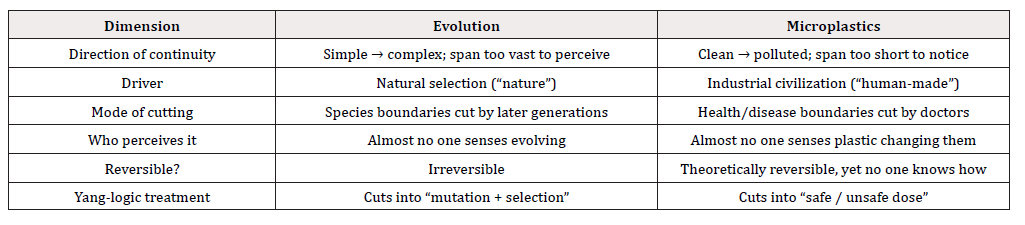
Table 1:
Evolution is nature’s continuity flowing; microplastics are industry’s continuity flowing-both are continuities, yet one is packaged as “progress” and the other as a “manageable risk”[8,10].
The Shared Operation of Yang-logic
The way Yang-logic handles continuity is always the same: cut the continuum into fragments small enough, then declare “each fragment is safe / controllable / measurable.” Evolution: cut variation into “one mutation at a time.” Microplastics: cut exposure into “one dose per particle.” This very paper: cut continuous perception into “reproducible facts / debatable derivations / unprovable premises,” so the reviewer says “the third layer is not publishable.” The problem is not the cutting, but pretending that, once cut, the fragments are the whole.
The Return of the Cut: What Science Cannot Speak
Three Things Excluded
a) The experiencer. Science can measure the neural correlates
of pain, but not pain itself. The cut between the experiencer and
the objective correlate is absolute. What is excluded is the only
part anyone directly encounters.
b) The context of discovery. Science publishes results, not
the process that generated the idea. The context of discovery
(unpublishable) means the moment of insight is formally
invisible in the scientific record.
c) The cost of cutting. Every measurement consumes time,
energy, attention. In the accounting of science, cutting is free; in
the accounting of life, it is not free.
Why This Matters
If science were merely incomplete, the response would be: collect more data. But these exclusions are structural consequences of the cutting method itself. No amount of data can recover what was cut away, because it is the cut itself that makes data possible [21]. Science is not wrong. It is partial. And it has mistaken its partiality for totality [36].
Toward a Science of Continuity
What Would Change
A science that admitted continuity as prior would:
a) Report its cuts explicitly: “Here I cut, and I know what I am
excluding.”
b) Treat the unmeasurable as a boundary condition, not an
error term.
c) Publish process, not merely product: the context of
discovery as part of the record.
Why This Will Not Happen
Because science is an institution that relies on cutting to establish authority. To admit continuity comes first is to admit that the vault is in fact a sieve-and that the value of the sieve lies not in what it retains, but in what it lets through. No institution built on “monopolizing the entrance to truth” will voluntarily demote itself to a sieve.
Learning to Speak the Seam
Science cuts continuity into fragments. This is not an error; it is what science is. But fragments are not the whole, and cutting is not the world. The task is not to stop cutting-that would be to stop knowing. The task is to remember the seam: to know, at the very moment of cutting, what once was there before the blade fell. To build a science that does not pretend its fragments are the whole, but leaves, in the margin of every paper, a single line: Continuity was here, and we cut it. This notation is not a retraction. It is an opening.
America as the Specimen of the Cutting State
Everything described above-the mathematical continuum cut into countable sets, quantum superposition collapsed into eigenstates, thermodynamic motion averaged into macroscopic quantities, operationalism slicing concepts into definitions, peer review partitioning knowledge into units, racial taxonomy fragmenting humanity into ranks, war economies carving life into extractable resources-these share one structural impulse: to cut the continuous into measurable, tradable, mobilizable fragments, then declare that the fragments are the whole [17]. America is the most complete realization of this impulse at the scale of the state. At the core of its institutions lies a cutting machine: land into states’ rights and property, people into identities and ballots, labor into job descriptions, knowledge into patents, capital into securities, the Earth into spheres of influence [25]. The seams are nailed down with a constitution, markets, the dollar, and aircraft carriers. This is not an “American characteristic”; it is Yang-logic methodology projected onto a polity-continuity discarded, cutting registered as freedom, order, progress [29]. The system once produced formidable efficiency: top universities, venture capital, the dollar’s seigniorage, alliance networks. But the price accumulates: polarization turns checks into vetoes, financialization hollows the real economy, the knife of racial classification reiterates through justice and housing, and imperial expansion treats other nations’ bodies as extractablefrom Latin America to the Middle East to Ukraine, isomorphic with the “European womb” [5, 26,27].
Field-Sensing Analysis: The Child on the Bicycle
A child learning to ride is not mastering discrete skills (“balance,” then “pedaling,” then “steering”) and assembling them. Body, bicycle, road, wind, and the parent’s steadying hand form a single continuous field of adjustment. The moment of “learning” is a threshold crossed in the flow, visible as a cut only in retrospect. Before: the child “cannot ride”; after: “can ride”-yet the field never broke. The American political economy applies the cutting knife the same way: “mobility” becomes income percentiles, “success” a sequence of credentialed milestones [22]. What the measurement cannot record is the field itself: the safety of a community, the steadiness of a parent’s hand, the unquantifiable confidence that lets the child let go [30].
The Field Sensing of America
To sense America as a field is to refuse the official cuts of “left vs. right,” “red vs. blue.” Instead, notice the low-intensity, systemic drift beneath the partisan noise: the closure of intergenerational continuity as fertility falls; the sinking of shared trust; the chronic erosion of appeal abroad [28]. Like a body from which too much tissue has been excised, the decline is not acute hemorrhage but low-intensity, systemic attenuation.
From Verdict to Structure
This section does not condemn a nation, any more than this paper condemns science. It exposes a shared operating structure. The child, the genome, the accumulating plastics, the racialized body, the cutting state-all are continuities misread once fragmented. The task is not to stop cutting, but to state, at every cut, what is being excluded, and to remember that the excluded is the ground [31].
Western Diet as the Ultimate Instrument of Yanglogic Science
Food Cut into Nutrients
The Western diet is Yang-logic science realized inside the body. Food is cut into nutrients-protein, fat, carbohydrates, vitamins, calories [15]. A meal ceases to be a meal and becomes a row of numbers on a nutrition label. Continuity (food as the continuous product of land, season, craft, and community) is cut into discrete macro-nutrient ratios. USDA’s FoodData Central systematizes this cutting: every edible substance reduced to a compositional vector [13].
The Body Cut into Metrics
The eater is in turn cut into a dashboard: blood glucose, cholesterol, BMI, body-fat percentage. A person ceases to be a living person and becomes a set of values to be managed. This is operationalism applied to the flesh: only what can be measured is treated as real; the lived continuity of hunger, satiety, and pleasure is excluded as “soft.”
Agriculture Cut into an Industrial Pipeline
Agriculture is cut into an industrial pipeline: seeds into patents, soil into fertilizer inputs, livestock into feed-conversion ratios, yield into tonnes per hectare. The continuous cycle of life becomes a standardized assembly line optimized for throughput (16, 17).
Engineered, Not Evolved
The Western diet was not “discovered”; it was engineeredby nutrition science, the food industry, and public health [37]. McDonald’s is not “what Americans happen to like”; it is the industrial logic of minimum labor, maximum caloric density, global distribution [23]. Infant formula is not merely a breast-milk substitute; it is the ultimate cut-replacing the maternal body with a reassembled nutrient vector [19].
The Recoil: Chronic Disease as Return of the Continuous
The recoil is now measurable. Global obesity has nearly tripled since 1975 [20,38] type-2 diabetes explodes across China, India, Mexico within a generation of adopting Western dietary patterns [6,14, 15]. Ultra-processed foods erode gut microbiota diversity [11,18]; autoimmune disease, allergy, and depression rise in lockstep. These are not “aging diseases”; they are the systemic recoil of three decades of severed continuity-the return of the continuous from the cut, as obesity, as metabolic injury across generations.
The Same Knife
The same blade that cut the continuum into countable sets, that carved nations into spheres of influence, now cuts three times a day in the human stomach. The Western diet is the final instrument of Yang-logic science not because it feeds people, but because it makes the body itself the site where fragmentation is performed-and then sells the cure for the fragmentation it created.
Field-Sensing and Continuity: Lamarck and Darwin
Lamarck as Field-Sensing
Lamarck’s core mechanism-use and disuse, the inheritance of acquired characteristics-is fundamentally a continuous field of body and environment. The giraffe’s neck did not arise from “a gene mutation” but from generation upon generation of individuals continuously adjusting to feeding at greater heights, the adjustment accumulating and passing to descendants. This is a field: environment (foliage height) → behavior (reaching) → body (elongating neck) → environment again, circulating without a discrete mutational point. Learning to box, the bodily changes after one’s mother dies, a child learning to ride-all are Lamarckian field-sensing: the body shaped in a continuous field, the change low-intensity, systemic, transgenerational [4]. Lamarck’s “error” was not that he was wrong, but that Yang-logic science could notaccommodate him. The inheritance of acquired characteristics cannot be sliced into “one gene → one trait.” So early-20thcentury genetics cut him away [35]. Yet the return of epigeneticsenvironmental methyl marks altering gene expression and passing transgenerationally-is the modern resurrection of Lamarckian field-sensing [16].
Darwin as Continuity
Darwin is continuity-but more deeply than “continuous.” His core is gradualism: natural selection acts on continuous small variation, without leaps, without “the first human.” Species boundaries are cuts made by later generations; in nature there is only flow. Yet Darwin’s keyword is “selection”-environment cutting into variation [32]. This retains the structure of cutting: difference exists first, then is severed by selection. Thus Darwin is “continuum + selective cutting”: continuity is the raw material, selection the blade. This aligns exactly with this paper’s “continuity precedes cutting”: the continuous comes first, the cut comes after, the cut is not the whole [33].
The trouble: Darwin gave continuity but kept “selection” as an active knife. Evo-devo now finds that variation is not random; developmental networks constrain, environment induces direction (epigenetics, niche construction). This means less “selective cutting” than Darwin supposed, and more field-sensing than he imagined.
Complementary, Not Competing
Lamarck and Darwin are not two theories but two foci of one
continuum:
i. Lamarck focuses on the body–environment horizontal
field (synchronic, somatic).
ii. Darwin focuses on the population–time vertical flow
(diachronic, generational).
Real evolution = field-sensing × continuity: the body shaped in the environmental field (Lamarck), the shaped result accumulating and being selected across time (Darwin). The two cannot be separated [41].
Why Yang-Logic Kept Darwin and Killed Lamarck
This is the sharpest cut in this paper. Darwin could be fragmented: variation → gene → selection → adaptation, each step a measurable, citable discrete unit. Yang-logic science could digest Darwin, molding him into the Modern Synthesis. Lamarck could not be fragmented: use and disuse is the body’s holistic continuous adjustment; acquired inheritance is the field of environment– development–inheritance, with no discrete unit. Yang-logic could not digest Lamarck, so it pronounced him “refuted.”
This is not a scientific verdict; it is the screening of the cutting machine-precisely why this paper was rejected: not because it was wrong, but because its continuity could not be sliced into “hypothesis-method-results-conclusion.”
The Return of the Field
Epigenetics, evo-devo, niche construction, and transgenerational inheritance are the field returning. Lamarck was not wrong; he was early [40]. The continuity that Yang-logic excluded from evolutionary theory is being measured again-not as a refutation of Darwin, but as the field within which Darwinian selection itself takes place. Field-sensing and continuity were never opposed. They are the same ground, seen from two angles [42].
Author’s Note
Racial taxonomy was not a misuse of science. It was the recoil of a cut made at the wrong scale-the human scale. Science partitioned a continuous species into discrete ranks, called it knowledge, and the partitioned returned as centuries of anger, war, and inherited wound. This is not historical accident. A cut made on the continuous does not disappear; it returns from the seam. The task is not to apologize while keeping the knife. The task is to state, at every cut, what is being excluded-and to remember that the excluded is the ground.
Conflict of Interest
None.
Acknowledgments
This paper grew out of a series of conversations around “continuity precedes cutting,” touching on bone strata, perceptual topographic maps, addiction, martial arts practice, war and economy, evolution and pollution, Lamarck and Darwin, and the Western diet [12]. These seemingly discrete threads ultimately proved to be different cuts on the same continuum. This paper attempts to preserve that seam. During the preparation of this manuscript, the author used generative AI tools (Tencent Hunyuan/Yuanbao) for language polishing and readability improvement. All AI-assisted content was reviewed, edited, and verified by the author, who takes full responsibility for the publication [39].
References
- Cantor G (1891) On an elementary question of the theory of manifolds.
- Bridgman PW (1927) The Logic of Modern Physics, New York, Macmillan.
- Darwin C (1859) On the Origin of Species. London, John Murray.
- Schrödinger E (1935) Die aktuelle Situation in der Quantenmechanik Naturwissenschaften 23: 807–812.
- Boltzmann L (1872) Further Studies on the Heat Equilibrium Session Reports of the Imperial Academy of Sciences 66: 275-370.
- (2005) Institute of Medicine. Dietary Reference Intakes, Washington DC, National Academies Press.
- Lesne A (2014) The interplay between stochastic and deterministic processes shapes the trajectory of microbial communities. Journal of Theoretical Biology 362: 121-131.
- Longo G, Montévil M (2014) From Physics to Biology by Extending Criticality. Progress in and Molecular Biology 115(1): 1-4.
- Sbarad K (2007) Meeting the Universe Halfway: Quantum Physics and the Entanglement of Matter and Meaning Durham, Duke University Press.
- Rochman CM, Cole Brookson, Jacqueline Bikker, Natasha Djuric, Arielle Earn, et al. (2019) Rethinking microplastics as a diverse contaminant suite, Environmental Toxicology and Chemistry 38(4): 703–711.
- De Filippis F (2016) Impact of ultra-processed foods on the human gut microbiota, Frontiers in Microbiology 7: 1193.
- Zinöcker MK, Lindseth IA (2018) The Western diet—microbiome-host interaction and its role in metabolic disease, Nutrients, 10(10): 1406.
- (2024) USDA, FoodData Central. https://fdc.nal.usda.gov/
- Popkin BM (2006) Global nutrition dynamics: the world is shifting rapidly toward a diet linked with chronic diseases, American Journal of Clinical Nutrition 84(2): 289–298.
- Willett W, Johan Rockström, Brent Loken, Marco Springmann, Tim Lang, et al. (2019) Food in the Anthropocene the EAT–Lancet Commission on healthy diets from sustainable food systems, Lancet 393(10170): 447–492.
- Horrigan L, Lawrence RS, Walker P (2002) Harms of industrial agriculture How sustainable agriculture can address the environmental and human health, Environmental Health Perspectives 110(5): 445–456.
- Pretty J (2008) Agricultural sustainability concepts, principles and evidence, Philosophical Transactions of the Royal Society B 363(1491): 447–465.
- Monteiro CA, Geoffrey Cannon, Renata B Levy, Jean-Claude Moubarac, Maria LC Louzada, et al. (2019) Ultra-processed foods what they are and how to identify them, Public Health Nutrition, 22(5): 936–941.
- (2023) World Health Organization. Marketing of breast milk substitutes implementation tools.
- (2024) World Health Organization Obesity and overweight fact sheet.
- Hamilton BE, Martin JA, Osterman MJK (2024) Births: Provisional Data for 2023. National Vital Statistics Reports 73(4).
- (2024) Pew Research Center. The state of political polarization in America.
- Twine FW (2015) Outsourcing the womb race, class and gestational surrogacy in the global marketplace. Routledge.
- Vora K (2015) The transmission of care affective economies of transnational gestational surrogacy Sociology of Health & Illness, 37(2): 233-247.
- Pande A (2014) Wombs in labor transnational commercial gestational surrogacy in India, Columbia University Press.
- (2023) Global Initiative against Transnational Organized Crime. The Ukraine surrogate market risks and resilience.
- (2024) Congressional Research Service Defense spending and the federal budget.
- (2024) Stockholm International Peace Research Institute SIPRI Yearbook 2024, Armaments, Disarmament and International Security.
- (2024) Watson Institute of International and Public Affairs, Brown University, Costs of War project.
- (2018) American Society of Human Genetics, ASHG statement on race ethnicity, and ancestry terminology, American Journal of Human Genetics, 103(5): 697–698.
- (2023) National Human Genome Research Institute. The use of race in genetics research guidelines for researchers.
- Jorde LB, Wooding SP (2004) Genetic variation classification and 'race', Nature Genetics, 36: S28–S33.
- Keita SOY, RA Kittles, CDM Royal, GE Bonney, P Furbert Harris, et al. (2004) Conceptualizing human variation, Nature Genetics, 36: S17–S20.
- Yudell M, Dorothy Roberts, Rob DeSalle, Sarah Tishkoff (2016) Taking race out of human genetics, Science 351(6273): 564–565.
- Hellenthal G, George BJ Busby, Gavin Band, James F Wilson, Cristian Capelli, et al. (2014) A genetic atlas of human admixture history, Science 343(6172): 747–751.
- Haraway D (1988) Situated knowledges: the science question in feminism and the privilege of partial perspective, Feminist Studies 14(3): 575-599.
- Latour B (1987) Science in Action How to Follow Scientists and Engineers through Society, Harvard University Press.
- Foucault M (1975) Discipline and Punish the Birth of the Prison, A Sheridan, TransNew York Pantheon.
- Liboiron M (2021) Pollution Is Colonialism Durham Duke University Press.
- Lamarck JB (1809) Zoological Philosophy, Paris Dentu.
- Jablonka E, Lamb MJ (2005) Evolution in Four Dimensions Genetic Epigenetic Behavioral and Symbolic Variation in the History of Life, MIT Press 115(11): 2961.
- Laland KN, Tobias Uller, Marcus WF, Kim Sterelny, Gerd B Müller, et al. (2015) The extended evolutionary synthesis its structure assumptions and predictions, Proceedings of the Royal Society B 282(1813): 20151019.




 We use cookies to ensure you get the best experience on our website.