
Research Article 
 Creative Commons, CC-BY
Spacetime Conversion and Distance of Time Travel: Research on the Application of Life’s Flash in Spacetime Physics
*Corresponding author:Ming Tian, Yangjiang Nuclear Power Plant, China General Nuclear Power Corp, Yangjiang, Guangdong Province, 529941, China.
Received:September 15, 2025; Published:September 22, 2025
DOI: 10.34297/AJBSR.2025.28.003708
Abstract
The reason why spacetime conversion occurs is that the displacement change of an object at time t1 only occurs in t1 spacetime, and its displacement change at time t2 only occurs in t2 spacetime, etc. The motion path of an object is a polyline, and the shortest distance between the ends of the polyline is the distance of time travel. Because the polyline passes through n (a large number) dimensions, its distance of time travel is surprisingly short, giving us a more concrete understanding of time travel.
Keywords:Spacetime conversion, Time travel, Distance of time travel, Flash, Polyline, Material world, Dimension
Introduction
When we walk on the beach, the lost time is like our footprints left behind. May I ask, when we look back at those footprints, where are our past selves? Now we use the observer’s flash to time and answer this question. “Thinking or feeling is composed of one flash in series with another. Using a movie as an analogy, successive scenes are played in rapid succession from frame to frame … Simply put, flash is a sudden thought, as fast and short as lightning.” [1] Leibniz said, “Thousands of facts lead us to believe that there are an infinite number of continuous perceptions within us” [2]. Assuming that a light source emits a beam of parallel light (light L), an observer (life Y) starts timing. The time of No.1 flash is recorded as time t1 , the time of No.2 flash is recorded as time t2 , etc (Figure 1).

Figure 1:Diagram of the relationship between flash and time.
The spatial region perceived by life Y at time tx , i.e., the material world m(tx ) of life Y at time tx , is referred to as tx spacetime of life Y (abbreviated as tx spacetime) in this article. At time tx , light L exists in tx spacetime; when light L appears in t x+1 spacetime, we refer to this spatiotemporal change as spacetime conversion. This article starts with the motion path of light to study the law of spacetime conversion, and we hope to provide new method for the study of spacetime physics.
The First Spacetime Conversion
Assume that life Y observes the entire process of light L traveling, that is:
a) The light source emits light L at A0 .
b) At the end of time t1 , light L reaches location A1 .
c) At the end of time t2 , light L reaches location A2 , etc.
In t1 spacetime, light L travels from (A0 +α ) to A1 , where α represents infinitesimal. The distance from (A0 +α ) to A1 is denoted as A0 A1 . The phenomenon of light L traveling in t1 spacetime is denoted as Lt1 . In t2 spacetime, light L travels from 1 (A1 +α ) to A2 , and the distance from (A1 +α ) to A2 is denoted as A1 A2 . The phenomenon of light L traveling in t2 spacetime is denoted as Lt2 . Although life Y sees A0 , A1 and A2 as shown in Figure 2, the path taken by light L in t2 spacetime is only Lt2 (Figure 2).

Figure 2:A common diagram illustrating the path taken by light L.
In t2 spacetime, light L does not actually pass through Lt1 (Figure 2). If Lt1 appears in t2 spacetime, life Y will simultaneously see the following two phenomena:
a) Light L travels from A1 to A2 .
b) Light L travels from A0 to A1 .
The simultaneous appearance of light L in two locations is obviously not in line with the facts. If Lt1 is not perpendicular to t2 spacetime, then the vertical projection of Lt1 in t2 spacetime is not zero, and the component of L1 in t2 spacetime is denoted as projt2 (Lt1) . In this way, life Y can simultaneously observe Lt2 and projt2 (Lt1) in t2 spacetime, which means that light L appears in two locations at the same time. This is obviously not true. In short, Lt1 is perpendicular to t2 spacetime. When light L appears in t2 spacetime, the first spacetime conversion occurs. Because Lt2 is located in t2 spacetime, we further obtain Lt1 ⊥ Lt2 . And Lt1 ⊥ Lt2 can be represented by Figure 3, where “a” represents the distance traveled by light L in one flash of time (Figure 3).
Assume that A0-2 represents the actual distance traveled by light L from the start of timing to the end of time t2 .
A0-2 = A0 A1 + A1 A2 = 2a .
Assume that Lt0,t2 represents the length of the dashed line connecting A0 and A2 in Figure 3. Its physical meaning is the distance of time travel, which will be described in detail below.
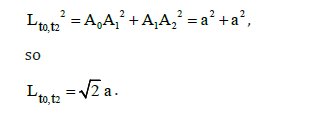

Figure 3:The actual path taken by light L at the end of time t2 .
The Second Spacetime Conversion
The phenomenon of light L traveling in t3 spacetime is denoted as Lt3 . If Lt2 and Lt1 appear in t3 spacetime, life Y will simultaneously see the following three phenomena:
a) Light L travels from A2 to A3 .
b) Light L travels from A1 to A2 .
c) Light L travels from A0 to A1 .
The simultaneous appearance of light L in three locations is obviously not in line with the facts. If Lt2 and Lt1 are not perpendicular to t3 spacetime, then their vertical projections in t3 spacetime are not zero, and their components in 3 t spacetime are denoted as projt3 (Lt2 ) and t3 t1 proj (L ) , respectively. Life Y can simultaneously observe Lt3 , projt3 (Lt2 ) , and projt3 (Lt1) in t3 spacetime, which means that light L appears in three locations at the same time. This is obviously not true. In short, Lt2 and Lt1 are perpendicular to t3 spacetime. When light L appears in t3 spacetime, the second spacetime conversion occurs. Because Lt3 is located in t3 spacetime, we further obtain Lt2 ⊥ L3 and Lt1 ⊥ Lt3 . If Lt1 ⊥ Lt2 , Lt1⊥ Lt3 and Lt2 ⊥ Lt3 hold simultaneously, we use Lt1 ⊥ Lt2 ⊥ Lt3 to represent their relationship. Lt1 ⊥ Lt2 ⊥ Lt3 can be shown by Figure 4, which depicts a three-dimensional image on a plane, so the shape becomes abstract, but the algebraic relationship is correct (Figure 4).

Figure 4:The actual path taken by light L at the end of time t3.
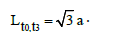
Assume that A0-3 represents the actual distance traveled by light L from the start of timing to the end of time t3 .
A0-3= A0 A1+ A1 A2+ A2 A3= 3a.
Assume that Lt0,t3 represents the length of the dashed line connecting A0 and A3 .

so
At the end of time tn , light L reaches An , as shown in Figure 5. Similarly, when light L appears in n t spacetime, spacetime conversions have occurred (n-1) times, and Lt1 ⊥ Lt2 ⊥...⊥ Lt(n-1) ⊥ Ltn holds (Figure 5).

Figure 5:The actual path taken by light L at the end of time t2 .
Assume that A0-n represents the actual distance traveled by light L from the start of timing to the end of time tn .
A0-n = A0 A1 + A1 A2 +...+ An-1 An = n ⋅a . (1)
Assume that Lt0,tn represents the length of the dashed line connecting A0 and An in Figure 5.
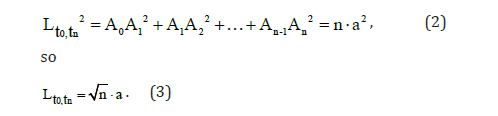
The motion path A0 A1→A1 A2→....→ An-1 An is a polyline, and the shortest distance between the ends of the polyline is the distance of time travel Lt0,tn .
Distance of Time Travel
At time tx , we denote life Y as Yx ; at time t x+1 , life Y is denoted as Y x+1 . At time t x+1 , if life Y x+1 perceives the spatial region of a being’s t x+k spacetime ( k ≠ 1), then we refer to this spatiotemporal change as time travel. Suppose that there is a star whose beam of light (light F) traveled 25 light-years to reach the earth. The distance traveled by a light in one second is 3.0 ×10⁸ m [3]. “In generally, the number of one’s flashes in 1 second is 3.2 ×10¹⁴ .” [1] Therefore, the length of the path taken by light F in each flash time is
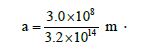
The length of the path taken by light F in 25 years is
A0-n= 25×365.25×24×60×60×3.0×108=2.52×1023.a,
so n = 2.52 ×10²³ . The distance of time travel between the beginning and end positions of light F in 25 years is

Similarly, Ft1 ⊥ Ft2 ⊥...⊥ Ft(n-1) ⊥ Ftn , where Ft1 denotes the phenom enon of light F traveling in t1 spacetime; Ft2 denotes the phenomenon of light F traveling in t2 spacetime, etc. Consequently, light F enters our field of view after passing through n dimensions. Spacetime conversions results in Lt0,tn being so short. The motion path of light is like this, what is the motion path of an ordinary object like?
Suppose that life Y continuously observes a stationary object (beach W) for 25 years. However, beach W is relatively stationary, as the speed of the solar system in the rotation of the Milky Way is about 220 km/s [4]. Then we assume that the speed of beach W in the Milky Way is 220 km/s. The phenomenon of beach W moving in t1 spacetime is denoted as Wt1 ; the phenomenon of beach W moving in t2 spacetime is denoted as Wt2 , etc. If Wt1 is not perpendicular to t2 spacetime, then the vertical projection of Wt1 in t2 spacetime will not be zero, and the component of Wt1 in t2 spacetime is denoted as projt2 (Wt1) . Life Y can simultaneously observe Wt2 and projt2 (Wt1) in t2 spacetime, which means that beach W appears in two locations at the same time. This is obviously not true. In short, Wt1 is perpendicular to t2 spacetime. When beach W appears in t2 spacetime, the first spacetime conversion occurs. Similarly, Wt2 and Wt1 are perpendicular to t3 spacetime. When beach W appears in t3 spacetime, the second spacetime conversion occurs. Finally, the (n-1)th spacetime conversion occurs, and equations (1), (2), and (3) still hold. Assume that aw denotes the distance traveled by beach W in a flash time, then
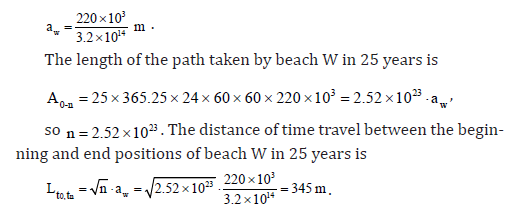
The distance of time travel is surprisingly short. World-Quantum Theory and Time Travel: A Study on the Role of Life in the Composition of the Universe “demonstrates that a person can travel back to the past by focusing on reminiscing and travel forth to the future with single-minded visualization” [5]. Therefore, it is believed that personal time travel will become a mature and controllable technology. We can further boldly make the following prediction: One day, human consciousness will be connected to the spacecraft, like a complete life. Then this spacecraft jumps freely between different spaces-times.
Conclusion
This article quantizes spacetime and derives the law of spacetime conversion. The law of spacetime conversion consists of three parts:
Firstly, time is quantized. Time t1 corresponds to No.1 flash, and time t2 corresponds to No.2 flash, etc. This is reasonable because series of flashes form the timeline.
Secondly, spacetime is quantized. m(t1 ) , m(t2 ) , etc., are worldclass macroscopic quanta [3], which means that t1 spacetime, t2 spacetime, etc., are world-class macroscopic quanta. Now we can answer the question at the beginning of this article: When we walk on the beach and look back at the footprints behind us, our past selves exist in the spacetimes of the past.
Thirdly, the motion path of an object is a polyline. Some people may ask: Before life Y sees light F, does light F undergo spacetime conversions? Like Schrodinger’s cat, if life Y does not observe light F, it means that light F does not manifest in life Y’s world. So light F is chaotic in life Y’s world, and its motion path is also chaotic. When life Y observes light F, light F and its path collapse from the chaotic state, and thus they manifest themselves. If Ft1 is not perpendicular to t2 spacetime, then the vertical projection of Ft1 in t2 spacetime is not zero, and the component of Ft1 in t2 spacetime is denoted as projt2 (Ft1) . In this way, light F appears in two locations at the same time in t2 spacetime. This is obviously not true. In short, Ft1 is perpendicular to t2 spacetime. When light F appears in t2 spacetime, the first spacetime conversion occurs. Similarly, the (n-1)th spacetime conversion also occurs. Doing it in this way is reasonable because the displacement change of an object at time t1 only occurs in t1 spacetime; its displacement change at time t2 only occurs in t2 spacetime, etc. The analysis of light L, beach W and light F can lead to the following conclusion: the motion path of an object is a polyline that follows the quantization of time and the quantization of spacetime.
The law of spacetime conversion not only reveals the essence of spacetime conversion, but also provides a new perspective for humans to understand the structure of the universe. Time is no longer the carriage moving forward at a constant speed, but rather one flash after another of the observer. This idea reveals distance of time travel, giving us a more concrete understanding of time travel.
Acknowledgment
None.
Conflict of Interest
None.
References
- Tian M (2025) Mathematical Expression of the Relationship Between Spirit and Matter. American Journal of Biomedical Science & Research 26(2): 225-228.
- Copleston F (2022) The Rationalists: Descartes to Leibniz (Chen Y, Trans.). Jiuzhou Press. (Original work published 1958).
- Close F (2016) The Void (Yang YW, Trans). Chongqing University Press. (Original work published 2007).
- Zhong Y (2013) A Comprehensive Guide to Cosmic Knowledge. Enterprise Management Publishing House.
- Tian M (2025) World-quantum Theory and Time Travel: Research on the Role of Life in Composition of the Universe. American Journal of Biomedical Science & Research 25(5): 563-568.




 We use cookies to ensure you get the best experience on our website.