
Case Report 
 Creative Commons, CC-BY
Hypothesis on the Self-Organizing Process in the Function of the Helical Myocardium
*Corresponding author:Jorge Carlos Trainini, Presidente Perón Hospital. National University of Avellaneda, Argentina.
Received:December 08, 2024; Published:December 18, 2025
DOI: 10.34297/AJBSR.2025.29.003818
Abstract
The relationship between the cardiac fulcrum, the AV node, and the stimulation circuit that activates the myocardial double helix-which begins and ends at a support (fulcrum)-is likened to a system comprised of basic elements and organized around the reception, feedback, and transmission of information. This collected information has the capacity for negentropic regulation, as it reduces uncertainty and degradation (entropy), allowing the system to self-organize in decision-making since different alternatives may arise. In this way, the heart is not only subject to external fluctuations connected to the Central Nervous System (CNS), but also to an internal organizing process that provides information management that maintains the required homeostasis. The concept of a field, which can be defined as a potential force in space without any substance on which to support these forces, influenced this current scientific view. This concept, coupled with the dissolution of objective reality, means that science describes not the behavior of the reality of the world, but rather the knowledge we have of said behavior.
Keywords:Cardiac fulcrum, Cardiac stimulation, Node AV, Helical myocardium
Introduction
Addressing the organizational unity of the heart through an interconnectedness that integrates physics and science in their entirety, alongside biology, is currently an essential but complex step, given the positivist tendency inherent in medical knowledge. This approach is not without the “heretical” risks with which traditional medicine often labels such initiatives. To prevent this knowledge from falling into disrepute, this research has advanced the understanding of cardiac function by incorporating current quantum physics science without neglecting epistemology. This strategy is not a simple step, but it is the one that can bring us closer to medical science evolving toward horizons being explored by other disciplines. We have reached this point in the investigation after an extensive journey over the helical heart [1,2], which allowed us to understand the following topics: Phylogenetic Aspects of the Circulatory System; Spatial Anatomical Location of the Cardiac Chambers; The Cardiac System; The Continuous Myocardium; Architecture of the Cardiac Apex; Why is the Heart Helical? The Twists of the Myocardium; The Cardiac Fulcrum: Support of the Myocardium; Anatomical and Physiological Relationship Between the Cardiac Fulcrum and the AV Node; The Mechanism of Friction in Cardiac Movements Function of hyaluronic acid; Cardiac modeling; Stimulus propagation and cardiac torsion; Interpretation of myocardial activation in relation to the cardiac fulcrum and the torsion mechanism; Interpretation of diastolic filling; Electrophysiological research on cardiac suction; Negative intraventricular pressure and the suction mechanism: clinical and experimental research; Biventricular complementarity; Contributions of the helical heart organization to heart failure with preserved ejection fraction; Intraventricular vortex.
Only after investigating these topics did, we find that the connection between the biology of the heart and quantum physics was possible without violating the principles governing biological epistemology. Given the anatomy and physiology found in the continuous myocardium, a troubling question arose: why does the myocardium originate and terminate at the same point, the cardiac fulcrum, after a helical path, being the only muscle with this characteristic of beginning and ending in the same place? Are we witnessing a self-organizing process? In this sense, does the fact that it remains contracted at its terminal end for 83 ms after systole in our research [1,2] indicate that this energy retention contributes to its reorganization providing information? When we encountered this horizon of new, not yet fully resolved concepts, we left it within the realm of hypothesis. In short, we believe this approach can help us advance our understanding of cardiac physiology and its therapeutic possibilities.
Thermodynamics of Life
The second law of thermodynamics, which states: in an isolated system the entropy or disorder of the system evolves towards a maximum (Rudolf Clausius, 1865), has played a fundamental role in the understanding of the new worldview [3-5]. Boltzmann explored this relationship between dynamics and kinetics, constructing his microscopic model of entropy. Thus, far from the anxiety that this second law of thermodynamics might impose on a final equilibrium, science discovers the creative power of time. At this point, Darwin and Boltzmann converge in a dispute. The former states that living beings grow and transmit information from the past subject to change, while for Boltzmann, in an infinite number of particles, collisions lead to entropic growth and thermodynamic irreversibility [6-8]. The emergence of life allows for its transmission from one individual to another, from one species to another, and gives it complexity. It is the realm of the non-linear. This is also true of human behavior. The brief scale of human history in relation to that of the universe helps us understand the instability and fluctuation to which all systems in the universe are subject. Darwin triumphed. Boltzmann acknowledged that he lacked a microscopic interpretation of the irreversibility of his system. It was the ageold debate between Parmenides’ static and predictable world and Heraclitus’ continuous transformation. A system can, over time, return close to its origins, but it will never be the same. There is always change, which we call time. And a sense that causes us to be born, grow, reproduce, and die.
We must understand that the relationship established by kinetic theory between dynamics and thermodynamics is what leads from trajectories to physicochemical processes. New conceptions in the sciences can be traced back to Ludwig von Bertalanffy’s (1901- 1972) general systems theory, Norbert Wiener’s (1894-1964) cybernetics, and Claude Shannon’s (1916-2001) information theory. [9,10] Today, they respond to Ilya Prigogine’s postulate, based on the concept that systems far from equilibrium are found in both the natural and social sciences. [8,11-13] No field of knowledge can abstract itself from the reorganizational processes that allow for the continuity of systems. The systems that comprise the cosmos in its entirety belong to one of three states:
a) At equilibrium, there are no differences in temperature or
concentration. Inert. The entropy produced is zero.
b) Near equilibrium, they reach equilibrium when there is no
longer a difference in concentration. They exist with small
thermodynamic differences.
c) Far from equilibrium (they produce entropy). They exhibit
fluctuations toward the new dynamic regime. They evolve
through periodically indeterminate nonlinear transformations
toward regions increasingly distant from equilibrium. These
are the third-state systems and constitute the main elements
of the general synthesis of evolution.
The sciences cannot be isolated. The interrelation (implexion) between them is fundamental to understanding problems. A convergence of biology and physics is absolutely necessary. In fact, this has allowed us to understand the evolution of living matter, which, before the physical revolutions, was thought to violate the second law of thermodynamics. Today, we know that this is substantially different and that an open system self-organizes through a gradient. There is an accumulation of information in the interactions of the system with its environment. The theory of dissipative structures proves that human beings and the microcosm share identical characteristics. According to the theory of dissipative structures, parametric requirements drive the evolution of systems. The thermodynamic view of matter emerged around the mid-18th century. James Watt (1736-1819) and James Joule (1818-1889) were its precursors, with Hermann von Helmholtz (1821-1894) describing the principle of conservation of energy in all systems. In 1824, Nicholas Léonard Sadi Carnot (1796-1832) established the explanation for the dissipation of mechanical energy. Later, in 1865, Rudolf Clausius (1822-1888) established the laws of thermodynamics.
In summary, the understanding of dissipative structures, nonequilibrium states, particle collisions, fluctuations, instability and irreversibility, only has scope within the new physics [14]. Living beings are open systems connected to the external environment. Their thermodynamic foundation implies that, being interconnected with the external world through a flow of matter and energy, they constantly experience a gradient that moves them away from disorder, chaos, inertia, and uniformity, and allows for a continuous process of self-organization [15]. The condition is that they maintain a certain distance from thermodynamic equilibrium through a flow of matter and energy that determines fluctuations. Living beings are thermodynamic systems containing heterogeneity composed of more and less stable structures, also known as systems that are closer to or further from equilibrium. Before delving into the process of myocardial self-organization, it is essential to address the concepts of entropy and implexion, which are fundamental to understanding it.
Entropy
Understanding the value of entropy in the organization of scientific disciplines involves referring to the second law of thermodynamics, which states that in every isolated system organization and structure tend to disappear and be replaced by uniformity and randomness [16]. Systems form a continuum in matter, in life, and in history. Older levels exhibit strong and consolidated links, in relation to more recent ones, which are weak and flexible. There is no hierarchical separation in the levels of complexity, but rather complementary integration between them. Complexity allows for the association of ideas. Suddenly, this alchemy between ideas achieves a knowledge that was previously dissociated [17-19]. It is fundamental to understand the concept of feedback: in this temporal course that involves reaching maximum disorder, feeding the system with energy (information) external to it can modify its course, potentially reactivating it, decreasing the level of entropy, and preventing the system from closing and evolving toward its heat death.
There are systems that, when the constraint that maintains them in a dynamic state disappears, enter a chaotic state, but other systems, such as chemical ones, are a source of new structural creations [20-22]. In 1958, Boris Belousov (1893-1970), while mixing chemicals, observed that the solution periodically changed color. The reaction reversed and then progressed, similar to a chemical clock. This finding was ignored at the time in academic circles. Re-examined by Anatol Zhabotinskii (1938-2008), this phenomenon now bears both their names. The explanation is that the reaction, by remaining far from equilibrium and having a feedback mechanism, influences its own dynamics. This is called autocatalysis and constitutes positive feedback corresponding to a non-linear equation. Here, irreversibility escapes the lack of entropy and fleeting behavior, evolving toward new evolutionary possibilities. It moves from synthesis to information. Irreversibility and probability are not concepts of our limited knowledge, but rather reflect the existence of a chaotic dynamic system with a time horizon that limits the permanence of any information in relation to the future. This explanation of self-organizing processes is a situation that had already been glimpsed in other fields by Hegel, Darwin, Marx, and Engels [23-24]. The continuous transformation, observed in antiquity by the Greeks with the word “trope,” is known to us through the word “entropy.”
An old proverb says that all knowledge is bound to evolve, otherwise it regresses. The evolutionary performance of a discipline, if it remains temporarily isolated and without implexion (interconnection) with other disciplines, ends up isolating itself (its entropy increases). It needs to decrease this entropy by remaining open through genuine growth in connection with elements close to its system. In a way, we are using the concept of complexity. The possibility of complementarity allows for evolution, preventing it from falling into a state of equilibrium (inactivity). The universe is change, and therefore so is the knowledge we gain from it. It is subject to fluctuations and random processes in its transcription from the past to the future. This continuous transformation was observed in antiquity by the Greeks. We know it through the word “entropy.” It means something different from the original term used to describe the transformation to which the Greeks referred. In this sense, in modern physics, systems move toward a maximum possible state. Biological systems, like social, economic, and physical systems, are composed of a large number of components, which translate into random behavior that invalidates the classical scientific method. In the 19th century, the social field offered a solution to this obstacle in scientific methodology when Adolphe Quetelet (1796-1874) developed the feasibility of probability, or statistics, in 1820. However, this political arithmetic applied to populations falls short in the face of the randomness of a system like the human being. Knowledge of quantum mechanics has helped us understand the randomness and uncertainty inherent in these systems.
Implexion
Modern physics has described the universe using the concept of implexion, from the Greek “emplexis,” which has the capacity to relate the human mind to the entire universe not only as intertwined entities, but as constituents of the whole. And this is not merely the transfer of information between physical particles; it also implies the superposition of states. The friar Gregor Mendel (1822-1884), from the Austro-Hungarian Empire, working with peas, established the laws of genetics, which summarized what the Greek philosopher Plotinus had already stated in the 3rd century with this concept: “Everything is everywhere. Each one is the All and the All is each one” [25]. The concept of the holoverse must be seen in the depth of Mendel’s work. The subsequent development of electrodynamic theory by Michael Faraday (1791-1867) and James Maxwell (1831-1879) in the 19th century marked the beginning of the collapse of the old physics. The transcendent step they achieved with the concept of a field-the potential to produce a force in spacemarked the beginning of subsequent scientific revolutions. In the following century, the theories of relativity, quantum mechanics, chaos theory, and the concept of dissipative structures would be successively linked [26].
The behavior of the non-biological has been conceptualized and recorded within mathematics, a situation that cannot be applied with evidential force in living beings. Perhaps we should understand that the interaction from elementary particles to planets is not the same measure to which human emotions are subjected. This concept does not imply separating consciousness from the physical world, but rather understanding that the behavior of human beings is random and their qualitative responses cannot be certaint with a purely quantitative tool [27-29]. Ilya Prigogine (1917-2003, Nobel Prize in Chemistry, 1977), for his part, considers that the guiding principles operate throughout the universe, from atoms to human beings [30-34].
Interpretation of myocardial activation in relation to the AV node, cardiac fulcrum, and the torsion mechanism
We were able to begin this path of analyzing the self-organization of the helical myocardium at the moment of understanding the morphological, histological and functional relationship between the AV node and the cardiac fulcrum, the latter site where the myocardium begins and ends after its helical journey [1,2]. For a proper understanding of the heart as a participant in the quantum concepts of modern science, it seems appropriate to first explain the interpretation of myocardial activation in relation to the cardiac fulcrum and the torsion mechanism (Figure 1).
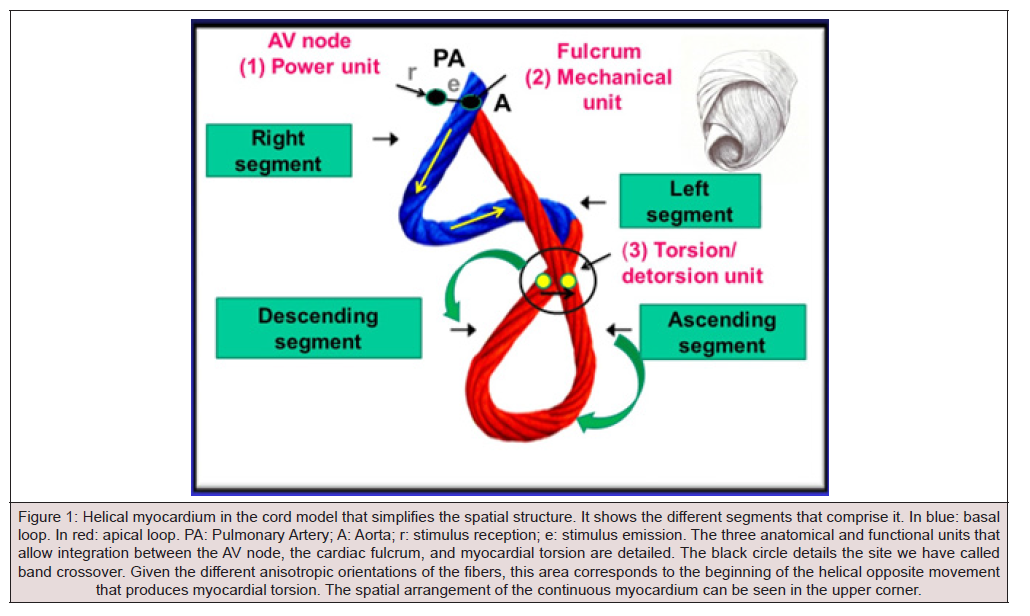
Figure 1:Helical myocardium in the cord model that simplifies the spatial structure. It shows the different segments that comprise it. In blue: basal loop. In red: apical loop. PA: Pulmonary Artery; A: Aorta; r: stimulus reception; e: stimulus emission. The three anatomical and functional units that allow integration between the AV node, the cardiac fulcrum, and myocardial torsion are detailed. The black circle details the site we have called band crossover. Given the different anisotropic orientations of the fibers, this area corresponds to the beginning of the helical opposite movement that produces myocardial torsion. The spatial arrangement of the continuous myocardium can be seen in the upper corner.
The complexity of biological phenomena implies dynamism, progression, and simultaneous coexistence of diverse stages and different structures within an organizational unit. The same occurs in the heart from the perspective of electrical, mechanical, and electromechanical phenomena, with myocardial activation, contraction, and relaxation during systole, suction, and diastole. There is always an instance in nature where it is possible to integrate higher-level functions with the components that make up a system [9,10]. This is the case of the “pulse center.” The heart has historically been studied in terms of its individual components, exhibiting a global and homogeneous contraction, simultaneous throughout its muscular structure; but not with the clear understanding that the movements in its different phases occur sequentially and overlappingly, contributing to its complex function in an infinitesimal time of less than one second per cycle and 100,000 cycles per day. The heart has been studied only partially, undoubtedly because referring to the complexity of its function in terms of the duration of its cycle implies the difficulty of observing the reality that occurs within it.
This situation was noted by William Harvey (1578-1657), who recounts the difficulties in proving his theory of blood circulation: “I came to think, [he says] with Fracastoro, [the Renaissance epidemiologist], that the movement of the heart could only be known by God.” Because of the rapidity of the heart’s movement, Girolamo Fracastoro (Verona, 1478-1553) had expressed this concept in his book “De sympathia et antipathia rerum” (Venice, 1546) [35]. It is understandable to consider that the integrity proposed by general systems theory will remain relegated as long as adherence to purely analytical models continue, reducing the whole to the study of only its parts. Through the development of technology applied to morphology, a comprehensive biological perspective adapted to functional requirements was achieved [1,36-39]. This view of the cardiac organ and its function, which we have investigated, is consistent with the general systems theory [40-42], a situation we consider throughout the research.
Our previous publications concerning the cardiac fulcrum as a support for the myocardium, its relationship with the Aschoff- Tawara node (Figures 2 and 3), and the sequential activation of the heart in a clear organizational arrangement to achieve torsional movement [43-49], led us to analyze these structures in terms of their potential and functional aspects [50-54]. Thus, we arrived at the concept that the heart acts through three fundamental units: activation, electromechanical unit, and myocardial torsion, which are interrelated in their anatomy and organization to act in accordance with a highly efficient system (Figure 1). We have already detailed the anatomical-physiological relationship between the fulcrum and the AV node. In this research, the anatomical and histological relationship of the cardiac fulcrum with the atrioventricular node in human and bovine hearts was analyzed, as well as the myocardial activation channels for achieving the torsion-detorsion of the heart.
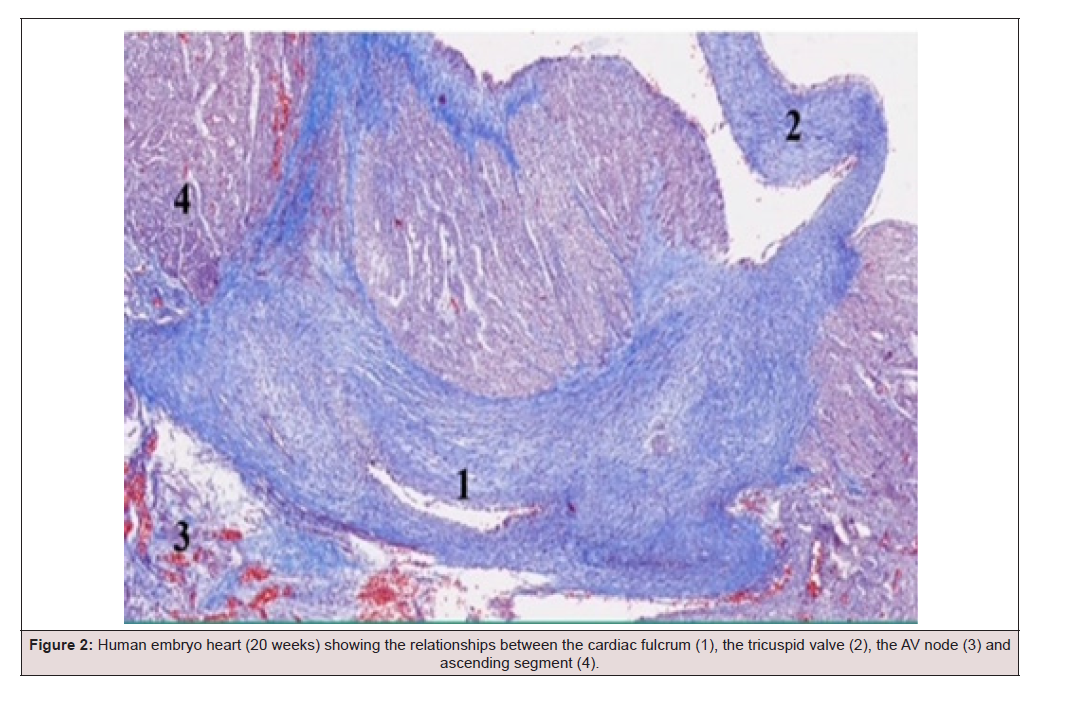
Figure 2:Human embryo heart (20 weeks) showing the relationships between the cardiac fulcrum (1), the tricuspid valve (2), the AV node (3) and ascending segment (4).
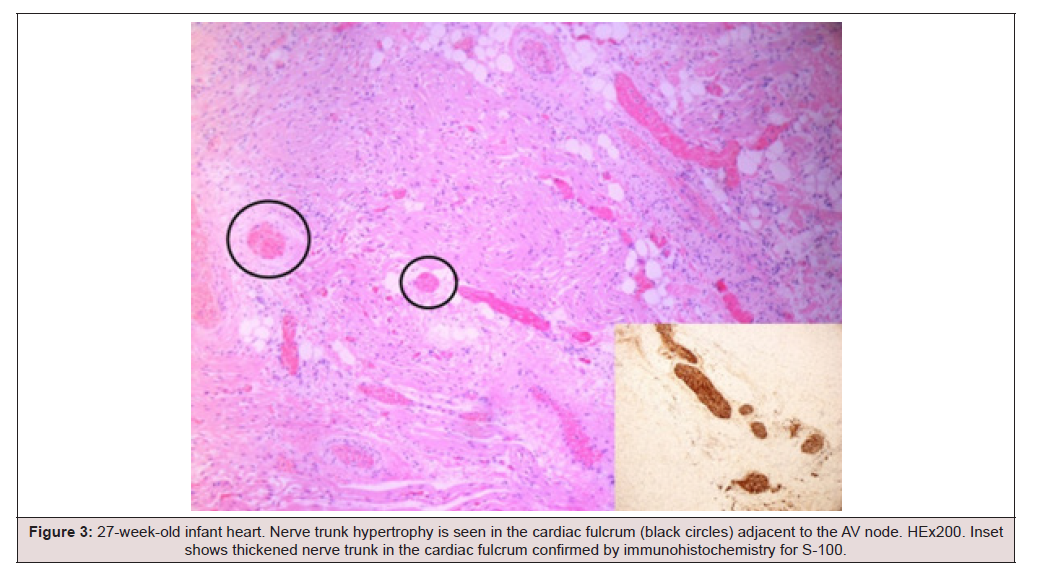
Figure 3:27-week-old infant heart. Nerve trunk hypertrophy is seen in the cardiac fulcrum (black circles) adjacent to the AV node. HEx200. Inset shows thickened nerve trunk in the cardiac fulcrum confirmed by immunohistochemistry for S-100.
The research results reveal key reference points that define the organizational pattern of cardiac function. These include: the anatomical contiguity between the AV node and the cardiac fulcrum; the continuous presence of the filaments that structure the AV node within the fulcrum-where the myocardium originatesclearly forming an electromechanical unit; and the pathway of activation through the myocardium, enabling helical torsion, via the anatomical, anisotropic, and functional spatial arrangement between the descending and ascending segments at the septal level, as confirmed by echocardiographic and electrophysiological studies (Figure 1). At this point, we must analyze how these elements, including structures and circuits of energy and mechanical transfer, interact. The analysis is closely related to myocardial movements and the stimulation that travels through its segments, according to the electrophysiological studies we have conducted [1,2]. The interpretation of the anatomical relationships between the cardiac fulcrum and the AV node implies the complementarity of anatomy with the physiology of the continuous helical myocardium, since their contiguity lies at the site where stimulation begins and ends, producing the mechanical action of torsion and detorsion during the systolic and suction phases of the ventricles as the different myocardial segments are activated.
Cardiac electrical activation
We have widely published the endocardial and epicardial electrical activation sequence of the left ventricle using threedimensional Electroanatomic Mapping (MET) with a Carto navigation and mapping system (Biosense Webster, California, USA), which allows for three-dimensional anatomical representation with activation and electrical propagation maps. All patients were in sinus rhythm, with a normal QRS complex, and had no demonstrable structural heart disease as determined by Doppler echocardiography or stress and rest gamma camera studies. MET was performed during radiofrequency ablation procedures for arrhythmias due to probable occult epicardial anomalous pathways. The mapping was performed at the beginning of the studies, continuing afterward with the ablation maneuvers. No complications occurred [1,2]. Figure 4 shows a synthesis of the stimulation found in this research using the string model.
As previously mentioned, left ventricular activation begins in the descending endocardial segment, which depolarizes longitudinally and transversely with a 12.4 ms delay relative to the basal loop (right and left segments) (Figure 4). At the point of contact with the ascending segment, activation propagates from the endocardium to the epicardium (transverse propagation), that is, from the descending to the ascending segment, with a 25.4 ms delay. From this point, the ascending segment depolarizes in both directions: toward the apex and toward the base, while the descending segment completes its activation toward the apex. This results in two primary phenomena:
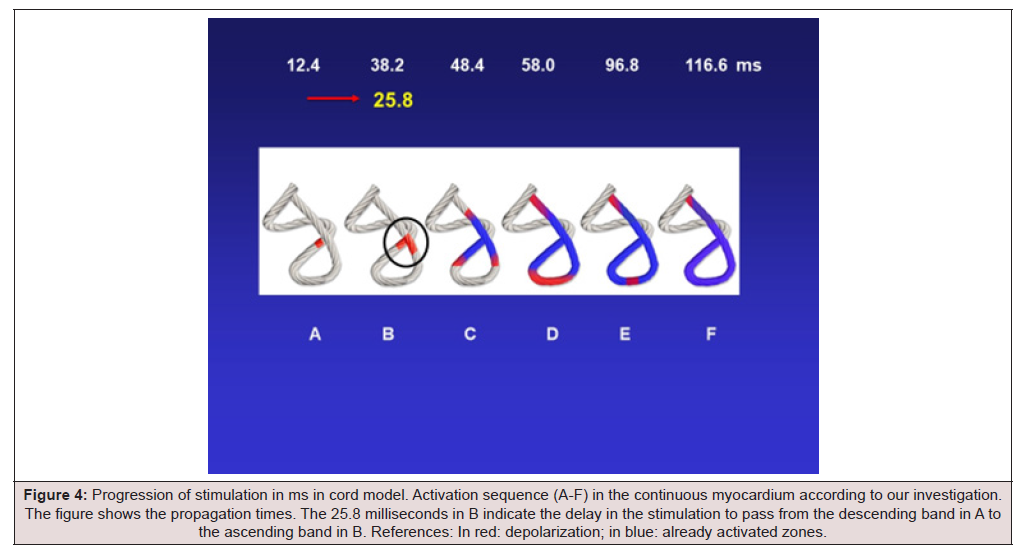
Figure 4:Progression of stimulation in ms in cord model. Activation sequence (A-F) in the continuous myocardium according to our investigation. The figure shows the propagation times. The 25.8 milliseconds in B indicate the delay in the stimulation to pass from the descending band in A to the ascending band in B. References: In red: depolarization; in blue: already activated zones.
1) The apical loop, upon depolarization from the crossing of
the segments, with two simultaneous wavefronts (from
the descending and ascending segments), generates a
synchronized contraction of both.
2) Activation of the ascending segment occurs from the crossing
point in two opposing directions: towards the apex and
towards the base. The resulting mechanical contraction will
also have an opposing direction, giving rise to clockwise (apex)
and counterclockwise (base) rotations.
3) The helical spatial arrangement of the myocardium forces
the muscle to overlap segments in its spatial configuration.
This situation is clearly observed in the modeling achieved in
previous research that we have presented [55].
In a cardiac cross-section (Figure 5) below the atrioventricular valves, we can observe that the descending segment is located internally surrounded by the ascending segment in the free wall of the left ventricle (2). The ascending and descending segments undergo opposite movements, both in systole and diastole, to achieve the expulsion and suction of ventricular blood contents, generating friction between their surfaces, a topic we have discussed in other publications when finding hyaluronic acid, with a lubricating function, in abundance both in the myocardium and in the Thebesius vessels in studies performed in anurans, bovines and humans (Figures 6 to 8) [56,57]. The histology in the box of figure 5 clearly shows the different orientation of the fibers of the descending segment in relation to the ascending segment, which explains the opposite movements they present. The arrangement of myocardial fibers in the epicardium and endocardium, whose 180º angulation change causes the epicardial fibers to be arranged in the opposite orientation to the endocardial ones. Given the different anisotropic orientations of the fibers, this area corresponds to the beginning of the opposite movement that produces myocardial torsion. The constitution of the septum with the contiguity between the descending and ascending segments allows the continuity of activation between them with opposite movements and the consequent myocardial torsion. The interventricular septum has a predominant value in the function of the myocardium since its location is essential in biventricular interdependence [58].
An important detail derived from tractographic images is their correspondence with the changes in angulation observed in the two-dimensional sections published by Streeter or with the rough arrangement of the band bundles in the anatomical sections of the recomposed hearts once dissected, highlighting the abrupt change in angulation present in the interventricular septum, due to the absence of transition of fibers with a circumferential course, since the septum is a structure that results from the apposition of the descending and ascending segments of the continuous myocardium [1,2]. The research aspect on the stimulation sequence allowed to determine the electrophysiological propagation in the continuous myocardium and also led to deductions about ventricular torsion and the suction effect in the left ventricle protodiastolic phase of myocardial contraction (LVPPMC) [59]. The orientation of the fibers in the continuous myocardium and its activation imply a concatenation of muscular movements in cardiac mechanics. These occur giving rise to four phases: narrowing, shortening-torsion, lengthening-detorsion and widening, which allow it to perform its functions of systole, suction and diastole. The fundamental movements in which the different segments of the continuous myocardium participate in systole and suction are shown in Table 1.
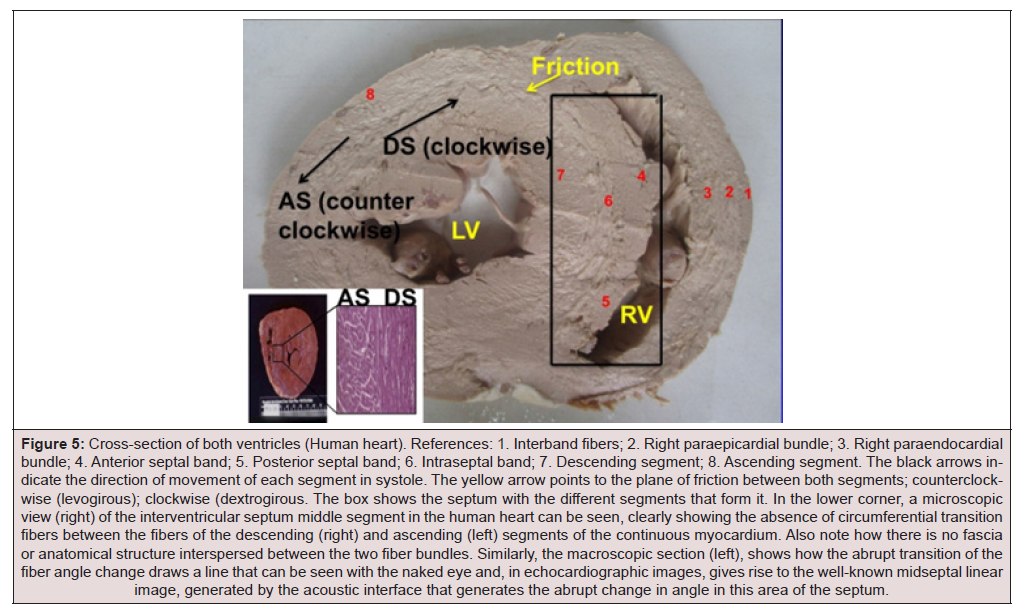
Figure 5:Cross-section of both ventricles (Human heart). References: 1. Interband fibers; 2. Right paraepicardial bundle; 3. Right paraendocardial bundle; 4. Anterior septal band; 5. Posterior septal band; 6. Intraseptal band; 7. Descending segment; 8. Ascending segment. The black arrows indicate the direction of movement of each segment in systole. The yellow arrow points to the plane of friction between both segments; counterclockwise (levogirous); clockwise (dextrogirous. The box shows the septum with the different segments that form it. In the lower corner, a microscopic view (right) of the interventricular septum middle segment in the human heart can be seen, clearly showing the absence of circumferential transition fibers between the fibers of the descending (right) and ascending (left) segments of the continuous myocardium. Also note how there is no fascia or anatomical structure interspersed between the two fiber bundles. Similarly, the macroscopic section (left), shows how the abrupt transition of the fiber angle change draws a line that can be seen with the naked eye and, in echocardiographic images, gives rise to the well-known midseptal linear image, generated by the acoustic interface that generates the abrupt change in angle in this area of the septum.
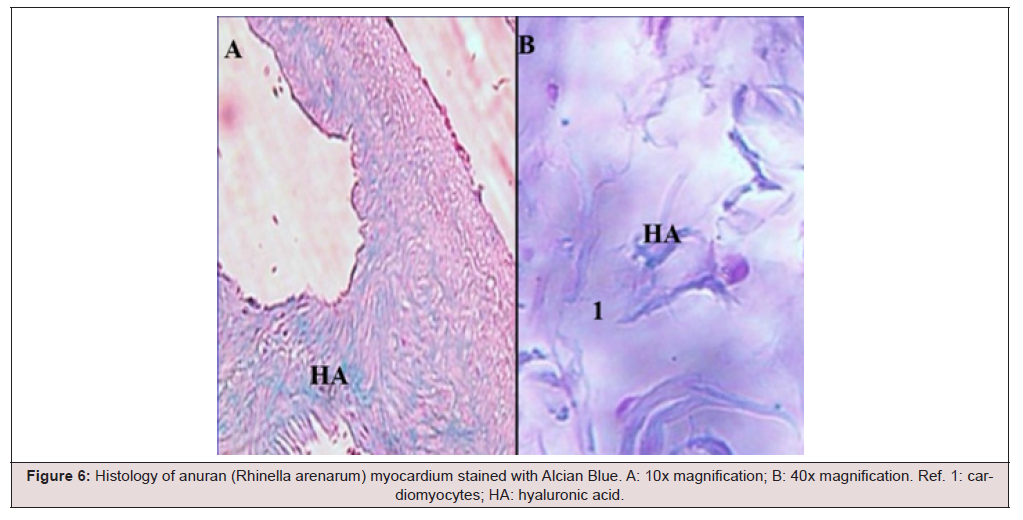
Figure 6:Histology of anuran (Rhinella arenarum) myocardium stained with Alcian Blue. A: 10x magnification; B: 40x magnification. Ref. 1: cardiomyocytes; HA: hyaluronic acid.
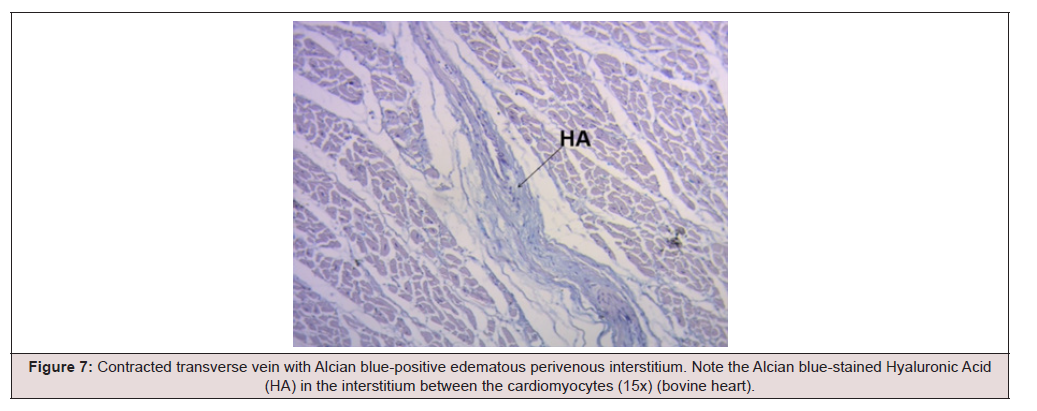
Figure 7:Contracted transverse vein with Alcian blue-positive edematous perivenous interstitium. Note the Alcian blue-stained Hyaluronic Acid (HA) in the interstitium between the cardiomyocytes (15x) (bovine heart).

Figure 8:Interstitium between cardiomyocytes showing Hyaluronic Acid (HA) stained light blue with Alcian blue (15x) (adult human heart).
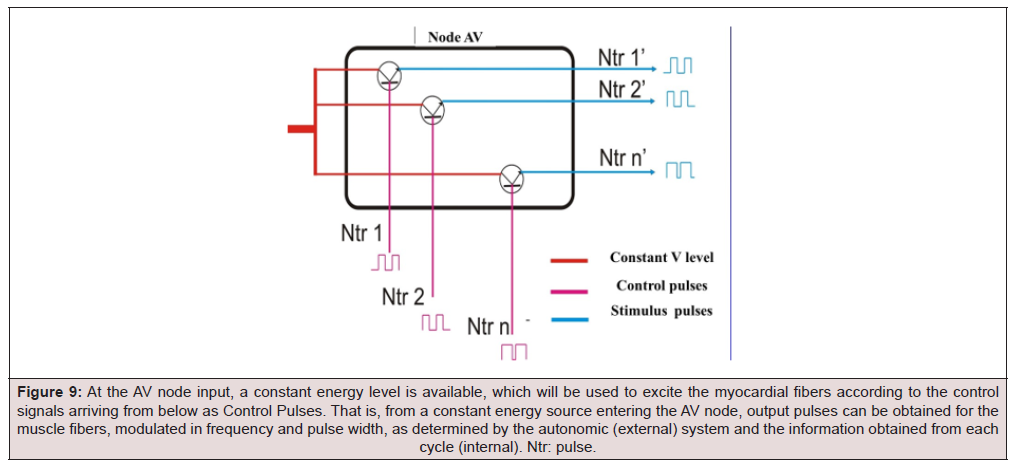
Figure 9:At the AV node input, a constant energy level is available, which will be used to excite the myocardial fibers according to the control signals arriving from below as Control Pulses. That is, from a constant energy source entering the AV node, output pulses can be obtained for the muscle fibers, modulated in frequency and pulse width, as determined by the autonomic (external) system and the information obtained from each cycle (internal). Ntr: pulse.

Table 1:Segment function.
This sequential activation correlates with fundamental phenomena that are well known today, such as the opposing clockwise and counterclockwise torsion of the apex and base of the left ventricle, which are responsible for its mechanical efficiency. In order to try to explain the mechanism of the muscular torsion, this research aimed to analyze the sequence of ventricular electrical activation by means of the simultaneous endo-epicardial MET of the segments from their beginning in the anatomical and functional contiguity between the AV node and the cardiac fulcrum. In the narrowing phase there is a consecutive contraction of the right (free wall of the right ventricle) and left (edge of the mitral orifice) segments, which constitute the basal loop. According to Armour (1970) [60,61], this contraction constitutes an external cover within which the apical loop will contract. In reality, the crescentic free wall of the right ventricle is located “ad latere” of the rest of the ventricular mass (septum and left ventricle), since the left segment constitutes part of the posterior epicardial wall of the left ventricle in its upper portion, surrounding the mitral annulus, while the rest of it is covered externally by the ascending segment.
In this layer (basal loop) the stimulation goes from subepicardium to subendocardium. Then, it stimulates the descending segment and at 25.8 ms average in our research the ascending segment is activated. The end of the stimulation in the myocardium occurs at the level of the terminal part of the ascending segment, close to its insertion into the cardiac fulcrum, during the first 80-100 ms of diastole in the Protodiastolic Phase of Myocardial Contraction (PPMC) [62]. Since Harvey and later with Einthoven’s electrocardiography, both the electrical activation and mechanical contraction of the heart were considered to be linear and homogeneous processes. Thus, contraction would occur “en bloc” during systole and relaxation would occur uniformly during diastole. At this stage of current knowledge of the helical myocardium, these concepts do not explain cardiac function, whose movements are sequential [63]. Although various aspects of electrical stimulus propagation in the ventricle have long been understood, the advent of three-dimensional navigators and electroanatomical mapping has enabled a much more detailed study of this process in the human heart under completely physiological clinical situations. This research allows us to elucidate the activation sequence of contractile areas and their entry into cardiac dynamics in relation to the path of the excitation wave with a coordinated pattern consistent with the helical structure of the continuous myocardium.
Research conducted with MET explains the torsion phase of the heart, defined as the opposing rotational movement of the base and apex. Activation, for this purpose, at the intersection of the descending and ascending segments propagates from the endocardium to the epicardium (transverse propagation), that is, from the descending segment to the ascending segment. This research on the transmission of impulses through the myocardium led to the analysis presented here, which correlates with the continuous and helical structure of the myocardium with the propagation of stimulation.
Our analysis implies that diffusion occurs simultaneously longitudinally and transversely between the descending and ascending segments. We must find a relationship between the activation action and the mechanical product. The explanation is provided by the simultaneous longitudinal and transverse electrical conduction pathways. The ventricular narrowing phase (systolic isovolumic) at the beginning of systole is produced by the contraction of the right and left segments of the basal loop. The superimposed shortening phase is due to the descent of the base, which occurs simultaneously with myocardial torsion. It originates longitudinally when the annulus contracts before the apex. The fact that the latter does not move is due to the mechanism of the base descending in systole and ascending in diastole. The pressure generated to expel the largest amount of blood at the beginning of ejection, in a period that occupies only 20% of the systolic phase, is made possible by the torsional movement.
Although there is a progression in electrical conduction along the continuous myocardium, this isolated activation does not explain the generation of a force capable of ejecting ventricular contents at a speed of 200 cm/s at low energy expenditure. What was found in this investigation: the transverse propagation from the descending segment to the ascending one plays a fundamental role in ventricular torsion, allowing opposing forces on its longitudinal axis to generate the intraventricular pressure necessary to achieve the abrupt expulsion of blood. In this way, a torsion mechanism similar to “wringing out a towel” would be produced, as described by Giovanni Borelli and Richard Lower [2].
Cardiac self-organization
At this stage of the research, we understood that the threedimensional helix state of the heart implied that the relationship between the cardiac fulcrum and the stimulation, and the consequent myocardial torsion, played an organizing role, as energy returned to that site after completing an 800 ms cycle that repeats 100,000 times daily. During this journey through the myocardium, the stimulation not only provides energy that is transformed into work and heat, but also accumulates information. This recurrent journey allows it to accumulate information to reorganize the next cycle, since the cardiac fulcrum is connected to the AV node, constituting an electromechanical unit. This situation would allow it to optimize data and bring the cycle from disorder to the order it needs, sharing information and energy for efficiency. A fundamental point in this analysis is the interconnection between the AV node and the cardiac fulcrum. The latter acts as an attractor of the stimulus, which travels the same circuit, originating and terminating in the myocardial fibers that insert into the fulcrum. It is worth asking whether this periodicity transmits information that originates and returns to the heart in variables such as amplitude, voltage, and frequency. The pulse width defines the energy transmitted to the muscle fiber. The wider the pulse, the more energy. This is called Pulse Width Modulation.
AV Node. The energy destined to stimulate the myocardial muscle fibers enters the AV node, as well as the control signals derived from this energy (Figure 9). A constant level of energy enters the AV node, which is used to excite the muscle fibers via neurotransmitters. To obtain the output impulses from the AV node that will reach the muscle fibers, control pulses are required, which respond to the Central Autonomic Nervous System (Figure 9).
Each subsystem owns its own process and can modify it, positively impacting it and thus reducing the disorder and chaos inherent in any activity or process. Shannon’s information theory is applicable here:
S = k (Pa Log₂ (1/ Pa) + Pb Log₂ (1/ Pb) + Pc Log₂ (1/ Pc) + Pd Log₂ (1/ Pd ))
Where Pa, Pb, Pc, and Pd are the probabilities of occurrence of events with decreasing qualities, with “a” being the optimal quality and “d” the inferior quality. If the norm allows for the existence of all four probabilities, the resulting S1 (entropy) will be greater than the S2 that would result from eliminating the worst qualities, leaving only “a”.
In the case of the self-organization that the heart implements, the local subsystem (AV Node) appears to be both cause and effect, a situation that is guaranteed by the feedback of information that cyclically allows it to reorganize and improve the management it exercises, for which it incorporates information and energy (negentropy). At the AV node, a constant energy level is available, which will be used to excite the myocardial fibers according to the control signals that arrive from below as Control Pulses. That is, from a constant energy source entering the AV node, output pulses can be obtained for the muscle fibers, modulated in frequency and pulse width, as determined by the autonomic (external) system and the information obtained from each cycle (internal). This concept implies what would be a considerable challenge: verifying the energy (or voltage) levels reaching the AV node. It also involves verifying the control pulse trains and, consequently, the stimulus pulse trains.
The physiology of myocardial stimulation, with its consequent torsion, implies recognizing the AV node + fulcrum as subject to negentropy, which is the process of creating and maintaining order within a system, acting as the opposite of entropy, the natural tendency toward disorder and chaos. It manifests as the capacity of systems (natural, living, or even social and economic) to organize, innovate, and self-regulate, using energy or information from the outside to remain stable and complex. The AV node + cardiac fulcrum would act as a subsystem receiving information from the CNS (external) and from the myocardium itself (internal). This information would allow negentropy to keep the organizational system of cardiac stimulation away from equilibrium and viable, and prevent final equilibrium. Faraday and Maxwell potentials are important in these fields. Energy fields exist in the heart, resulting from vortical electrical flows, which are coupled to information fields not subject to the limitations of time and space [64,65]. Studies have confirmed the interrelationship between ECG patterns and the brain (Rein’s resonance hypothesis). The heart generates energy as described by Russek and Schwartz (1996). This energy is coupled to the information field. In this way, the heart and brain process information.
These concepts are consistent with that of syntropy, investigated by Luigi Fantappiè, understood as a measure of the degree of internal organization of any system formed by interacting components. He details that phenomena produced by past causes adhere to the second law of thermodynamics. Therefore, energy dissipates, order is lost, and structures are destroyed, while future phenomena (syntropy) tend toward the reorganization of the system. Syntropy was referred to in 1974 as “negative entropy” (negentropy) by Albert Szent-Györgyi. According to these developments, the heart appears to have the property of connecting the organism to itself and to the environment. In 1959, Léon Brillouin combined Shannon’s informational entropy with Boltzmann’s statistical entropy, stating that information is negentropic and can cancel entropy. This has applications in molecular biology and nonequilibrium thermodynamic processes.
Conclusions
During this investigation, in human, bovine, and porcine hearts, histological studies revealed that the fulcrum (the beginning and end of the continuous myocardium) is adjacent to the AV node, defining a space rich in neurofilament plexuses. A crucial finding is that the neurofilaments also occupy the myocardial fibers of the cardiac fulcrum, constituting an electromechanical unit [63,66,67]. We mapped left ventricular activation on its endocavitary and epicardial surfaces according to the described methodology. The mapping was performed simultaneously with the surface ECG. This provided a unified temporal frame of reference, allowing us to correlate both recordings and obtain a synchronized view of the simultaneous activation observed in various electro anatomical sequences.
This investigation found a relationship between myocardial stimulation and its mechanical product. The mechanical consequence of the cardiac structure is the initiation of stimulation in the anatomical-functional unit between the AV node and the cardiac fulcrum, and its continuation in myocardial activation up to the zone of simultaneous activation with movements between the descending and ascending segments, which generates torsion of the left ventricular myocardium, by opposing rotation between the base and the apex with simultaneous shortening of both ventricles.
In summary, cardiac movements are governed by three units
(Figure 1):
1) Energy unit. Constituted by the AV node.
2) Electromechanical unit. Located at the fulcrum where the
neurofilaments interconnect with the myocardium.
3) Torsion/detorsion unit. At the level where energy is transferred
from the descending to the ascending segment, achieving
myocardial torsion.
The relationship of the cardiac fulcrum to the AV node, and to the double-helix electrical circuit of the myocardium that begins and ends at a support (fulcrum), is likened to a system comprised of basic elements and organized around the reception, feedback, and transmission of information. This collected information has the capacity for negentropic regulation, since it reduces the amount of uncertainty and degradation (entropy), allowing the system to selforganize in decision-making, as different alternatives may arise. In this way, the heart is not only subject to external fluctuations connected to the central nervous system, but also to an internal organizing process that provides information management that does not deviate from the required homeostasis. The concept of a field, which can be defined as a potential force in space without any substance on which to support these forces, has surely influenced this current scientific view [64,65]. This concept, coupled with the dissolution of objective reality, means that science describes not the behavior of the reality of the world, but rather the knowledge we have of said behavior.
Acknowledgement
None.
Conflicts of Interest
None.
References
- Trainini J, Lowenstein J, Beraudo M, Mora Llabata V, Carreras Costa F, et al. (2022) The helical heart. Fulcrum and Torsion. UNDAV Ed, Buenos Aires; Argentina.
- Trainini J, Lowenstein J, Beraudo M, Valle Cabezas J, Wernicke M, et al. (2023) Anatomy and organization of the helical heart. UNDAV Ed., Buenos Aires.
- Prigogine I (1984) Order out of chaos: man´s new dialogue with nature. Bantam, New York.
- Eddington AS (1957) The mathematics theory of relativity. Cambridge University Press, Cambridge.
- Trainini JC (2003) Towards the need for a new medical paradigm. Rev Argent Cardiol 71: 439-445.
- Carli A (2017) Dialectics of health and disease. Ed. Biblos, Buenos Aires.
- Sánchez Guillén J (2009) L.E. Boltzmann. University Presses of Zaragoza, Spain.
- Prigogine I, Stengers I (1991) Between time and eternity. Buenos Aires, Alianza Ed.
- Bertalanffy von L (1978) General Systems Theory. Alianza, Buenos Aires.
- Bateson G (1979) Mind and nature: a necessary unity. Dutton, New York.
- Sametband MJ (1994) Between order and chaos. Complexity. Buenos Aires, Fondo de Cultura Econó
- Morris R (1987) The arrows of time. Salvat Scientific Library, Barcelona.
- Capra F (1992) The Tao of Physics. Luis Cárcamo Ed, Madrid.
- Trainini JC (2004) Thermodynamic model in cardiac regeneration. Rev Conarec 74: 59-64.
- Eigen M, Schuster P (1979) The hypercicle: a principle of natural self-organization”. Springer, Nueva York 64: 541-65.
- Calzetta E (2009) Entropí Ministry of Education of the Nation, Buenos Aires.
- Hoyle F (1970) Frontiers of astronomy. Heinemann, Londres.
- Trainini JC, Biscioni C, Romanelli L, Needleman C, Carli A, et al. (2008) Complexity-Based Medicine. Estudio Sigma, Buenos Aires.
- Ordoñez J (1986) Boltzmann. Writings on Mechanics and Thermodynamics. Alianza Editorial, Madrid.
- Nicolis G, Prigogine I (1977) Self-organization in non–equilibrium systems. Whiley Interscience, Nueva York.
- Schrödinger E (1955) The interpretation of quantum mechanics: Dublin Seminars (1949-1955) and other unpublished essays. Ox Box Press, Woodbridge.
- Bohm D (1951) Quantum Theory. Prentille-Hall, New York.
- Wheeler J A, Mehra J (1973) The physicist’s conception of nature. D. Reidel, Dordrecht, Holanda.
- Morin E (2011) The Seven Necessary Knowledges for the Education of the Future. Nueva Visión, Buenos Aires.
- Dossey L (1986) Time, Space and Medicine. Ed. Kairós, Barcelona.
- Simpson PK (1990) Artificial neural systems. Pergamon Press, New York.
- Einstein A, Podolsky B, Rose N (1935) Can quantum mechanical description of reality be considered complete. Physical Review 47: 777.
- Stapp HS (1971) Correlation experiments and the nonvalidity of ordinary ideas about the physical wordl. Physical Review D3: 1303.
- Engel GL (1977) The need for a new medical models: a challenge for biomedicine. Science 196: 129-136.
- Trainini JC (2020) Humanization in medical practice. Educ Med 21: 65-66.
- Bohr N (1958) Atomic physics and human knowledge. John Wiley & Sons, Nueva York.
- Trainini J (2019) Being and humanism. Editorial Biblos, Buenos Aires.
- Schrödinger E (1955) The interpretation of quantum mechanics: Dublin Seminars (1949-1955) and other unpublished essays. Ox Box Press, Woodbridge.
- Martínez Fernández J (2005) The concept of universal language. Quaderns de filosofia i ciéncia 35: 7-18.
- Trainini J, Trainini A (2025) The Circulation of the Blood. Ed. Biblos, Buenos Aires.
- Karamchandani JR, Nielsen TO, van de Rijn M, West RB. Sox10 and S100 in the diagnosis of soft-tissue neoplasms. Appl Immunohistochem. Mol Morphol 20: 445-450.
- Rushmer RF (1972) Structure and Function of the Cardiovascular System. Philadelphia, Saunders Company.
- Torrent Guasp F (1998) Structure and function of the heart. Rev Esp Cardiol 51: 91-102.
- Trainini J, Beraudo M, Wernicke M, Trainini A, Lowenstein J, et al. (2021) Myocardial Torsion and Cardiac Fulcrum. J Morphol Anat 105: 15-23
- Best A, Egerbacher M, Swaine S, Pérez W, Alibhai A, et al. (2022) Anatomy, histology, development and functions of Ossa cordis: A review. Anat Histol Embryol 51(6): 683-695.
- Buckberg GD, Coghlan HC, Torrent Guasp F (2001) The structure and function of the helical heart and its buttress wrapping. V. Anatomic and physiologic considerations in the healthy and failing heart. Sem Thorac Cardiovasc Surg 13: 358-85.
- Cosín Aguilar J, Hernándiz Martínez A, Tuzón Segarra MT, Agüero Ramón Llin J, Torrent Guasp F (2009) Estudio experimental de la llamada fase de relajación isovolumétrica del ventrículo izquierdo. Rev Esp Cardiol 62: 392-9.
- Arvidsson M, Töger J, Carlsson M, Steding Ehrenborg K, Pedrizzetti G, et al. (2017) Left and right ventricular hemodynamic forces in healthy volunteers and elite athletes assessed with 4D flow magnetic resonance imaging. Am J Physiol Heart Circ Physiol 312: H314-H328.
- Carreras F, Ballester M, Pujadas S, Leta R, Pons Lladó G (2006) Morphological and functional evidences of the helical heart from non-invasive cardiac imaging. Eur J Cardiothoracic Surg 29: S50-55.
- Henson RE, Song SK, Pastorek JS, Ackerman JH, Lorenz CH (2000) Left ventricular torsion is equal mice and humans. Am J Physiol Heart Circu Physiol 278: H1117-H1123.
- Maksuti E, Carlsson M, Arheden H, Kovács S, Broomé M, et al. (2017) Hydraulic forces contribute to left ventricular diastolic filling. Scientif reports 7: 43505.
- Pedrizzetti G, Arvidsson PM, Töger J, Borgquist R, Domenichini F, et al. (2017) On estimating intraventricular hemodymamic forces from endocardial dynamics: A comparative study with 4D flow MRI. J Biomech 60: 203-210.
- Poveda F, Gil D, Martí E, Andaluz A, Ballester M, et al. (2013) Estudio tractográfico de la anatomía helicoidal del miocardio ventricular mediante resonancia magnética por tensor de difusió Rev Esp Cardiol 66: 782-90.
- Trainini JC, Trainini A, Valle Cabezas J, Cabo J (2019) Left Ventricular Suction in Right Ventricular Dysfunction. EC Cardiology 6: 572-7.
- Ballester M, Ferreira A, Carreras F (2008) The myocardial band. Heart Fail Cli n 4: 261-272.
- Mora V, Roldán I Romero E, Saurí A, Romero D, Perez Gozabo J, et al. (2018) Myocardial contraction during the diastolic isovolumetric period: analysis of longitudinal strain by means of speckle tracking echocardiography. J Cardiovasc Dev Dis 5: 41.
- Mora V, Roldán I, Bertolín J, Faga V, Pérez Gil M, et al. (2001) Influence of ventricular wringing in the preservation of left ventricle ejection fraction in cardiac amyloidosis. J Am Soc Echocardiog 34: 767-774.
- Torrent Guasp F, Buckberg G, Carmine C, Cox J, Coghlan H, et al. (2001) The structure and function of the helical heart and its buttress wrapping. I. The normal macroscopic structure of the heart. Seminars in Thorac and Cardiovasc Surg 13: 301-319.
- Trainini JC, Beraudo M, Wernicke M, Carreras Costa F, Trainini A, et al. (2022) Evidence that the myocardium is a continuous helical muscle with one insertion. REC: CardioClinics 57: 194-202.
- Valle J, Herreros J, Trainini J, García Jimenez E, Talents M, et al. (2017) Three-dimensional definition of Torrent Guasp´s ventricular muscle band and its correlation with electric activation of the left ventricle (abstract). XXIII Congreso SEIQ, Madrid, Españ BJS 105: s2.
- Trainini JC, Wernicke M, Beraudo M, Lowenstein J, Trainini A, et al. (2021) Hyaluronic acid in the heart. J Trends Biomedical Research 4: 1.
- Trainini J, Beraudo M, Wernicke M, Carreras Costa F, Trainini A, et al. (2022) The hyaluronic acid in intramyocardial sliding. REC: CardioClinics.
- Rodríguez Padilla J, Petras A, Magat J, Bayer J, Bihan Poudec Y, et al. (2022) Impact of intraventricular septal fiber orientation on cardiac electromechanical function. Am J Physiol Heart Circ Physiol 322: H936-H952.
- Trainini JC, Lowenstein J, Beraudo M, Trainini A, Mora Llabata V, et al. (2019) Myocardial Torsion”. Ed Biblos, Buenos Aires; Argentina.
- Armour JA, Randall WC (1970) Structural basis for cardiac function. Am J Physiol 218(6): 1517-1523.
- Ballester Rodés M, Flotats A, Torrent Guasp F, Carrió Gasset I, Ballester Alomar M, et al. (2006) The sequence of regional ventricular motion. Eur J Cardiothorac Surg 29: 139-144.
- Trainini J, Lowenstein J, Beraudo M, Wernicke M, Mora Llabata V, (2022) Cardiac Helical Function. Fulcrum and Torsion. Japan Journal of Clinical & Medical Research SRC/JJCMR-139.
- Trainini J, Wernicke M, Beraudo M, Cohen M, TraininiI A, (2023) Cardiac Fulcrum, its Relationship with the Atrioventricular Node. Rev Argent Cardiol 91: 429-435.
- Ballester Rodés M, Carreras F, Narula J, Oschman JL (2016) A New Look at the T Wave. Fluid Mech Open Acc 3: 128.
- Oschman JL, Oschman NH (2015) The Heart as a Bi-directional Scalar Field Antenna. J Vortex Sci Technol 2: 121.
- Trainini Jorge, Beraudo Mario, Wernicke Mario, Trainini Alejandro, Lowenstein Jorge, et al. (2024) Fundamental Conclusions on Research into the Anatomy and Organization of the Helical Heart. Am J Biomed Sci & Res 23(5): AJBSR.MS.ID.003125.
- Trainini J, Beraudo M, Wernicke M, Trainini A, Cohen M, et al. (2024) Relationship of the cardiac fulcrum and the AV node with ventricular torsion. Am J Biomed Sci & Res 24(2): AJBSR.MS.ID.003180.




 We use cookies to ensure you get the best experience on our website.